The Sky Road to the Sacred Mountain: Ishizuchi Skyline, Shugendo Faith, and the Blue of Omogo on the Roof of Shikoku
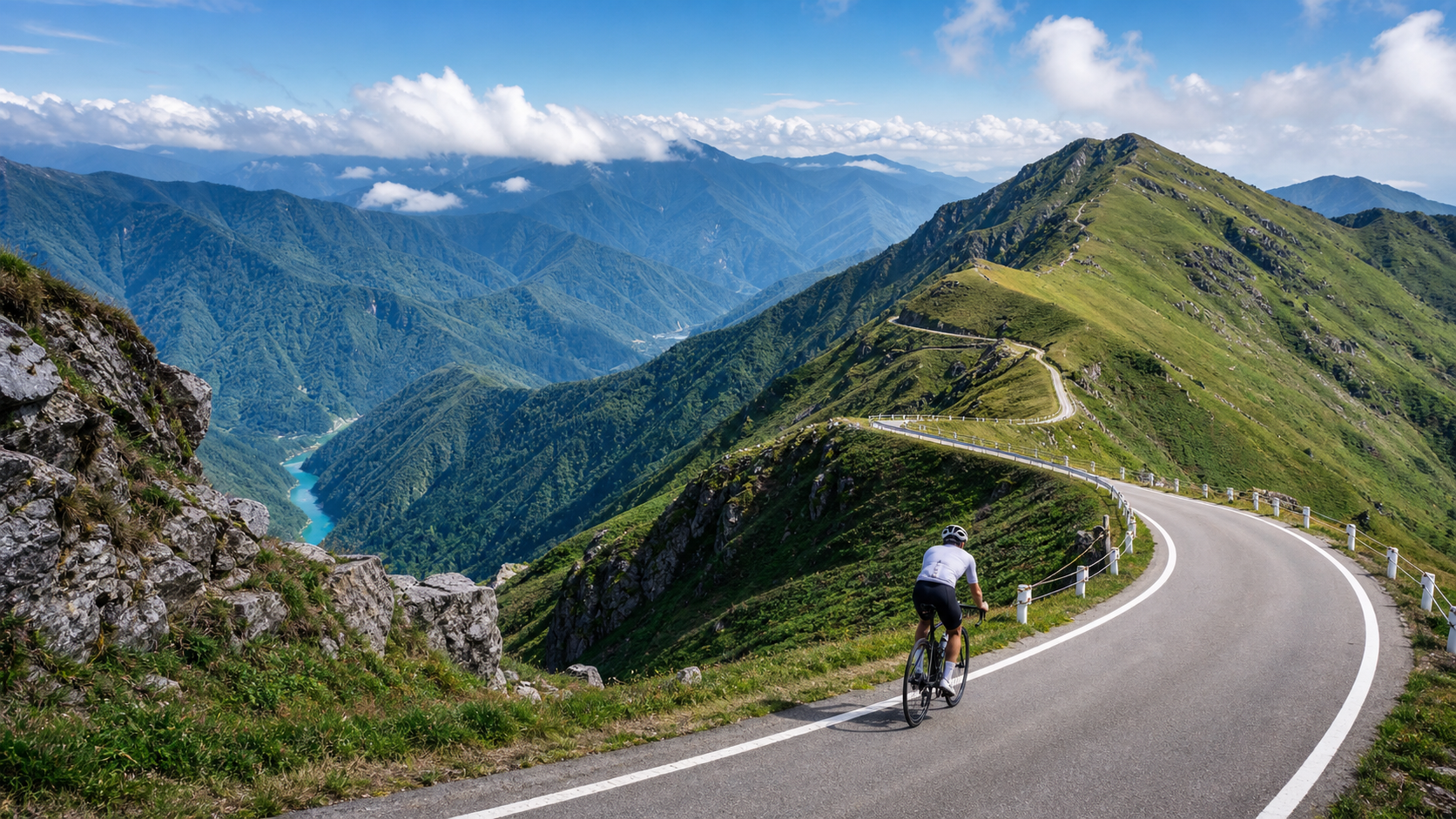
On the roof of Shikoku stands a sacred mountain that has been revered for over 1,300 years, and a sky road that leads to it. The Mount Ishizuchi Skyline is not just a climb—it is a modern pilgrimage route that cuts through faith, pristine streams, and breathtaking scenery.
Mount Ishizuchi, at 1,982 meters, is the highest peak in western Japan. But its significance goes far beyond an elevation figure. Since the Nara period, this mountain has been a sacred site of “mountain worship (Shugendo),” and for centuries, countless white-robed ascetics have come to climb and pay homage. When you ride the Mount Ishizuchi Skyline, you are pedaling along a road that leads to this spiritual mountain. In this article, we set aside the bike computer and step into the faith, pristine streams, and scenery behind this sky road.
First, a picture for those unfamiliar with this route: the Mount Ishizuchi Skyline is located in Ehime Prefecture, winding upward from the Omogo direction to “Tsuchigoya” (elevation approx. 1,492 meters), one of the trailheads of Mount Ishizuchi. It is a scenic road with a steady gradient and open views, and together with the adjacent UFO Line (Kamegamori Forest Road) ridge-top scenic route, it forms the most captivating sky riding on the roof of Shikoku. But what truly moves you about this road is not the numbers—it is the sacred mountain it leads to, and the stories of faith, pristine streams, and scenery along the way.
A Mountain Revered for 1,300 Years
To understand the Mount Ishizuchi Skyline, you first need to understand Mount Ishizuchi’s place in the hearts of the Japanese people.
Mount Ishizuchi is a renowned “spiritual mountain” in Japan and one of the so-called “Seven Sacred Mountains of Japan.” Since the Nara period, it has been a training ground for Shugendo. Legend has it that around 1,300 years ago, En no Gyōja (En no Ozunu), the “founder of Shugendo,” opened this mountain and established the ascetic path of Shugendo monks; it is also said that Kōbō Daishi Kūkai once trained here. This mountain carries profound religious and historical significance, standing as one of the core centers of faith in Shikoku and all of western Japan. Its exalted status makes it a representative of mountain worship in western Japan.
Shugendo is a unique Japanese ascetic tradition that blends mountain worship, Buddhism, and Shinto. Practitioners (yamabushi) believe that by trekking and undergoing austerities through rugged mountains, they can purify body and mind and gain spiritual power. Mount Ishizuchi is one of the most important stages of this tradition in western Japan. When you ride the sky road leading to this spiritual mountain, you are in fact traveling a path that has been steeped in devotion and ascetic practice for 1,300 years.
Every year from July 1 to 10, the “opening ceremony of the mountain (o-yamabiraki)” is held on Mount Ishizuchi, and white-robed ascetics from across the country come to climb. Imagine this: the mountain you are riding toward has been a sacred site that people have approached on foot with reverence for centuries. As you ascend the skyline and head toward the trailhead of Mount Ishizuchi, you are, in a modern way, continuing an ancient pilgrimage tradition. This connection to faith adds a weight to every meter of climbing on the Mount Ishizuchi Skyline that transcends mere sport.
During the opening ceremony, Mount Ishizuchi presents a striking scene: white-robed yamabushi and devotees, holding diamond-headed staffs and chanting sutras, climb step by step toward the sacred mountain. Along the climbing route are the famous “chain sections”—several near-vertical rock faces that devotees must ascend by gripping heavy iron chains. This is the very embodiment of Shugendo’s spirit of “purifying the mind through physical austerity.” This tradition, unbroken for 1,300 years, still plays out on this mountain today. For a rider, understanding this background gives you a different feeling about the road—you are not just completing a physical challenge; you are, in your own way, joining a millennium-spanning act of approaching and paying tribute to this sacred mountain. As your wheels press over the road to the holy peak, you find a strange resonance with those white-robed ascetics.
This is also what most sets the Mount Ishizuchi Skyline apart from many climbs that rely purely on scenery. Every meter of its elevation is overlaid with the weight of faith; it leads not just to a geographical high point, but to a sacred site of the nation’s spirit. This depth is something no purely scenic road can match.
Omogo Blue: The Clarity of the Niyodo River’s Source
The entrance to the Mount Ishizuchi Skyline lies near Omogo Valley (Omogo-kei)—and hidden here is one of Shikoku’s most moving tales of pristine streams.
Omogo Valley is the source of the Niyodo River. The Niyodo is famed for its crystal-clear water, and its translucent, almost transparent blue-green hue is called “Omogo Blue (Omogo Blue).” The water quality here has been rated the best in Japan, and in more ancient times, this valley was a path of ascetic practice for Shugendo practitioners.
Picture this scene: steep valley walls cloaked in lush forest, a stream at the bottom so clear you can see the texture of the riverbed stones, sunlight filtering through the treetops and dancing on the water’s surface, refracting into a jewel-like blue-green glow. This is “Omogo Blue”—a color that can only emerge from the purest water. It is not an artificially rendered beauty, but a natural treasure preserved by this land over centuries. And what keeps this water so clear is none other than the sacred Mount Ishizuchi upstream, protected by faith. Faith taught people to revere nature and not destroy it, and so this pristine stream has been preserved through generations—you see, faith and nature complete each other in this way.
So, before you officially begin the climb, if you can pause for a moment at Omogo Valley and gaze at the stream known as “Omogo Blue,” it will add a beautiful opening to your ride. The clear water, the lush valley, and the light flowing over the surface—this is the purest face of Shikoku’s mountains. It reminds you that what you are about to climb is not just a mountain, but a sacred land nourished by both pristine streams and faith.
The clarity of the Niyodo River is backed by science—it has repeatedly ranked at the top of Japan’s water quality assessments, and that transparent blue-green known as “Niyodo Blue” or “Omogo Blue” is a sight countless photographers travel specifically to capture. And the source of this clear river lies in the Ishizuchi mountain range. When you realize that the mountain you are about to climb is the very source of this stunningly clear stream, you gain a deeper respect for this land. The mountain gives birth to the water, the water nourishes the earth, and faith guards it all—the nature and culture of the Ishizuchi range are thus tightly interwoven, inseparable. Spend a quiet moment watching the water at Omogo Valley before you start climbing, and your ride will begin with an especially poetic and beautiful note.
Tsuchigoya: The Atmosphere of the Trailhead
The end of the skyline is Tsuchigoya, one of the trailheads of Mount Ishizuchi, at an elevation of about 1,492 meters.
Here you will find a national lodging facility, a cafeteria, and free parking—it is where climbers gather and set out. When you ride up to Tsuchigoya, you find yourself in a very special atmosphere: hikers with large backpacks, ready to summit Mount Ishizuchi, meet you—a rider who arrived by bicycle—at the same elevation. Everyone has come for this sacred mountain, just by different means. The name Tsuchigoya itself carries a humble, mountain-dwelling character; it is not a flashy tourist destination, but a genuine gateway where climbers rest and prepare.
Looking toward Mount Ishizuchi from Tsuchigoya, on a clear day you can see its rugged profile. The majestic form of western Japan’s highest peak is the most magnificent reward for anyone who has worked hard to reach Tsuchigoya. You may not have summited on foot, but you have brought yourself to the gateway of the sacred mountain on two wheels—that in itself is a form of closeness.
Time spent at Tsuchigoya gives you a rare sense of “convergence.” This is a place where hiking culture and cycling culture meet—some carry heavy gear, ready to summit on foot; others ride light road bikes, having just completed a climb. Everyone meets at the same elevation, before the same scenery, exchanging nods and sharing the sense of accomplishment that comes with “finally making it up.” This resonance across different forms of sport is the unique atmosphere of Tsuchigoya.
You can also take a break at the cafeteria at Tsuchigoya, refuel, watch the passing climbers, and soak in the daily life of this gateway to the sacred mountain. When you are replenished and ready to descend, take one more look back at the profile of Mount Ishizuchi—the satisfaction of “I have been to the gateway of this sacred mountain” will accompany you all the way down. And that memory will be reawakened every time you hear the name “Mount Ishizuchi” in the future.
Adjacent Scenery: The UFO Line Ridge Road
Tsuchigoya also connects to another famous Shikoku route—UFO Line (Binomori Forest Road).
This ridge road runs along the rooftop of Shikoku at elevations of 1,300 to 1,700 meters, earning it the name “Road to the Sky.” It is a scenic mecca in the hearts of photographers and riders alike. When you stand at Tsuchigoya and look toward the direction where the UFO Line extends, that road winding along the ridgeline truly seems to lead to the heavens. The “UFO” in its name actually comes from a Japanese pun on the word “peak” (yūhō), having nothing to do with aliens—but the surreal feeling of “riding on a ridge in the sky” is certainly well-deserved.
Interestingly, this sci-fi-sounding name has only added a layer of mysterious charm to the ridge road. Many people smile when they first hear “UFO Line,” then, upon seeing that road suspended along the ridgeline as if leading to the horizon, can’t help but marvel at how fitting the name truly is. Whether its origin is a pun or coincidence, the UFO Line has become a legendary and coveted landmark on the rooftop of Shikoku. It connects with the Ishizuchi Skyline at Tsuchigoya, making this area one of Japan’s most alluring high-altitude cycling paradises.
If your schedule and stamina allow, stringing together the Ishizuchi Skyline and the UFO Line makes for an ultimate sky journey across the rooftop of Shikoku. Just be sure to check the access regulations and road conditions for both routes, and plan thoroughly.
The UFO Line is called the “Road to the Sky” because its entire length runs along a ridgeline at elevations of 1,300 to 1,700 meters. Riding on it, you’ll often have steep valleys dropping away on both sides, with the road ahead seeming to float between clouds and sky. On clear days, you’ll experience the illusion of “cycling in the sky”; when clouds and mist surge up over the ridge, the road becomes like a gateway to a mystical realm. This surreal scenery makes the UFO Line a dream destination for many photographers and riders.
By linking this ridge-top spectacle with the pilgrimage road of the Ishizuchi Skyline, you can experience both the solemnity of approaching a sacred mountain and the awe of traversing the sky in a single journey. This is the double feast the rooftop of Shikoku offers to riders, and one of the most coveted cycling experiences this land has to offer. Of course, be sure to research the road conditions, weather, and access status of the ridge road in advance—after all, when riding at such high elevations, safety always comes first.
What This Road Means to Riders
The significance of the Ishizuchi Skyline to riders lies in how it naturally fuses “sport” with “pilgrimage.”
You’re not challenging some nameless mountain; you’re riding toward a sacred peak that has been venerated for 1,300 years. Every inch of road beneath your wheels leads to a holy site steeped in devotion and history. This connection to faith gives the effort of climbing a quiet, profound meaning.
Meanwhile, the clear streams of “Omogo Blue” along the way, the spectacular UFO Line on the ridge, and the unique atmosphere of the trailhead town of Tsuchigoya make this ride a feast for both the eyes and the soul. It’s not a road that tortures you with brutal gradients; it’s a road that slowly nourishes you with faith, clear water, and breathtaking scenery. When you stand at Tsuchigoya and gaze upon the majestic form of Mount Ishizuchi, you’ll understand: this ride has brought you, in a very special way, close to the rooftop and the soul of Shikoku.
The Road to the Sky Through the Seasons
Because the Ishizuchi Skyline is closed in winter (December–March), the visiting season is limited, but during its open months of April through November, each period offers its own beauty.
Spring (April–May): The mountains are just waking from their winter slumber, fresh greenery shines brilliantly, and the clear streams of the Omogo Valley are especially abundant with snowmelt. This is a comfortable season with crisp air, few tourists, and pleasant weather—perfect for leisurely riding and enjoying the new growth. Summer (June–August): Especially during the opening ceremony in early July, this sacred mountain welcomes its most spiritually charged moment of the year, with white-robed mountain ascetics adding solemnity to the forested slopes. The high-altitude area around Tsuchigoya stays cool, making it a rare summer retreat. Autumn (September–November): The Shikoku mountains don their autumn colors, and the slopes along the skyline become a tapestry of red and gold—the favorite season for photographers. The clear autumn air also makes the view of Mount Ishizuchi from Tsuchigoya exceptionally crisp.
Regardless of the season, don’t forget the road’s access time restrictions and the unpredictable mountain weather. Choose your timing well and prepare your logistics, and this Road to the Sky will reward you with its most beautiful face. For many riders, climbing this road to western Japan’s highest peak on a crisp autumn day, surrounded by fiery foliage and the rugged visage of Mount Ishizuchi, is one of the most unforgettable scenes in all of Shikoku cycling.
Shikoku: An Underrated Gem for Cyclists
When it comes to cycling travel in Japan, many people first think of Hokkaido’s vastness, Mount Fuji’s grandeur, or the highlands of Shinshu. But Shikoku is truly an underrated gem overlooked by many riders from elsewhere.
This island has a unique geographic character: its center is pierced by towering mountain ranges, forming what is known as the “rooftop of Shikoku,” while its perimeter is a long and varied coastline. This topography of “high mountains in the center, sea on all sides” gives Shikoku both magnificent mountain climbs and beautiful coastal routes. The Ishizuchi Skyline and UFO Line represent the island’s mountain climbing at its finest, while the famous Shimanami Kaido is the flagship of Shikoku’s coastal cycling, hailed as a world-class cycling route. On a single island, you can satisfy both “mountain lovers” and “coastal cruisers”—a diversity rarely found elsewhere in Japan.
Even more precious, Shikoku preserves a rich traditional culture—the “Shikoku 88 Temple Pilgrimage” that spans the entire island fills it with an atmosphere of pilgrimage and spiritual practice. When you ride in Shikoku, you’re not just riding a road; you’re traversing a land deeply steeped in faith and tradition. The Shugendō tradition of Mount Ishizuchi is one of the most powerful expressions of this cultural spirit.
The “Shikoku Pilgrimage” is Japan’s most famous pilgrimage route—devotees dressed in white robes and conical hats walk to 88 temples across the island associated with Kōbō Daishi Kūkai, covering over 1,000 kilometers in total. This tradition, unbroken for a thousand years, imbues the entire island of Shikoku with a quiet, reverent atmosphere. And Mount Ishizuchi, as a sacred peak where Kūkai once practiced asceticism, stands as one of the highest spiritual points of this pilgrimage land. When you ride the Ishizuchi Skyline, you are echoing the island’s deepest spiritual current—an ancient tradition of drawing closer to faith and purifying the soul through physical movement. From this perspective, your bicycle is your era’s “white robe and conical hat,” and your climb is your own form of pilgrimage for this age. This subtle resonance with a thousand-year-old tradition gives every pedal stroke a deeper meaning.
A Journey Combining Sport and Pilgrimage
In cycling travel, some roads are purely athletic challenges, letting you revel in sweat and breakthrough. Others give you something beyond sport, letting you carry away a spiritual touch beyond the ride itself. The Ishizuchi Skyline clearly belongs to the latter.
It makes every pedal stroke carry you toward a sacred mountain that has been venerated for 1,300 years. This experience of “making a pilgrimage through sport” is truly unique. You don’t need to be a devout believer to feel the mountain’s solemnity and weight; you don’t need to hike to the summit to touch the gateway of the sacred peak at Tsuchigoya. Sport and faith merge naturally on this road, elevating the effort of climbing into a quiet, profound spiritual experience. This sense of unity between body and mind is something purely competitive routes can never offer—and it is the most distinctive value of the Ishizuchi Skyline.
Perhaps this is what makes this road most precious. In an age obsessed with speed and data, the Ishizuchi Skyline reminds us: cycling can also be a form of meditation, a pilgrimage, a dialogue with the land and with faith. When you slow your pace and truly feel every layer of this road—the clear streams, the forests, the faith, the scenery—what you gain will far exceed a climbing time. You’ll take away a journey that nourishes the soul. This depth is precisely why the Ishizuchi Skyline is worth a dedicated visit.
Ride with Respect, Take It Slow
If you decide to visit the Ishizuchi Mountain Skyline, my advice is this: don’t rush—take it slow.
This is not a road that demands you push yourself to the limit. Its gradient is gentle and even, never tormenting you with brutality; what it truly offers is the scenery along the way, the atmosphere of faith, and the satisfaction of arriving at the gateway to a sacred mountain. So, slow your pace—admire the clear streams at Omogo Valley, gaze across the mountain ranges from the Nagao Ridge lookout, and feel the convergence of mountaineering culture at Tsuchigoya. Treat this ride as a leisurely journey across the roof of Shikoku. Ride with that mindset, and you’ll find this road gives you far more, and far deeper, than you ever expected.
With respect for this sacred mountain, attention to the rules of the road, and awareness of the weather, you can safely enjoy this skyway to the highest peak in western Japan. When you stand at Tsuchigoya and look upon the rugged yet solemn face of Mount Ishizuchi, you’ll feel genuine gratitude toward the version of yourself that decided to come here. This is what the Ishizuchi Mountain Skyline leaves every rider—a precious gift that blends sport, scenery, and faith.
Suggested Side Trips
- Omogo Valley: The headwaters of the Niyodo River. Admire the crystal-clear, captivating “Omogo Blue”—an excellent photography spot.
- Tsuchigoya: The trailhead for Mount Ishizuchi. Gaze upon the highest peak in western Japan and soak in the mountaineering culture.
- UFO Line (Kamegamori Forest Road): A “skyway” with stunning ridgeline views, connecting to Tsuchigoya—an extension for the ultimate ride across the roof of Shikoku.
- Mount Ishizuchi Climb: You can arrange a hike to the summit (note that the ropeway is on the Saijo City Seizaisha side, a different trailhead from Tsuchigoya).
- Ehime Citrus: Ehime is one of Japan’s most famous citrus (mikan) prefectures. Enjoy local oranges and related specialties at the foot of the mountain.
- Matsuyama City: The capital of Ehime Prefecture, home to Dogo Onsen, one of Japan’s oldest hot springs, and other attractions—an ideal base for a Shikoku cycling trip.
Seasonal reminder: The Ishizuchi Mountain Skyline is closed in winter (December–March) and prohibits nighttime riding year-round. Operating hours vary by season, so be sure to check in advance. In the Shikoku mountains, the weather tends to change in the afternoon, so bring warm layers and rain gear. Ride this skyway to the highest peak in western Japan with respect for this sacred mountain—it will reward you with clear streams, faith, and breathtaking views, giving you a profound and unforgettable journey across the roof of Shikoku that goes far beyond the climb itself.
Related Reading
- Ishizuchi Mountain Skyline Guide: The 12 km Sky Climb to Tsuchigoya, Gateway to Western Japan’s Highest Peak
- Riding to the Highest Reachable Point on Mount Fuji: A Cloud-Level Journey on the Fuji Skyline, Hoei Crater, and Forest Belt
- A Pilgrimage on a World Cultural Heritage Site: The Fuji Subaru Line’s Path of Devotion and the Sea of Clouds for Those Who Earn It
- Pilgrimage Beneath a Towering Wall: The Fuji Azami Line, Subashiri Trailhead, and a Trial of Will on a Brutal Climb
台北闊瀨陡坡 騎旅 / 日本單車雜誌編輯車友臨時加入!/ 髮香才是最強的 / feat. 北迴歸線小隊 / 公路車 CT Yeh
6 個月前
京都!99%人不知道的秘境玩法!租 E-Bike 騎進探訪宇治抹茶原鄉 刺激好玩絕美的山林古道 鬼滅之刃的場景探訪 / CT Yeh
13 天前
2025 乘鞍 KOM 登山賽挑戰實錄 / 日本公路最高 ! 賽前探路篇 / 比富士山厲害,無敵絕景!/ 40週年 / 中文YT首發 / 公路車 / CT Yeh #乘鞍ヒルクライム
10 個月前
#北橫 + #北進武嶺 最硬的員工旅遊 EP1 | #公路車 #拉拉山 | 明池 | 武嶺 | 武陵農場 | 雲海 | Taiwan Cycling Route Wulin
6 年前
2025 乘鞍岳登山賽 比賽全紀錄篇 / 完整路線攻略介紹 / 日本版武嶺 公路最高點 / 高山空拍絕景 / 明年會開團! / 公路車 / CT Yeh
10 個月前
嘉義大埔、阿婆灣挑戰賽,美到以為在日本!ft. 環騎5 Cool 西拉雅188 / 公路車 / CT Yeh
7 個月前
新竹羅平 x 天湖部落 大禹嶺級變態陡坡! 4K超高畫質 空拍 | 公路車
5 年前
小野田真的存在!日本赤城山爬坡公路賽 台灣首發團完全實錄 | 頭文字D真實賽道! | 看完東奧自行車賽後好想再去騎一次啊! | 公路車 | CT Yeh
4 年前