The Gentle Slopes of Zhongshe Road: Among the Mountain Scenery of Waishuangxi, the Reasons That Keep Bringing Me Back
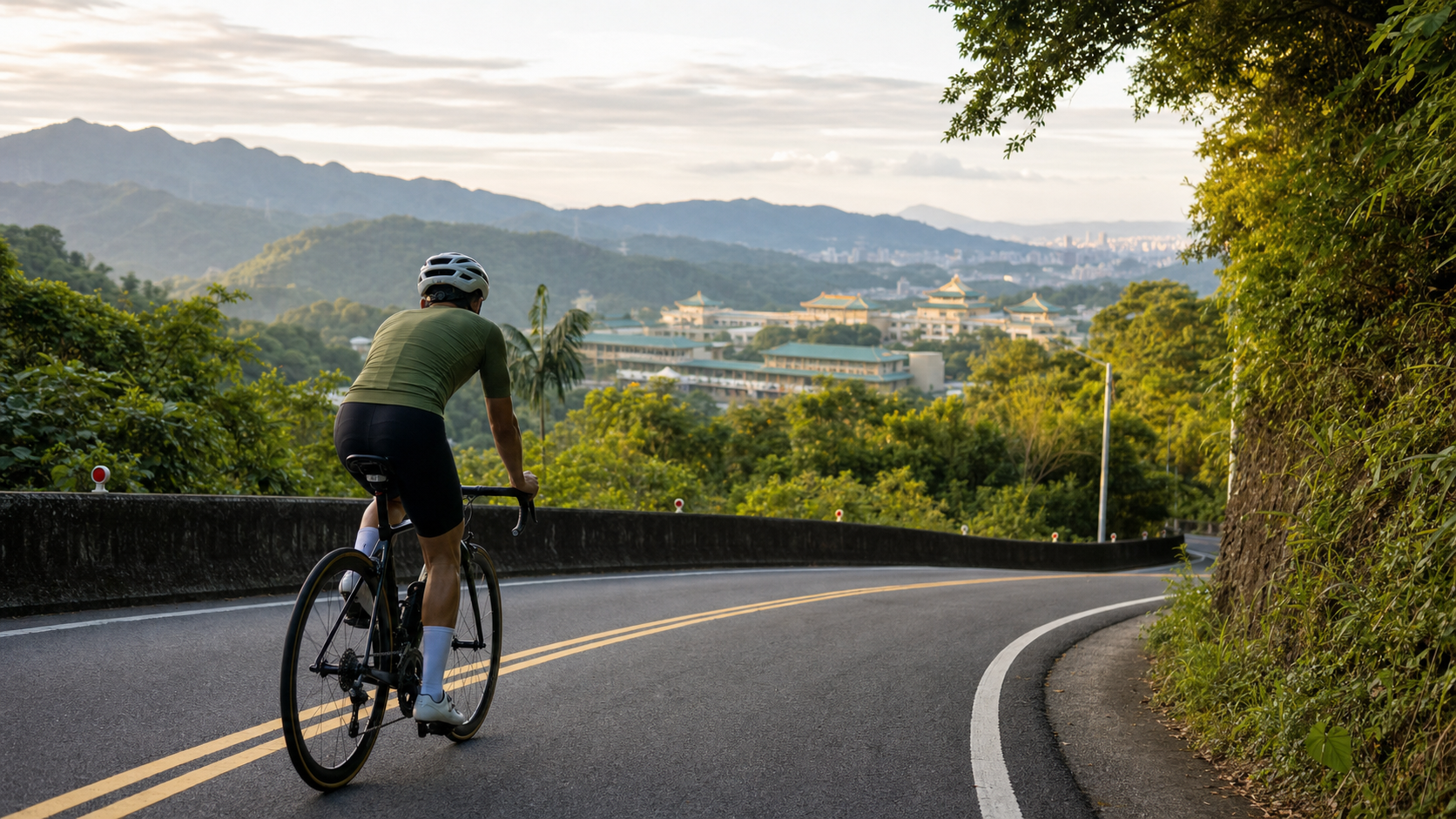
Zhongshe Road, Shilin District, Taipei City, total length 3,944.22 meters, elevation gain 244.9 meters, average gradient 6.3%. I can recite these numbers by heart, because it’s the road I’ve revisited the most in my years of cycling in Taipei. But what I want to talk about today isn’t pacing or gear ratios—it’s the things this road has given me that can’t be quantified by numbers.
First Encounter with Zhongshe Road: An Unexpected “Reality Check”
I still remember my first ride up Zhongshe Road on an ordinary Saturday morning. I had just upgraded from an entry-level road bike not long before, and I considered myself to be in decent shape—riding 30 to 40 kilometers on flat ground was no problem at all. So I took the advice of a senior member in my cycling group: “Head out to Waishuangxi and ride Zhongshe Road to practice climbing. It’s not too hard.”
Those four words—“not too hard”—later became a classic joke in our cycling group. That day, I turned onto the entrance of Zhongshe Road near the National Palace Museum, and at first it did feel manageable. The gentle gradient made me think, “That’s it? The senior member was way too dramatic.” But before I’d even covered a kilometer, the gradient began to climb noticeably, and my breathing went from steady to rapid. The relaxed rhythm of my ride vanished in an instant, replaced by nothing but the sound of my gasping and the friction of the chain. In that moment, I truly understood why this road is called “the road every Taipei cyclist must travel to grow and thrive”—it won’t completely stop you in your tracks, but it will make you keenly aware of the gap between yourself and the “climbing strong.”
That day, it took me nearly half an hour to complete the whole route, and at one point I was even forced to dismount and walk a short section, too breathless to speak. But strangely enough, the complex mix of frustration and accomplishment I felt after finishing gave me a peculiar obsession with this road—I wanted to come back, to prove to myself that I could ride it better.
The Scenery of Waishuangxi: Nature’s Gift Beyond Cycling
The Waishuangxi area where Zhongshe Road is located is one of the few regions in Taipei that simultaneously offers river valleys, mountain forests, and cultural landscapes. It sits right next to the National Palace Museum, and the surrounding mountain areas retain relatively intact vegetation and natural terrain, forming a stark contrast with the concrete jungle of the city. Riding into this area in the early morning, you can often feel a noticeable difference in temperature and air quality—not long after leaving the noisy urban roads, the sound of traffic gradually gives way to birdsong, and the air begins to carry the fresh scent of vegetation mixed with earth.
This sense of transition is especially precious for city dwellers who commute in Taipei’s urban core and are surrounded by high-rises and asphalt. I often describe riding Zhongshe Road to my friends as a brief “urban escape”—before you set off, you’re still frustrated by traffic lights and congestion, but within minutes of riding into the mountains, your attention is completely absorbed by the gradient ahead and your breathing rhythm, and those nagging thoughts about work and life stress somehow get left behind without you even noticing.
The vegetation along the route changes subtly with elevation. Although Zhongshe Road’s overall climb isn’t particularly high, because the gradient is concentrated, the visual changes within just a few kilometers are quite rich. On clear days, when you look back at the road behind you, you can often catch a glimpse of the Waishuangxi river valley intersecting with the distant city skyline—that visual contrast of “half nature, half city” is a unique atmosphere I rarely experience on other climbing routes.
The Cultural Vibe Around the National Palace Museum: An Unexpected Intersection of History and Sport
Zhongshe Road’s proximity to the National Palace Museum gives this simple climbing route an extra layer of cultural depth. The area around the museum has long been one of the key destinations for international visitors to Taipei. On weekdays, riding through this area, you’ll occasionally brush past tour buses and crowds of sightseers—that contrast between “sweating athletes on one side, leisurely tourists on the other” always makes me smile.
After finishing Zhongshe Road, if time permits, I’ll deliberately detour to the area near the National Palace Museum to pause for a moment, take a sip of water, snap a photo, and let myself gradually recover from the high-intensity effort. Gazing at the museum’s architectural silhouette against the mountains behind it, I feel something remarkable—this museum housing millennia of cultural relics and the steep slope I just conquered with my legs seem completely unrelated, yet both tell the same story of “persistence and accumulation”: the museum’s collection is built on layer upon layer of artifacts passed down through generations, and my progress on Zhongshe Road is likewise built on ride after ride of refusing to give up.
Beyond the National Palace Museum, the Waishuangxi area is also dotted with local Shilin amenities and small eateries. After a ride, sitting down at a local food stall, ordering a bowl of hot noodle soup or a simple Taiwanese breakfast, paired with the sense of accomplishment from working up a sweat—that’s what I consider the standard “perfect ending.” This seamless blending of sport and everyday life is another reason Zhongshe Road keeps drawing me back.
One Memorable Post-Rain Ride: Another Face of the Moist Mountain Forest
Once, when I rode Zhongshe Road, I happened to catch a weather pattern where it had rained the night before and cleared up that morning. That ride was completely different from usual—the air was filled with that distinctive post-rain moisture, the road surface still bore traces of water, and the greenery on both sides looked even more saturated and vivid thanks to the rain’s nourishment.
That day, the climb felt especially “immersive,” because the slippery surface forced me to control my pedaling force and bike balance more carefully, especially on sections with sharper gradient changes, where any unstable out-of-the-saddle effort could cause the rear wheel to slip. This kind of riding experience, requiring complete focus on the road conditions, gave me a whole new appreciation for this familiar route—it turns out that even the same road can present entirely different challenges and sensations under different weather conditions.
After that post-rain ride, I paused briefly by the roadside, watching mist slowly rise from the valley, sunlight piercing through gaps in the clouds and scattering onto the wet leaves, refracting into glimmers of light. That image is still deeply etched in my memory, and it made me realize that cycling offers more than just physical training—it’s a sensory experience deeply connected to the natural environment.
What Zhongshe Road Means to Me: More Than Just a Climbing Route
Over the years, I’ve lost count of how many times I’ve ridden Zhongshe Road. From being defeated by the gradient on my first attempt and having to dismount midway, to later completing the entire route without stopping, to now treating it as a “benchmark test route” for regularly assessing my fitness—Zhongshe Road has witnessed my transformation from a cycling novice to someone with solid climbing ability.
I’ve gradually come to understand why the Taipei cycling community describes this road as “the road every cyclist must travel to grow and thrive.” Its length is just right—not intimidating enough to scare people off; its gradient is sufficient—capable of genuinely reflecting a person’s climbing progress; its location is convenient—allowing busy city dwellers to complete a meaningful training session within limited time. More importantly, it carries the collective memories of countless Taipei cyclists—almost everyone who has ridden a road bike in Taipei for more than a year has their own Zhongshe Road story, whether it’s the frustration of a first attempt, the joy of breaking a personal record, or simply the pleasure of enjoying mountain scenery on a clear morning.
Seasonal Scenery: When Is Zhongshe Road at Its Most Beautiful
If you asked me to recommend the best season to ride Zhongshe Road, I would unhesitatingly choose spring. In March and April, Taipei’s temperatures warm up without becoming oppressively hot, the vegetation around Waishuangxi begins to show vibrant life after the dormancy of winter, and the air carries a faint fragrance of flowers and grass. Riding Zhongshe Road during this season, the challenge of the gradient resonates with the thriving natural scenery around you, creating a special sense of “everything is growing, and so am I.”
Autumn on Zhongshe Road has a different charm. On October and November afternoons, the sunlight angle becomes softer, and light filtering through the trees creates dappled shadow effects, making the ride feel like moving through a living painting. The crisp, cool autumn weather also makes prolonged high-intensity climbing relatively comfortable, so you’re less likely to burn through your energy early from the heat.
As for summer, although the hot, humid weather makes the challenge significantly harder, setting off in the early morning just after sunrise, paired with the occasional mountain breeze, offers a different kind of “the harder it gets, the more I want to conquer it” thrill—which is exactly why many cyclists prefer visiting Zhongshe Road on summer mornings.
Suggested Side Trip: Adding Zhongshe Road to a Complete Shilin Day Trip
If you plan to make a special trip to Zhongshe Road, consider making the whole outing more complete rather than just “riding and leaving.” It’s recommended to set off on a weekend morning, taking advantage of the cooler temperatures and lighter traffic to complete the climbing challenge, then head to the National Palace Museum area afterward to soak in the historical and cultural atmosphere, or make your way toward Shilin Night Market to sample local street food, putting a perfect finishing touch on a trip that combines sport and lifestyle.
For friends living in Taipei City who rarely have the chance to get close to nature, Zhongshe Road offers an excellent “mini-vacation” option—no need to travel far, no need to spend an entire day; in just one or two hours, you can gain the sense of accomplishment from physical training, the healing feeling of mountain scenery, and the warmth of local cultural atmosphere. This is also why, even though I’ve ridden this road countless times, I still find myself, on a clear weekend morning, instinctively turning my handlebars toward Waishuangxi and once again taking on this familiar slope that always brings new sensations.
Team Riders and Zhongshe Road: The Days We Grew Stronger Together
Looking back on my years of riding, Zhongshe Road means more to me than just a road—it’s more like a witness to the growth I’ve shared with my team riders. There are several regular riding partners in our team who meet up almost every month for a Zhongshe Road session. At first, we each rode solo, challenging ourselves at our own pace, but it gradually evolved into a fixed routine with a hint of friendly competition—who improved their finish time by how much, who discovered a new pacing trick—all shared in casual conversation after the ride.
I still remember one teammate who, at first, always had to stop midway up Zhongshe Road to catch his breath, and even occasionally had to get off and walk a short stretch. During that period, he often joked, “I’m probably the weakest climber on our team.” But he didn’t give up; instead, he stubbornly added Zhongshe Road to his weekly training schedule, challenging himself through rain and shine. About six months later, on one particular day, after completing the full ride, he announced with barely contained excitement that he had finally managed to ride the entire slope without stopping once. That joy was infectious—everyone present was genuinely happy for him.
Stories like this are actually not uncommon on Zhongshe Road. Perhaps it’s precisely because its difficulty is set just right—challenging enough that every improvement deserves celebration, yet not so daunting that hard work never seems to pay off—that this road has become an important place in the hearts of many Taipei teams for bonding and witnessing each other’s growth. Every time I think about this, I feel that the most touching part of cycling isn’t just the personal achievement of conquering a slope, but the precious moments of sweating, improving, and sharing joy together with your teammates.
Riding Zhongshe Road Solo: Moments of Dialogue with Yourself
Beyond the lively scenes of challenging the road with teammates, Zhongshe Road also carries many of my quiet solo rides. When work pressure builds up, I tend to head out alone on my bike, and Zhongshe Road is often one of my chosen destinations. Facing this steep slope alone is, in a way, a process of inner dialogue—no teammates chatting to distract you, just the sound of your own breathing, your heartbeat, and the various thoughts that keep surfacing and gradually settling in your mind.
A few solo rides stand out vividly in my memory, when I chose to ride up Zhongshe Road alone to vent after major setbacks at work. The pedaling force was always especially fierce at the start, as if I wanted to pour all my frustration into the pedals; but as the gradient gradually increased, physical fatigue began to outweigh emotional irritation, and my attention was forced onto the immediate task of “getting through this section of the climb,” which ironically caused those negative thoughts occupying my mind to slowly fade away. By the moment I reached the top, though my body was exhausted, my mood was unexpectedly calm—as if through that physical effort, I had released all the mental clutter along with it.
This is also why, even though I’ve ridden Zhongshe Road countless times, I still instinctively choose to return here in certain states of mind. It’s not just a training slope; it’s more like a silent yet reliable old friend, always willing to accompany me through challenges and help me process my emotions whenever I need it.
Equipment and the Gear I’ve Swapped Over the Years: A Journey of Upgrades Alongside Zhongshe Road
Looking back on my years of riding Zhongshe Road, it’s not just my fitness that has improved—my equipment setup has also been continuously adjusted and upgraded as my understanding of this road deepened. I still remember my first attempt at Zhongshe Road, riding an entry-level aluminum road bike with a stock standard crankset and a cassette with relatively heavy gearing. A large part of that painful memory wasn’t actually insufficient fitness, but rather a gear ratio completely unsuited to sustained steep climbing—I was forced to grind away at an extremely low cadence, and before long, my knees were sending clear signals of discomfort.
Later, on the advice of fellow riders, I swapped the cassette for one with a wider range, and my cadence immediately settled into a more reasonable range, significantly reducing the suffering of the ride. Some time after that, I upgraded to a carbon-framed road bike with a compact crankset and electronic shifting, and the experience of riding Zhongshe Road was elevated to another level—shifting became quicker and more precise, and the advantage was especially noticeable at gradient transition points where rapid gear changes were needed.
This journey of equipment upgrades is, in a sense, also my process of understanding Zhongshe Road and understanding my own physical limits. Every equipment adjustment corresponded to a concrete insight gained from riding experience—so this is why a wrong gear ratio makes your knees hurt so much, so this is how much tire pressure adjustment affects grip, so this is how much shifting speed really impacts riding fluidity at gradient transitions. These practical lessons accumulated through repeated rides up Zhongshe Road are far more profound and authentic than simply reading equipment review articles.
Riding Zhongshe Road with Family: A Different Kind of Parent-Child Time
Beyond being a place for personal challenges and shared progress with teammates, Zhongshe Road also holds a particularly heartwarming memory for me: riding this route with my child. My child has been interested in cycling from a young age, and once he had a solid riding foundation, I began considering taking him on some moderately challenging mountain routes, and Zhongshe Road naturally became our father-son first choice.
On his first attempt at Zhongshe Road, I deliberately slowed my own pace, staying by his side the entire way, offering encouragement and advice on when to rest. He struggled quite a bit at first, wanting to give up and walk several times, but with my company and encouragement, he gritted his teeth and persevered, ultimately completing the full challenge. The moment we reached the top, the mix of exhaustion and pride on his face is still deeply etched in my memory—watching your child overcome difficulties and gain a sense of accomplishment through their own effort is, for a father, far more meaningful than completing any personal challenge of my own.
Since then, Zhongshe Road has become a regular shared activity between us, a father-son tradition where we agree to take on the challenge again every so often—partly to continue the wonderful memories of exercising together, and partly, through repeated challenges, to let my child personally experience the truth that “effort leads to progress.” This value passed down to the next generation through cycling is perhaps the most unexpected yet most precious gift Zhongshe Road has given me.
Zhongshe Road Through the Seasons: A Year of Observational Notes
Because I have visited repeatedly over the years, I have gradually developed a habit of silently noting the subtle changes Zhongshe Road presents across different seasons and weather conditions—like keeping an observational diary for an old friend. In early spring, the mountain vegetation begins to awaken from winter’s bleakness, and unnamed wildflowers bloom along the roadside one after another. Occasionally during a ride, I catch a faint scent of fresh greenery, and that aroma always reminds me of the anticipation of a new year and a new training cycle about to begin.
Midsummer on Zhongshe Road is an entirely different sight. Although the tree canopy provides a certain degree of shade, the muggy, humid air still makes every pedal stroke accompanied by copious sweat. I remember once attempting a ride shortly before noon in high summer; I was drenched in sweat before even reaching the halfway point, and the water in my bottle ran out far faster than expected. That experience taught me deeply that even on a familiar route, once you overlook the choice of season and time of day, the difficulty can be magnified severalfold invisibly.
After autumn arrives, the weather gradually cools, and the riding comfort on Zhongshe Road noticeably improves. Breathing no longer becomes labored as quickly, and this season tends to be the period when my personal performance is at its best. As for winter, although temperatures in Taipei’s urban area are usually not severely cold, the mountainous terrain and elevation make the perceived temperature considerably lower than downtown. Combined with the occasional northeastern monsoon and moisture, tackling Zhongshe Road in winter is a particular test of willpower and whether your cold-weather gear is thoroughly prepared.
These accumulated seasonal observation notes have not only enriched my understanding of this route but also allow me to more accurately anticipate the weather and physical conditions I might encounter on any given day when planning each ride, preparing the appropriate equipment and mindset in advance.
From Awkwardness to Familiarity: A Gradient Map in Muscle Memory
Beyond the equipment upgrade journey, my “soft skills” over these years of riding Zhongshe Road—namely, my understanding of the road and the mindset for handling it—have also undergone significant growth. When I first started riding, I had no concept of where the gradient transition points were. I would often hit a steep section unprepared, caught off guard and forced to slow down or even stop to catch my breath. Later, as my ride count accumulated sufficiently, I gradually learned to anticipate upcoming gradient changes through body memory, adjusting my breathing and cadence in time. This internalized familiarity with the route is a precious asset that no equipment upgrade can ever replace.
Rainbows After Rain and Unexpected Surprises
Aside from the unforgettable experience of the post-rain mountain mist mentioned earlier, Zhongshe Road has also gifted me another unexpectedly beautiful scene. Once, during a ride, I encountered a brief afternoon shower. I planned to take shelter and wait for the rain to pass, but the rain quickly weakened, and sunlight broke through a corner of the sky. Turning my head, a clear rainbow stretched across the valley. The sight was so beautiful that it instantly made me forget the frustration caused by the sudden downpour. Instead, I felt that witnessing such a natural wonder firsthand was a precious gift unexpectedly reaped from that ride.
Experiences like this have also taught me that a large part of the charm of mountain road riding comes precisely from this kind of unpredictable surprise—you never know what weather, what play of light and shadow, or what chance encounter you might meet on your next visit. This quality of being full of unknown variables is exactly what makes outdoor sports so captivating compared to indoor training, and it is an important reason I continue to love riding Zhongshe Road and always maintain a sense of freshness.
For Those Preparing for Your First Challenge
If you are preparing to tackle Zhongshe Road for the first time, I want to tell you: do not be afraid of that feeling of being defeated by the gradient—that is precisely the purpose of this road. It is not a route meant for you to complete easily and gain a sense of vanity; it is there to honestly tell you how far you still are from being “stronger,” and that as long as you are willing to keep coming back to challenge it, that distance will eventually be shortened bit by bit.
What Zhongshe Road has taught me is not just how to pace my energy or how to choose gear ratios, but also a mindset of “accept first, then break through” when facing difficulty. Every time I gasp for air while climbing that final stretch and look out at the gradually widening view, that feeling mingling fatigue and satisfaction has always been one of the most important sources of motivation sustaining my love for cycling. If you are also a rider in Taipei, why not find a clear morning and personally experience this slope that countless people call “the necessary road to growth and maturity”? Feel free to bring your team members, or choose to face this challenge quietly on your own. Whichever way you choose, I believe it will leave your own unique memory in your cycling career and become an irreplaceable milestone when you look back on your growth trajectory in the years to come.
Related Reading
- Zhongshe Road Practical Guide: 3.94 km, 245 m of Climbing, Shilin Riders’ First Touchstone
- Riding from Dakeng to Xinshe: A Leisurely One-Day Ride Through Mushrooms, Flower Seas, and Taichung’s Mountain Town
- Dakeng to Xinshe Practical Guide: An 8.5 km Gentle Slope Linking Zhongxingling, the Main Artery of Taichung Training Rides
- Wind on the Tableland, Red Clay, and a Slope Called Dakelu: A Cultural Journey Along Linkou Cycling Routes
爬坡ITT實境)台中 魔王 松鼠坡 首航 6:12 大肚山 大三元 科福路
8 年前
中社路 12分 #Canyon #Aeroad 8.0 Di2 首航 [Checkpoint6]
9 年前
台北闊瀨陡坡 騎旅 / 日本單車雜誌編輯車友臨時加入!/ 髮香才是最強的 / feat. 北迴歸線小隊 / 公路車 CT Yeh
6 個月前
單車 梅山36灣 坡度介紹 路段介紹 空拍 (相關遊記影片,請參考說明或我的頻道喔,歡迎訂閱)
6 年前
台中大雪山 膏王領騎 震到都沒畫面了 公路車
5 年前
梅山36彎 奮起湖 #公路車 之旅 2400m
6 年前
16/02/16 - 夜訪中社路 緩慢進步中
10 年前
2016/4/20 - 中社路 夜騎 半年甩肉14KG 後測
10 年前