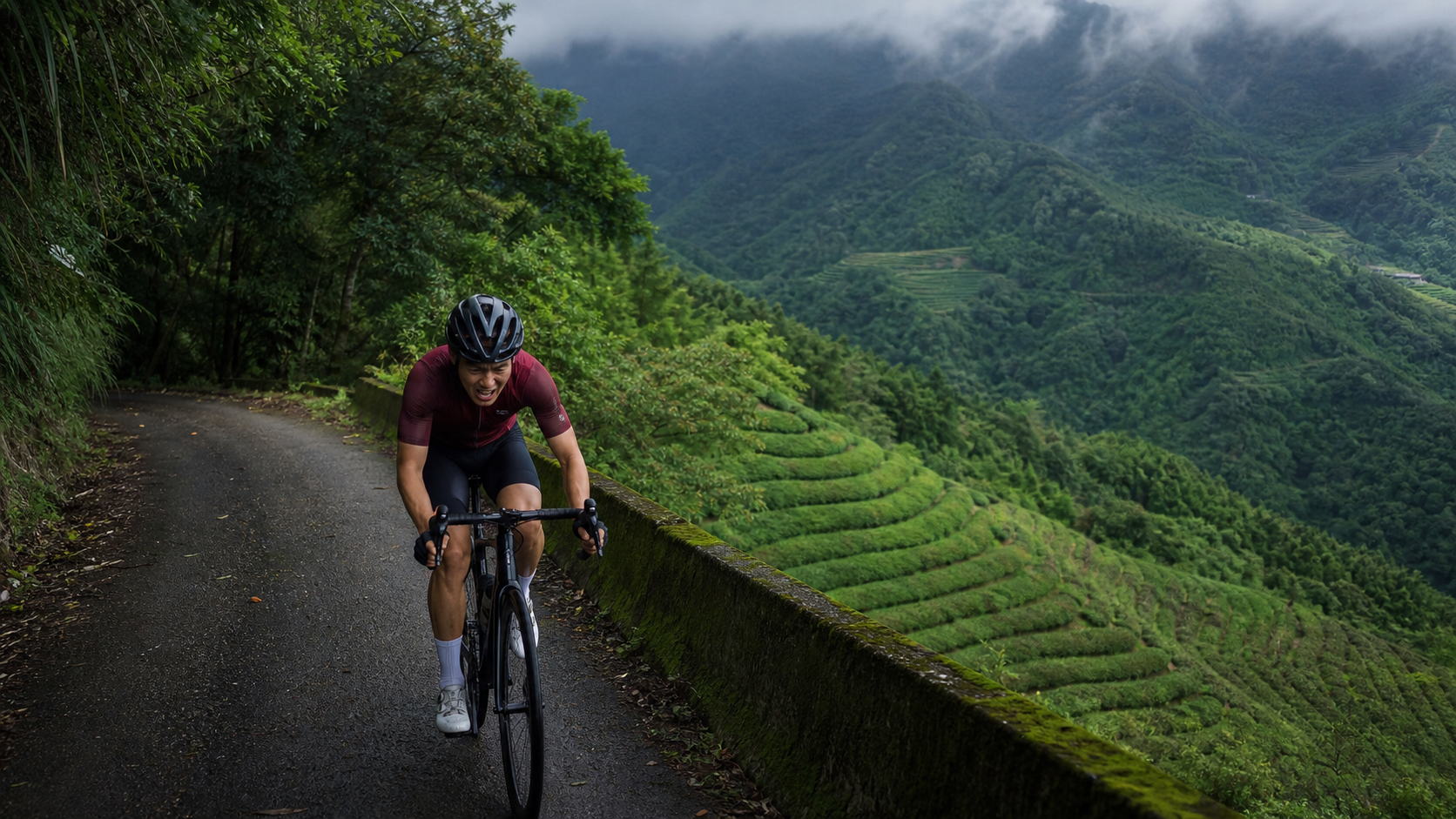
Some routes define themselves by length, others by intensity. Xiongkong Traverse belongs to the latter—it’s so short it barely qualifies as a “route,” yet within those less-than-three kilometers, it laid bare the most pristine side of the Sanxia mountains without reservation.
1. The Underestimated Three Kilometers
I still remember my first reaction upon hearing the name “Xiongkong Traverse”—Xiongkong? It sounded like a place name transliterated from an indigenous language, carrying a mystique that only exists deep in the mountains. It wasn’t until I looked it up that I learned this area is indeed a relatively enclosed, isolated corner of the Sanxia mountain region. Because of the terrain’s natural barriers, it has preserved a more complete primary forest and a mountain ecosystem less disturbed by human development than its surroundings.
For most people, New Taipei City’s Sanxia District conjures up images of the old street’s ox-horn croissants and indigo dyeing crafts; few would associate “Sanxia” with “deep-mountain traversing.” But once you ride into Xiongkong’s industrial roads, you quickly realize that the city’s edge is closer to the mountain’s heart than you ever imagined. Since ancient times, the Xiongkong area has been an important node connecting Sanxia to the mountains, with some routes leading toward Lala Mountain, the Sheipa area, or other traverse paths. The road over Xiongkong is, in a sense, a microcosm of our ancestors’ history of crossing mountains and pioneering the wilderness—though today we ride road bikes or mountain bikes, the roadbed beneath our wheels likely carries memories of movement far older than we can imagine.
The distance is only 2904.9 meters—a number so small it’s easy to dismiss. But I later came to understand that the weight of this route has never been measured in kilometers.
2. Tea Plantations, Terraced Fields, and That Unbelievably Green Hillside
Riding into Xiongkong, the first thing to seize your gaze is the expanse of tea terraces laid out along the hillside’s contour lines. Because the elevation and climate around Xiongkong are well-suited for tea cultivation, it has long been one of the most important tea-producing areas in the Sanxia mountains. The tea gardens stack layer upon layer following the terrain, and on clear days, that green takes on an almost glossy sheen—when the wind blows through, the entire hillside seems gently combed, rippling in wave after wave.
Passing along the industrial road beside the tea gardens, I often can’t help but slow down (though the gradient of this route hardly permits you to “leisurely” ease off), and as my gaze sweeps across those orderly rows of tea bushes, a strange illusion sets in—as if I’m not out riding for exercise, but have stumbled into a landscape painting that demands careful contemplation. The tea farmers bending to pick leaves, the woven bamboo baskets, the occasional sound of a weed trimmer—these images piece together to form the most authentic daily life of the Xiongkong area, and we riders are merely visitors passing through in haste.
Beyond the tea gardens, the nearby Lepei Valley area is also an essential part of this mountain landscape. The stream valley, the forest shade, and the mountain breeze together create an atmosphere entirely different in character from Sanxia Old Street—the old street is bustling and clamorous, while the Xiongkong area is so quiet you can almost hear your own heartbeat and breathing, especially during those most breathless minutes of climbing, when the silence becomes all the more distinct.
On stretches where the forest canopy is dense, sunlight is sliced into fine dappled patches that scatter across the asphalt. As you ride through, the light and shadow flicker rapidly across your field of vision with your speed, like some natural metronome, keeping time with your cadence and counting down how much of the climb remains.
3. People on the Mountain Road: Tea Farmers, Ancient Traverse Trails, and Forgotten Roadbeds
Riding along Xiongkong’s industrial roads, you occasionally pass tea farmers tending their gardens. Most of them merely glance up at this panting, sweat-soaked rider, then lower their heads to continue their work. That unremarkable sense of everydayness strikes me as particularly real—for them, this hillside is not a “route” to be conquered, but the very ground of their daily labor and livelihood. This gap in perspective often makes me pause mid-climb to reflect: the “steep slopes” we riders travel specifically to challenge are, for generations of people who have lived here, perhaps just the ordinary path to work.
Many of the mountain roads in the Sanxia area carry historical threads far older than the modern road system. In earlier times, mountain residents and tea farmers carved out numerous traverse trails to connect settlements with the outside world. Some of these ancient paths were later widened and paved into the industrial roads we ride today, while others have gradually fallen into disuse and vanished into the forest. As an important node connecting Sanxia to the mountain depths, this traverse route likely overlays a stretch of historically significant trail, only that with the passage of time, the means of transport shifted from walking and carrying shoulder poles to the road bikes and mountain bikes beneath us today.
This sense of “layering” adds a weight of history to my riding. I imagine how, before asphalt roads and gear systems existed, local residents relied on their own two feet to cross this same steep hillside step by step, transporting tea, daily necessities, and even news and emotions. By comparison, when we challenge this route today with high-tech equipment and meticulously calculated gear ratios, we are in a sense building upon the foundation our predecessors carved out, reacquainting ourselves with this mountain forest through a more effortless yet more efficiency-driven approach.
The specific historical details of the ancient trails and the exact evolution of their paths still await more complete historical research, and I won’t speculate recklessly here. But this imagination of “stories hidden beneath the pavement” has indeed added a depth beyond mere athletic challenge to Xiongkong Traverse in my mind.
4. The Shock, Completed Within Three Minutes
If I had to sum up the riding experience of Xiongkong Traverse in one sentence, I’d say: this is a condensed shock.
Long climbs have their own narrative rhythm—you cycle through fatigue, adjustment, more fatigue, more adjustment, with emotions tracing a slowly undulating curve. But Xiongkong Traverse is not that kind of route. It gives you almost no room to “build up your emotions.” The slope rises unapologetically from the very start, forcing you to funnel all your attention into just three things within an extremely short span: cadence, breathing, and heart rate.
I’ll never forget that ride. For the first few hundred meters of the attack, I still carried a casual “how hard can this route really be” attitude. Then, within less than a minute, I heard my own breathing shift from a steady rhythm to rapid gasping. After a certain turn, the gradient clearly stepped up another notch. I instinctively glanced down at the grade reading on my bike computer, and for a moment I wondered if I’d misread it—but the body doesn’t lie. The burning ache in my thighs was more honest than any number.
That feeling is hard to capture with the simple word “tired.” More precisely, it’s a compressed intensity—you know the summit isn’t far, your rational mind tells you this route will soon be over, yet the load your body is enduring shows no sign of easing just because “it’s almost done.” This contradiction is precisely what makes Xiongkong Traverse both most captivating and most tormenting.
And when you finally pedal past the last steep switchback, your view suddenly opens up, and the traverse point lies right before your eyes—that sense of release is an intensity I’ve never felt even at the finish of many long climbs. Perhaps precisely because the process is so extremely compressed, the emotional release feels all the more full-bodied. A few short minutes, yet you’ve walked through a complete arc of struggle and relief.
5. The Shift in Perspective at the Moment of Traversing
The most moving moment of a climbing route often comes not during the climb itself, but at the instant you crest the ridge and your view suddenly opens. Xiongkong Traverse is no exception.
When you finally ride past the steepest section and the terrain gradually eases, the scenery before you undergoes a distinct “scene change”—the view that was hemmed in by mountain walls and tea gardens on both sides suddenly broadens near the traverse point, and the layered silhouettes of distant ridges, with wisps of cloud and mist drifting by, crash into your sight without warning. It feels like a cinematic dolly shot, cutting abruptly from a claustrophobic close-up to a sweeping wide-angle vista.
I think this is also why, despite the route’s brevity, it’s still worth a dedicated ride—it tells the entire story of “struggle, crossing, release” in the most economical form. You don’t need to spend an entire afternoon to experience the core emotional arc of a climbing route. This “condensed complete narrative” is a unique experience that many long routes simply cannot offer.
6. What This Route Means to a Rider
In all my years of continuous riding, I’ve encountered plenty of routes that emphasize “distance” and “milestones”—finishing a hundred kilometers, completing a long climb of alpine proportions. The sense of achievement from these often comes from the endurance of “persevering to the end.” But what Xiongkong Traverse taught me is a completely different kind of value: intensity itself can be a challenge worthy of respect.
Not every challenge needs to be measured in hours. Sometimes, pushing yourself to the limit within a few short minutes, honestly confronting every signal your body sends, and learning to maintain a steady pedaling rhythm even in the most painful moments—this process of “turning inward” deserves to be seen just as much as long-distance endurance challenges.
For riders who train regularly, Xiongkong Traverse is an excellent self-assessment—is your explosive power sufficient? Is your gear ratio well-chosen? Can your mental fortitude hold up under extreme intensity? These questions receive honest answers within just three kilometers, without needing an entire day to verify.
And for beginners just starting to explore mountain riding, Xiongkong Traverse might serve as a shock to the system—it will tell you very directly that “short distance” has never been a guarantee of “low difficulty.” That realization itself is an important lesson every advancing rider needs to learn.
7. Seasonal Mountain Scenery
The natural landscape around Xiongkong takes on completely different faces with each season, which is one of the reasons this route is worth revisiting again and again.
Tea Harvest Season: During the harvest period, Xiongkong’s tea gardens present their most vibrant scene of productivity, with tea farmers moving between the rows and the tender green of newly sprouted leaves composing a busy yet poetic picture of mountain village life. The specific harvest schedule varies with the year’s climate and tea variety; if you hope to capture such a scene, it’s best to rely on actual on-site conditions rather than pinning expectations to a specific date.
Misty, Cloud-Wreathed Forests: The Sanxia mountains have a typically humid climate, and because Xiongkong’s terrain is relatively enclosed with a certain elevation, it’s especially prone to cloud and mist in the early morning or after rain. When the fog slowly rises from the valley floor and envelops the tea gardens and forest, that hazy beauty is an entirely different mountain expression from the bright, sun-drenched scenery of clear days. However, heavy mist also means reduced visibility and an increased risk of slippery roads—be sure to pay extra attention to safety when riding.
Firefly Season: In the stream valleys and shaded areas of northern Taiwan’s mountains, fireflies often gather in large numbers during certain seasons. The Lepei Valley area near Xiongkong, with its relatively pristine ecological environment, theoretically offers good conditions for firefly habitats. However, the timing and abundance of fireflies are influenced by multiple factors including that year’s climate, rainfall, and light pollution. For specific timing and locations, please defer to local authorities or on-site information. Never ride steep mountain roads at night in pursuit of a particular sight—safety is always the first priority.
Seasonal Forest Changes: Even if you don’t particularly chase the above seasonal spectacles, Xiongkong’s forest itself shifts in hue through the seasons—from the dense emerald of spring and summer to the layered yellows and reds of deciduous trees in autumn and winter. Each visit may capture a different picture.
8. Suggested Side Trips: A One-Day Itinerary from Deep Mountain to Old Street
If you’re planning a dedicated ride of Xiongkong Traverse, you can actually structure the entire trip as an in-depth Sanxia mini-journey, rather than just a pure athletic challenge.
Before and After the Ride: Around the Xiongkong Tea Gardens: After completing the challenge, take the pace down and linger a while around Xiongkong to soak in the leisurely rhythm of this tea country. The tea garden scenery alone is worth savoring. For specific tea houses or attraction details, please defer to on-site conditions and information from local businesses—I won’t fabricate specific itinerary details here.
A Side Visit to Sanxia Old Street: After finishing the mountain challenge, if time permits on the way back down, Sanxia Old Street is a natural addition. The red-brick arcades and Baroque-style facades of the old street buildings form a stark contrast with Xiongkong’s pristine natural landscape—on one side, the accumulation of human history; on the other, the raw face of mountain ecology. This contrast itself is well worth experiencing. The aroma of ox-horn croissants and the lively bustle of traditional snacks will give you a completely different kind of relaxation after the high-intensity mountain challenge.
Indigo Dyeing Cultural Experience: Sanxia has been an important center of indigo dyeing since ancient times, a traditional craft deeply tied to the region’s once-thriving history of cultivating dye crops. If you’re interested in local culture, Sanxia’s indigo-related cultural spaces are a wonderful way to get to know another facet of this city, extending the trip from a pure athletic challenge into a deep experience encompassing both culture and nature.
Pacing Suggestions for the Itinerary: Since Xiongkong Traverse itself takes little riding time but demands no small amount of physical exertion, it’s best scheduled early in the day (for example, in the cooler morning hours). After completing the challenge, you can gradually move on to the old street or other side destinations, giving your body ample time to recover and allowing you to enjoy the rest of the trip with a more relaxed mindset.
9. To the Next Rider Who Will Take on Xiongkong
Writing to this point, I want to share a few words from the heart with you, who are about to take on Xiongkong Traverse.
This is not a route that will earn you an impressive mileage number on Strava. It’s so short it might not even appear prominently in your “today’s ride summary.” But if you’re willing to face it honestly, Xiongkong Traverse will, in the most economical way possible, make you reacquaint yourself with your own limits—within less than fifteen minutes, you’ll experience the eager anticipation at the start, the existential doubt on the mid-climb steep sections, and the speechless awe when your view opens at the traverse point.
Sanxia is a city with far too many facets worth exploring—the clamor of the old street, the indigo of its dyeing tradition, the emerald of its tea gardens—and Xiongkong Traverse is perhaps the face closest to the city’s mountain essence. It reminds us that even on the edge of the densely populated Greater Taipei living area, if you’re willing to ride just a short distance, you can find a nearly untouched corner of mountain forest, and after a few minutes of extreme challenge, relearn to appreciate the quietest, most primal breathing on the mountain side of this city.
Next time you pass through Sanxia, if time allows, detour into Xiongkong. Come with the mental preparation to face intensity honestly, and you’ll discover that three kilometers can also be a complete and profound journey.
10. What I Eventually Came to Understand About “Short”
Cycling as a sport makes it all too easy to fall into a “numbers obsession”—the feeling that the farther you ride, the higher you climb, the greater your sense of achievement, and the more worthy it is to bring up among friends. Long-distance traverses, century rides, single-day double-crossings—these terms carry their own halo, as if distance itself were a medal.
But Xiongkong Traverse, in a sense, broke my attachment to that obsession. It taught me that the value of sport should never be measured by length alone. A three-kilometer road, if you’re willing to treat it honestly, can just as thoroughly drain your physical reserves, test your willpower, and force you to confront your most authentic reactions under extreme intensity. This challenge of “turning inward” and the challenge of “expanding outward” in distance are, at their core, the same thing—both are explorations of the boundaries of your body and will, just along different paths.
I later developed a habit: whenever planning a ride, I no longer look only at the total length of the route on the map, but instead imagine the route’s “topographic personality”—is it gentle and long, or short and fierce? Does it demand patient accumulation, or instantaneous explosion? Each route personality corresponds to a different growth need within the rider. Xiongkong Traverse belongs to the latter. It forced me, in a very short time, to learn to control my breathing, control my panic, and control the urge to give up. These abilities later became crucial psychological material when I faced other longer, harder challenges.
11. Written to the Mountain, and to Myself
Every time I ride Xiongkong, I recall the shock of first crossing that ridge. That feeling is hard to capture with a simple phrase like “the scenery is beautiful”—it’s closer to a kind of reconciliation reached after coming face-to-face with nature at close quarters.
The Xiongkong mountain forest, preserved in a relatively pristine state by its geographic isolation, carries a metaphor in itself—some beautiful things are preserved intact precisely because they are difficult to reach. The process of crossing Xiongkong is not easy; the gasping, the aching, and the doubt mixed into those few minutes are, in a sense, a filtering mechanism—filtering out mindsets that only want an easy arrival at the summit, and keeping those willing to pay the price to draw close to this mountain forest.
I think this is also why, even though the painful memory of that climb remains so vivid in hindsight, I have never once regretted making the dedicated trip. The mountain does not consider your effort cheaper because you crossed it in just ten minutes; on the contrary, precisely because the process is compressed so intensely, the emotion of crossing feels all the more precious.
If you ask me which route among all of Sanxia’s offerings lingers in my mind the most, I think I’d still say Xiongkong Traverse. Not because its scenery is the most magnificent, nor because its distance carries the most commemorative significance, but because it allowed me, in the most honest and unadorned way, to reacquaint myself within a few short minutes with the purest dialogue between myself and the mountain.
May you also find your own ridge line. Ride into Xiongkong with a heart ready to face intensity honestly—and then, cross it.
Related Reading
- Sanxia Xiongkong Traverse Practical Guide: The Hellish Slope Under Three Kilometers—Are You Really Ready?
- Maokong Zhanghu Traverse: Rediscovering the Original Leisure of Cycling Between Tea Aroma and Mist
- A Stick of Incense at the End of the Trail: A Riding Journal of Sanxia’s Li Shen Temple
- That Wall Called Zihe Road: A One-on-One Dialogue with 2.87 Kilometers
台北闊瀨陡坡 騎旅 / 日本單車雜誌編輯車友臨時加入!/ 髮香才是最強的 / feat. 北迴歸線小隊 / 公路車 CT Yeh
6 個月前
嘉義大埔、阿婆灣挑戰賽,美到以為在日本!ft. 環騎5 Cool 西拉雅188 / 公路車 / CT Yeh
7 個月前
新竹羅平 x 天湖部落 大禹嶺級變態陡坡! 4K超高畫質 空拍 | 公路車
5 年前
[4K空拍] 三灣落羽松 秘境 與 神仙谷
7 年前
#北橫 + #北進武嶺 最硬的員工旅遊 EP1 | #公路車 #拉拉山 | 明池 | 武嶺 | 武陵農場 | 雲海 | Taiwan Cycling Route Wulin
6 年前
一定要騎一次!阿里山最深處:里佳部落!單車旅行 | 2800m爬升 | 深度部落體驗:嗨翻晚會、螢火蟲、銀河 | feat. JJSC & 廢物伙伴 | 公路車 CT Yeh
10 個月前
梅山36彎 奮起湖 單車挑戰 下集 #公路車
6 年前
那瑪夏x茶山 阿里山系深山單車行 Day2 累積爬升6000M | 🥶超陡連續下坡 整路看隊友刷 | 爬升一座西進武嶺 | JJSC | 公路車 | CT Yeh
3 年前