Another Face of Pingxi
For most people, the impression of Pingxi lingers on that moment when sky lanterns drift upward—the crowded throngs on Shifen Old Street, lanterns inscribed with blessings lining both sides of the railway tracks, and the sky dyed a warm amber the instant the shutter clicks. But Pingxi actually has another face, one rarely seen by tourists: the ridgelines encircling this valley, the black veins of coal that once sustained the livelihood of the entire settlement, and the quiet rhythm of mountain village life that gradually settled in after the mining industry declined.
The name Pingxi itself carries a geographical plainness—meaning “gentle stream,” referring to the stretch where the upper Keelung River flows through with a relatively wide and calm channel. But what truly shaped the character of this land was not the water, but the mountains. From the Japanese colonial era through several decades after the war, the Pingxi area harbored abundant coal resources and was once a major coal-mining hub in northern Taiwan. The Pingxi Line railway, originally built for mining transport, has since been transformed into a tourist branch line, carrying visitors through the small towns of Shifen, Jingtong, and Wanggu that once flourished on “black gold.”
And Wufen Mountain stands at the high point of this once mine-dotted terrain, quietly overlooking the rise and fall of it all. As I rode onto this 10.28-kilometer climb, what occupied my mind was not just the 577.4 meters of elevation gain ahead, but also the weight this land once carried—the people who once made their living in the dark mine shafts, and the mountain views they saw when they looked up, perhaps under the same sky I was now climbing.
A Dialogue Between the White Sphere and the Green Ridgeline
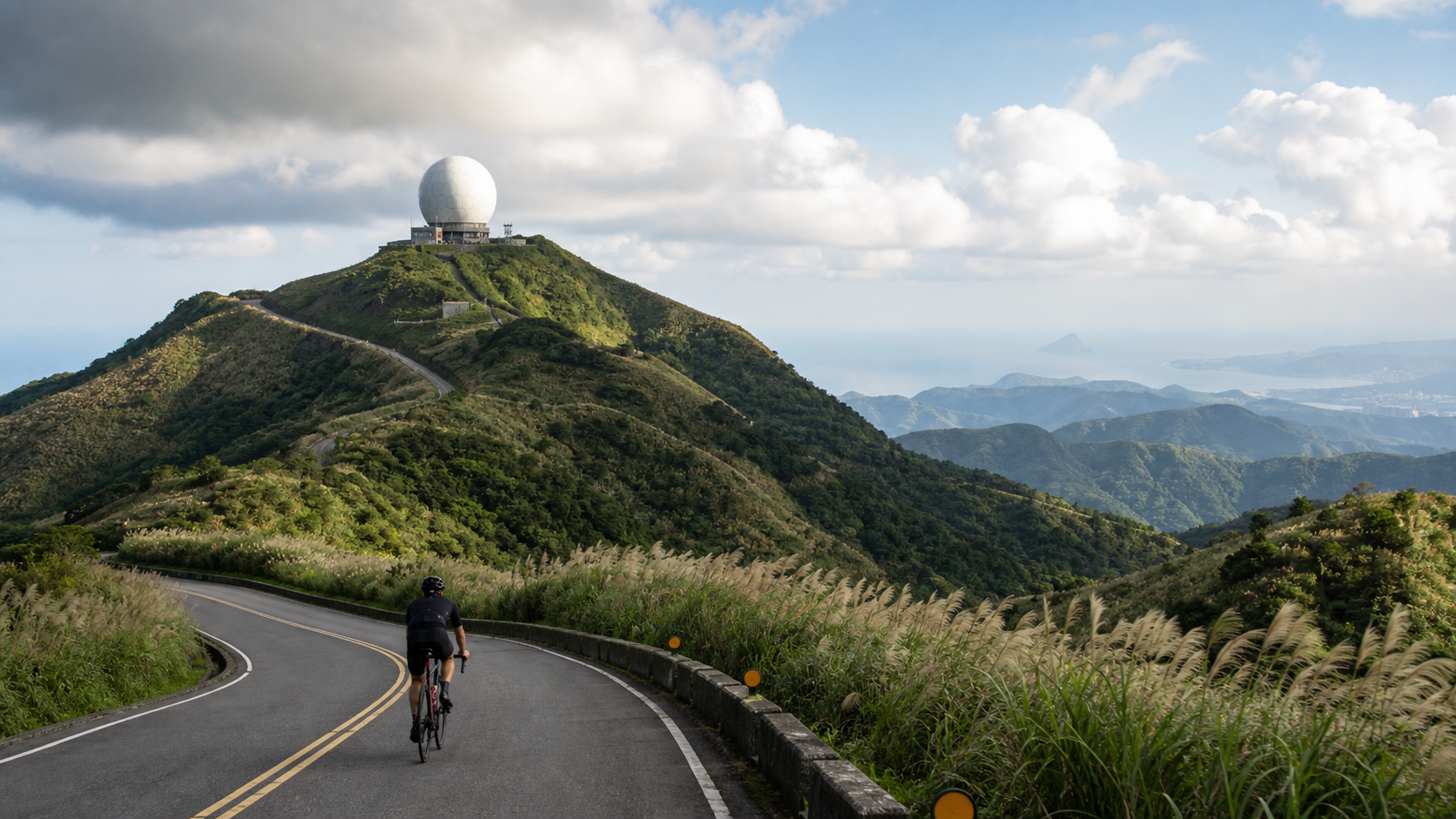
Wufen Mountain’s most unforgettable landmark is undoubtedly the giant white radar dome at the summit—the Central Weather Administration’s Wufen Mountain Weather Radar Station. Most people who catch their first distant glimpse of it will pause for a moment: amid these layered green mountains, how did such an incongruous giant white ball come to be?
But the closer you ride, the more that sense of incongruity gradually transforms into a peculiar harmony. This weather radar station is a critical link in Taiwan’s meteorological observation network, scanning atmospheric rainfall and wind-field changes around the clock, providing first-hand data for northern Taiwan’s disaster early-warning systems. It is a product of pure modern technology—precise, cold, and function-driven—while surrounding it is the most primal natural landscape: undulating ridgelines, wind-swayed silvergrass, and mist-shrouded valleys.
This stark contrast in imagery, in a way, echoes the dual character of the Pingxi land itself: on one side, the romantic and traditional ritual of sky lantern blessings; on the other, the cool, rational scientific monitoring of a weather radar; on one side, the memory of human labor in old mine shafts; on the other, modern facilities running on automation. Riding the road to Wufen Mountain, you constantly feel this unique atmosphere where old and new interweave, where humanity and technology stand side by side—and that, beyond the sheer physical challenge, is what makes this route so intriguing.
Scenery Along the Way: Tea Plantations, Bamboo Groves, and Valley Seas of Clouds
Leaving the foothill settlements behind, the wheels begin to bite into the gently rising slope, and the scenery gradually shifts with it. On the lower-elevation stretches, terraced tea plantations appear sporadically on either side, laid out along the contour lines, their rows of green tea bushes reflecting a warm, soft luster under morning or afternoon sunlight. The history of tea cultivation in these mountains is closely tied to the region’s hilly terrain and climate—ample rain, frequent fog, and moderate day-night temperature swings are common natural conditions shared by many tea-growing areas in northern Taiwan.
Riding a bit higher, the tea plantations give way to dense bamboo groves. The rustling sound of wind passing through bamboo is one of the most soothing background sounds on this route—a sound hard to describe precisely in words, somewhere between murmuring and sighing, swelling and fading with the strength of the wind, as if the entire forest were breathing in time with your cadence. The bamboo sections also usually mean the gradient has settled into a steadier range, making this a stretch of the ride well-suited for easing your heart rate and focusing on the sounds and scents around you.
And the most breathtaking scenery often appears under specific weather conditions: a sea of clouds in the valley. When low-level clouds pile up and churn in the valleys due to terrain uplift, forming a soft, cotton-like sea of clouds, standing at the edge of the ridgeline and looking down feels almost like being in a fairyland—the world below is wrapped in mist, leaving only the ridgelines of distant peaks floating like islands above the clouds. Such cloud-sea views are not something you encounter on every ride; they require the right alignment of time and conditions. But precisely because they are so hard to come by, each encounter feels all the more precious.
A First-Person Climb: A Dialogue of Rhythm, Breath, and Heartbeat
Climbing Wufen Mountain, the most profound physical sensation is not a single moment of awe, but a rhythm that builds continuously. Spreading 577.4 meters of elevation gain across 10.28 kilometers means this is not the kind of short, steep pitch that leaves you gasping and questioning your life choices within minutes; it is a sustained battle requiring a long dialogue with your own breath and heartbeat.
In the first few hundred meters, your body still carries the inertia of flat-road riding—cadence light, breathing relaxed. But as the gradient gradually asserts itself, I begin to consciously slow my pace—not because I don’t want to go fast, but because this road teaches me that the most precious resource on a long climb is not explosive power, but patience. Each exhale, each inhale, each full revolution of the pedals becomes a near-meditative repetition. Over time, this repetition produces a curious state of flow—you stop calculating how many kilometers remain and become completely immersed in “this moment of pedaling.”
On the middle section, the gradient is steady and even—no obvious flat stretches to catch your breath, no sudden steep pitches to catch you off guard. This “consistency” itself becomes a form of discipline: it forces you to honestly confront your physical condition. You can’t bluff your way through with a lucky burst of power; you can only chew away the distance bit by bit through one stable pedal stroke after another. Sweat begins to slide down your temples, and the sound of your breathing gradually overtakes the wind. At this point, the world becomes very small—small enough to be just the front wheel, the road surface, and the next turn.
Until, at some moment, the white radar dome unexpectedly peeks out from behind the treetops. The feeling at that instant is hard to describe—like finally seeing light at the end of a long tunnel, all accumulated fatigue suddenly diluted by a surge of excitement. I remember unconsciously quickening my cadence, even though reason told me to save some reserve, but my body was already being driven forward by that longing for “the finish line in sight.”
At the Summit: The Grandeur of Keelung Islet and the Coastline
The moment you reach the summit of Wufen Mountain, if weather conditions cooperate, the panorama that unfolds before you makes you instantly forget the fatigue of the past ten kilometers. Looking northeast, the small whale-shaped island on the sea—Keelung Islet—floats quietly on the azure or mist-veiled waters; extending to either side is the winding coastline of the Northeast Coast, its grandeur of sea meeting sky forming a stark contrast with the green of the mountains you just left. Looking the other way, the faint urban silhouette of the Taipei Basin comes into view, and on clear days you can even sense that subtle distance between city and mountain—having ridden barely ten kilometers, it feels as though you’ve crossed between two entirely different worlds.
Whether this view reveals itself clearly depends largely on the weather and visibility of the moment. Mountain weather is inherently fickle; sometimes you grind your way to the summit only to be greeted by a wall of white—dense fog so thick you can’t see your hand in front of your face. But precisely because of this uncertainty, every summit experience with a sea view becomes all the more worth cherishing. I once heard a seasoned rider say something that has stayed with me: “You don’t climb a mountain to see the view; you climb to become worthy of the view.” Applied to Wufen Mountain, those words seem especially apt—you must first honestly complete that 577.4-meter climb before you earn the right to stand in that spot and accept whether nature is willing to grant you this expanse of sea and sky.
Standing near the weather radar station, the wind is always stronger than down below, carrying an intermingling of oceanic moisture and the cool, crisp scent of the forest. Watching that giant white sphere continue its rotation, monitoring the changes of this sky day after day, there’s a curious sense of groundedness—as if no matter how people come and go, this mountaintop always has a pair of eyes, quietly keeping watch over the weather rhythms of this land.
What This Route Means to Cyclists
For me, Wufen Mountain has long surpassed its simple designation as “a climbing route.” It functions more like a mirror—each ride honestly reflects who I am at that moment: whether my fitness has improved, whether my mindset has grown steadier, and whether I can maintain patience and focus through long stretches of monotonous climbing.
This route has no dramatic gradient shifts, no adrenaline-fueled sprint sections. What it offers is a long, honest conversation with yourself. You cannot ride Wufen Mountain well through luck alone; you can only shorten your time and push back the threshold of perceived fatigue through repeated training accumulation and repeated pacing adjustments. This “honesty” is precisely where its most precious value lies—in an era saturated with quick fixes and shortcuts, having a route willing to reflect your effort so truthfully is, in fact, a rare gift.
Whenever the pace of life becomes chaotic and my thoughts grow tangled, I think of the middle section of Wufen Mountain—where the gradient is even, the scenery repetitive, and there are no obvious milestones, leaving you to push forward only by your own internal rhythm. That feeling resembles many phases in life that require long-term cultivation with no immediate results, and Wufen Mountain, through the most direct physical experience, has taught me how to coexist peacefully with such processes.
Seasonal Scenery: Seas of Clouds, Silvergrass, and the Cold, Damp Sensation
Wufen Mountain’s appearance transforms dramatically with the changing seasons, which is one of the reasons this route deserves repeated visits.
Summer: Afternoon convection in the mountains is strong, often producing localized thunderstorms toward evening. I recommend setting off in the early morning hours—this both avoids the high heat and offers a higher chance of encountering the hazy beauty of morning mist that has yet to dissipate. Summer vegetation is at its most lush and verdant, and the layered sensation of being enveloped by dense greenery along the entire route is the most vivid of all four seasons.
Autumn: As the northeast monsoon begins to strengthen, the silvergrass on the ridgelines gradually heads out, surging in the wind into waves of silvery white that reflect against the deep blue sea in the distance. This is an important season for many photography enthusiasts who make special trips to this mountain area. Temperatures also begin to cool during silvergrass season, making the perceived comfort relatively friendly for climbing cyclists.
Winter: The northeast monsoon exerts its full force, and Wufen Mountain bears the brunt of it. The cold, damp conditions at the summit intensify noticeably, often accompanied by drizzling rain and thick fog that drastically reduce visibility. Challenging Wufen Mountain in this season tests not only your fitness but also your equipment preparation and mental resilience against low temperatures and wet conditions—be sure to have complete windproof and thermal measures in place.
Seas of clouds are not exclusive to any particular season; rather, they depend on specific atmospheric pressure and humidity conditions—when humidity near the foothills is high and the temperature stratification is suitable for temperature inversion, standing on Wufen Mountain’s ridgeline offers the chance to capture that magnificent sea-of-clouds spectacle. This serendipitous, cannot-be-forced opportunity also imbues every ride with a hint of anticipation and the possibility of surprise.
Suggested Side Trips: Incorporating Wufen Mountain into a Pingxi Day Trip
If time and energy permit, Wufen Mountain pairs beautifully with the well-known attractions of the surrounding Pingxi area, allowing you to arrange a deep, small-scale journey combining sport and culture.
Shifen Waterfall is one of Taiwan’s most famous curtain-style waterfalls. Its broad curtain of water cascades down the cliff face with tremendous force, forming a striking contrast to Wufen Mountain’s introverted, tranquil mountain stillness—making it an ideal relaxing itinerary after finishing your ride.
Jingtong Old Street preserves much of the architectural character of the Japanese colonial-era mining settlements. The wooden train station and the surrounding wishing bamboo tubes are particularly distinctive, and strolling through the area feels as though you can sense the atmosphere of life from that coal-mining heyday.
Pingxi sky lantern culture is the most widely recognized image of this land. Whether or not you happen to be there during a lantern release event, walking among the lantern installations hung with blessing messages along both sides of the railway tracks allows you to feel the warmth of this unique folk culture.
As for the exact opening hours of these attractions, business status of shops, or event schedules, I recommend deferring to on-site announcements or the latest official information, as such details adjust with time and season. What is certain, however, is that Wufen Mountain and the surrounding Pingxi area deserve more than just one ride from you—each visit, whether focused on the physical challenge of the climb itself or slowing down to appreciate the surrounding cultural landscape, will bring you different layers of reward and emotion.
When I finish an entire ride and look back at that gradually shrinking white radar sphere, what surfaces in my mind is not the relief of “finally done,” but a faint, lingering thought of wanting to return. This, I suppose, is what a great route should be like—it makes you begin anticipating the next reunion the moment you complete it.
Overlapping with Mining Memories: The Black History Beneath the Mountain Path
Riding along the industrial road toward Wufen Mountain, few people realize that the seemingly ordinary asphalt beneath their wheels may well overlap with some long-abandoned coal-transport trail. At its peak, the mining operations in the Pingxi area supported the livelihoods of thousands of people across the entire settlement. Miners entered the tunnels before dawn each day, trading their most primitive labor in the dim, damp underground for their families’ daily sustenance. In that era, the hilly terrain around Wufen Mountain was densely dotted with mine entrances of all sizes, and light rail tracks for coal transport wove through the valleys, forming a unique industrial landscape across this mountain region.
As the energy structure shifted and coal sources were depleted, these once-bustling mines closed and fell silent one after another. Many miners and their families chose to leave the mountains and head to the cities in search of new livelihoods. Today, most of the former coal-transport tracks have been buried under overgrown vegetation, or transformed into the tourist-oriented Pingxi Line railway, while those tunnels buried deep within the mountains lie quietly in the darkness, becoming a gradually forgotten collective memory.
Often during my rides, especially when passing certain sections that clearly bear traces of artificial excavation, I cannot help but slow down and imagine what bustling scenes might have played out on this path decades ago—the weary footsteps of miners heading home after their shifts, the rhythmic clatter of coal carts gliding over the tracks, the figures of women and children waiting by the roadside for their loved ones to return safely. Though these images exist only in imagination, they add a layer of historical depth and human warmth to this purely physical challenge. Wufen Mountain is not merely a peak on a geographic coordinate; it is also a silent witness to the industrial transformation of this land, standing quietly there, watching the entire journey of Pingxi’s evolution from a mining settlement into a tourist town.
The Pingxi Line Railway: Another Way of Moving Slowly
If cycling represents an active, physically demanding mode of movement, then the Pingxi Line railway, winding along the Keelung River valley, embodies a completely different philosophy of slowness. This branch line of the Taiwan Railways Administration connects a series of nostalgic little stations—Sandiaoling, Dahua, Shifen, Wanggu, Lingjiao, Pingxi, and Jingtong—and the carriages travel at a leisurely pace, swaying through the valleys and along the streams, allowing passengers to appreciate the passing gorge scenery in the most relaxed manner.
The original purpose of this railway was, in fact, inseparable from mining transport—it was built precisely to carry the coal mined in the Pingxi area down to the foothills for collection and transshipment. Today, mining has long since become history, yet this railway, thanks to sky lantern culture and the nostalgic charm along its route, has unexpectedly transformed into a tourist railway, carrying travelers from around the world to experience a mode of slow movement utterly different from the pace of urban life.
While climbing the roads of Wufen Mountain, you can occasionally glimpse from above the winding silhouette of railway tracks in the valley below, or hear the distant sound of a train’s whistle. In those moments, a peculiar sense of temporal and spatial overlap arises—I am conquering the 577.4 meters of vertical elevation gain inch by inch with the strength of my legs; meanwhile, the train in the valley below, with its century-old unchanging slow rhythm, carries another group of travelers experiencing this landscape in an entirely different way. Two modes of movement, two completely different perceived speeds, yet they coexist without conflict within the same valley, each telling its own story.
Scent Memories in the Mountain Wind
The most easily overlooked yet most deeply ingrained memory of riding up Wufen Mountain is actually the ever-changing layers of scent along the way. On the low-elevation sections, the warm smell of sun-baked asphalt mingles with the occasional whiff of everyday village life—perhaps the aroma of cooking drifting from someone’s kitchen, or the scent of pickled vegetables drying outside a small roadside grocery store. These smells of everyday mountain village life, though ordinary, feel especially authentic.
As the elevation gradually climbs, the scents begin to shift. On the tea plantation sections, a faint, elusive hint of tea-leaf fragrance lingers in the air, becoming more pronounced around the harvest season. Entering the bamboo grove sections, the moist earthy scent interweaves with the distinctive green aroma of bamboo leaves, and combined with the coolness provided by the shaded canopy, it feels as if you are suddenly immersed in a sea of green freshness.
On the sections approaching the summit, the scents take on yet another character—sea breeze mingled with the mountain forest’s aroma, carrying a faint salty, damp oceanic quality. This is because Wufen Mountain’s location is relatively close to the northeastern coast; when the wind direction is favorable, the ocean’s scent is carried up to the summit by terrain-lifted air currents. This complex fragrance blending mountain and sea is a unique experience I have rarely felt on other purely inland mountain routes, and it leaves Wufen Mountain in my mind with a distinctive character where mountain and ocean converge.
A Note to the Next Rider Ready to Set Off
If you are reading this article, hesitating over whether to plan a ride up Wufen Mountain, let me tell you: what this route gives you goes far beyond the 577.4 meters of climbing or the 10.28 kilometers of accumulated distance. It will teach you, through the continuous turning of your pedals, to reconnect with your own breathing; it will let you feel a grounded sense of accomplishment the moment you reach the summit, whether what lies before you is a sweeping ocean view or swirling clouds and mist; and it will send you on the descent home, drenched in sweat and fatigue, yet carrying with you an indescribable sense of fulfillment and calm.
The mountain region of Pingxi carries too many layers of stories—the historical memory of the mining industry’s rise and fall, the romantic legend of sky lantern wishes, the nostalgic charm of slow-moving railway lines, and the weather radar station atop Wufen Mountain that operates day and night, keeping watch over the sky. When you ride this route, you are not merely challenging a stretch of gradient; you are engaging in a quiet yet profound dialogue with the multifaceted identity of this land.
May you also find your own rhythm, riding slowly and steadily toward that white sphere, and then, in the wind at the summit, see the sea that is yours alone.
Related Reading
- The White Giant Sphere Above the Clouds: A Misty Ridge Ride to Pingxi’s Wufen Mountain
- Wufen Mountain Guide: A Rhythm-Riding Textbook for 10.28 Kilometers and 577 Meters of Climbing
- Mist and Railway Tracks in the Sky Lantern Mountain Town: Riding to Shifen Waterfall, Encountering Pingxi’s Rain and Light
- Keelung Nuannuan to Pingxi Route: A Unique Riding Experience Through Northern Taiwan’s Mining Landscape
水金九不厭五分 10度寒流冷到不願停!feat. 卡卡 / 公路車 / CT Yeh
6 個月前
嘉義大埔、阿婆灣挑戰賽,美到以為在日本!ft. 環騎5 Cool 西拉雅188 / 公路車 / CT Yeh
7 個月前
騎單車去大屯山賞雪! 助航台滑冰 全記錄 | 台北R友大集合 | 下雪打雪仗囉 | 4K超高畫質
5 年前
太平山單車員工旅遊 | 這樣玩CP值最高!| 公路車
5 年前
新竹白蘭部落! 爬陡坡還能講笑話...? 廢物伙伴の約騎 | 公路車 | CT Yeh
4 年前
新竹羅平 x 天湖部落 大禹嶺級變態陡坡! 4K超高畫質 空拍 | 公路車
5 年前
梅山36彎 奮起湖 單車挑戰 下集 #公路車
6 年前
無耳茶壺山 半屏山 空拍震撼絕景 驚險O型縱走
8 年前