The Final Finger of the Buddha's Palm: A Slow Ride Through the Fog-Shrouded Balaka Road and the Volcanic Memory of Yangmingshan
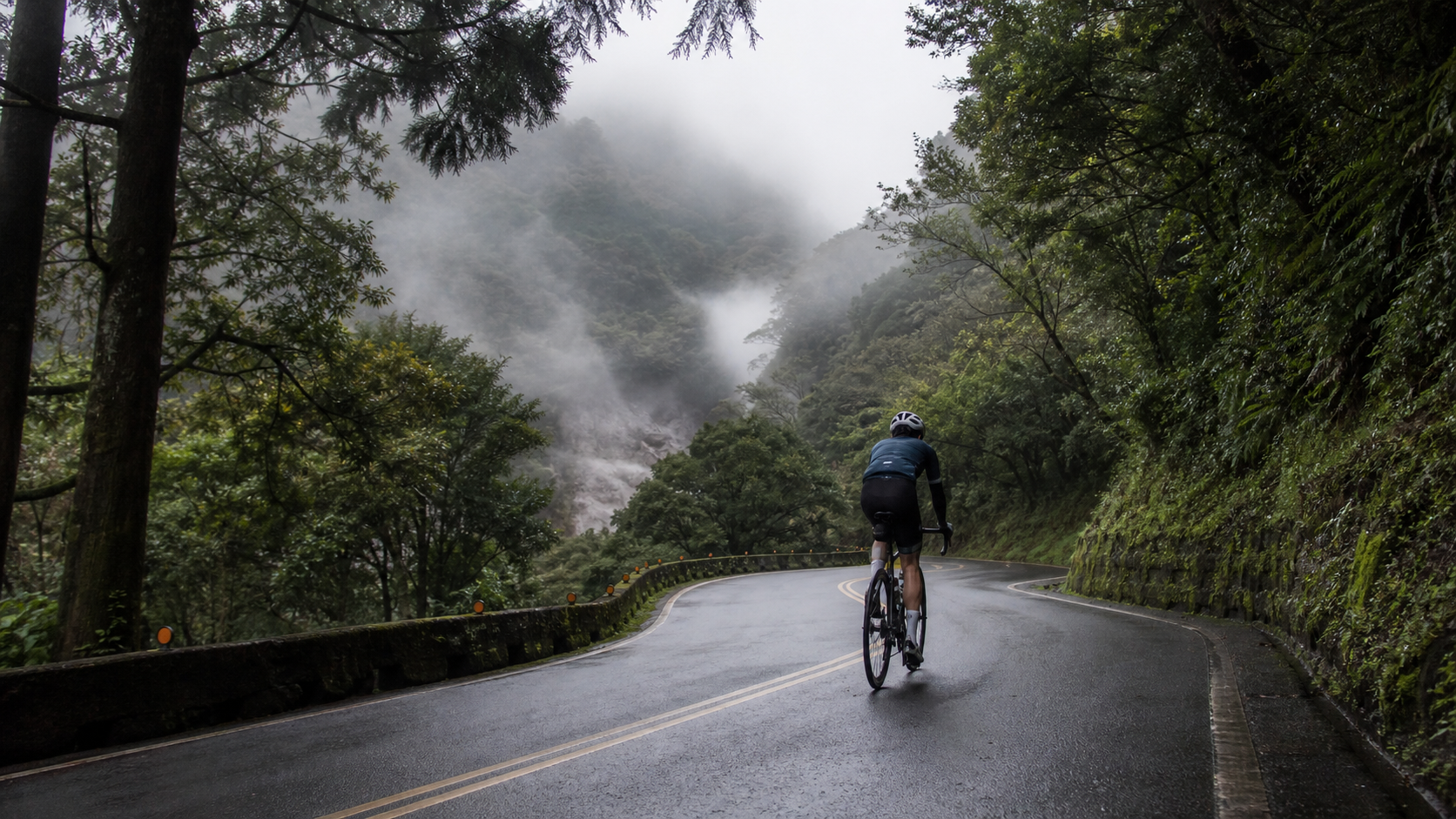
The fog began to thicken shortly after passing Zhuzihu. It had been a clear morning that day, but not long after riding onto the Balaka Highway, the Japanese cedar and broadleaf forests on either side gradually narrowed the sky into a thin slit, and the wind began to carry the damp scent of soil—that distinctive Yangmingshan aroma, a blend of sulfur and humus, reminding every rider who climbs this mountain: you are pedaling atop a volcano.
1. The Breath of a Sleeping Volcano
The Datun Volcano Group, home to Yangmingshan National Park, is a relatively young volcanic terrain. Although it is currently generally classified as a dormant or extinct volcanic system, sporadic geothermal activity and sulfur fumaroles can still be observed in the area to this day (for the actual activity status and the latest geological research, please refer to official announcements). This volcanic heritage has shaped the mountain range’s unique landforms—conical peaks, caldera topography, and valley basins like Zhuzihu, formed by ancient damming. The Balaka Highway was built along the western ridge of this volcanic terrain, winding its way through a network of mountain-and-sea roads connecting Zhuzihu and Sanzhi.
Riding on such a road, it’s hard not to imagine what a geological theater this place must have been tens of thousands of years ago—flowing lava, falling volcanic ash, crustal movements squeezed by subduction zones, all eventually settling into the forest we now traverse with our pedals. The reason Yangmingshan can sustain such a multi-layered microclimate and vegetation is, to some extent, thanks to this volcanic heritage—geothermal heat, rainfall, and elevation differences interweave to create an ecosystem far more complex than that of downtown Taipei.
2. “The Buddha’s Palm”: A Legend of the Local Riding Community
Before officially riding the Balaka Highway, I’d like to talk about the name “The Buddha’s Palm.” This is a nickname long circulated within Taipei’s road cycling community, used to describe a challenging network of climbing routes that encircle the Yangmingshan area—because these roads radiate outward from the mountaintops, riders describe them as resembling an open palm, with each climbing route being a finger extending from the palm. According to the general understanding within the local riding community, this combination roughly covers several classic roads around Yangmingshan, including the Balaka Highway, Fengguizui, Neishuangxi, and Pingjing Street, but exactly which roads count and how the order is arranged varies slightly in detail from one account to another, and there is no “official version” that everyone agrees on—which is what makes this legend so interesting; it relies on word of mouth, not official certification.
“Reverse riding” is the advanced way to take on this challenge—beyond the direction most riders are accustomed to, tackling these climbs in reverse order offers a completely different feel and rhythm. And the Balaka Highway is often arranged as the “final finger” in this reverse sequence. I love the imagery behind this phrase: a full day of challenge, draining your energy finger by finger, until the last bit of strength left is just enough to grip that final finger—and the Balaka Highway’s wide, smooth pavement, to some extent, feels like a relatively gentle way to wrap things up for a weary rider, even though its actual elevation gain (917 meters) is by no means easy.
3. Climbing Through the Fog Forest
Back to that day’s ride. As the fog grew denser, visibility shrank to just the dozen or so meters of asphalt ahead and the blurred silhouettes of trees on either side. Riding in such poor visibility requires extra focus—not just watching the road, but also slowing down and staying alert for vehicles that might suddenly appear. But curiously, the fog also brings a peculiar sense of concentration: the outside world is reduced to just the short stretch of road ahead, the sounds of breathing and cadence become amplified, and you’re forced into a state bordering on meditation.
The continuous switchbacks on the middle section of the Balaka Highway feel particularly oppressive in the fog—you can never see clearly what gradient lies beyond the next corner, relying only on your body’s sense of resistance to decide whether to downshift. That tension brought on by the “unknown,” to some extent, adds a psychological layer to the climb—not just a physical drain, but also a test of your ability to adapt to uncertainty. I remember at one particularly fog-dense corner, I could only rely on hearing to judge whether a car was coming—the sound of tires pressing over wet asphalt carries especially far in thick fog.
4. Memories of Zhuzihu’s Calla Lilies
The end of the Balaka Highway near Zhuzihu is a scene Taipei residents know all too well—every spring, the calla lily fields bloom into a sea of white, drawing crowds of visitors up the mountain specifically to admire the flowers (for actual bloom conditions and opening times, please refer to on-site and official announcements). The first time I rode through Zhuzihu was on an ordinary day outside the blooming season; the fields held only tended soil and a few scattered unharvested plants, yet even so, that valley was beautiful enough to make you want to stop and take a longer look.
The name Zhuzihu itself carries a story—this valley is said to have been a dammed basin formed by ancient volcanic activity and terrain erosion, and in early times it truly was a lake, which later silted up and dried out to form the valley terrain suitable for farming today (for detailed geological history, please refer to academic research and official sources). Also, thanks to its higher elevation and relatively cooler climate, it has developed a tradition of growing highland vegetables and flowers since the Japanese colonial era, and to this day, you can still see numerous mountain-produce and wild-vegetable restaurants and seasonal flower fields along the way, offering another layer of scenery worth slowing down to experience on this route besides cycling (for actual business status, please refer to on-site conditions).
5. The Weight of the Final Finger
That day, I wasn’t attempting the full “Buddha’s Palm”—I was simply riding the Balaka Highway as a standalone outing. But even so, when I reached those corners in the latter half where the gradient noticeably kicked up, I couldn’t help but imagine how agonizing this climb would be if my legs had already been drained by the previous “fingers” earlier in the day. With a total elevation gain of 917 meters, if it were placed at the final stage of a full day of multiple climbs, that fatigue would be something you simply cannot appreciate from riding it alone.
It’s precisely for this reason that I can truly understand why local riders use the江湖-flavored term “final finger” to describe this road—it’s not just geographically the last climb, but more like a ritualistic finish line, a psychological marker that says, “get through this, and today’s mission is complete.” When reaching that open vista near the Sanzhi exit, where riders can see the coastline and the glow of sunset in the distance, that overwhelming sense of relief probably explains better than any data what this road means to the local riding community.
6. A Road Network Between Mountain and Sea
Perhaps the most fascinating geographic trait of the Balaka Highway is how it connects two completely different landscapes: “mountain” and “sea.” Setting out from Zhuzihu, you’re surrounded by layered forests and clouds, but as the route descends toward Sanzhi, the view gradually opens up, and eventually you can see the Tamsui River estuary and the waters of the Taiwan Strait in the distance. This kind of landscape transition completed within just ten kilometers is rare in Taiwan’s road cycling network—most long climbs are either entirely enveloped by forest or entirely facing the sea; routes that offer both scenery at once are uncommon.
This also makes the Balaka Highway a favorite among photography enthusiasts—especially on clear evenings, looking back from the open vista near the Sanzhi end, you can capture images of sea of clouds, sunset, and coastline interwoven, though actual scenery varies greatly with weather, season, and visibility, so it’s advisable to check the real-time weather forecast before heading out.
7. A Riding Philosophy of Coexisting with the Mountain
After riding the Balaka Highway several times, I’ve come to realize that what this road teaches riders isn’t just the technical matters of pacing and gear ratios, but also a mindset of coexisting with the unpredictable mountain weather. Yangmingshan’s weather changes in an instant—clear and cloudless one moment, then thick fog may swallow the entire mountain road the next; calm one moment, then strong crosswinds may suddenly sweep across the ridge section before the summit. This uncertainty, to some extent, is precisely what makes mountain riding both captivating and deserving of respect—you can never fully control the weather; all you can do is be prepared and learn to stay flexible when plans are disrupted.
After that ride ended, I stopped at the intersection on the Sanzhi end and looked back at the fog-shrouded forest I had just traversed, suddenly feeling that what this ride had given me far exceeded any breakthrough in pacing data. It was a feeling of having briefly conversed with the entire mountain and its tens of thousands of years of volcanic history—even if it was just ten kilometers, even if it was just an ordinary weekend ride.
8. For Riders Preparing to Take on the “Buddha’s Palm”
If you’re planning a full “Buddha’s Palm” reverse-direction challenge, I want to remind you that this is not just a test of physical fitness, but also a comprehensive test of route planning and mental resilience. I recommend planning your resupply points and rest times in advance, and doing your homework based on route combination experience shared by local cycling community groups—since there is no single definitive definition of the “Buddha’s Palm,” it’s best to confirm before departure that you and your riding partners share a consensus on the route scope of this challenge, to avoid disputes mid-ride caused by differing expectations.
And if Balaka Road is indeed the final finger of your challenge, be sure to start conserving energy for it from the earlier fingers—917 meters of climbing will not go easy on tired legs just because it comes last, nor because it carries the reputation of being a “gentle climb.”
9. Balaka Through the Four Seasons
Aside from that fog-shrouded ride, I have since revisited this road in different seasons. During the spring calla lily season, the Zhuzihu end is crowded with both people and vehicles—a good time to slow down and enjoy the cultural scenery. In summer, convective cloud systems tend to form in the afternoon, so I recommend setting off early in the morning to avoid afternoon thunderstorms. Autumn offers clear, transparent air, making it the best time to photograph the scenery where mountains meet the sea. In winter, when the northeast monsoon prevails, the summit area is often damp, cold, and foggy, and the strong winds on the final climb segment truly test your willpower—but that riding experience of swirling clouds and near-zero visibility carries its own desolate beauty, just be sure to prepare thoroughly for warmth and traction.
10. In Closing: One Road, Two Names
Balaka Road, County Highway 101A—that is its official identity. The final finger of the Buddha’s Palm—that is its legendary title among local riders. Behind these two names lies the same road existing in two ways: one is the objective coordinate defined by maps and transportation authorities, the other is a collective memory slowly built up through countless pedal strokes, countless fog-locked mornings, and countless exhausting yet willing challenges.
If you also plan to ride this road—whether as a standalone afternoon outing or as the grand finale of the “Buddha’s Palm” challenge—I’d like to invite you, on that stretch before the summit where the view gradually opens up, to slow down a little and take in the mountain-and-sea scenery nurtured by this volcanic terrain. At that moment, you’ll understand why this road has accumulated its own legend and weight through the stories passed down among Taipei cyclists.
11. Appendix: Supplementary Notes on the Road Name and Route Network
“Balaka”—this place name with its exotic flavor—has no single confirmed etymology. Local accounts mostly relate it to surrounding indigenous peoples or early place-name transliterations, but there is no single definitive official research. I won’t speculate beyond what’s known here; I’ll simply note the layer of mystery this name adds to the road. As for the title “Buddha’s Palm” itself, it was not coined by any official tourism body—it is purely a nickname that spread organically from the road cycling community. This cultural phenomenon of riders naming and赋予 meaning to routes themselves, to some extent, reflects the flourishing development of Taiwan’s road cycling scene in recent years, gradually accumulating its own vernacular and collective memory.
12. Some Reminders for First-Time Challengers
If this is your first time riding Balaka Road, don’t be completely persuaded by its reputation as a “popular gentle climb”—the continuous switchbacks in the middle and latter sections, and the wind before the summit, both deserve serious respect. But there’s no need to feel intimidated either. The road’s wide surface and relatively forgiving gradient rhythm genuinely make it an excellent choice for many riders’ first “proper long climb” in their cycling careers. Set off with a sense of reverence without losing anticipation, and you’ll find that this ten-kilometer journey is far richer than the numbers alone suggest.
13. Conclusion: After the Fog Lifts
That day, as I approached the exit near the Sanzhi end, the dense fog suddenly parted as if someone had drawn back a curtain. Sunlight poured down without warning onto the mountain road that had been shrouded in mist just moments before, and the outline of the coastline far ahead came into sharp focus. That moment of contrast remains one of my most profound memories of Balaka Road—as if the entire ride were a metaphor for “persisting through the unknown will eventually lead to open horizons.”
If you too are ready to take on this final finger of the “Buddha’s Palm,” may you also encounter your own moment of clearing skies after the summit.
14. Two Mindsets: Riding Solo vs. Riding with Companions
On that ride through the dense fog, I set out alone. Facing a mountain road with extremely poor visibility by yourself requires stronger mental fortitude—there’s no one to cheer you on, and every judgment call rests on your own shoulders. But precisely because of that, the experience of complete solitude—just you and the mountain in dialogue—feels especially profound. Later, I also re-rode Balaka Road with a few friends, and that was an entirely different landscape—reminding each other of road conditions through the switchbacks, encouraging each other to push harder on the summit segment, and the high-fives at the Sanzhi end exit—a warmth that solo riding can hardly replicate.
If you’re attempting a multi-climb itinerary like the “Buddha’s Palm” for the first time, I’d recommend riding with a few companions. Especially in the final stage, when your energy has been drained by the earlier fingers and your willpower is at its weakest, the presence of companions is often the key to pushing through. But if you simply want to find a road to spend quiet time with yourself, the solo riding experience on Balaka Road is equally worth having at least once.
15. Suggestions for Exploring Around Zhuzihu
If time permits, the area around Zhuzihu is well worth exploring before or after your Balaka Road ride. Beyond the calla lily fields, this valley also hosts a number of mountain restaurants specializing in locally grown high-altitude vegetables. After expending your energy on a climb, sitting down to a hot meal of mountain vegetable dishes is an unspoken reward ritual among cyclists (please refer to on-site and official information for actual restaurant details and business hours). If you visit on a weekday outside the flower season, there are relatively few tourists, and you can better appreciate the tranquil, rustic side of this volcanic valley—no crowds needed to enjoy the pastoral scenery.
In addition to Zhuzihu, the area around the Sanzhi end of Balaka Road also connects to the North Coast’s coastal cycling network. If your energy allows, consider extending your ride to the seaside, finishing with a gentle coastal stretch to let your body gradually transition from the high-intensity climbing load back to a relaxed, easy pace—a fitting full stop for a journey that spans both mountains and sea.
16. To Those Who Haven’t Ridden Balaka Road Yet
If you haven’t yet had the chance to ride this road yourself, let me tell you this: data and guides can ultimately only convey part of the truth—the 917 meters of climbing, the 9% actual average gradient, the challenge of the continuous switchbacks—these are just the skeleton. What truly makes Balaka Road worth riding is the focus and tranquility of passing through that foggy forest, the ever-changing face of the Zhuzihu valley through the seasons, the expansive mountain-and-sea view after the summit, and that complex feeling of exhaustion mixed with release when you complete the “final finger.” These experiences, in the end, can only be truly understood by getting on the pedals yourself.
17. On the Blurred Line Between “Gentle Climb” and “Hard Climb”
Throughout the process of writing this article, I kept pondering a question: why has a route with 917 meters of actual climbing and an average gradient close to 9% been stereotyped as a “popular gentle climb” through years of word-of-mouth? I eventually figured it out—perhaps it’s precisely because the road surface quality and switchback design of Balaka Road are so forgiving. The wide, smooth asphalt and the broad, open curves give riders a “subjective feel” that it’s much easier than other routes with comparable elevation gain. Over time, this subjective “ease” replaced the objective climbing numbers and became the road’s label in collective memory.
This actually reminds us of something more universal: route assessments passed down by word-of-mouth in local communities often incorporate hard-to-quantify factors like road surface quality, scenic experience, and psychological perception—they don’t purely equate to physical performance data. As a rider, maintaining both kinds of awareness—respecting the experiential wisdom accumulated by the local community while also staying sensitive to objective data—is perhaps the most mature riding attitude. What Balaka Road taught me isn’t just how to climb a hill, but how to find my own judgment between legend and data.
18. Afterword: A Note to Myself for the Next Visit
On the day I left the Sanshi end of the road, I bought a sports drink at a 7-Eleven by the roadside. Sitting on the low wall beside the scooter parking spaces, I looked back at the direction I had just descended—the mountaintop was still shrouded in a grayish-white mist, and I could hardly tell that I had just ridden through that thick fog. That feeling of “having experienced it firsthand, yet barely recognizing it when looking back” is, in a way, the magical moment unique to mountain riding.
I jotted down my thoughts from this ride in my notes, reminding my future self: the next time I take on the full reverse route of the “Rulai Shenzhang” (Buddha’s Palm), I must save enough energy and mental preparation for this final finger—the Balaka Road. This road won’t go easy on tired legs just because it’s known as a “gentle climb”—but it will indeed reward every rider who faces it honestly and pedals through every corner with the magnificent scenery where mountains meet the sea.
Related Reading
- Balaka Road Guide: The 10.2km Classic Gentle Climb of Yangmingshan, Breaking Down the Real Difficulty of the “Last Finger of Rulai Shenzhang” with Data
- Mist over Mingchi: An 18.5km Ride from Baling into the Depths of the Japanese Cedar Forest
- Yangjin Highway and Lengshuikeng: A Loop Ride Through Yangmingshan’s Volcanic Landscape
- From Jinshan Coast to the Volcanic Crater: Geothermal Steam, Clouds, and Local Warmth at Xiaoyoukeng on the Yangjin Highway
2024 如來神掌 百人約騎挑戰!feat. 秘境單車社團 / 神人們太可怕 / 全程錄影 x 完整坡度解析 / 公路車 / CT Yeh
2 年前
里佳部落 阿里山單車深度旅遊! | 竹山/草嶺/來吉/奮起湖 | 無敵銀河絕景 全新路線探索! 驚險狀況百出! | 4K沉浸式畫質 | 公路車 | CT Yeh
3 年前
阿里山塔塔加 兩倍特濃版!全新隧道開通! 進喔!公路車 | CT Yeh
3 年前
一定要騎一次!阿里山最深處:里佳部落!單車旅行 | 2800m爬升 | 深度部落體驗:嗨翻晚會、螢火蟲、銀河 | feat. JJSC & 廢物伙伴 | 公路車 CT Yeh
9 個月前
台北闊瀨陡坡 騎旅 / 日本單車雜誌編輯車友臨時加入!/ 髮香才是最強的 / feat. 北迴歸線小隊 / 公路車 CT Yeh
6 個月前
#北橫 + #北進武嶺 最硬的員工旅遊 EP1 | #公路車 #拉拉山 | 明池 | 武嶺 | 武陵農場 | 雲海 | Taiwan Cycling Route Wulin
6 年前
嘉義大埔、阿婆灣挑戰賽,美到以為在日本!ft. 環騎5 Cool 西拉雅188 / 公路車 / CT Yeh
7 個月前
藤枝二集團 單車行 Day1 | 南部小武嶺 | 爬坡爬到罵罵叫 | JJSC | 公路車 | CT Yeh
3 年前