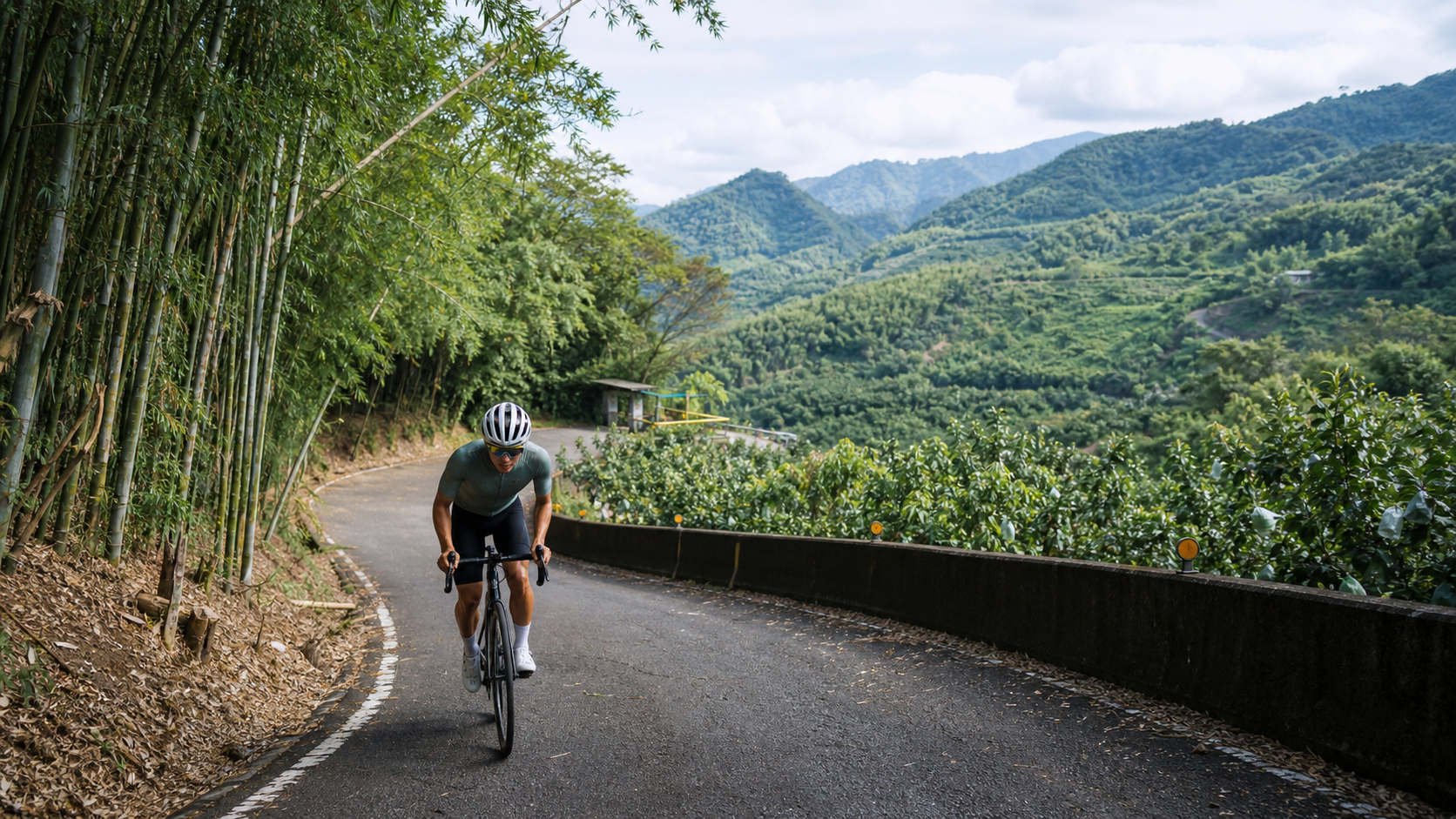
The Water Channel, a Quiet Yet Demanding Climb on the Mountainside of Zhuqi Township
A Road Named After Water
The first time I heard the route name “Water Channel” (Shuidao), the image that came to mind had nothing to do with cycling at all—I thought of irrigation canals, water diversion structures, and the hydraulic engineering projects carved out in early Taiwan’s countryside for farming or domestic water needs. It wasn’t until I actually rode it several times that I slowly came to understand why cyclists call this climbing route in Zhuqi Township, Chiayi County, by that name. It’s mostly because the route was once associated with local water conservancy and water source facilities, and the road name or colloquial term has been passed down, becoming a shared language between locals and cyclists. This kind of “named after function” road naming is actually not uncommon in Taiwan’s countryside—it often resonates more closely with lived memory than formal administrative place names, and is more easily preserved through word of mouth.
Within Chiayi’s geographical context, Zhuqi Township has always played the role of a “transition from the plains to the mountains.” Starting from downtown Chiayi and heading toward Alishan along Provincial Highway 3 or county roads, Zhuqi Township is roughly the turning point where you clearly feel the terrain begin to undulate and the air start to cool. This area was once a key node for the early Alishan Forest Railway and timber transport, as well as a必经之地 for mountain agricultural products (such as tea, bamboo shoots, and fruit) to be gathered and shipped downhill. Riding on the Water Channel road, you’ll notice orchards, tea gardens, and bamboo groves interwoven along the roadside—an atmosphere blending the breath of agricultural life with the tranquility of the mountains, a world apart from city streets.
Some routes exist for their scenery, some exist out of transportation needs; the Water Channel probably sits somewhere in between—it was originally just a local road connecting mountain settlements, but because its gradient and length happen to be ideal for training, the cycling community has given it another layer of meaning.
I’ve always felt that a route’s name often holds the most honest memory of the land it crosses. The Water Channel doesn’t have a poetic name like some tourist routes; its name is direct and pragmatic, much like the early settlers who built this road, carrying the simple purpose of solving basic needs in life. This naming logic actually makes me feel a bit more attached to the road—it didn’t exist to attract visitors, but rather grew out of the necessities of daily life, gradually evolving into what we ride today. Every time I ride this road, I can’t help but imagine how the early residents relied on it to transport goods and travel between settlements. That way of life, so intimately connected to the land, stands in stark contrast to the convenience modern people are used to—and yet it’s precisely this that gives the road an added depth worth savoring.
The name “Zhuqi Township” itself is also quite interesting. The characters “Zhuqi” (bamboo + ridge) literally refer to the bamboo groves that were once widely cultivated in the area. Because this region lies in the hilly belt between the Chiayi Plain and the Alishan Range, the climate and soil are well suited to bamboo growth, and related bamboo weaving and bamboo timber industries developed in earlier times. Although the scale of these traditional industries has changed beyond recognition with the passage of time, riding along the Water Channel, you can still occasionally spot scattered bamboo groves that remain, reminding riders of the industrial landscape this land once had.
That Deep Breath Before the Climb
Every time I come to challenge the Water Channel, I make a habit of arriving a little early. I don’t rush to get on the bike; instead, I stand at the junction for a moment, looking at the road stretching into the mountains ahead. 10.93 kilometers, average gradient 6.6%—I’ve memorized these two numbers by heart, but my mood facing this road is still different every time. Sometimes I come with a training purpose, thinking about chasing a personal best; sometimes I simply want a place to quietly work up a sweat and leave behind the noise accumulated from work and life.
The early morning in Zhuqi Township suits this mood perfectly. The air still carries a hint of the mountains’ characteristic moisture and the scent of vegetation, and occasionally you can hear roosters crowing from nearby farmhouses or dogs barking in the distance. This combination of sounds is completely different from the honking horns and engine noise of the city. Even before starting to pedal, just standing at the junction and taking a few deep breaths of this air already feels healing. I often think that many people ride to chase improvements in their numbers, but more often than not, what we truly need is this kind of temporary escape from the daily routine—and the Water Channel provides exactly such a buffer zone between the city and the deep mountains.
The moment the climb begins, the road starts to tilt gently, and the sensation in your legs immediately switches from “cruising” to “resisting.” This transition actually excites me a little every time, as if my body is reminding me: for the next ten minutes to an hour, all attention must be pulled back to this stretch of road, this gradient, this rhythm of breathing—everything else can be set aside for now.
I particularly love this moment of “switching.” When riding on flat ground, my thoughts often drift to work to-dos, unread messages, or news I didn’t finish watching last night; but once I hit the climb, the body’s instinctive survival response forces the brain to reallocate resources—you have to focus on your breathing, your cadence, and every detail of the road ahead. This forced focus is, in some ways, more direct and effective than any meditation class. No wonder so many people treat climbing as a way to decompress—because in those short ten minutes to an hour, the world truly quiets down, leaving only you, this road, and the body’s most primitive rhythm.
Scenery Along the Way and Traces of Labor
Riding on the Water Channel, what impresses me most isn’t any particular landmark, but the persistent yet ever-changing mountain scenery. Zhuqi Township’s terrain consists of low hills—not particularly high in elevation, but because it sits right at the front edge of the Alishan Range, the vegetation and climate already carry distinct mountain characteristics. As you climb, you’ll see orchards along the roadside—the Chiayi area has long been known for its fruit, with longan, lychee, and citrus crops grown on low-elevation slopes. Depending on the season, you might catch the aroma of ripe fruit by the roadside, or see farmers busy at work in their orchards.
This feeling of “passing through other people’s lives” is the biggest difference between cycling and driving. When driving by, everything outside the window is just a quickly fleeting backdrop; on a bicycle, the pace slows down, and you can truly sense the people laboring by the roadside, the crops growing, even the subtle changes in the air’s scent. Several times during climbs, I’ve encountered local farmers driving small trucks slowly downhill, carrying freshly harvested produce. We’d nod to each other in greeting—no words exchanged—but that simple, direct kindness between people in the mountains always warms my heart.
Zhuqi Township also preserves quite a few traces related to the history of the Alishan Forest Railway, given that this region was once an important corridor for timber and goods transport. Although the Water Channel route itself isn’t at the core of the railway heritage sites, riding through these mountains, it’s hard not to think of the industrial history this land carried a century ago—from logging and tea-making to today’s leisure agriculture and cycling. The same hillside has witnessed the transformation of vastly different ways of life across eras, and this layering of time over the scenery adds a dimension of historical depth to every climb.
When you reach mid-mountain and look back at the road you’ve come, you can often see the Chiayi Plain gradually unfolding below. This elevated perspective is completely different from the view of flatland life—you suddenly realize that the city where you live and work every day is just a small piece of this vast landscape. This shift in perspective is, in some ways, part of what makes climbing so fascinating: it doesn’t just train the body; it quietly broadens our spatial awareness of the environment we inhabit. On clear days, you can even see further mountain layers in the distance, one stacked upon another, presenting different shades of blue-gray as the sunlight shifts—a scene so beautiful you can’t help but want to stop and gaze a while longer, even as your legs tremble slightly from the gradient you’ve just conquered.
Self-Dialogue in Sweat
After reaching the middle section of the climb, the body enters a rather contradictory state—muscles aching, heart rate elevated, breathing rapid, yet the mind becomes unusually clear. I often find myself having a silent conversation with myself at this stage: How am I feeling today? Should I push harder? Or should I ease off a bit to protect my knees? This self-dialogue might sound a bit lonely, but it’s actually a shared experience among many long-time cyclists—climbing forces you to confront your body’s most honest responses head-on. There’s no deceiving yourself, and no escaping.
Although the Water Channel’s 6.6% average gradient isn’t the steepest route in Taiwan, its unrelenting demand for sustained effort turns every challenge into a small self-test. On good days, you might feel the road is “not that bad”; on days after a poor night’s sleep or under heavy work stress, the same gradient can feel oppressively heavy. This trait of never having the same riding experience twice is precisely why I keep coming back to challenge the Water Channel—it’s like an honest mirror, reflecting the truest version of yourself at that moment, rather than the perpetually energetic image on social media.
I remember one time riding the Water Channel during a particularly busy work period. I’d been pulling all-nighters on a project, and both mind and body were in a tense, exhausted state. I’d expected that challenge to be especially grueling, since I wasn’t in my usual physical shape, but oddly enough, that ride turned out to be one of my most memorable experiences. Perhaps because so much pressure had built up inside, the process of climbing—each pedal stroke, each drop of sweat—slowly became a kind of release. By the time I reached the top, my legs were so sore I could barely stand, but the pent-up irritability that had been gnawing at me had, strangely, dissipated by more than half. After that ride, I began to understand that for some people, climbing has long transcended the meaning of mere athletic training—it’s more like a ritual for processing emotions and making peace with oneself.
I’ve also had the complete opposite experience—once, in peak form after finishing a structured training block, I came to challenge the Water Channel with full confidence, expecting to easily set a new personal record. Instead, I hit a headwind mid-climb, and with unseasonably hot and humid weather, the entire ride was far harder than expected. That experience taught me a profound lesson: even when the data shows you’re in good shape, uncontrollable external factors like weather and wind can dramatically affect actual performance. This is what makes cycling both captivating and punishing—you can never fully predict what challenges you’ll face on any given day; you can only prepare as best you can and adapt on the road.
By the time I reach the final stretch near the summit, energy is usually running low, and that’s precisely when willpower needs to step in. I’ve noticed I often think of completely unrelated things to distract myself—maybe a melody, a phrase, or simply counting my breathing rhythm. This kind of wandering mind at the limits of exertion is, in a way, a psychological defense mechanism, keeping the brain from fixating solely on pain signals. When the summit finally comes into view, that complex surge of fatigue and accomplishment washes over you, and you momentarily forget how hard it was just moments ago, thinking only, “I’ll be back for more next time.”
What a Mountain Road Means to City Dwellers
For people who live long-term in urban environments, mountain climbing routes like the Water Channel offer an experience that’s hard to replace by any other means. City life moves fast, information overload is constant, and our attention is often fragmented—we juggle many things at once but rarely get the chance to truly focus on a single bodily sensation. Climbing is the opposite—you can’t scroll through your phone while climbing, and you can’t multitask. This forced focus becomes a rare psychological breathing space for modern people.
Unlike the main Alishan route, Zhuqi Township isn’t heavily touristed. There are no endless streams of tour buses or vendors; it retains a relatively simple, rustic countryside character. Precisely because of this, riding on the Water Channel rarely carries that atmosphere of being “on display” or “consumed” that you find in tourist areas. Instead, there’s a more direct, more genuine sense of connection with the land and its people. This feeling is hard to describe precisely in words, but I believe every cyclist who has personally ridden this road will, at some moment, experience something similar.
I know some local cyclists who have ridden in the Zhuqi area for years, and their feelings toward the Water Channel are quite different from mine as an occasional visiting rider. For them, this road is almost part of daily life—maybe a weekly fixed training menu, maybe a routine route to unwind after work. One person even told me that as a child, he used to play on these mountain roads, and returning as an adult on a bicycle to rediscover this familiar land created a strange sense of time overlapping. Listening to them share these stories, I often think about how the same route can carry such different meanings for different people—some challenge their limits here, some rediscover childhood memories, and some simply treat it as a daily commute-and-exercise route. This layering of multifaceted meaning is also why I find the Water Channel particularly worth writing about.
The Water Channel Through the Seasons
Most climbing routes in Taiwan have distinct seasonal personalities, and the Water Channel is no exception. In summer, the Water Channel is hot and humid; sweat flows almost nonstop from the very start, but precisely because of that, the exhilarating sense of relief after completing the challenge is especially intense. In autumn and winter, mountain temperatures cool down, allowing you to focus more on pacing and breathing rhythm without being drained by the heat. Spring is the season when fruit and crops begin to sprout, the greenery along the roadside is especially vivid, and occasionally you catch a faint floral fragrance mingling with the mountain air.
Visiting the Water Channel in each season yields completely different sensory experiences—which is why many local cyclists, even after riding this road dozens of times, are still willing to return again and again—because every visit to the Water Channel is never quite the same.
I particularly enjoy visiting this road right after a rain has cleared. After a downpour in the Zhuqi mountain area, it’s as if all the dust in the air has been washed away; visibility becomes exceptionally clear, and the ridgelines of distant mountains appear especially sharp. Riding the Water Channel at such times—though the road surface may still be slightly slick and require extra caution—the fresh scent of vegetation after the rain’s nourishment, mixed with the damp smell of earth, adds an indescribable healing quality to the entire ride. That’s why I’ve never felt that imperfect weather makes a ride not worth doing—rather, it’s these ever-changing weather conditions that make each memory of challenging the Water Channel unique, impossible to replicate, and impossible to forget.
Riding Solo, or Riding with a Group
A route like the Water Channel offers completely different experiences whether you ride it alone or with a group. When challenging it solo, the entire journey becomes almost an inner monologue—no one to share the scenery with, no one to cheer you on—but precisely because of that, the feeling of being fully immersed in your own rhythm is especially intense. Every breath, every heartbeat belongs only to you. On the other hand, if you gather a few friends to tackle it together, encouraging each other along the way, sharing observations and feelings, then sitting by the roadside catching your breath and chatting after reaching the summit—that camaraderie forged through shared hardship is also a precious experience that solo riding can’t replicate. I’ve tried both approaches myself, and it’s hard to say which is better. Rather, I find that alternating between different riding styles according to my current mood allows the Water Channel to keep offering me fresh experiences.
Nearby Suggestions and Conclusion
After conquering the Water Channel, if your energy allows, consider lingering a while in Zhuqi Township to explore the surrounding country lanes and local food stalls, soaking in the distinctive pace of life in this transitional zone between the plains and Alishan. For specific shops and attractions, please refer to on-site conditions and local business announcements, as rural establishments’ opening hours and offerings often adjust with the seasons and farming schedules. Visiting in person and chatting with locals often yields unexpected rewards—one of the greatest joys of exploring a place by bicycle.
The Water Channel isn’t a famous landmark that appears on travel book covers. It’s more like an interlude in the mountains that only cyclists can truly appreciate—quiet, unassuming, yet quietly leaving its own stories with every pedal stroke. If you, too, are tired of the city’s perpetual clamor, find a clear-weather day, come to Zhuqi Township, and let the Water Channel accompany you as you pedal away the noise in your mind, bit by bit.
Writing this, I recall the feeling of sitting by the roadside after each ride, drinking water and resting, gazing at the hillside before me. Zhuqi Township won’t become noisy and crowded just because a few articles have introduced it. It will continue at its own pace, day after day welcoming the farming seasons, welcoming the occasional visiting cyclist, and welcoming every afternoon thunderstorm that arrives unannounced. This kind of place—undisturbed by the outside world, operating on its own rhythm—is becoming increasingly rare and increasingly precious in today’s era of information overload and the demand for rapid exposure.
If you ask me whether the Water Channel is worth a special trip to challenge, my answer will always be yes—not because its gradient is astonishing, nor because there are must-visit photo spots along the way, but because it offers a very pure cycling experience: a stretch of mountain road, a stretch of sweat, a stretch of time for self-dialogue. This kind of experience may never appear in any tourism marketing copy, yet it might be the feeling most cherished deep in the hearts of every true cycling enthusiast. May every rider who reads this find their own Water Channel, or their own mountain road within, and through pedaling, rediscover the truest version of themselves in life.
Related Reading
- The Complete Guide to Chiayi’s Water Channel Climb: A 10.93 km, 6.6% Average Test in Zhuqi Township
- A Rolling Road Through Coffee Aromas: A Cyclist’s Private Memories of the Dongshan Coffee Highway
- 36 Curves, 36 Conversations with Yourself: The Roadside Marvel and Riding Philosophy of Meishan’s 36 Bends
- Riding into the Landscape of Xindian: The Southern Side of Shitou Mountain, a Climb Alongside the Xindian River
半日 小台灣 極限單車路線挑戰實錄
7 年前
高雄綠園道鐵路自行車道 / 外地人能輕鬆駕馭 還是整路崩潰? / 2025 全線開通 春節實地探索一次!(附GPS連結)/ 公路車 / CT Yeh
1 年前
嘉義大埔、阿婆灣挑戰賽,美到以為在日本!ft. 環騎5 Cool 西拉雅188 / 公路車 / CT Yeh
7 個月前
4K單車實境) 嘉義 梅山36灣 訓練台 爬坡 輕鬆騎
6 年前
虎豹潭!日本老師來台一日約騎 台灣車友熱情招待私房路線 / CT Yeh
21 天前
藤枝二集團 單車行 Day1 | 南部小武嶺 | 爬坡爬到罵罵叫 | JJSC | 公路車 | CT Yeh
3 年前
單車 梅山36灣 坡度介紹 路段介紹 空拍 (相關遊記影片,請參考說明或我的頻道喔,歡迎訂閱)
6 年前
大武山後門26%歡樂陡坡!JJSC南台灣單車行Day2 / 被颱風追著跑 / 公路車 / CT Yeh
2 年前