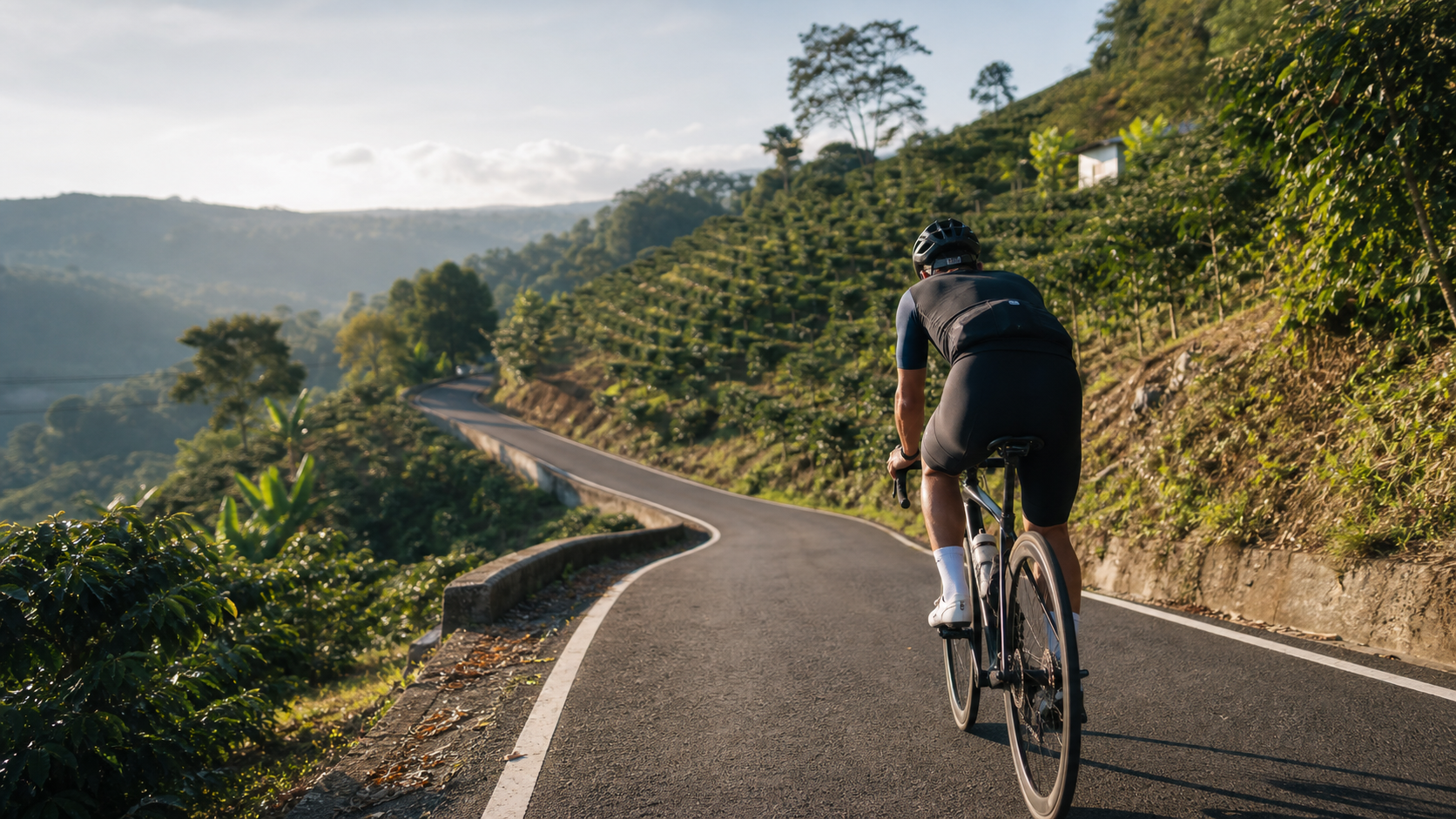
A Road Hidden in the Scent of Coffee
If you ask me what’s most captivating about the Dongshan Coffee Road in Zhongpu Township, Chiayi County, I wouldn’t start with the numbers—though as a rider who habitually records everything with a cycling computer, I’m well aware of the objective facts: 16.41 kilometers long with an average gradient of 3.9%. But what truly draws me back here time and again is the aroma of coffee drifting from both sides of the slopes, mingled with the scent of earth. The Dongshan area of Zhongpu Township sits on the western foothills of the Alishan mountain range, where mountains and plains each occupy roughly half the land. This topography happens to fall perfectly within the altitude and climate zone that coffee trees prefer—no wonder Dongshan coffee has become a frequently mentioned crop on the local agricultural specialty list. I must be honest: regarding the exact origins of coffee cultivation in Dongshan and who first promoted it, I couldn’t find a universally accepted authoritative version—accounts vary slightly from source to source. On this matter, I’d recommend deferring to the official statements from the local farmers’ association or coffee estates. I don’t intend to fabricate a moving but unverifiable story here. What I can confirm, however, is that this hilly region has indeed nurtured a tradition of smallholder coffee farming, and this road is the physical thread that ties it all together.
I’m somewhat embarrassed to admit that when I first heard the name “Dongshan Coffee,” my initial thought was actually the Dongshan District in Tainan—after all, Tainan’s Dongshan coffee has gained considerable fame through promotion in recent years, and when most people hear “Dongshan” paired with “coffee,” their instinct is to think of Tainan. It wasn’t until later that I figured out this refers to the Dongshan area within Zhongpu Township, Chiayi County—a completely different place from Tainan’s Dongshan District. They just happen to share the coincidence of both having developed their own coffee industries thanks to similar hilly terrain and climatic conditions. This “same name, different place” coincidence, to some extent, reflects the geographic reality that the hilly regions of central and southern Taiwan are broadly suitable for coffee cultivation—more than one hillside can grow its own coffee story. Precisely because this information is so easily confused, I spent considerable time before writing to verify the route’s actual geographic location and administrative boundaries, to avoid mixing things up and misattributing unrelated stories to this route.
From the Chiayi Suburbs into the Heart of the Hills
On the day I first rode this road, I set out from downtown Chiayi. The urban clamor quickly faded once I crossed the Zhongpu Township boundary, replaced by gradually opening rural vistas—betel nut groves, bamboo forests, and the occasional neatly trimmed tea plantation or orchard. This is the most direct visual representation of Zhongpu Township’s “half mountain, half plain” topography. When I turned onto the Dongshan Coffee Road, the gradient was still gentle, the asphalt surface glistening faintly under the morning sun. Occasionally I’d spot crops laid out to dry by the roadside, and the air carried a mixture of earth and vegetation—a scent that’s hard to describe precisely in words, but every time I catch it, I unconsciously slow my breathing, as if trying to hold a little more of that fragrance in my lungs.
As the kilometers accumulated, the road began to climb, and the landscape on both sides gradually transitioned from lowland crops to the fruit trees and coffee shrubs typical of hillside terrain. I remember around the six or seven-kilometer mark that day, the sunlight happened to pierce through the gaps between coffee leaves, casting dappled light and shadow across the road. I stopped to take a photo—no post-processing whatsoever—yet the naturally formed layers of light and shadow were more striking than many filter effects I’ve seen since. These are moments that no data or route guide can convey—you have to physically place yourself in that moment to truly understand.
During the ride, I developed a habit: at regular intervals, I’d deliberately slow down, even come to a complete stop—not because I was running out of energy, but to give myself a legitimate reason to “be allowed to stop and admire the view.” Urban life always urges you forward—traffic light countdowns, commute schedules, to-do lists—everything reminds you that you can’t stop. But on this hill road, aside from the occasional farm vehicle passing by, almost nothing urges you onward. I once stopped at a wide-open bend, gazing at the layered mountain ridges in the distance and the neatly arranged coffee gardens nearby. In that moment, it suddenly struck me that “scenery” perhaps was never about those postcard-style grand vistas, but rather these everyday moments that make you willingly slow down and take a second look.
Coffee and Hills: An Industry Memory Built Slowly
In Taiwan’s coffee industry landscape, Gukeng in Yunlin has long occupied the public’s first impression of “Taiwanese coffee” thanks to early promotion and loud marketing. But in reality, the Zhongpu area of Chiayi possesses equally similar geographic and climatic conditions. Dongshan coffee has always held its place on the local agricultural specialty list—just relatively low-key, never pushed into the spotlight by large-scale tourism marketing. I think this “low-key” quality is precisely what makes it most charming—when you ride along this road, the coffee gardens you see on both sides are mostly smallholder operations, not the kind of display farms deliberately built for tourists. What you see and smell is a relatively authentic, unpolished picture of the industry.
During my ride, I once spotted a few farmers pruning coffee tree branches by the roadside. Their focused, repetitive labor reminded me of a certain “mechanical” rhythm I enter during long rides—cadence, breathing, heart rate, layering one revolution after another. In a sense, farming and long-distance cycling share a similar philosophy of patience: neither is accomplished through a burst of explosive effort, but through day-after-day, seemingly monotonous repetition that accumulates into results. I didn’t interrupt their work—just watched from a distance for a while, quietly absorbing that grounded atmosphere of land and labor, before continuing to pedal deeper into the mountains. Specific estate names and whether they’re open to visitors change over time; for riders interested in a deeper experience, I’d recommend checking directly with local coffee estates or the Zhongpu Township Office for the latest information. I don’t want to list establishments that may have already closed or have outdated information, potentially misleading fellow riders who want to make a pilgrimage there.
Beyond coffee, Zhongpu Township is also known for black fungus, camellia oil, reishi mushrooms, and shiitake mushrooms—the agricultural landscape of this hilly region is far more diverse than outsiders might imagine. Riding along this road, you’ll see coffee trees, betel nut groves, and bamboo forests growing in intermingled patches. This mixed-cropping landscape, to some extent, reflects the pragmatic attitude of local farmers who continuously adjust their planting strategies in response to market and climate changes—coffee may be the more prominent emerging crop in recent years, but it hasn’t replaced the original agricultural patterns; rather, it’s been layered into and integrated with the existing industrial fabric. This coexistence of diversity, rather than dominance by a single crop, makes the riding experience along the entire route all the richer—every kilometer or two, the scenery shifts subtly, without that monotonous, repetitive fatigue.
Solitary Moments on the Slopes
The middle section of the route, where the gradient noticeably steepens for a few kilometers, is actually my favorite part of the entire road—not because it’s easy, quite the opposite, precisely because it’s hard enough to leave me no spare mental capacity for work or the trivial annoyances of life. All my attention gets funneled into breathing and cadence. For me, long-distance riding is, to some extent, a deliberately chosen “single-task mode.” In this era of information overload where multitasking has become the norm, being able to spend time with my brain focused on just one thing—finishing the climb ahead—becomes a luxurious form of relaxation.
That day, when I reached the middle section, I happened to encounter a gentle breeze carrying the distinctive coolness of the mountains across my sweat-soaked neck. That instant of relief is something you could never experience in an air-conditioned room. I laughed out loud between breaths—not because something was funny, but because it was a primal, almost instinctive joy that surfaced naturally when the body is pushed to a certain threshold. I think this is why so many people, knowing full well how grueling climbs can be, still choose to return to these mountain roads again and again—the line between pain and pleasure here is far blurrier than one might imagine.
Over time, I’ve come to understand and appreciate why so many seasoned riders say that climbing is the form of exercise through which you truly get to know yourself. On flat roads, you can rely on team drafting, favorable winds, or various shortcuts to mask your true fitness level—but gradients don’t lie. Your current cardiovascular capacity, muscular endurance, and even mental resilience are all honestly reflected in every single push of the pedals. That day, on the steepest stretch of the middle section, I briefly considered getting off and walking, but I managed to push through those most agonizing few hundred meters by forcing my attention onto coffee leaves, onto the stray dogs occasionally poking their heads out by the roadside, onto anything unrelated to “my legs are burning.” Looking back after cresting the climb, I realized that experiences of “almost giving up but pushing through anyway” tend to stay in your memory far more vividly than rides completed with ease.
The Four-Season Scenery of the Rolling Hills
The hill country where the Dongshan Coffee Road runs actually offers a surprisingly rich variety of scenery across the seasons, just not as dramatic as what you’d find in the high mountains. In spring, you can occasionally spot coffee trees blooming on the slopes, with small white flowers dotting the deep green foliage. If your timing happens to be right, you might catch this sight, but the blooming period varies with climate and elevation, so it’s best not to plan your trip around a fixed date. Leave some flexibility for nature’s unpredictability. Summer in the hills presents a different face entirely—the chance of afternoon thunderstorms rises, and the sight of clouds piling and churning over the distant ridges is well worth stopping to admire. That said, for safety’s sake, it’s still advisable to keep an eye on the weather forecast and avoid lingering on exposed stretches when a storm is approaching.
In autumn and winter, the humidity over the Chianan Plain drops, and visibility often improves compared to summer. I once rode this road on a November morning, and the distant Chianan Plain appeared and disappeared through the thin mist. That layered visual effect made me pause on the hillside for nearly ten minutes, just to watch the fog gradually dissolve as the sun rose. These kinds of “unexpected bonus” views are something no amount of careful planning can guarantee, and precisely because of that, every ride up this familiar route still holds the potential for a brand-new experience.
Perhaps this is why I especially enjoy riding the same route repeatedly across different seasons—many people chase a “check-in and collect” style of riding, ticking off a route after a single pass and moving on to the next new goal. But the Dongshan Coffee Road taught me a completely different way of experiencing things: the same road, ridden in different seasons, different weather, or even different moods, reveals an entirely different character. Riding in summer, you feel the almost oppressive humidity, the intense sun, and the vigorous vitality of the crops under that harsh light; riding in winter, you get comparatively drier air and sharper silhouettes of the distant mountains. This experience of “repetition without repetition” echoes, in a way, the logic of how crops themselves grow—the same piece of land yields completely different appearances and harvests across the four seasons, and only if a rider is willing to visit again and again do they have the chance to truly read the full story of a place, rather than snapping a photo, collecting a landmark, and rushing off.
What This Road Means to Me
I started riding this route regularly probably because it’s not too far from the city, yet in a relatively short time it lets me shift from the urban pace to the slower rhythm of the hills and forests. It’s not like Wuling, which demands all-out planning and a full day or even several days to complete the challenge. It’s more like an old friend who’s always ready to meet up—whenever you want, you can hop on your bike and, in an hour or two, reconnect your body with this land.
For modern people who live in the city and have their attention hijacked by screens and notifications, I think a route like this—one that’s always accessible yet still retains a genuine sense of place—is actually more precious than those famous destinations that require a long journey to reach. The Dongshan Coffee Road has no breathtaking landmark that leaves you speechless, no Instagram-worthy photo wall. What it has is honest gradients, sincere rural landscapes, and, behind every cup of coffee, the stories of the local people who work the land quietly.
I’ve also gradually come to realize that my attachment to this route is, in some ways, similar to the nature of coffee itself. From a single seed to a fully brewed cup with complete flavor, coffee must go through planting, harvesting, sun-drying or washing, roasting, and a series of time-consuming processes that demand patience—none of which can be rushed. And riding this climbing route offers no shortcuts either: you can’t rely on a burst of adrenaline to skip the breathless steep sections in the middle; you can only maintain a steady, consistent cadence and grind out the kilometers one turn of the crankset at a time. Perhaps it’s this shared quality of “can’t be rushed” that creates an indescribable resonance between coffee and this road in my mind. Every time I take a sip of locally grown coffee, I can’t help but think of those gasping yet strangely lucid moments on the climb, and the two intertwine to form my most vivid memory of the Dongshan area in Zhongpu Township.
What Sets It Apart from Other Popular Routes
Chiayi County actually offers quite a few cycling route options. To the east, there’s the Alishan Highway, a nationally renowned climbing route; to the south, there are the lake-loop routes around Dapu and Tsengwen Reservoir. By comparison, the Dongshan Coffee Road is far more low-key. It lacks the epic difficulty of the Alishan Highway, with its tens of kilometers and over 2,000 meters of elevation gain, nor does it have the grand lake-and-mountain scenery of the reservoir loops. But precisely because of this “neither here nor there” positioning, it unexpectedly fills a gap in the market—for riders who want to experience the joy of climbing but aren’t yet ready to take on a truly big mountain, the Dongshan Coffee Road is an ideal training ground and transitional route.
Several riding buddies I know started building their climbing confidence on this route, confirming that they could maintain a steady rhythm on a mid-to-long-distance gradual ascent before gradually taking on harder routes. This “easy first, hard later, step by step” approach to route planning actually mirrors a basic principle in many training programs: rather than tackling a high-difficulty goal you’re not yet capable of, it’s better to build confidence and foundational ability in a relatively forgiving environment first, then gradually increase the load. The Dongshan Coffee Road, in a sense, plays exactly this role of “entry-level yet still challenging.” It lets riders genuinely experience the test that a long climb puts on their lungs and willpower in a relatively safe environment with light traffic, without being so difficult that they get discouraged and give up on their first attempt.
Suggested Add-Ons: Combining Riding with Cultural Experiences
If you’re planning a ride centered on the Dongshan Coffee Road, I’d suggest setting out on a holiday morning, completing the main climbing sections before the temperature peaks. After the ride, if time and energy permit, consider stopping by some local coffee shops in Zhongpu Township to taste a cup of locally grown and roasted coffee—since business information changes over time, it’s best to check online or ask local friends before you go to confirm which shops are still open and convenient for cyclists to stop at, rather than relying on outdated information from years ago.
Beyond coffee itself, Zhongpu Township also has cultural attractions like the Siraya National Scenic Area and Wu Feng Temple. If your energy and schedule allow, you could extend the trip to include nearby hot springs or agricultural creative parks, turning the ride into not just a physical challenge but also a small journey of discovering the cultural landscape of Chiayi’s hills. Spaces like the Zhongpu Granary Agricultural Creative Park, which combine agriculture with cultural and creative exhibits, are also worth noting as part of the recent wave of local revitalization. They work well as a final stop on a riding itinerary, offering a chance to rest and learn about local products—though actual opening hours and exhibits should be confirmed with official announcements. If time permits, the hot spring resources in Zhongpu Township are also worth experiencing along the way. After finishing a physically demanding climb, soaking in a hot spring to soothe tired muscles has almost become a fixed closing ritual for me.
I often feel that a route truly worth revisiting shouldn’t be just a one-time physical challenge. It should be like an old friend—as your own life stage changes, each meeting reveals something new. When I first started riding this road, my mind was full of numbers: pacing, heart rate, gradient percentages. Later, as I rode it more often, I began to pay more attention to the small changes along the roadside—the coffee trees’ leaves are denser than last time, a turn’s view is partially blocked by newly planted crops, the humidity in the air feels different from the last ride. These small observations, pieced together, are what “getting to know a route” truly means to me—far more profound than simply setting a new personal best. After all, for me, cycling has never been just about chasing speed and numbers; it’s a way of reacquainting myself with a place in the most grounded manner possible—and the Dongshan Coffee Road is exactly the kind of route worth slowing down for, savoring carefully, and returning to again and again.
Related Reading
- Dongshan Coffee Road Practical Guide: 16.41 km, 3.9% Average Grade—The Ideal Endurance Training Choice
- A Climb Scented with Coffee: Gukeng Huashan Dahu Di, a Riding Memory Through the Birthplace of Taiwanese Coffee
- Cycling Café Culture: Routes to Bike-Friendly Coffee Shops Across Taiwan
- Shuidao, a Quiet but Demanding Climb on the Hillside of Zhuqi Township
大武山後門26%歡樂陡坡!JJSC南台灣單車行Day2 / 被颱風追著跑 / 公路車 / CT Yeh
2 年前
太平山單車員工旅遊 | 這樣玩CP值最高!| 公路車
5 年前
那瑪夏x茶山 阿里山系深山單車行 Day2 累積爬升6000M | 🥶超陡連續下坡 整路看隊友刷 | 爬升一座西進武嶺 | JJSC | 公路車 | CT Yeh
3 年前
一定要騎一次!阿里山最深處:里佳部落!單車旅行 | 2800m爬升 | 深度部落體驗:嗨翻晚會、螢火蟲、銀河 | feat. JJSC & 廢物伙伴 | 公路車 CT Yeh
9 個月前
藤枝二集團 單車行 Day1 | 南部小武嶺 | 爬坡爬到罵罵叫 | JJSC | 公路車 | CT Yeh
3 年前
台中大雪山 膏王領騎 震到都沒畫面了 公路車
5 年前
高雄綠園道鐵路自行車道 / 外地人能輕鬆駕馭 還是整路崩潰? / 2025 全線開通 春節實地探索一次!(附GPS連結)/ 公路車 / CT Yeh
1 年前
里佳部落 阿里山單車深度旅遊! | 竹山/草嶺/來吉/奮起湖 | 無敵銀河絕景 全新路線探索! 驚險狀況百出! | 4K沉浸式畫質 | 公路車 | CT Yeh
3 年前