The Windy Saddle: Riding Up Fengguizui, the First Milestone for Every New Taipei Cyclist
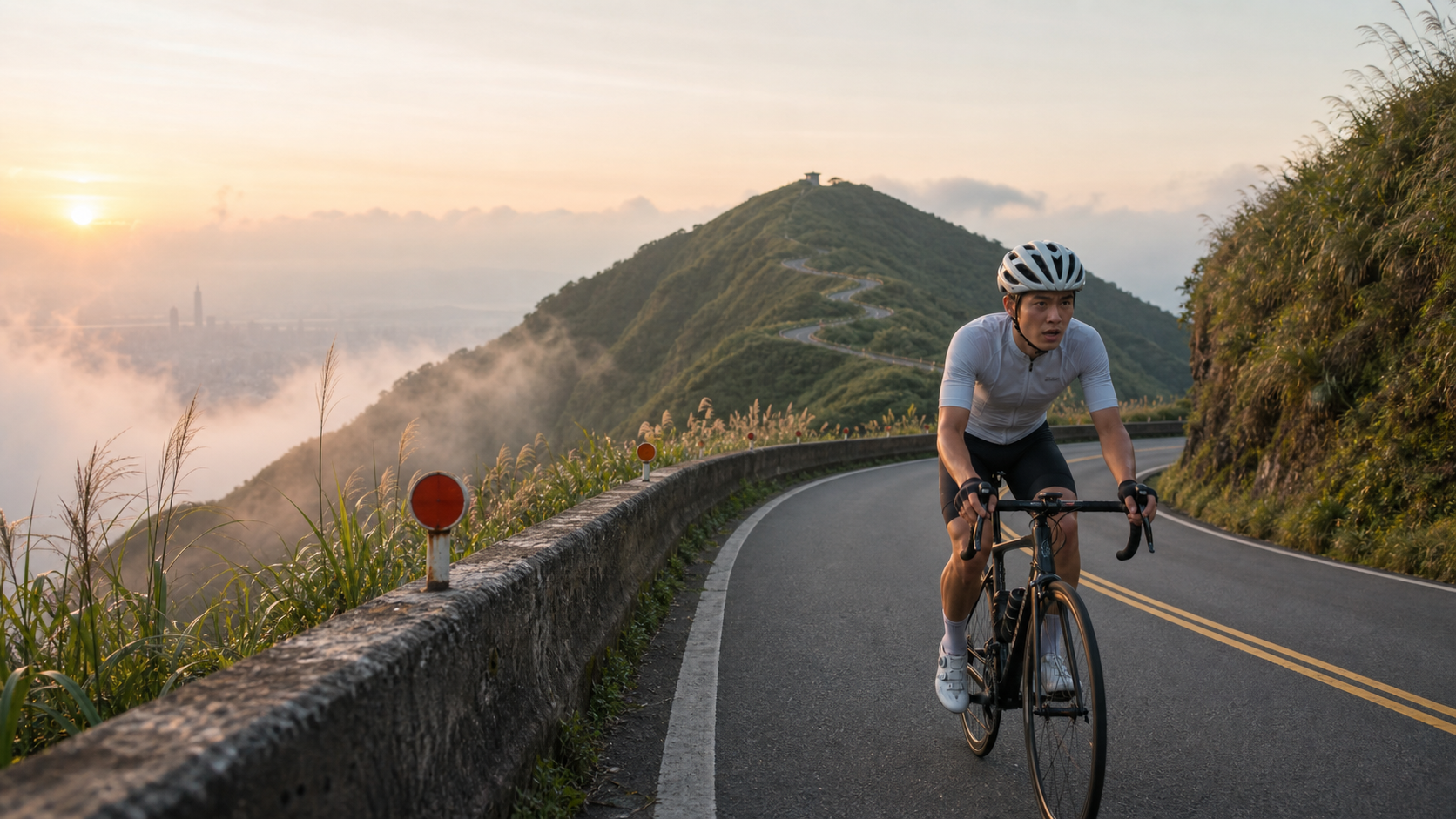
At 5:30 in the morning, with the sky not yet fully light, I filled my water bottle and wheeled my bike out the door. Today’s destination was Fengguizui—a name that, for Taipei’s cycling community, is almost synonymous with “climbing.” It sits at the boundary between Xishan Village in Shilin District and Wanli District in New Taipei City, on the edge of Yangmingshan National Park, a ridge saddle between Xiangdui Mountain and Neishuangxi Mountain. The distance isn’t long—6.13 kilometers—but the elevation gain is 410.8 meters, with an average gradient of 7.2%. For anyone attempting it for the first time, those numbers alone are enough to constitute an entire morning of mental preparation.
A Saddle Chosen by the Wind
To understand Fengguizui, you first have to understand the origin of the word “fenggu” (wind box). According to the older generation, the terrain here resembles the “fenggu”—a bellows used to stoke fires in blacksmith shops in the old days. It’s a device powered by human effort to fan the flames, with a narrow, concentrated outlet that makes the wind exceptionally strong. Applied to the terrain, Fengguizui refers precisely to such a “narrow and concentrated” wind outlet: mountains flank both sides, leaving a saddle-shaped passage in the middle. Whether the northeast monsoon is entering the Taipei Basin or the southwest monsoon is crossing out, nearly all airflow must pass through this single channel.
As a result, no matter the season, Fengguizui has wind almost year-round. In winter, the northeast monsoon pours through here into the basin, carrying damp, cold moisture; in summer, the southwest air current flows out in the opposite direction, carrying away the basin’s stifling heat. This geographic position—where all airflow must pass through—makes Fengguizui a very special presence both meteorologically and topographically. It isn’t just a mountain peak; it’s a vent in the respiratory system of the entire Taipei Basin.
At 597 meters above sea level, the saddle doesn’t sound particularly high at first, but the wind you feel standing there often makes you reassess the meaning behind that number. The funneling effect of the terrain compresses the wind here, making it more concentrated and more forceful—which is why so many cyclists on their first summit are deeply impressed by that sudden crosswind. This kind of geographic knowledge might normally be just a passage in a textbook, but when you’re actually standing on the ridge, nearly blown off your feet, you truly understand the weight of the phrase “terrain determines climate.”
I often think that a mountain peak being given such a life-filled name is itself a rather romantic thing. It wasn’t named with academic geographic terminology, but rather compared to the most familiar tool in our ancestors’ daily lives—this naming approach reveals a kind of down-to-earth observational skill. The early residents must have stood on this saddle countless times, feeling a wind stronger than anywhere else around, and only then thought of the bellows fanning the forge fire in a blacksmith shop. This kind of place name, distilled from lived experience, conveys the character of the place more precisely than any ornate rhetoric. Every time I ride up here, I imagine that perhaps hundreds of years ago, someone else led livestock or carried shoulder poles, laboriously crossing this saddle, feeling the same wind—only their purpose wasn’t leisure sport, but the necessities of life, traveling back and forth between the two sides of the mountain.
Starting from Fenglin Bridge: The First Breath of Dawn
I parked my bike near Fenglin Bridge, at an elevation of about 182 meters—the usual starting point for most riders. Dawn had just broken, and the mountain air still carried the night’s moisture, with a crisp, cool sensation as it filled my lungs. I took two deep breaths before mounting, glanced at my cyclocomputer reset to zero, and set off.
For the first 1.5 kilometers, the gradient sits directly at 5–8%, with no buffer whatsoever. I remember the first time I rode this route—within less than ten minutes of pedaling, my thighs began to send that familiar ache, and my breathing shifted from a steady rhythm to short, rapid gasps. That feeling is honest—your body quickly tells you whether today’s preparation was sufficient.
On the shaded road sections in the early morning, sunlight hasn’t yet fully filtered through, the pavement carries a dampness from the dew, and occasionally the calls of early-rising birds cut through the quiet air. At times like this, cycling isn’t just a physical challenge; it feels more like a process of dialogue with yourself. Every pedal stroke is a negotiation with the version of you that stayed up late the night before, that usually skips exercise; every gasp reminds you that on this road today, there are no shortcuts.
The silvergrass and miscellaneous trees along the roadside sway gently in the breeze, and occasionally you can hear the faint sound of other early-rising cyclists shifting gears in the distance—so at this hour, quite a few people on the mountain are already like me, choosing to greet the day with pedal strokes. This unspoken understanding, in a way, is one of the warmest parts of Taipei’s cycling culture: strangers who, because they share a love for early-morning mountain roads, momentarily fall into a shared rhythm.
Along the way, you encounter several switchbacks, where the gradient seems especially fond of playing tricks on you—just when you think you’ve found your rhythm, the slope steepens slightly after the next bend, forcing you to readjust your breathing and cadence. This continuous process of fine-tuning is actually the most fascinating part of climbing: it isn’t a monotonous repetition, but an ongoing dialogue and negotiation between body and terrain. Every cadence adjustment, every brief stand-up sprint, is reaching a temporary truce with the slope ahead. Over time, I’ve gradually developed a habit: I stop looking at the numbers jumping on the cyclocomputer and instead focus on the signals my body sends—the level of ache in my thighs, the depth of my breathing, the rhythm of my heartbeat. This way of riding—letting go of numbers and returning to bodily sensation—is perhaps the real lesson climbing has taught me.
The Ridge View: The First Reward After the Effort
Once you push through the early steep sections, the route gradually transitions to rolling terrain—a stretch of easy, a stretch of steep, alternating repeatedly. At this point, the view slowly begins to open up; the dense forest gives way to gaps, and the contours of distant valleys gradually emerge. I like to slow down slightly on this section, not because I’m running low on energy, but because I can’t bear to miss this transition of scenery—that shift from “surrounded by trees” to “gradually opening views” unfolds like a slow overture, hinting at the moment of reaching the summit.
When the wheels finally roll over the last stretch of slope, the saddle’s wind hits you in the face without warning. In that instant, you truly understand why this place is called “Fengguizui”—not from descriptions in literature, but from the strong, terrain-compressed wind your body genuinely feels. Standing on the 597-meter ridge, you can gaze out over the layered scenery of the Taipei Basin and surrounding valleys. On clear days, looking northeast, there’s even a chance to see as far as the coastline beyond—that sense of openness makes all the gasping and aching from before instantly worth it.
Some cyclists describe the wind at Fengguizui not as “blowing past you,” but “blowing through you”—because of the terrain, the wind here carries an unapologetic directness, as if it made a special detour just to give you a hearty welcome the moment you reach the summit.
The first time I arrived at the saddle, that gust of wind nearly knocked me backward; I scrambled to steady my handlebars, feeling both startled and delighted—startled because the force far exceeded my imagination, delighted because I had truly pedaled my way to this place famous for its wind on my own two legs. That expression, a mix of gasping and laughter, is probably the shared portrait of everyone who summits Fengguizui for the first time.
The Mountain-Top Chicken Farm and Local Life
After reaching the summit, there are a few chicken farm restaurants around Fengguizui where many cyclists and motorcyclists habitually stop after completing the challenge. Ordering a bowl of hot soup, paired with freshly prepared mountain-style side dishes, sipping water while watching other riders arrive one by one and exchanging nods of acknowledgment—this unspoken camaraderie is a unique sense of community found on Taipei’s climbing routes. Though strangers to one another, having conquered the same climb and endured the same wind, they share a kind of “fellow recruit” familiarity.
This local food culture, to some extent, carries on Fengguizui’s long-standing character as a transportation hub. In the era before cable cars and highways were developed, such a saddle terrain was naturally a必经之路 between settlements, and it was only natural that simple food and rest stops gathered at the mountain top. Today, although most who pass through are recreational riders on bicycles, scooters, or cars out for a drive, the rhythm of life—“cross the mountain, catch your breath, have something to eat, then continue on”—seems never to have truly changed.
Sitting on the plastic chairs at the chicken farm, watching the steam rise from the soup on the table, overhearing riders at the next table excitedly discussing their completion times or complaining about how brutal the early slopes were—this scene plays out almost every weekend at the mountain top. This unpretentious rest culture, with no fancy decor and no elaborate plating, is nonetheless the most healing summit ritual in the hearts of many riders.
I particularly enjoy observing the convergence of different generations and groups at these mountain rest stops. Young road bike enthusiasts in brightly colored racing jerseys might be sitting right next to heavy motorcycle riders in leather jackets astride vintage manual-transmission bikes; on weekends, families driving up for a spin watch their children run and jump in the courtyard, while a few silver-haired folks in the corner sip tea and chat about stories from mountain roads they’ve ridden countless times. Fengguizui is like a natural social arena, briefly bringing together people whose life paths would never otherwise cross—united by the same mountain, the same wind. This simple yet genuine warmth of human connection is, alongside the physical challenge, one of the things I treasure most every time I ride up here.
The Starting Point of the Grand Traverse: Extending from Cycling to Hiking
Fengguizui is not only the endpoint of a cycling route but also the starting point of Section 4 of the “Taipei Grand Trail” hiking system. The trail from here leads all the way to Daluntou Mountain, Baishihu Suspension Bridge, Dagouxi Waterfront Park, and finally to Neihu’s Dahu Park, spanning about ten kilometers—one of the few long-distance trails in the Taipei suburbs that connects mountain scenery in one continuous stretch.
Although the cycling route itself doesn’t pass through hiking sections like Baishihu Suspension Bridge, many riders who complete Fengguizui will park their bikes at the summit and walk a short section of the Grand Trail, experiencing the shift in rhythm from “measuring the mountain by cadence” to “feeling the forest with your feet.” This connection, in a way, reflects the unique nature of Fengguizui—it is simultaneously the endpoint of a cycling route and the starting point of a hiking trail, like a crossroads that brings together people who pursue different forms of exercise.
One afternoon when I still had plenty of energy left, I locked up my bike and walked a short way along the trail entrance. The trail’s rhythm is completely different from cycling—no need to worry about cadence or shifting gears, only the focus on feeling the ground beneath your feet and the changing vegetation around you. That experience of switching exercise modes unexpectedly became another way to relax both body and mind, beyond riding itself. Perhaps this is also what makes Fengguizui special—it doesn’t just serve the recreational needs of a single group, but gathers cyclists, hikers, motorcyclists, and even ordinary folks driving up for a scenic ride, all at the same saddle, sharing the same view and the same wind.
A Newcomer’s First Milestone
In the development of Taipei cyclists, Fengguizui is almost an unavoidable stop. I know many friends who just started road cycling; for the first few months, they accumulated mileage along riverside paths and flat roads, until one day, a seasoned rider brought them on their first Fengguizui challenge—that experience of being harshly schooled by the gradient, yet feeling an unprecedented sense of achievement at the summit, often becomes the watershed moment they later recall as “when I started taking cycling seriously.”
At just 6.13 kilometers, for many people, it’s the first time they truly understand what “climbing” is all about: not brute force, but rhythm; not a momentary burst of energy, but understanding and trusting your own body. The image of finishing the entire climb for the first time, legs nearly cramping, yet still grinning for a photo at the summit—that’s a shared memory almost every Taipei cyclist has experienced.
Also because of its short distance and convenient access, Fengguizui has become a fixed venue for many to “test their progress.” Sections where half a year ago you were gasping for air and pushing your bike, half a year later you might be able to ride through without stopping to catch your breath. This tangible sense of improvement is more convincing than any numerical record, and it’s why this route holds a special place in the hearts of Taipei cyclists.
I still remember bringing a friend who had just gotten into the sport for her first challenge. On the steep 1.5-kilometer initial section, she was nearly in tears, repeatedly asking me, “How much longer?” and “Are we almost there?” I didn’t lie and tell her we were close; I just stayed with her, riding slowly at the same pace. When she finally reached the ridge, squinting as the wind blew into her eyes, yet smiling brighter than anyone—I knew this road had once again done what it does best: turning a newcomer afraid of climbing into a rider who believes she can complete the challenge.
Winter’s Mist and Summer’s Clear Skies
The scenery at Fengguizui takes on completely different expressions with the seasons. During the winter months dominated by the northeast monsoon, fog frequently forms in the mountains, rolling in along the saddle’s terrain and shrouding the entire route in a hazy veil. Riding in these conditions, your world shrinks to just a few dozen meters of asphalt ahead, with trees on both sides appearing and disappearing, and occasionally, when the wind momentarily eases and the mist parts, a glimpse of a valley’s outline emerges—gone in an instant. This riding experience carries a lonely yet serene atmosphere, as if you’ve surrendered yourself to the mountain, to the fog, to the unknown next bend.
Summer is an entirely different scene. During the days dominated by the southwest monsoon, the sky is mostly clear, sunlight streaming through the forest canopy, with light and shadow dancing through the gaps in the leaves as you ride, creating a rhythmic visual effect. When you reach the top of the ridge, visibility is exceptionally clear—the outline of the Taipei Basin is distinctly visible in the sunlight, with layers of distant mountains stretching to the edge of sight. Of course, summer also brings the need to watch out for afternoon thunderstorms—a regular occurrence in Taipei’s mountain areas. It’s usually recommended to set out early in the morning, completing the challenge before clouds pile up and thunderstorms brew, so that on the way back you can often just miss the most unstable weather of the afternoon.
Two seasons, two landscapes, yet the same route. This is also why many riders are willing to visit Fengguizui again and again—even after riding it countless times, the experience is never quite the same depending on the season and weather. I myself have had the experience of riding the entire route in thick winter fog where I could barely see ten meters ahead, yet persisting to the end. That feeling of advancing with only familiarity and intuition to guide you in extremely low visibility is a completely different mental state from riding under the vast, clear skies of a sunny summer day. It’s precisely for this reason that I’m even more convinced: whether a route is worth revisiting isn’t determined by its length or difficulty, but by whether it can give you something new every time you encounter it.
After the Descent: Exploring Neihu and Extending the Day
After conquering Fengguizui, planning what to do after the descent is part of the enjoyment of the ride. Some riders choose to coast down slowly, savoring the speed of the descent and the scenery along the way; others plan to explore the Neihu area, finding a brunch spot to sit down, reminiscing about the strong wind felt on the ridge while replenishing spent energy.
If time permits, parking the bike and walking a short section of the Grand Trail to take in a different perspective of the Taipei Basin is another extension activity many recommend. Switching from the speed of cycling to the slow pace of walking allows you to observe the vegetation and terrain along the way more carefully, appreciating the rich layers of this land at the edge of Yangmingshan National Park.
For me, sitting by the window of a café in Neihu after the descent, watching the bustling everyday street scene outside, then recalling that just an hour ago I was standing on the wind-swept ridge—that contrast always brings a knowing smile to my face. Perhaps the most enchanting thing about Taipei is its ability to let you experience both the convenience of the city and the wildness of the mountains within a single morning—and Fengguizui is the shortest, most faithful bridge connecting these two worlds.
One Road, Countless Reasons to Ride
Having ridden Fengguizui so many times, I’ve gradually come to realize that everyone comes here for different reasons. Some come to train, treating it as a fixed interval workout; some come to socialize, gathering with teammates at Maple Bridge before riding and chatting along the way; and others, like me, simply want a place where, through physical exhaustion, they can let their cluttered thoughts settle.
I’ve seen a middle-aged rider climbing alone in the early morning silence, his focus so intense it looked like some kind of meditation; I’ve also seen families heading out on weekends, with kids on small-wheel bikes struggling to keep up behind their parents—a heartwarming scene. The kids probably won’t make it to the summit, but watching a family take on the climb together always brings a smile. Fengguizui never judges who comes to visit, what background they’re from, or what purpose they carry—it simply stands there honestly, responding to everyone willing to turn the pedals with the same gradient and the same wind.
This inclusiveness is perhaps exactly why Fengguizui has maintained its enduring popularity over the years. Unlike certain attractions that require tickets, reservations, or catering to specific groups, it only asks that you be willing to set out and push through that first 1.5 kilometers of steep climbing—then it rewards everyone in the fairest way possible, in proportion to what they give.
In Closing: Every Climb Is a Reunion with Yourself
To me, Fengguizui has long ceased to be just a training route. It’s a place I can go alone whenever I feel restless, sorting out my thoughts through each pedal stroke; it’s the stage where I’ve witnessed friends break through their own limits on their first climbing challenge; and it’s a place that, no matter how many times I’ve ridden it, still greets me with that unapologetic wind at the summit—a constant reminder that this saddle pass has never truly been tamed.
6.13 kilometers, 410.8 meters of elevation gain—it sounds like a string of cold numbers, but anyone who has ridden it knows that behind those numbers lie the shared memories of countless Taipei cyclists: the nervousness of the first attempt, the struggle of almost wanting to give up midway, the release the moment you reach the top, and that wind that is forever faithful to the mountain. Perhaps that’s why, no matter how many times you’ve ridden it, every return to Fengguizui still feels like a reunion with yourself.
If you haven’t ridden Fengguizui yet, find a morning, take out your bike, and head toward Maple Bridge. You don’t need fancy equipment or extraordinary fitness—you only need the willingness to steady your breathing through that first 1.5 kilometers of steep climb, the patience to find your rhythm again through the rolling terrain of the middle section, and the composure to smile as that final gust of wind hits you head-on. Fengguizui will welcome you the way it always has—with an honest gradient, in exchange for a genuine sense of accomplishment. And that sense of accomplishment will be the first milestone in your cycling life in Taipei, one worth savoring again and again.
Related Reading
- Complete Fengguizui Climbing Technique Analysis: Insider Tips for Taipei’s Northern Training Ground
- Fengguizui Practical Guide: 6.13km, 410.8m Elevation Gain—Segment-by-Segment Breakdown and Gear Ratio Calculations for Taipei’s Cycling Landmark
- South Cross-Island Highway Eastbound Practical Guide: A Category 5 Battle from Xiangyang, 48km with 2074m of Climbing, Fully Analyzed
- Fengguizui Guide: The Most Popular Climbing Destination in Taipei’s Suburbs
風櫃嘴 | 全台最多大砲的單車路線 | 尋寶網攝影師告訴你怎麼擺拍起來才好看 | 熱門攝影地點巡禮
6 年前
#公路車 台北 #風櫃嘴 23:47 全台單車實境請訂閱鎖定
7 年前
風櫃嘴時間 預測西進武嶺時間?13000名車友統計數據分析告訴你 !
5 年前
台北闊瀨陡坡 騎旅 / 日本單車雜誌編輯車友臨時加入!/ 髮香才是最強的 / feat. 北迴歸線小隊 / 公路車 CT Yeh
6 個月前
台北大雁西飛 約騎挑戰 feat. Doris | 公路車 | CT Yeh
3 年前
2015/05/18 HMHS 山港晨騎團特集 第二彈 ( 風櫃嘴 )
10 年前
風櫃嘴! 現實與虛擬騎乘 會有誤差嗎? 背著iPad邊騎一趟風櫃嘴實際測試一次 | 公路車 | CT Yeh
3 年前
陽明山 風櫃嘴 下雪 雪景
10 年前