The Misidentified Hidden Mountain Road: Solo Riding the Back Mountain of Wushan in Nanhua, Encountering the Taiwan Strait and Hillsides Scented with Pozi Fruit
Let’s Be Clear First: The Wushan I Mean Isn’t the Wushantou You’re Thinking Of
The night before departure, I posted my riding plan to the cycling group chat. The first message that popped up was: “Wushantou Reservoir! I’ve been there, super comfortable riding around the lake.” I stared at the screen with a wry smile—no, I wasn’t heading to that reservoir in Guantian District, the one nicknamed “Coral Lake” for its aerial resemblance to a coral reef and constantly crowded with tourists. I meant the mountain range on the eastern edge of Nanhua District in Tainan City, bordering Kaohsiung City, which locals call “Wushan.” Provincial Highway 20 (the Southern Cross-Island Highway) cuts this range into northern and southern sections. The northern part is called “Greater Wushan,” above 700 meters in elevation; the southern part is “Inner Wushan,” around 500 meters, which is what people generally mean by Wushan. Although these two places share the same name “Wushan,” geographically they have nothing to do with each other—one sits upstream of a Zengwun River tributary at the Guantian–Liujia border, the other deep in the mountains of Nanhua District. Even their watersheds are different.
I think this is one of the reasons the Nanhua mountain area has remained relatively low-profile for so long—every time Wushan is mentioned, people picture that coral-shaped reservoir, and very few think of the mountain range in Nanhua that actually bears the name “Wushan.” And this ride is exactly about introducing everyone to this private mountain area that has been misunderstood for a long time, yet whose scenery rivals any popular route.
On Strava, this segment is labeled “Wushan Back Mountain,” ID 713925, with a distance of 7.05 kilometers, 384.3 meters of elevation gain, and an average gradient of 5.4%. For riders familiar with climbing routes, these numbers probably already give a rough idea—not particularly brutal, but definitely not an easy rolling slope either. But more than the numbers, what I really want to talk about is the feeling of being surrounded by quiet mountain forest while riding this road.
Nanhua, the Mountainous Hidden Gem at Tainan’s Easternmost Edge
To understand the Wushan Back Mountain route, you first need to understand Nanhua District. Nanhua is located at the easternmost tip of Tainan City, with terrain dominated by mountains and very little flatland—one of the few administrative districts in Tainan almost entirely surrounded by forested hills. It has a typical mountain climate. Although overall temperatures are mild year-round, compared to the plains of downtown Tainan, Nanhua’s humidity, diurnal temperature range, and even the angle of light all carry a distinctly different mountain quality.
The most important geographical landmark in the area is Nanhua Reservoir. This reservoir is one of Taiwan’s key water resource facilities, responsible for supplying water to the southern region, and it has also shaped Nanhua District’s unique landscape—mountain ridges embracing emerald-green water, surrounded by vegetation that hasn’t been overdeveloped, forming a relatively rustic, unpolished mountain scene. Unlike the tourist-packed Wushantou Reservoir, the area around Nanhua Reservoir lacks the hustle and bustle of commercialization, offering instead a greater sense of tranquility and rawness.
The Wushan mountain range is precisely a major component of Nanhua’s topographical framework. It stretches along the district’s eastern edge, bordering Kaohsiung City, with rolling, continuous ridgelines forming a natural barrier between Nanhua and the outside world. Because of this terrain, Nanhua has long been relatively isolated and developed later than other areas, which has inadvertently preserved many low-development mountain landscapes—for cyclists who love exploring hidden gems, this is actually a rare gift.
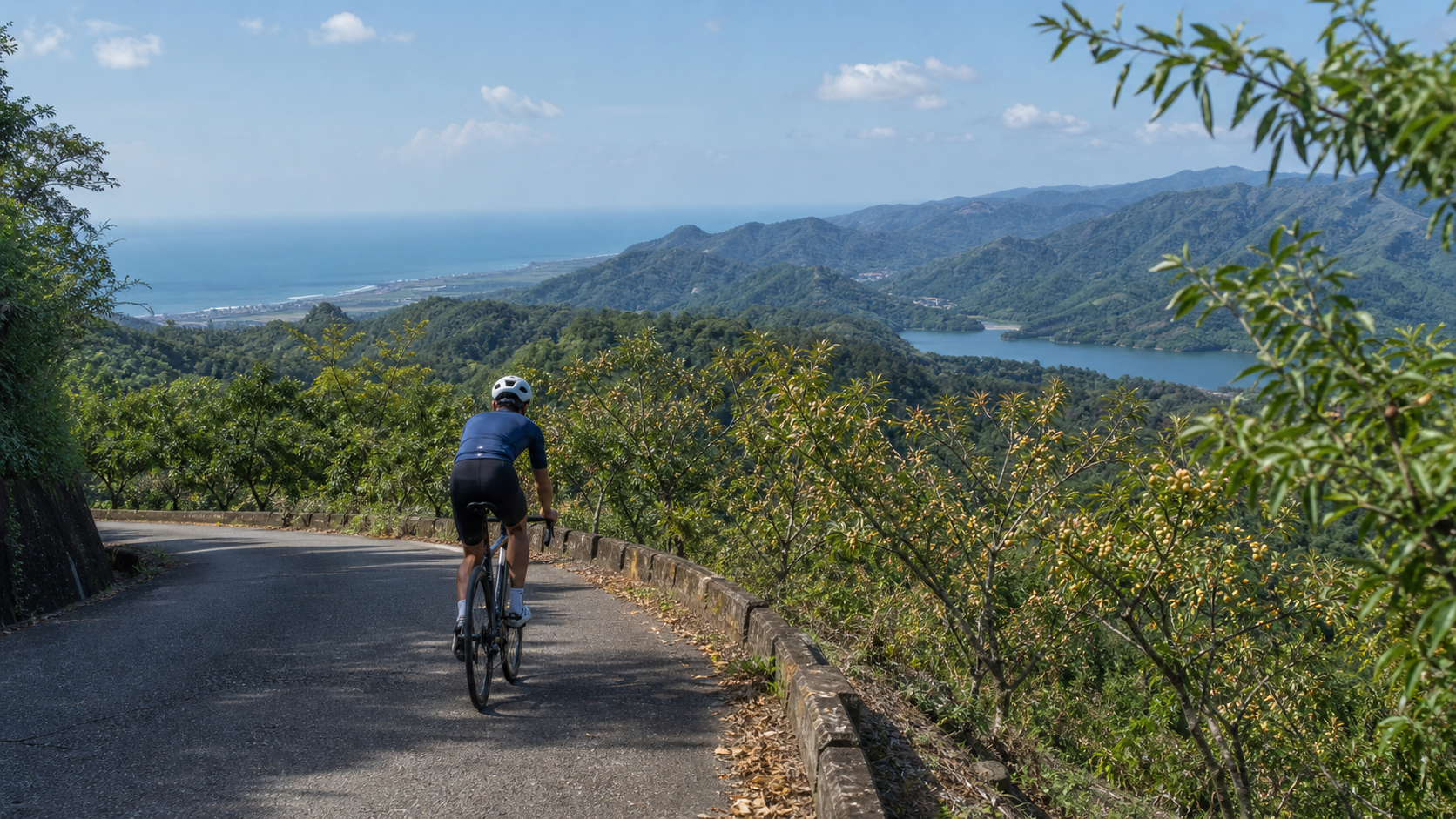
Along the Wushan range, local authorities have planned a hiking trail system stretching about 12 kilometers from north to south. Along the way, you can gaze out at the Taiwan Strait and look down on Nanhua Reservoir and Jingmian Reservoir. Although the cycling route doesn’t fully overlap with this trail system’s right-of-way, their geographic proximity means that riding on Wushan Back Mountain offers similar opportunities to capture that expansive view—which is one of the most captivating aspects of this route.
Scenery Along the Way: The Moment on the Ridge When You See the Taiwan Strait
Before actually riding up Wushan Back Mountain, my expectations for this route were actually quite simple—just a mountain climb to train my legs and work up a sweat, nothing more. But when the wheels truly rolled out of Nanhua’s town center and into the mountains, and the scenery began to unfold with the rising elevation, that unexpected sense of surprise is a unique experience only “non-popular routes” can offer.
In the early section of the route, the roadside features typical Tainan mountain terrain—layered hills, large orchards and woodlands, with the occasional glimpse of distant farmhouse roofs glinting in the sunlight. As the gradient gradually appears, the road begins to wind upward, and the views open up bit by bit. By the middle-to-later section, if the weather is clear and visibility is good, looking westward, you can vaguely sense the direction of the Taiwan Strait—standing on a ridgeline, catching your breath while realizing you’re at a height from which you can see toward the ocean. That is one of the most profound memory fragments this route has given me.
Looking inland, there’s a different kind of scenery—Nanhua Reservoir and Jingmian Reservoir lie quietly nestled among the encircling mountains. Gazing down at the reservoirs from above, the calm, ripple-free water surface reflects shimmering light under the sun, creating a curious contrast with the slightly hurried rhythm of your breathing during the climb—your body is working hard, but your eyes are being treated.
This sense of contradiction—“panting while enjoying the view”—is precisely what makes mountain climbing routes so fascinating. Unlike cruising on flat roads where you can easily divert your attention to the scenery, you must first pay with sweat and push through the gradient before you can earn that open vista on the ridgeline as your reward—in a way, it’s a fairly fair exchange.
Mountain Agriculture and Local Life: Nanhua’s Hillsides Fragrant with Pickled Olives
Riding on Nanhua’s mountain roads, besides the terrain and reservoir scenery, another thing that left a deep impression on me is the inseparable connection between this mountain area and agriculture. Nanhua, along with neighboring Tainan mountain townships like Yujing, Nansi, Liujia, Danei, and Dongshan, is one of the important production areas for “pobuzi” (Chinese olive, also known as “shuzi”). This crop is particularly well-suited to cultivation on poor, calcareous hillside soils, which perfectly matches Nanhua’s agricultural landscape of mountainous terrain with scarce flatland.
In Taiwan’s food culture, pobuzi is a distinctly local ingredient—whether as a sauce paired with steamed fish or as a flavor-enhancing supporting player in traditional snacks, that slightly savory, sweet aftertaste carries the long-standing wisdom of rural life in Taiwan’s mountain areas. Riding on Nanhua’s mountain roads, you might occasionally see fruits drying in farmhouse courtyards by the roadside, or clusters of crops stubbornly thriving on poor soil on the slopes—all silently telling of the deep bond between this land and agriculture.
Besides pobuzi, Nanhua and the surrounding areas of Yujing and Nansi are also important longan and fruit-producing regions in Tainan’s mountain belt. Although the hillside terrain isn’t conducive to large-scale mechanized farming, it has nurtured many small-scale farming lifestyles that follow the seasons and adapt to the terrain. This agricultural landscape might seem completely unrelated to cycling, but for me, riding past these slopes and seeing these farmsteads always brings a particularly grounded feeling—you’re not just “consuming” the mountain forest for exercise; it’s more like using the speed of your wheels to personally pass through and witness the life trajectories of the people on this land.
This is also why I particularly enjoy riding non-popular routes. Popular tourist routes are often already commercialized and planned as photo-op itineraries for visitors, but relatively niche routes like Wushan Back Mountain preserve more unpolished textures of local life—what you see isn’t a deliberately crafted tourist attraction, but the way this land actually is.
From the Foothills to the Ridge: The Details Your Body Remembers
Some routes, when you look back afterward, you remember the overall picture—a landscape, a feeling. But other routes, your body remembers the finer details for you. Wushan Back Mountain, for me, belongs to the latter.
I remember the moment just after leaving Nanhua’s town center when the road began its gentle rise—the first wave of mild soreness in my leg muscles, like my body was asking, “Ready? The real climb is about to begin.” That feeling wasn’t painful; it carried a familiar sense of anticipation instead. Every time I take on a climbing route, my body goes through this phase—switching from easy flat-road riding into climb mode, muscles needing to redistribute effort, breathing needing to adjust its rhythm.
By the middle section of the ride, as the gradient became sustained, I noticed my breathing shifting from “one inhale-exhale per two pedal strokes” gradually shortening to “one inhale-exhale per pedal stroke.” This change in breathing rhythm is actually my body telling me the intensity is approaching a threshold. I didn’t deliberately check the heart rate number on my computer; instead, I chose to trust the signals my body was giving me—if my breathing could maintain a steady rhythm without being so winded that I couldn’t complete a full sentence, then this intensity was sustainable.
Sweat began to slide down my forehead, dripping onto the handlebars, then running down the frame to the ground. Nanhua’s mountain air carried a damp, vegetal scent, mixed with the saltiness of sweat, forming the most direct sensory memory of this ride. Occasionally a mountain breeze would blow through, carrying away some of the mugginess—that instant coolness makes you want to pedal a bit faster, just to keep the wind flowing over your soaked cycling jersey.
By the time I reached the section near the ridgeline where the gradient began to change, I could clearly feel the soreness of lactic acid building up in my thighs. But curiously, as the view gradually opened up and the scenery unfolded, that soreness seemed to have part of its attention diluted away. This is why I’ve always loved climbing routes—physical fatigue and the beauty of the scenery before you reach a wonderful balance at some point, letting you clearly feel the effort you’re putting in while simultaneously enjoying the reward that effort brings.
After reaching the most open section of the route, I stopped, leaned on the handlebars, and caught my breath for a few moments. Sweat had already soaked through my entire jersey. Looking back at the mountain road I’d just climbed, the winding asphalt drew an arc across the green hillside. In that moment, the sense of accomplishment didn’t come from breaking any record or beating anyone—it came simply from the fact that my body remembered what it had just done.
This kind of body memory is something no words or data can fully convey. You can tell someone this route is 7.05 kilometers with 384.3 meters of elevation gain and a 5.4% average gradient, but that muscle soreness while pedaling, the changing breathing rhythm, the sensation of sweat dripping, the instant coolness of a mountain breeze—these are things only your body will truly remember after riding it yourself.
Solo Riding Wushan Back Mountain: Self-Dialogue on a Quiet Mountain Road
That day, I rode alone. Setting out from Nanhua’s town center, the sky still held a hint of morning chill, and there was almost no traffic on the road—only the occasional farm vehicle reminding me that this is indeed a mountain area where people live and work the land, not an uninhabited wilderness.
The most captivating yet challenging aspect of riding solo is that there’s no teammate to chat with and distract you—all the fatigue, the panting, and even the occasional thought of “how much longer do I have to ride” must be faced and processed by yourself alone. The early gentle slopes were still manageable; my body gradually settled into a rhythm, and my breathing slowly found a sustainable cadence. But by the middle section, as the gradient became sustained and perceived temperature rose with increased effort, the loneliness began to feel tangible—no one to encourage each other, no group to draft behind, only the sound of your own breathing, the whirring of the chain, and the occasional chirping of insects and birds.
But it’s precisely this solitude that turns the entire ride into a near-meditative experience. When external distractions are minimized, you become more acutely aware of your own body—which muscles are starting to tighten, whether your breathing rhythm is steady, whether your heart rate is within a reasonable range. This process of conversing with your own body is something lively group rides can rarely offer.
When I reached the ridgeline section near the end of the route where the views opened up, I stopped for a sip of water and looked back toward the direction I’d come from. The entire Nanhua mountain area displayed layered shades of green under the afternoon sun; in the distance, I could vaguely make out the glimmer of the reservoir, while nearby were continuous slopes and scattered farmhouse rooftops. In that moment, much of the accumulated fatigue from the ride seemed to dissolve before this scenery.
This is the charm of riding solo on niche routes—no crowds, no noise, just the most direct and honest dialogue between you and this mountain forest.
What This Route Means to Me: Not Popular, But the Scenery Never Compromises
Spend enough time in the cycling world, and you’ll inevitably be pulled along by various “must-ride” lists and “check-in hotspots.” Wuling, Hehuan Mountain, the Hualien–Taitung loop—these names have almost become a common language among cycling enthusiasts. Everyone is eager to take on these well-known benchmark routes and naturally treats them as the standard for measuring their own ability. But after riding Wushan Back Mountain, I’ve started to rethink what “worth riding” really means.
Wushan Back Mountain won’t appear on any popularity rankings. It’s even often mistaken for the famous Wushantou Reservoir and thus overlooked. But the experience this route gave me—that ridgeline view where you can see the Taiwan Strait, the expansive vista overlooking Nanhua Reservoir and Jingmian Reservoir, the local texture of the pobuzi industry and small-scale mountain farming along the way, and the quiet self-dialogue with my body while riding solo—all of it combined is absolutely no less satisfying than any popular route, and in some ways, even more profound.
I’ve gradually come to believe that the most precious part of cycling has never been the braggable checklist of “how many famous routes I’ve ridden,” but rather those private moments when you truly feel, in an instant, that “this ride was worth it.” For me, Wushan Back Mountain is exactly such a route—it’s quiet, low-key, and often mistaken for something else, but if you’re willing to spend the effort of 7 kilometers and 384 meters of climbing to get to know it, it will reward you in the most honest way with scenery and tranquility unique to Nanhua’s mountains.
This is perhaps a tacit understanding that every rider who loves exploring niche routes knows deep down—truly good scenery never needs fame to prove itself.
Season-Limited Slices of Scenery
Although Nanhua District’s overall climate is mild year-round, riding Wushan Back Mountain in different seasons offers subtly different qualities of scenery, worth revisiting again and again to savor.
In summer, although the sunlight is intense and it feels muggy, it’s precisely for this reason that the mountain vegetation appears exceptionally lush and verdant. Riding through sections with more tree cover, the light and shadow filtering through the leaves has a particularly layered quality. If you choose to set out in the early morning, you can also avoid the hottest hours and enjoy the hazy, mysterious atmosphere of the mountain forest while the morning mist hasn’t fully dissipated.
Winter in Nanhua is relatively dry, with few prolonged spells of rain, and atmospheric visibility is often better than in other seasons. This means the view of the Taiwan Strait from the ridgeline is especially sharp and clear on sunny winter days. Although there’s a diurnal temperature difference, it actually makes the body heat generated by prolonged climbing feel especially pleasant.
Spring and autumn are when Nanhua’s mountains appear at their gentlest—not too hot, not too dry and cold. The vegetation on the slopes shows subtle color shifts during these two transitional seasons, whether it’s the tender green of spring’s new shoots or the slightly desolate yellow-brown tones of autumn, adding different visual layers to the ride.
If you also enjoy revisiting the same route to observe the delicate changes brought by the turning seasons, Wushan Back Mountain is a great subject—unlike popular tourist attractions that are packed with crowds year-round and whose scenery gets consumed until it loses its freshness, it quietly shifts with the seasons, presenting different faces at its own pace, waiting for those willing to spend the time to get to know it.
Why I Keep Returning to Routes Like This
After finishing that ride on Wushan Back Mountain, on the drive back through Nanhua’s town center, I made a special detour to a small eatery nearby and ordered a simple bowl of noodles, chewing slowly along with the fatigue from the ride. The owner was a local. When he heard I’d just ridden down from Wushan, he smiled and said, “Not many people come here specifically to ride these days. Most people head to Wushantou instead.” That remark made me even more certain that the route I’d chosen was indeed one marginalized by the times and by tourism’s spotlight.
But being marginalized doesn’t mean being worthless—in some ways, it’s precisely what makes it most precious. I began to reflect that among the routes I’ve ridden over the years, the ones that left truly lasting memories were often not the famous spots packed with crowds and photo queues, but routes like Wushan Back Mountain that quietly exist in some corner, waiting to be discovered by the few willing to spend time getting to know them.
This shift in mindset actually reflects my maturing understanding of cycling. In my first few years of riding, like most beginners, I was eager to collect completion records of famous routes, treating benchmark challenges like Wuling and Hehuan Mountain as medals proving my ability. But the more I rode, the more I craved experiences without any ulterior purpose—riding purely because I enjoy it—and Wushan Back Mountain happened to give me exactly that space. No crowd pressure, no psychological burden of having to perform for anyone, just myself, my bike, and this mountain forest that has been misunderstood for so long.
I think this is also why I’d suggest every cycling enthusiast occasionally set aside those popular route lists and go find their own private stretch of road. It doesn’t need to be grand or famous—as long as the route gives you space to find dialogue with yourself during the ride, that’s already precious enough. For me, Wushan Back Mountain is exactly such a road—it taught me that the standard for measuring a route’s value should never be its fame or popularity, but whether it can, in some moment, make you feel the pure joy of riding.
Suggested Add-Ons: A One-Day Itinerary Connecting Nanhua’s Mountain Area
If you’re planning to make a dedicated trip to Nanhua to ride Wushan Back Mountain, consider making the itinerary more complete by exploring nearby places worth stopping at, turning this ride from merely completing a route into a small journey of getting to know Nanhua’s mountain area.
Around Nanhua Reservoir: As the most important geographical landmark in Nanhua District, the lakeside roads and viewpoints around Nanhua Reservoir are suitable as easy riding and rest sections before or after the main climb. The tranquil water surface and surrounding mountain ridges are an excellent place to let your body and mind wind down after high-intensity climbing.
Jingmian Reservoir: Like Nanhua Reservoir, it’s an important water body in the region. If time and energy allow, you can arrange a visit, experiencing the charm of Nanhua’s reservoir landscapes from a different angle, echoing the view you saw from the ridgeline—forming a complete experience of “gazing far from above, observing up close below.”
Nanhua Visitor Center: Located at the foot of Wushan, it offers basic facilities such as showers and hot water, making it a practical base for preparing before the ride and resting afterward. You can also obtain more local information here to plan your onward itinerary.
Yujing and Nansi One-Day Extension: Nanhua and the neighboring Yujing and Nansi are all major agricultural towns in Tainan’s mountain belt. If you’re planning a longer trip, consider linking these townships to learn about the local fruit industry and mountain living, experiencing the unique customs and character of Tainan’s highland areas that differ from the plains.
Whether you’ve come specifically to take on this route or are treating it as one stop in exploring Tainan’s mountain areas, Wushan Back Mountain is worth slowing down for, savoring this relatively low-key Nanhua highland that is nonetheless solid in both scenery and cultural depth. Next time you’re planning a ride, consider adding it to your list—just remember, don’t tell your friends you’re going to Wushantou Reservoir.
Related Reading
- Wushan Back Mountain Guide: Complete Analysis of Nanhua District’s 7km Climb at 5.4% Average Gradient (Don’t Confuse It with Wushantou Reservoir)
- A Hard Climb Without a Name: Riding into Wulai’s Zhulu Mountain, 546 Meters of Self-Dialogue
- Riding into the Landscape of Xindian: Lion’s Head Mountain South Side, a Climbing Memory Alongside the Xindian River
- Sweat and the Hustle of Daily Life: A 7.6km Mountain Ride to Wulai’s Baoqing Temple
嘉義大埔、阿婆灣挑戰賽,美到以為在日本!ft. 環騎5 Cool 西拉雅188 / 公路車 / CT Yeh
7 個月前
大武山20%魔王陡坡【JJSC南台灣遊騎Day2】!屁股真的要裂開了...凡士林抹滿也沒用?神秘金教堂還有超便宜夜市
3 個月前
虎豹潭!日本老師來台一日約騎 台灣車友熱情招待私房路線 / CT Yeh
21 天前
鯉魚潭水庫 歡笑單車騎旅,季節限定大景 | 大湖/鯉魚潭水庫/龍騰斷橋/薑麻園 | 公路車 | CT Yeh
3 年前
觀霧 變好騎了! | 北高車友爆笑大會師 | 公路車 | 單車旅遊 Taiwan Cycling Route GuanWu
6 年前
太平山單車員工旅遊 | 這樣玩CP值最高!| 公路車
5 年前
大武山後門26%歡樂陡坡!JJSC南台灣單車行Day2 / 被颱風追著跑 / 公路車 / CT Yeh
2 年前
台北闊瀨陡坡 騎旅 / 日本單車雜誌編輯車友臨時加入!/ 髮香才是最強的 / feat. 北迴歸線小隊 / 公路車 CT Yeh
6 個月前