Encountering Butterflies and Serenity on Lijia Forest Road: A Climbing and Cultural Journey Through the Daba Liujiu Mountains
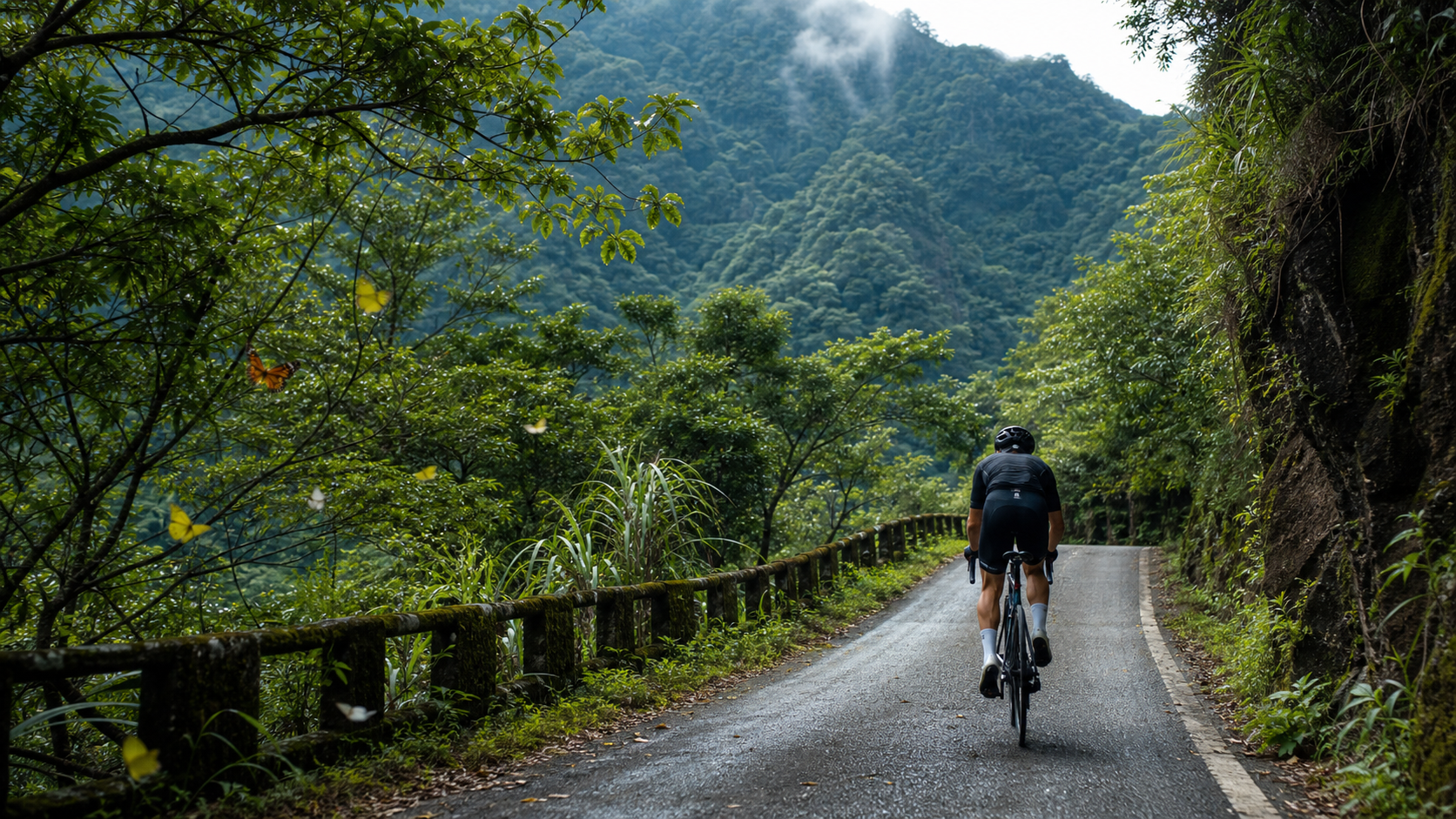
The Rebirth of a Logging Road: Starting from the Daba Liujiu Mountains
As my wheels rolled over the asphalt at the entrance to Lijia Forest Road, my mind was still fixed on the gradient I was about to face—8.33 kilometers, 960.5 meters of climbing, an average grade of 8.2%. These numbers had been looping through my head repeatedly before setting off. But less than ten minutes into the ride, the cold figures were quietly diluted by the greenery rushing past on both sides.
Lijia Forest Road winds through the Daba Liujiu Mountains in Beinan Township, Taitung. This forest may seem unremarkable on a map, yet it is where the story of this road begins. Originally built for logging purposes, this type of industrial road was once scattered across mid- and low-elevation mountain areas during the heyday of Taiwan’s forestry industry, tasked with hauling mountain resources down to the lowlands. As times changed and the logging industry declined, many such roads were either abandoned or transformed. Lijia Forest Road took the latter path—it gradually evolved from a timber-hauling industrial road into an ecological and recreational corridor. This transformation itself is a story about how the land came to be understood anew.
The forest road stretches approximately 40 kilometers in total (some records cite 39 kilometers), with vehicle access currently permitted up to the yellow gate at the 11.5-kilometer mark. Beyond that, the road surface remains in good condition but is primarily reserved for walkers and cyclists. Elevation rises from roughly 50 meters at the base to nearly 1,500 meters, a vertical span that crosses several vegetation zones—no wonder the ecological diversity here is so rich and layered. The difficult popular segment recorded on Strava—the 8.33 kilometers I was challenging today—is precisely the most substantial climbing section from the road’s entrance, with nearly all of the 960.5 meters of elevation gain concentrated within that distance, and an 8.2% average grade that gives no quarter. But what I want to write about today is not the numbers or strategy guides, but this road, this mountain, and the feelings of riding through it.
The Name “Lijia” Holds the Memory of the Land
While researching before departure, I was particularly intrigued by the origin of the place name “Lijia.” Lijia, rendered as Ligavon in the Puyuma language, is said to mean “lush giant elephant ear taro growing on fertile land.” The imagery is vivid—not some grand mountain or river scene, but a very everyday, lived-in observation: soil fertile enough that even a common plant like giant elephant ear taro thrives exceptionally well. This naming logic reveals a meticulous relationship between the Puyuma ancestors and this land—they knew every inch of soil beneath their feet and understood how to read the environment’s quality through the vigor of plant growth.
The Lijia area has long been the traditional hunting grounds and farming land of Puyuma tribes. To the tribe, this forest was never a blank slate “awaiting development,” but a homeland carrying memories of daily life, hunting trails, and agricultural wisdom. As I rode along this forest road, flanked by dense secondary forest and various native plants, I often found myself thinking that this seemingly wild landscape is actually a palimpsest of layered human memories—from the tribe’s ancestral hunting paths, to the later logging roads, to the ecological corridor I was traversing today. Each phase has left its mark on this land, though later visitors may not all be able to discern them.
Riding on a road that carries such layered history, I felt that rather than purely chasing climbing data, it was worth slowing down a bit to feel the accumulated thickness of time in this forest. That’s why, even when the gradient had me gasping for air, I would deliberately stop at certain bends to take in my surroundings—not just to catch my breath, but also to give myself more time with the mountain before me.
While chatting with a local elder at a rest stop at the foot of the mountain, he mentioned that in the early days when the road was still used for timber transport, trucks loaded with logs could often be seen slowly descending the mountain road, kicking up clouds of dust. In that era, Lijia Forest Road was a lifeline for economic activity and livelihoods, with a rhythm completely different from today. Now the rumble of those trucks has long vanished, replaced by the occasional passing cyclist or hiker—and more often than not, only the sound of wind, birdsong, and my own pedaling rhythm. This process of industrial roads transforming into ecological and recreational corridors has occurred in many mountain areas across Taiwan, but because Lijia Forest Road is relatively secluded and less developed, it has preserved more of its original character, undiluted by excessive tourism infrastructure.
Riding on such a road, I often imagined what this path would have looked like if time could rewind to the logging era. Perhaps it would be a bustling scene of timber-laden vehicles coming and going, or perhaps the daily footprints of tribal members traveling between hunting grounds and the village. These imaginings added a layer of temporal depth to the ride—I wasn’t just climbing a slope; I was reading a page in the history of a mountain meeting its people.
Butterflies, Birds, and Fireflies: An Ecological Treasure Trove Deep in the Forest Road
If you ask me what I remember most fondly about Lijia Forest Road, the answer wouldn’t be the gradient—it would be the life I encountered along the way.
This forest road is renowned for its ecological richness. In spring and summer, plants along both sides bloom in succession—sweet osmanthus, elderberry, snakeroot, clinopodium, and Taiwan deutzia. I wasn’t familiar with these names initially and only matched them up later through research, but while riding, I could genuinely sense a faint floral fragrance drifting in the air, mingled with the distinctive moist scent of a forest after rain. These flowers attract a profusion of fluttering butterflies that dart among the shrubs on the steep slopes. Occasionally, a few would fly right across my front wheel, “climbing” alongside me for a short stretch before veering off and disappearing into the forest shade.
Lijia Forest Road is a well-known butterfly-watching route, and this reputation is thoroughly deserved. The moment that left the deepest impression on me was at a bend where the gradient eased slightly. As I stopped to catch my breath, five or six butterflies were simultaneously lingering among the low wildflowers before me. That scene felt more natural and authentic than any carefully designed tourist trail, because nothing here was deliberately arranged for sightseers—everything was simply the forest as it is.
Beyond butterflies, the road has recorded over 50 bird species. While I’m not a serious birder and can’t name most of the birds, the birdsong rising and falling throughout the ride was truly the most moving soundtrack of this route. Several times, when I was too winded to speak on a steep section, a clear bird call would reach my ears, carrying a strangely soothing effect—as if reminding me that the present struggle was temporary, while the vitality of this forest was constant.
As for fireflies, Lijia Forest Road has documented more than 20 species. Although I visited during the day and didn’t get to witness the scene of twinkling lights at night, simply knowing that this forest transforms into another dreamlike vista after dark gave me a deeper respect for the place—by day, flowing floral scents and butterfly shadows; by night, scattered points of glow. This forest road expresses its vitality in completely different ways at different times of the day.
This forest is adjacent to the “Lijia Major Wildlife Habitat” protected area and also near the Shuanggui Lake Nature Reserve. This geographic position underscores that its ecological value is not isolated but an important link in the broader ecological network of eastern Taiwan’s mountains. Riding here, in a sense, means riding into a larger ecosystem, which instilled in me a greater humility toward the surrounding environment as I pedaled.
During the ride, I also noticed occasional small animal tracks and traces on the road surface. While I lack the knowledge to identify exactly which animals left them, these subtle clues were enough to remind me that I was passing through a living ecosystem, not a road existing purely for human recreation. This awareness made me unconsciously slow my pace and pay closer attention to what lay ahead, wary of inadvertently interrupting some creature’s path. This forest had accepted me as an intruder; all I could do was pass through with minimal disturbance.
Beyond the visual and auditory ecological experiences, the scents deep in the forest road also left a strong impression on me. Moist humus mixed with the aromas of various plants created a forest fragrance that’s difficult to describe precisely in words—a complexity no commercial scent can replicate, something that must be experienced firsthand with your own nose. Each time I was panting from the climb, taking a deep breath of this air brought an indescribable sense of relief, as if the forest were quietly absorbing a portion of my fatigue.
The Contrast of Struggling Up the Climb with Butterflies as Companions
To be honest, this route is no walk in the park. An 8.2% average grade with localized sections exceeding 10% had me nearly dismounting and walking several times in the middle section. My heartbeat amplified in my ears, sweat dripped continuously from the edge of my helmet, and waves of burning sensation surged through my legs—this is the “welcome gift” any difficult climbing route gives you.
But strangely enough, just when I was almost out of breath and the thought “did I choose the wrong route?” crossed my mind, the corner of my eye would catch a butterfly drifting past leisurely, or I’d hear a crisp birdsong from the woods. The contrast was striking—I was giving it everything I had, drenched in sweat, while the life around me moved with such lightness and composure, as if completely untroubled by gradient or gravity. This contrast initially made me feel a mix of amusement and exasperation, but as I kept riding, it gradually became a peculiar form of companionship—as if the entire forest was telling me in its own way: take it slow, there’s no rush here.
Deep in the forest road, it was exceptionally quiet. Apart from my own heavy breathing and the mechanical sound of chain engaging with cassette, there was almost no man-made noise. My phone frequently lost signal here too. At first, it felt a bit unfamiliar, but gradually I came to appreciate this state of being “disconnected from the outside world” as the most precious part of the ride. No notification interruptions, no urban clamor—just myself, this slope, and the surrounding forest in solitude. That sense of tranquility is an experience difficult to replicate on city roads or tourist-oriented routes.
On one particularly steep stretch, I stopped to catch my breath, gripping the handlebars, and looked up to see sunlight filtering through gaps in the leaves, casting fine dappled patterns that swayed gently with the breeze. At that moment, all my fatigue seemed momentarily soothed by the play of light and shadow. I thought to myself, this is probably the most captivating aspect of a hard climbing route—it won’t let you cruise along singing happily, but when you look up at your most painful moment, you often see the most unexpected beauty.
This contrasting experience made me reconsider why I ride. In everyday city training, the focus is often on quantitative metrics—speed, power, heart rate zones—everything digitized and optimized for efficiency. But on the steep grades of Lijia Forest Road, I felt for the first time that cycling could also be a process of dialogue with the environment. I traded sweat and heavy breaths for every meter upward, and the forest responded to my effort with butterflies, birdsong, and light and shadow. This exchange isn’t data any sports watch can record, yet it was the most precious takeaway of my journey.
I remember before one particularly steep bend, I was on the verge of cursing the mercilessness of the grade. But the next second, a swallowtail butterfly drifted leisurely across my line of sight and landed on an unnamed little white flower by the roadside, its wingbeats slow and graceful. I couldn’t help but laugh—laughing at my own disheveled state, and at how this forest always found the perfect moment to remind me to loosen up. At that instant, the gradient was still 8.2%, still steep and unyielding, but the mental hurdle within me had quietly loosened a little. That’s perhaps the most special thing about this route—it never eases its gradient because of your fatigue, yet it always finds the most understated way to give you a reason to keep going.
What This Route Means to Riders: A Private Hardman Route in Eastern Taiwan
Compared to better-known eastern Taiwan cycling routes like Zhiben or Tamali, which are more commercialized and have greater fame, Lijia Forest Road is considerably more low-key. It has no polished signage system, no supply stations lining the route, and not even a guarantee of stable phone reception. This “unfriendly” character is precisely what has gradually built it a special reputation in the cycling community—this is a private hardman route that must be conquered with skill and preparation.
When I later chatted with a few local riders about this route, their reactions were remarkably consistent: this is the kind of route you wouldn’t casually recommend to beginners, but once you’re ready and your fitness is up to par, it rewards you with a sense of accomplishment in the most raw way. No excessive polish of tourist routes, no compromised gentle gradients designed to cater to visitors—Lijia Forest Road preserves the mountain’s original appearance and the honesty of its gradient. 8.2% is 8.2%; it won’t soften just because you’re a novice.
This “uncompromising” quality is precisely what captivates many seasoned riders. In an era when cycling is increasingly commercialized and routes are increasingly packaged as check-in photo spots, finding a route like Lijia Forest Road that retains its original texture is no easy feat. It tests not just your leg strength and cardiovascular capacity, but also your respect for the forest and the care you put into preparation—you must bring your own supplies, assess road conditions yourself, and face the solitude deep in the forest road alone. These are lessons that tourist-oriented routes can hardly teach you.
For me, the greatest feeling after completing this route wasn’t the collector’s mentality of “unlocking another new route,” but a deeper understanding of this forest—it taught me that the routes truly worthy of respect aren’t necessarily the most famous ones, but those willing to greet you with their authentic face.
Spring-Summer Butterfly Season: A Seasonal Spectacle of Light and Shadow in the Forest
If you ask me which season is best to visit Lijia Forest Road, I’d unhesitatingly recommend late spring to early summer. During this time, plants along both sides of the road bloom in succession—native species like sweet osmanthus and elderberry take turns with their flowering periods, pushing the butterfly density along the entire road to its peak. Riding through, you’ll find you’re not just challenging the gradient; you’re passing through a natural corridor that breathes and blossoms.
The light and shadow in the forest during spring and summer are also particularly enchanting. In this season, foliage is dense, and sunlight piercing through layers of canopy casts mottled, dancing patterns on the ground and road surface, flickering with the rhythm of the breeze. If you visit in the early morning, you can also see thin mist drifting slowly through the trees, interweaving with the morning light into an almost dreamlike scene—a sight that photographs can barely capture. Only by riding through it yourself can you feel that immersive sense of being embraced by the forest.
Of course, spring and summer also mean higher humidity and mugginess, plus the likelihood of afternoon convective showers in the mountain area—something you must be mentally prepared for when choosing this season. But as mentioned earlier, this is also the period when the forest road’s ecology is most active and butterfly-watching conditions are most stable. If your primary purpose is to experience the vitality of this forest rather than just refreshing your personal Strava record, spring and summer are the most recommended seasons.
Autumn and winter present a different character—rainfall probability decreases and road surfaces are relatively drier, but flower and butterfly activity noticeably recedes. The forest loses some of its boisterous vitality and gains a more serene, introspective temperament. Each season has its own flavor. If time permits, I’d suggest riders visit in different seasons to experience the various expressions this same forest road reveals through the cycle of the year.
Suggested Side Trips: Lijia Tribal Culture and the Healing of Zhiben Hot Springs
After completing this solid climb, I’d particularly recommend keeping your itinerary flexible and leaving time for the surrounding cultural and leisure experiences, making this journey not just a cycling challenge but a complete in-depth tour of eastern Taiwan.
Around Lijia Forest Road, there are ecotourism activities developed by the local tribe, such as ecological guided tours and DIY sour plum making—mostly reservation-based tribal cultural activities. If time allows, I suggest planning ahead and contacting them in advance to book. Through the explanations of local guides, you’ll gain a deeper understanding of this forest and the connection between the Puyuma people and this land—a perspective you simply can’t get from just riding through. After all, this forest carries not only ecological resources but also the accumulated wisdom of daily life and the memory of the land passed down through generations.
If, like me, you’ve traveled from elsewhere specifically to take on this route, consider heading to the nearby Zhiben Hot Spring area afterward to relax. After the high-intensity output of 8.33 kilometers and 960.5 meters of climbing, the soreness in your legs will typically surface within a few hours of finishing. At that point, soaking in a hot spring to let the warm water soothe your tense muscles is the most practical and healing way to wrap things up. The Zhiben Hot Spring area isn’t far from Lijia, and the logistics are convenient, making it a perfect finale to this challenging journey.
After riding Lijia Forest Road, I’ve developed a different emotional connection to this land of Taitung. It’s not famous for tourism like Zhiben Hot Springs, nor is it as scenic as the popular coastal highways, but with its most honest gradient and richest ecology, it taught me one thing: some beauty can only truly be seen by sweating for it yourself and waiting patiently.
If you’re also planning a challenge trip to Lijia Forest Road, I’d suggest stretching your schedule out rather than packing it too tightly. The night before, consider staying in Taitung City or near the Zhiben Hot Spring area to give your body adequate rest, then set out early the next morning to take on the forest road. Afterward, return to the hot spring area to soak and relax, and in the evening, find a local eatery to savor Taitung’s distinctive flavors, arranging the conclusion of your journey with some ease. This kind of rhythm is what does justice to all the effort and emotion this route gives you.
I’ll come back to this road. Perhaps next time, I’ll visit in autumn or winter to experience another expression of this forest in a different season; perhaps I’ll challenge a longer distance, venturing past the gate to explore the fuller extent of Lijia Forest Road. Either way, the Daba Liujiu Mountains have left a deep imprint on my heart—reminding me that Taiwan’s mountains still hold many such unassuming yet profoundly moving corners, waiting for every rider to discover them with their own legs and sweat.
Related Reading
- Lijia Forest Road Practical Guide: 8.33 km, 960.5 m Climb, Strava Difficult Hard Climb Segment by Segment
- Beiyi Highway (Provincial Highway 9) Riding Guide: Gradient Analysis of the 9 Bends and 18 Turns
- Beiyi Highway Pinglin Section 4 km Analysis: Taipei Riders’ Climbing Proving Ground
- Night Riding on Beiyi Highway: Asphalt Glowing Under the Lights, Fear and Freedom Side by Side
台北闊瀨陡坡 騎旅 / 日本單車雜誌編輯車友臨時加入!/ 髮香才是最強的 / feat. 北迴歸線小隊 / 公路車 CT Yeh
6 個月前
萬年峽谷! 30% 超激陡坡 里佳部落DAY2 還是很硬! | 公路車 | CT Yeh
3 年前
一定要騎一次!阿里山最深處:里佳部落!單車旅行 | 2800m爬升 | 深度部落體驗:嗨翻晚會、螢火蟲、銀河 | feat. JJSC & 廢物伙伴 | 公路車 CT Yeh
10 個月前
公路車 | 塔塔加驚險員工旅遊 | 還好手腳快沒被抓交替!
5 年前
里佳部落 阿里山單車深度旅遊! | 竹山/草嶺/來吉/奮起湖 | 無敵銀河絕景 全新路線探索! 驚險狀況百出! | 4K沉浸式畫質 | 公路車 | CT Yeh
3 年前
藤枝二集團 單車行 Day1 | 南部小武嶺 | 爬坡爬到罵罵叫 | JJSC | 公路車 | CT Yeh
3 年前
觀霧 變好騎了! | 北高車友爆笑大會師 | 公路車 | 單車旅遊 Taiwan Cycling Route GuanWu
6 年前
#北橫 + #北進武嶺 最硬的員工旅遊 EP1 | #公路車 #拉拉山 | 明池 | 武嶺 | 武陵農場 | 雲海 | Taiwan Cycling Route Wulin
6 年前