Between Steep Slopes and Golden Daylily Seas: A Riding Experience and Cultural Memory of Taimali's Golden Mountain
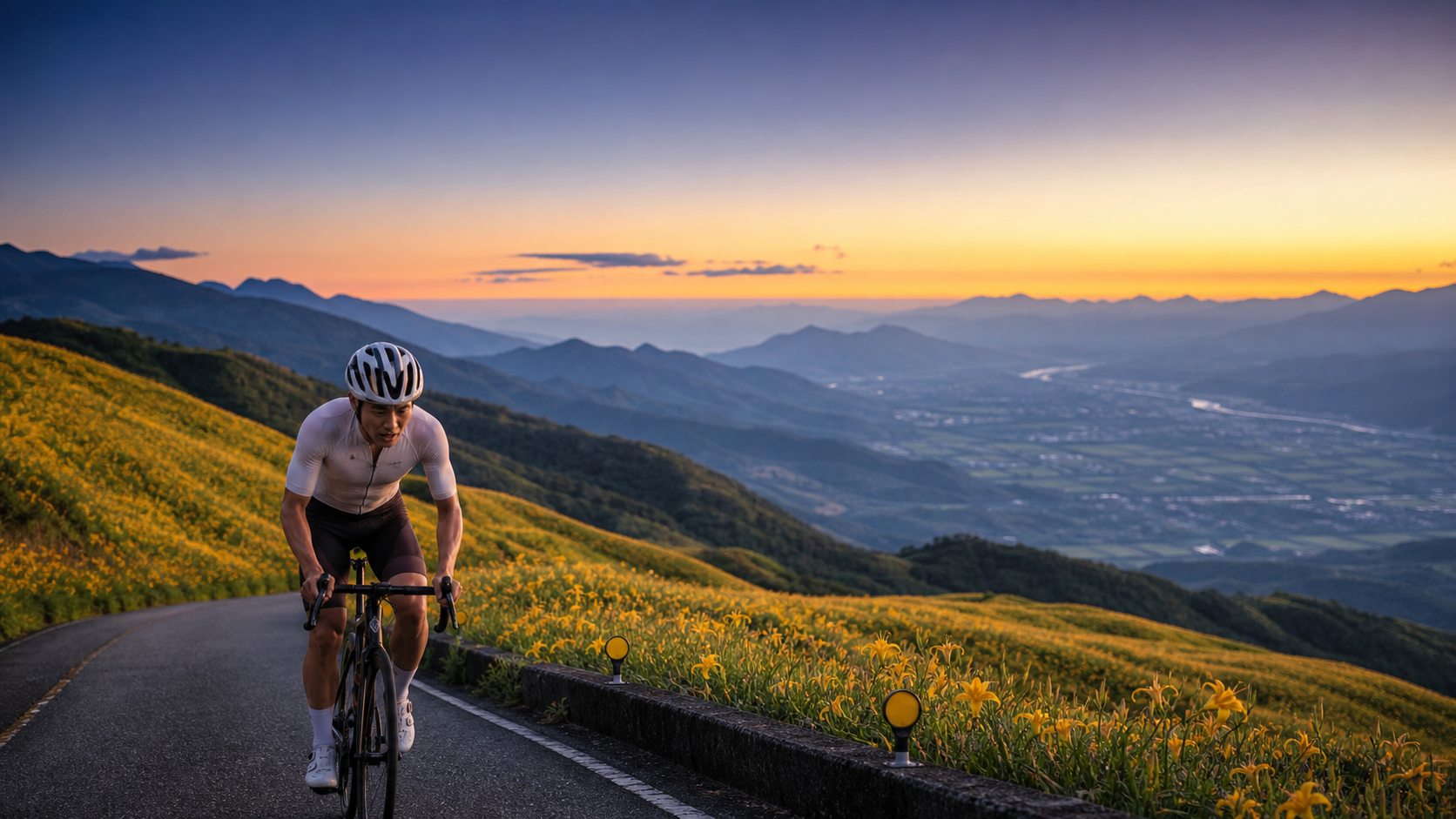
The Climb Begins: 13.03 Kilometers, the Shock Hidden Behind the Average Grade Numbers
Just past five in the morning, the sky was shifting from indigo to a pale orange. I filled my water bottle, checked the battery on my headlight, and took a deep breath at the intersection in downtown Taimali as I wheeled my bike over. Today’s challenge was the famed Taimali Jinhzen Mountain in Taiwan’s eastern cycling circles—Strava records the route’s specs: 13.03 kilometers, 1,250.3 meters of elevation gain, an average grade of 6.5%, and a classification of the highest, Category 5.
At first glance, these numbers might not seem particularly daunting; 13 kilometers doesn’t even sound that long. But a quick calculation reveals the true difficulty: over 13.03 kilometers, you have to absorb 1,250.3 meters of climbing, which means nearly a hundred meters of elevation gain per kilometer. To put it more honestly, if you worked backward from the average grade of 6.5% to estimate the route’s total elevation gain, you’d only get around 847 meters—but the actual climb far exceeds that estimate, by more than 400 meters. This means the middle section hides several steep pitches that far surpass the average, and the average grade figure can’t fool anyone who has actually ridden this road.
I still remember the first time a local rider described this route to me: “Jinhzen Mountain isn’t ridden up—it’s bitten up, section by section.” At the time, I didn’t fully grasp the weight of those words. It wasn’t until I personally pushed my pedals up those slopes that I truly understood that relentless, section-by-section pressure with almost no room to catch your breath. But it’s precisely after that pressure that the golden sea of flowers swaying in the wind at the summit becomes all the more moving and all the more worth it.
Preparation Before the Climb: A Pact Between One Person and a Mountain
The night before departure, I barely slept. Not because I was too nervous to fall asleep, but because my mind kept running through the next day’s route—from downtown Taimali to the summit, 13.03 kilometers, 1,250.3 meters of elevation gain, an average grade of 6.5%. These numbers played on a loop in my head, like some kind of countdown trailer. I knew the 6.5% average grade wasn’t terrifying in itself, but local riders had long since warned me that Jinhzen Mountain’s fearsome reputation never lies in the average—it lies in those hidden steep sections tucked into the middle, far exceeding the mean.
The alarm went off at 4:30 a.m., and outside the window it was still pitch black. I got up, changed, had a simple pre-ride meal of bananas and toast, filled my water bottle, and checked the tire pressure and brakes once more. This pre-departure ritual feels a bit clumsy, I admit, but every time I face a challenge on the level of Jinhzen Mountain, I unconsciously repeat this routine—as if by double-checking every detail, I can gain a little more sense of control over the suffering to come.
The moment I wheeled my bike out of the guesthouse, the sky wasn’t fully light yet, and Taimali’s air carried a humid blend of sea breeze and mountain wind. I looked up at the faintly visible ridgeline in the distance—that was the direction I’d be climbing. I took a deep breath, swung a leg over the saddle, and pushed down on the first pedal stroke—Jinhzen Mountain, here I come.
Land of the Rising Sun: Taimali’s Geographic Heritage
To understand Jinhzen Mountain, you first have to understand Taimali. Located in the southern part of Taitung County, Taimali is one of the first regions in Taiwan to greet the sunrise each day, earning it the local nickname “Land of the Rising Sun.” This title traces back to the year 2000, when Taimali hosted a grand sunrise-welcoming event for the millennium, drawing visitors from across Taiwan who traveled south specifically to catch the first rays of sunlight spilling across the ocean. Since then, “watching the sunrise in Taimali” has become a shared collective memory for people across Taiwan.
One clarification is worth making, though: the representative sunrise-viewing spot in Taimali is the Millennium Sunrise Memorial Park along the coast, a place entirely separate from Jinhzen Mountain with no direct geographic connection between the two. Jinhzen Mountain itself isn’t known for sunrise viewing, but it sits in Taimali Township’s mountainous area, at elevations ranging from roughly 1,300 to over 1,400 meters, with slopes covering more than 400 hectares. The views from the summit are equally expansive—especially in the early morning, when mountain mist swirls around and the rising sun casts light across layer upon layer of ridges. That play of light and shadow is every bit as stunning as watching the sunrise by the sea, just presented in a way that feels closer to the mountains and forests.
The name Taimali itself carries deep Paiwan and Pinuyumayan cultural overtones, as this land has been an important living area for indigenous peoples since ancient times. How Jinhzen Mountain came to look the way it does today is an entirely different story—a journey of gradual transformation from an agricultural production area into a tourist destination.
The Industrial Heritage of the Daylily Fields: One of the Three Major Daylily-Producing Regions in Eastern Taiwan
Jinhzen Mountain gets its name because the entire hillside was designated as a daylily-growing area decades ago, and on a considerable scale—the slopes cover more than 400 hectares, making it one of Taiwan’s important daylily-producing regions. In fact, Taimali’s Jinhzen Mountain, along with Chike Mountain in Hualien’s Yuli and Liushidan Mountain in Hualien’s Fuli, are collectively known as the “Three Major Daylily-Producing Regions of Eastern Taiwan.” Every year during the blooming season in August and September, these three peaks are simultaneously draped in golden carpets of flowers, creating one of eastern Taiwan’s most spectacular seasonal sights in late summer and early autumn.
The daylily also goes by a more poetic alias—the “forget-your-worries grass.” It’s said that ancient people believed this flower could help one cast aside sorrow, which is how it earned that elegant name. Appropriately, Jinhzen Mountain is home to a famous scenic spot named after this concept: “Wangyou Valley” (Forget-Your-Worries Valley), at an elevation of about 1,150 meters. Surrounded by mountains on three sides, the terrain hides layers of creeks and gorges, making it one of the most iconic flower-viewing landmarks along the entire route. Another landmark is “Shuangru Peak” (Twin Peaks), at roughly 1,340 meters, named for its rounded, symmetrical mountain shape. Standing atop Shuangru Peak and looking down over the entire hillside, the sight of golden flower seas swaying in the wind is a visual memory that stays with everyone who has ever visited Jinhzen Mountain.
For Taimali, the daylily industry is more than just a tourism resource—it’s a genuine agricultural economic lifeline. Local farmers have depended on these slopes for generations, growing daylilies to make a living. The short harvest window and the heavy labor required to pick the buds quickly have also created a uniquely bustling scene in the mountains during the blooming season—tourists heading up to admire and photograph the flowers on one side, farmers bent over rushing to harvest the buds on the other. Two completely different rhythms coexisting on the same hillside form a particularly distinctive cultural landscape.
Beyond Daylilies: Roselle and Sugar Apples—Taimali’s Agricultural Landscape
Taimali’s agricultural landscape extends far beyond daylilies alone. This land is also a major producer of roselle, and every autumn and winter, the hillsides and fields shift to an entirely different shade of red scenery. After the roselle calyces are harvested, they can be processed into candied preserves, jams, roselle tea, and a variety of other products—the sweet-and-sour flavor is another beloved local specialty of Taimali.
And when it comes to Taimali’s most iconic fruit, sugar apples absolutely cannot go unmentioned. Thanks to its得天獨厚的 climate and soil conditions, Taimali has long been one of Taiwan’s most important sugar apple-producing regions, earning it the reputation of the “Kingdom of Sugar Apples.” During the peak harvest season each year, fruit farmers set up roadside stalls along the way, and the plump, sweet atemoya and large-seeded sugar apples are one of the reasons many visitors make a special detour to Taimali.
This abundance of produce, in a sense, also explains the character of this land—Taimali isn’t a tourist town propped up by a single industry, but a bountiful mountain township woven together from daylilies, roselle, sugar apples, Taifeng tea, and a variety of other agricultural specialties. While tackling Jinhzen Mountain by bike, if time permits, picking up a few bags of local dried sugar apples or roselle tea along the way or after descending has almost become an unspoken “ritual” among riders who visit this mountain.
Contrast on Steep Climbs: Struggle and Healing Happen Simultaneously
Back to the riding itself. After leaving the urban area and entering the continuous climbing of the middle section, the gradient noticeably steepens, breathing becomes rapid, and waves of soreness surge through the thighs. I remember reaching a certain stretch where the slope was so steep that I had to stand and pedal out of the saddle just to keep moving forward, sweat dripping continuously from my forehead. At that moment, the only thought circling in my mind was “how much farther.”
The most captivating yet contradictory aspect of Jinjhen Mountain lies in how this struggle is often abruptly interrupted when you least expect it—just as you grit your teeth, almost doubting whether you can make it to the next switchback, you round a hairpin turn and the view suddenly opens up, with daylily flowers covering the mountainside arriving without warning. That overwhelming visual impact of golden yellow, combined with waves rippling through the flower sea as mountain breezes sweep across, makes you instantly forget the pain of battling the gradient just moments before.
I thought about this contrast for a long time before understanding why it resonates so deeply. During prolonged high-intensity climbing, the body exists in a state close to ascetic endurance—muscles aching, breathing rapid, heart rate spiking near its limit, with all attention contracted onto the steep slope immediately ahead. The appearance of the daylily sea releases that tension in an instant—it demands nothing of you, only that you lift your head and take a look, and beauty delivers itself to you. This experience of “exchanging physical pain for visual healing” is perhaps precisely the core allure that draws countless riders back to Jinjhen Mountain again and again.
Riders who have tackled this route describe the daylily sea not as “scenery” but as a “reward”—you must first pay the price of sweat and soreness before you earn the right to stand before that expanse of gold, and precisely because it comes so hard-won, the emotion feels all the more real.
Morning Clouds and Mist with the Rising Sun: Another Seasonal Exclusive
If you choose to challenge Jinjhen Mountain in the early morning hours, you’ll encounter a completely different yet equally breathtaking landscape. The mountain area is often shrouded in a thin layer of clouds and mist in the morning, especially in the high-altitude sections around Wangyou Valley and Shuangru Peak, where visibility constantly shifts with the density of the fog—one moment you can clearly see the contours of distant valleys, the next you might be completely enveloped in white mist.
As the sun gradually rises, light penetrates the gaps in the clouds and mist, casting golden beams across the valleys. That play of light and shadow holds the same breath-taking power as watching the first rays of dawn by the sea. Although Taimali is famous for its coastal sunrise, the morning clouds, mist, and rising sun on Jinjhen Mountain constitute another seasonal exclusive worth a dedicated visit—it just requires you to first expend the effort to climb this steep road before witnessing it with your own eyes.
This is also the greatest difference between challenging Jinjhen Mountain by bicycle versus driving up or taking a shuttle. When you’ve earned your way up step by step with your own legs, the feeling upon reaching the summit is entirely different from that of a tourist simply transported up—you cherish the scene of clouds, mist, and sunlight interweaving all the more, because you know you traded your sweat for this angle, this moment.
What This Route Means to Riders: The Stacking of Dual Impact
Having ridden many of Taiwan’s renowned climbing routes, Jinjhen Mountain has always held a special place for me. It doesn’t win through the grand narrative of “long distance, high altitude” like Wuling, nor is it known for the beginner-friendly positioning of “novice trial” like Fengguizui. What makes Jinjhen Mountain unique is that it compresses two things simultaneously into a route of just 13.03 kilometers with 1,250.3 meters of elevation gain: “one of eastern Taiwan’s acknowledged hard climbing routes” and “one of Taiwan’s three major daylily-producing regions with its stunning flower seas.”
This dual impact is rarely experienced on a single route. Most hard climbing routes feature relatively monotonous forest scenery along the way, testing purely physical endurance and willpower; most famous flower-viewing routes have relatively gentle gradients, suited for family outings rather than high-intensity challenges. Jinjhen Mountain possesses both extremes simultaneously—a brutal average gradient of 6.5% with localized steep sections far exceeding that figure, combined with mountainsides of golden daylily blooms interwoven with seas of clouds and sunrise, the two stacking together to create a unique experience difficult to replicate on any other route.
For me, every time I finish riding Jinjhen Mountain, I reconfirm one thing: the natural landscapes of eastern Taiwan are never gently displayed for your viewing—they demand that you earn them with sweat and soreness. This logic of “you must give before you receive” is perhaps precisely the fundamental reason Jinjhen Mountain leaves such a profound impression on the countless riders who have challenged it.
Suggested Side Trip: Stringing Together a Full Day in Taimali
If time permits, I recommend arranging the Jinjhen Mountain challenge as a full-day itinerary rather than simply climbing and turning back. After completing the morning climb challenge on Jinjhen Mountain, as you descend back toward town, you can stop by the Millennium Dawn Memorial Park on the Taimali coast—although you’ll have missed the timing for watching the first rays of dawn, the park itself, as a symbolic landmark of Taimali’s sunrise-welcoming culture, still offers that expansive atmosphere facing the Pacific and the direction of the rising sun during daytime visits, providing a nice contrast to the mountain scenery of Jinjhen Mountain.
Next, consider strolling through Taimali’s town center or nearby orchards and agricultural specialty shops, picking up a few packs of local dried sugar apples or roselle tea to bring home—these are Taimali’s most representative products. Buying them isn’t just about souvenirs; it’s a way to extend the memory of this ride. If your visit happens to fall during the daylily season, which runs from August to September each year, it’s even worth finding a vantage point after descending to look back at Jinjhen Mountain and take one more glance at that golden slope you just conquered with your own effort. The feeling of “I was just up there” makes the meaning of the entire journey more complete.
The land of Taimali simultaneously possesses a hardcore climbing route, stunning flower-sea landscapes, the cultural symbol of welcoming the first sunrise, and abundant agricultural products woven from daylilies, roselle, and sugar apples. Jinjhen Mountain is merely the steepest and most breathtaking piece of this puzzle, but precisely because of its existence, the entire Taimali journey gains a summit worthy of conquering with your own legs.
Every rider who has climbed Jinjhen Mountain would likely agree on one thing—what this route teaches you is never just how to handle the hidden steep grades behind a 6.5% average, but also how to rediscover the most primal joy of cycling amid the interweaving of soreness and beauty.
A Moment at the Summit: Wordless Camaraderie with Fellow Challengers
Upon reaching the area around the summit, near Wangyou Valley and Shuangru Peak, I pulled over to the roadside, nearly collapsing onto my saddle to catch my breath. Sweat had soaked through my entire jersey, my legs were still trembling slightly—that complex feeling unique to finishing a long, steep climb, a mixture of exhaustion and exhilaration, washed over me.
At that very moment, I noticed several other riders nearby who had also just completed the challenge—some sitting on low walls by the roadside rehydrating, others holding up their phones to photograph the sea of flowers spread across the mountainside. We nodded to each other without saying much, but that exchange of glances carried an unspoken understanding—we had all just endured the same torment of the gradient, and we had all been thoroughly healed by the same view before us. This camaraderie born of shared challenge between complete strangers is a unique community atmosphere found on eastern Taiwan’s hard climbing routes—no words needed, a single glance suffices.
An experienced local rider, noticing my breathless state, smiled and handed me a sports drink, saying: “First time here? This road shocks you every time you ride it, but it’s always worth it.” I’ve remembered those words ever since. Jinjhen Mountain indeed reminds you time and again that it has never been truly tamed, but precisely because of that, every re-challenge brings new insights.
Passing Moments with Flower Farmers: Everyday Scenes
Riding Jinjhen Mountain during the blooming season, besides the crowds of tourists and photography enthusiasts, there’s a group of people easily overlooked yet truly the protagonists of these slopes—the flower farmers bent over, busily harvesting among the blooms. Daylily harvesting follows strict timing; the buds must be picked before they fully bloom to preserve optimal quality and flavor. As a result, during the season, the hours from pre-dawn to early morning are the farmers’ busiest, and you can often see them carrying bamboo baskets, moving through the steep slopes as they pick.
I remember during my ride, on a slightly gentler stretch, passing by a farmer who was harvesting. She looked up at me, smiled, and waved, signaling me to ride carefully. That moment made me realize that Jinjhen Mountain is a dreamlike flower sea worth photographing for tourists, but for the farmers who have cultivated this land for generations, it is their livelihood—a working landscape requiring daily bending and labor. This tension between tourism and agriculture coexisting adds, in a way, a layer of human weight to Jinjhen Mountain that is heavier than mere scenery.
Compared to Other Seasons: A Different, Simpler Beauty of the Green Hillsides
It’s not just the blooming season that makes Jinjhen Mountain worth the challenge. I later rode this route again during the off-season, and instead of the golden expanse, the hillsides were covered in large swaths of green daylily leaves swaying in the wind. It lacked the visual splendor, but gained a simple, tranquil atmosphere. Without the crowded weekend traffic of the blooming season, the mountain roads felt exceptionally quiet, leaving only the sound of the wind, birdsong, and my own rhythm of pedaling and breathing.
This off-season riding experience actually allowed me to confront the challenge of the route itself more purely—without the flower fields to distract me, every hidden steep section behind the average 6.5% gradient had to be faced with complete honesty. If the blooming season’s Jinjhen Mountain is a magnificent adventure weaving together visuals and physical effort, then the off-season Jinjhen Mountain is a humble practice closer to the essence of climbing, a conversation with oneself. Both experiences have their own flavor, and they’ve made me even more certain that this route deserves repeated visits in different seasons, each time offering something new to gain.
In Closing: What a Mountain Taught Me
After riding up Jinjhen Mountain, I often find myself thinking that what makes this route so unforgettable isn’t just how daunting the numbers are, nor just how spectacular the flower fields are, but rather how precisely it demonstrates one thing—true, profound beauty often requires a corresponding price to be exchanged. Hidden behind the average 6.5% gradient are steep sections far exceeding the mean, just as behind the hillsides of Jinjhen Mountain lie the hard labor of generations of flower farmers; and the magnificent sea of flowers and the sunrise through clouds and mist that riders see upon reaching the summit are the most genuine reward for that effort.
The land of Taimali welcomes every visitor with the legend of the dawn in the Township of the Rising Sun, nourishes its people with the abundant produce of daylilies, roselle, and custard apples, and tests every cyclist willing to pedal up with the hard climb of Jinjhen Mountain. And I know I will return—not just for the flower fields, but to measure myself against this mountain once again.
Related Reading
- Taimali Jinjhen Mountain Practical Guide: A Complete Breakdown of the Category 5 Hard Climb—13.03 km, 1,250 m of Elevation Gain
- Taitung Taimali to Jinjhen Mountain: A Complete Guide to the Rolling Route Through Southern Taiwan’s Flower-Producing Region
- Chike Mountain Daylily Flower Fields: A Cultural Ride Through the East Rift Valley Written with Pedals
- Juming Museum Slope: A Cycling Memory of the Steep Climb Along the North Coast, and the Legend of “Buddha’s Palm”
那瑪夏x茶山 阿里山系深山單車行 Day2 累積爬升6000M | 🥶超陡連續下坡 整路看隊友刷 | 爬升一座西進武嶺 | JJSC | 公路車 | CT Yeh
3 年前
台北闊瀨陡坡 騎旅 / 日本單車雜誌編輯車友臨時加入!/ 髮香才是最強的 / feat. 北迴歸線小隊 / 公路車 CT Yeh
6 個月前
嘉義大埔、阿婆灣挑戰賽,美到以為在日本!ft. 環騎5 Cool 西拉雅188 / 公路車 / CT Yeh
7 個月前
大武山後門26%歡樂陡坡!JJSC南台灣單車行Day2 / 被颱風追著跑 / 公路車 / CT Yeh
2 年前
太平山單車員工旅遊 | 這樣玩CP值最高!| 公路車
5 年前
金門 ! 我騎過最棒的離島了 / 最後可以騎車上金門大橋的機會!?/ 公路車 / CT Yeh
1 年前
水金九不厭五分 10度寒流冷到不願停!feat. 卡卡 / 公路車 / CT Yeh
6 個月前
大武山20%魔王陡坡【JJSC南台灣遊騎Day2】!屁股真的要裂開了...凡士林抹滿也沒用?神秘金教堂還有超便宜夜市
3 個月前