The Weight of Nine Bends and Eighteen Turns: A Memory of the Beiyi Highway from Spirit Money to Pedals
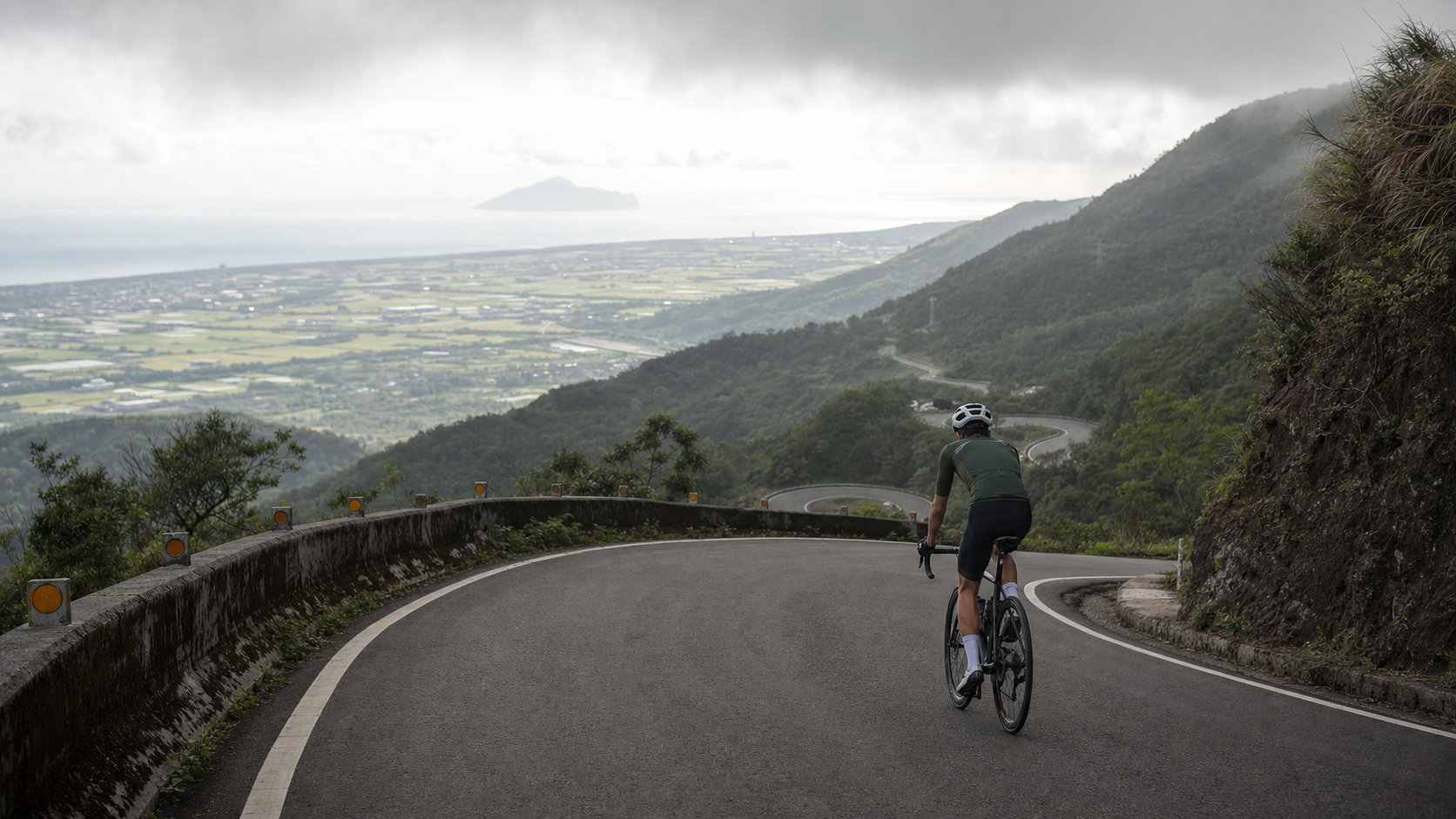
The Weight of Nine Bends and Eighteen Turns: A Memory of the Beiyi Highway, from Spirit Money to Pedals
Prologue: When Wheels Roll Over History
Some roads are paved with asphalt; others are built from layers of time and stories. The “Nine Bends and Eighteen Turns” at the Toucheng end of the Beiyi Highway is a quintessential example of the latter.
As I rolled out my road bike, determined to take on this 13.37-kilometer climb from downtown Toucheng all the way up to the Yilan County boundary marker, what crossed my mind wasn’t just the 511.6 meters of elevation gain, nor the 3.8% average gradient—what I thought about was how much reverence this road has carried for so many people, how much sweat from so many generations, and the split-second life-and-death moments hidden in each of its turns.
Nine Bends and Eighteen Turns is not an abstract place name; it is a stretch of road etched deeply into Taiwan’s highway history and folk memory. Today, from a cyclist’s perspective, I want to lay out the geography, history, legends, and scenery of this road, all spread open for you to read.
One Road, the Pioneering History of Two Eras
The Beiyi Highway is part of Provincial Highway 9, running from Bitan in Xindian District, New Taipei City (at the 10.3K mark of Highway 9) in the north, to Toucheng Township in Yilan County in the south, spanning approximately 58 kilometers. It is the most classic and story-rich section of the entire Highway 9. And the stretch I rode today—“Toucheng to the County Boundary Marker”—is precisely the most famous core landmark of the whole Beiyi Highway: Nine Bends and Eighteen Turns.
This section earned its name “Nine Bends and Eighteen Turns” because the mountain road twists and spirals to accommodate the terrain, with continuous switchbacks climbing from the Jinmian Mountain area of Toucheng. The sheer number and density of curves led early travelers to describe it with the vivid, slightly resigned humor of “Nine Bends and Eighteen Turns.” The name has endured to this day, no longer just a geographic description but a cultural code—in Taiwanese vernacular, “Nine Bends and Eighteen Turns” has even been borrowed to describe any convoluted, complicated, or twisty-turny matter or process.
Tracing the development history of this road takes us back to the Japanese colonial era. At the time, the Japanese government, seeking to open up land transportation between Taipei and Yilan, undertook the expansion of this mountain trail—originally passable only by foot and animal power—so that automobiles could traverse it. Under the engineering conditions of that era, this was an immensely challenging task. With layer upon layer of rugged peaks between Taipei and Yilan, and steep mountain terrain, carving out a road safe for vehicle passage amid such towering ranges required overcoming terrain challenges that need no elaboration.
After Taiwan’s retrocession, the Nationalist government continued with large-scale reconstruction projects on this road, gradually shaping the Beiyi Highway into what we know today. From a footpath, to a rudimentary road barely passable by cars, to today’s well-paved, heavily trafficked Provincial Highway 9, every widening and reconstruction of this road is a microcosm of Taiwan’s highway construction history, recording the gradual flow of people and goods between northern Taiwan and Yilan.
As I rode along this stretch, looking at the smooth asphalt and clear lane markings before me, it was hard not to imagine how people, in an era without precision engineering machinery, chiseled a road out of this mountainside one shovel and one pick at a time. The curvature of every bend perhaps conceals countless surveys and compromises made by the engineers of those days.
Folk Memories of an “Unclean Place”
If you’ve ever passed through the Nine Bends and Eighteen Turns section late at night or in the early morning, you might have noticed the occasional traces of spirit money scattered along the roadside—this is not casually discarded litter, but a real collective memory embedded in Taiwan’s folk culture.
In the early days of the Beiyi Highway, especially this continuous hairpin-turn section of Nine Bends and Eighteen Turns, the rugged road, poor sightlines, and road surface and lighting conditions far inferior to today’s standards made this a high-incidence area for major traffic accidents. Accident after accident gradually gave this stretch a reputation in the public imagination as an “unclean place”—people believed that beyond the terrain factors, the frequent crashes at these bends were also connected to the spirits of those who had died there.
As a result, many drivers passing through in the old days would scatter spirit money along the road as they traveled through the Nine Bends and Eighteen Turns. Behind this act lay a simple sense of reverence—both as consolation for those who had perished there, and as a psychological ritual for drivers praying for their own safe passage through the treacherous road. This custom persisted for a considerable period, becoming a unique cultural hallmark of the Beiyi Highway and adding a layer of mystery to the name Nine Bends and Eighteen Turns that transcends mere geographic description.
As a cyclist riding this road, I must honestly say that hearing such stories does instill a greater sense of awe for this stretch. But precisely because of that, in recent years, through continuous road improvement projects—including widening lanes, cutting back slopes to improve blind spots, and enhancing lighting and lane marking systems—the road’s safety has improved dramatically, and the frequency of major accidents has dropped significantly compared to the past. The once-feared perilous road has gradually transformed into a renowned route that combines historical significance with recreational and sporting value.
When I ride this section, I deliberately slow down—not just because the gradients and curves demand focus, but also out of respect for the history of this land. Those spirit money scraps once scattered on the pavement, those tales of reverence passed down through generations, all remind every user of this road: safety is always the most fundamental and important principle, whether riding or driving.
Where the Motorcycle Mecca Meets the Cyclist’s View
When it comes to Nine Bends and Eighteen Turns, the first image that comes to many people’s minds is actually the sight of motorcyclists skillfully leaning their bikes through the corners. This stretch of continuous hairpin turns, with its rich variety of curve radii and gradient changes, has long become a famous mecca for Taiwan’s motorcycle enthusiasts to showcase their cornering skills. On weekends, it’s common to see crowds of heavy motorcycle and geared-bike riders gathered here, enjoying the handling thrill of consecutive bends.
As a cyclist, I must admit that the first time I rode this section, I was indeed somewhat nervous about the frequent passing motorcycle traffic. After all, the speed difference between bicycles and motorcycles, and the interaction of right-of-way, require more cautious handling. But after riding here several times, I gradually came to appreciate that this experience of sharing the road with motorcycle culture is itself part of the Beiyi Highway’s unique charm—it is not a closed practice course tailor-made for cyclists, but a living road that genuinely exists within Taiwan’s highway system, carrying a diverse range of road users.
Of course, as a cyclist, safety awareness must be even more vigilant. Every bend on Nine Bends and Eighteen Turns has a certain degree of blind spot, and motorcycles often take corners at higher speeds. Cyclists must stay firmly within their own lane and avoid any line-crossing or drifting toward the center of the road. The habit I’ve developed is to check for approaching traffic from behind well before entering each hairpin, and to ride steadily as far to the right as possible, yielding the primary right-of-way to faster road users while also protecting my own safety.
This road culture of diverse users coexisting, in a way, echoes the essence of the Beiyi Highway as a “living historical road”—it is not a static exhibit in a museum, but a transportation artery that continues to be used and imbued with new meaning. The turning of cyclists’ pedals, the low growl of motorcycle engines, and the occasional whoosh of passing cars together compose the true face of this road at this very moment.
Shipai: A Place for Contemplation on the Climb
Within the Nine Bends and Eighteen Turns section, Shipai is a well-known landmark and viewpoint. By the time I ride up to it, I’ve usually completed the majority of the climb, and both my energy and focus are at a point where I need a brief pause.
Shipai became a famous landmark not only because of its geographic position—sitting in the latter half of the entire climbing route with expansive views—but also, in a sense, because it carries symbolic meaning tied to the road’s historical memory. When I stop near Shipai for a moment and look back at the road I’ve come—those continuous hairpin turns I just rode now reveal a sinuous, winding beauty from this vantage point—it’s hard to believe I just climbed up here, bend after bend.
I like to pause here, not just to let my legs relax, but also to give myself a chance to quiet my mind and feel the atmosphere of this road. The mountain climate along the Beiyi Highway is changeable; even on clear days, clouds and mist often linger in the valleys. Especially in the early morning or afternoon, the cloud vapor flows slowly along the mountain contours, adding an ethereal quality to the area around Shipai. This kind of scenery is a unique sight that riders on flat ground could never experience.
The location of Shipai, in a way, also serves as a psychological watershed—once past this point, the finish at the Yilan County boundary marker is no longer far off, and the remaining climbing sections are relatively steady, no longer featuring the dramatic gradient swings of the core Nine Bends and Eighteen Turns area ahead. That’s why many local riders familiar with this route treat Shipai as the “psychological relay station” of the entire ride—a place to reset their breathing and mindset, preparing for the final stretch to the end.
Lanyang Plain and Turtle Island: The Visual Reward at the End of the Mountains
When I finally pedaled through the last stretch of steady climbing and reached the Yilan County boundary marker, the scene that unfolded before me was enough to instantly compensate for all the fatigue.
Standing near the county boundary marker at an elevation gain of over 500 meters and looking toward Yilan, the vast expanse of the Lanyang Plain spread out before my eyes. This alluvial plain, embraced by the Central Mountain Range, the Xueshan Mountain Range, and the Coastal Mountain Range, presents a highly layered picture with its orderly agricultural field patterns and scattered settlements. From the winding curves of the mountain road to the open expanse of the plain, this stark visual contrast is precisely the reward landscape most celebrated from the Toucheng-side descent viewpoint on the Northern Cross-Island Highway. Having climbed up from the opposite direction, I could equally capture this magnificent scenery around the county boundary marker.
On clear days with good visibility, the faint silhouette of Turtle Island on the distant sea serves as the perfect finishing touch to this landscape. This volcanic island, shaped like a floating turtle, has long been a landmark and spiritual symbol of Yilan. Gazing at Turtle Island from the heights of the Northern Cross-Island Highway, the visual experience of mountain, sea, and plain layered upon one another is one of the key reasons many cyclists choose to return to this route again and again.
I will never forget the complex emotions that surged within me the first time I stopped at this spot and looked upon this scenery—a mixture of release after physical exertion, awe at the magnificent vista before me, and respect for a road carrying such weighty historical memories. A climb of 511.6 meters may not seem impressive in numbers alone, but when combined with visual rewards like the Lanyang Plain and Turtle Island, the sense of accomplishment far exceeds what mere physical data can measure.
Seasonal Clouds, Mist, and the Northeast Monsoon
The scenery along the Nine Turns and Eighteen Bends section of the Northern Cross-Island Highway is by no means static; it takes on completely different appearances with the changing seasons, which is another reason this route is worth revisiting time and again.
Every autumn and winter, as the northeast monsoon begins to influence northern Taiwan and the Yilan region, the climatic characteristics of this mountain road shift accordingly. Due to its topography, the Yilan area is frequently affected by moisture carried by the northeast monsoon in winter, making the mountain areas prone to clouds, mist, and drizzle. Under such weather, the Nine Turns and Eighteen Bends section becomes shrouded in a hazy veil of moisture, visibility drops, and the mountain scenery takes on an ethereal, poetic quality. While this weather poses certain challenges to riding safety, if approached with caution, the mist-wreathed Nine Turns and Eighteen Bends indeed offers a uniquely transcendent atmosphere—a stark seasonal contrast to the open, clear views of the Lanyang Plain on sunny days.
In contrast, during spring and summer, especially on clear days, visibility along the entire route tends to be crisper and more expansive, and the lush greenery along the climb is more vibrant. Although summer brings higher temperatures and a muggier feel that adds an extra challenge to riding stamina, the payoff is a clearer panoramic view of the Lanyang Plain and Turtle Island upon reaching the county boundary marker. This trade-off between weather and scenery is also a factor worth considering when planning your riding schedule.
Local riders share the experience that in the early morning hours, the Nine Turns and Eighteen Bends often offers dreamlike views of lingering mist and sunlight just beginning to filter through the trees—a play of light and shadow that is a unique experience difficult to replicate in the afternoon. If you too wish to pursue such imagery, consider planning a ride that departs in the early morning. Not only will you avoid peak holiday traffic, but you’ll also have a better chance of encountering the most poetic side of this route.
Cultural Highlights Along the Way and Side Trip Suggestions
Riding the Nine Turns and Eighteen Bends section of the Northern Cross-Island Highway offers dual rewards of physical challenge and scenery, but the cultural landscapes and local way of life along the route and around Toucheng are also well worth taking the time to appreciate.
Toucheng, as the starting town of this route, is a significant stronghold in Yilan’s development history, boasting a rich historical district and cultural heritage. If time permits, it is recommended to spend some time in town before officially tackling the Nine Turns and Eighteen Bends, or upon returning to Toucheng after completing the ride, to experience the pace of life in this gateway town of the Lanyang Plain. As for specific shops and attractions, it is best to rely on on-site observation and official local information, as businesses and their operating status change over time. Rather than depending on written descriptions, visiting in person to experience the current reality is the better approach.
For travelers hoping to combine cycling with sightseeing, after completing this climbing challenge, consider arranging follow-up activities on the Yilan side. Whether exploring natural ecological attractions around the Lanyang Plain or simply planning a relaxing itinerary, these additions can enrich the overall experience of this cycling trip. As for the Turtle Island landing tour, if time and season permit (be sure to check the island’s opening hours and ferry schedules, subject to official announcements), it is also an extended itinerary many riders plan, bringing a more complete conclusion to this journey that climbs from the land to the vastness of sea and sky.
From Old Road to New Road: The Transformation of the Northern Cross-Island Highway in Local Memory
In the oral recollections of local elders, the Northern Cross-Island Highway was never a road that was “completed in one go.” Rather, it is a living history that has undergone multiple realignments and widenings in response to increasing traffic volumes and rising road safety requirements. In its early days, the Northern Cross-Island Highway had relatively narrow lanes with limited passing space. When encountering large vehicles, one party often had to pull over to a slightly wider shoulder to yield—a “culture of yielding” that was an unspoken understanding among drivers on the highway back then.
As the number of motor vehicles in Taiwan climbed year after year, and with the growing commuting and tourism demand between Taipei and Yilan, traffic pressure on this road increased correspondingly. Due to the inherent topographical constraints of the continuous hairpin turns in the Nine Turns and Eighteen Bends section, widening work was far more difficult than on gentler stretches—every slope cut and roadbed reinforcement required careful trade-offs between steep terrain and limited available space. For this very reason, improvement works on this section were not accomplished overnight but were completed gradually over multiple phases. Each engineering record is, in effect, a microcosm of the evolution of local governance and civil engineering capabilities.
For local riders and residents who have long followed this route, the pavement condition, road marking clarity, and slope protection facilities of the Nine Turns and Eighteen Bends have visibly improved year after year. This incremental improvement, to some extent, also reflects the overall rise in road safety awareness in Taiwan—from the folk custom of “scattering spirit money to pray for safety” in earlier years, gradually shifting to a modern governance mindset of “substantially reducing accident risk through engineering measures.” These two mindsets may appear fundamentally different, but both point to the same core concern: ensuring that everyone traveling this treacherous mountain road reaches their destination safely.
After the Hsuehshan Tunnel opened, the positioning of the Northern Cross-Island Highway quietly shifted as well. Once the only land route between Taipei and Yilan, traffic on the highway noticeably decreased after the tunnel diverted a portion of the flow. For cyclists, this was, in a sense, an unexpected gift—the more relaxed traffic conditions compared to before allowed riders to focus more fully on enjoying the terrain and scenery of this mountain road itself, without constantly worrying about being overtaken by streams of long-haul freight or passenger vehicles. Of course, the Nine Turns and Eighteen Bends section remains a popular destination for motorcycle enthusiasts, and holiday traffic is still considerable. But overall, this road has transformed from “the only option” to “a road deliberately visited for the experience.” This shift in identity has also made the meaning it carries all the more pure.
Reverence and Passion: The Mindset for Riding This Road
Having written so much about the history and legends of the Nine Bends and Eighteen Turns, I’d like to address, before wrapping up, how I—as a rider who frequently visits this road—view the two seemingly contradictory emotions of “reverence” and “passion” that coexist harmoniously on this stretch.
Reverence comes from the road’s real history of pain—the accidents that have occurred here, the folk stories that still circulate—all reminding me that this is not a road to be taken lightly. Before every departure, I carefully inspect my bike, confirm the brakes and shifting systems are functioning properly, and check the day’s weather in advance to avoid challenging the road in poor visibility or wet conditions. This reverence is not fear, but a fundamental respect for the road itself, for other road users, and for my own safety.
Passion comes from the rich rewards this road offers riders—the joy of terrain changes brought by consecutive hairpin turns, the ethereal scenery of clouds and mist at the Shipai viewpoint, the magnificent vista of the Lanyang Plain and Turtle Island that greets you upon reaching the county boundary marker, and the complex sense of accomplishment—a blend of physical exhaustion and spiritual fulfillment—after each completed challenge. These positive experiences bring me back to this road time and again; even though I already know the curvature of every bend and the gradient of every climb, I’m still willing to return repeatedly.
I’ve gradually come to understand that reverence and passion are the two essential attitudes for a rider building a long-term relationship with a road that has a story. Without reverence, carelessness can exact a heavy price; without passion, it’s hard to truly understand why this road deserves repeated visits. The Nine Bends and Eighteen Turns is exactly such a road—it uses its history to remind you to stay cautious, and rewards your dedication with its scenery and challenges.
For every rider preparing to take on this route, my advice goes beyond physical and equipment preparation—it’s also an adjustment of mindset: set out with an understanding of the road’s history, ride with a cautious attitude toward road safety, and open your heart to the scenery and challenges before you. In doing so, what you gain will be not just a successful climb record, but a profound memory of truly connecting with this road.
The Meaning of Riding: One Road, A Dialogue
Writing to this point, I’d like to discuss why a climbing route of “only” 13.37 kilometers like the Nine Bends and Eighteen Turns holds such a special place in the hearts of countless riders.
I think the answer may lie in the multiple identities this road itself carries—it is a vital thoroughfare opened during the Japanese colonial era, a formidable and awe-inspiring road in folk legends, an arena for motorcyclists to showcase their skills, and a touchstone for cyclists to test their willpower and fitness. As you push the pedals, climbing round after round, you’re not just battling the 511.6-meter elevation gain; you’re also engaging in a dialogue with the road’s history, forging a connection across time and space with the countless travelers, drivers, and ghost stories that have passed through here, and even with the engineers who originally carved out this road.
Every time I ride the Nine Bends and Eighteen Turns, I experience it with a somewhat different mindset. Sometimes it’s a purely data-driven attitude focused on physical training, calculating power output and time; but more often—especially at moments when the weather and light are just right—I deliberately slow down, giving myself the chance to truly “see” the road—to see the flowing clouds around Shipai, to see the Lanyang Plain spreading out at the end of the mountains, to see the focused expressions on the faces of motorcyclists who occasionally pass me by, and to see how this road itself, amid the changes of the times, has gradually transformed from a fearsome and dangerous route into a modern road carrying recreational and sporting value.
The Nine Bends and Eighteen Turns has never been merely a place name; it is a three-dimensional narrative that condenses geographical challenges, historical memories, folk beliefs, and modern leisure culture. And every rider willing to measure this road with their legs and their sweat is, in their own way, continuing to write the next chapter of this road’s story.
The next time you plan a ride, why not give yourself the opportunity to start from Toucheng and take on the 13.37-kilometer climbing challenge. You’ll discover that the scenery and emotions upon reaching the county boundary marker far exceed what numbers can describe—that is a unique memory belonging to this road, and to every rider who travels it.
Related Reading
- Beiyi Nine Bends and Eighteen Turns Climbing Guide: A Pacing Masterclass for 13.37K, 511.6M of Climbing
- Beiyi Highway Nine Bends and Eighteen Turns: A Cyclist’s Reverse Challenge on a Motorcyclist’s Holy Land
- Beiyi Highway (Provincial Highway 9) Riding Guide: Gradient Analysis of the 9 Bends and 18 Turns
- Beiyi Highway Cycling Guide: Scenery and Supplies from Pinglin to Yilan
台北闊瀨陡坡 騎旅 / 日本單車雜誌編輯車友臨時加入!/ 髮香才是最強的 / feat. 北迴歸線小隊 / 公路車 CT Yeh
6 個月前
大武山20%魔王陡坡【JJSC南台灣遊騎Day2】!屁股真的要裂開了...凡士林抹滿也沒用?神秘金教堂還有超便宜夜市
3 個月前
大武山後門26%歡樂陡坡!JJSC南台灣單車行Day2 / 被颱風追著跑 / 公路車 / CT Yeh
2 年前
#北橫 + #北進武嶺 最硬的員工旅遊 EP1 | #公路車 #拉拉山 | 明池 | 武嶺 | 武陵農場 | 雲海 | Taiwan Cycling Route Wulin
6 年前
新竹白蘭部落! 爬陡坡還能講笑話...? 廢物伙伴の約騎 | 公路車 | CT Yeh
4 年前
台北大雁西飛 約騎挑戰 feat. Doris | 公路車 | CT Yeh
3 年前
嘉義大埔、阿婆灣挑戰賽,美到以為在日本!ft. 環騎5 Cool 西拉雅188 / 公路車 / CT Yeh
7 個月前
北宜騎車⋯好刺激 差點被🐒尻 / 露營單車旅 / 公路車後背攜車架開箱!/ 百人大團露 / YAKIMA 設備開箱儀式感都來了 / 公路車 / CT Yeh
12 個月前