Riding to the Foot of Mount Dawu: A Cycling Dialogue with Jiaping Tribe in Taiwu Township and the Sacred Mountain
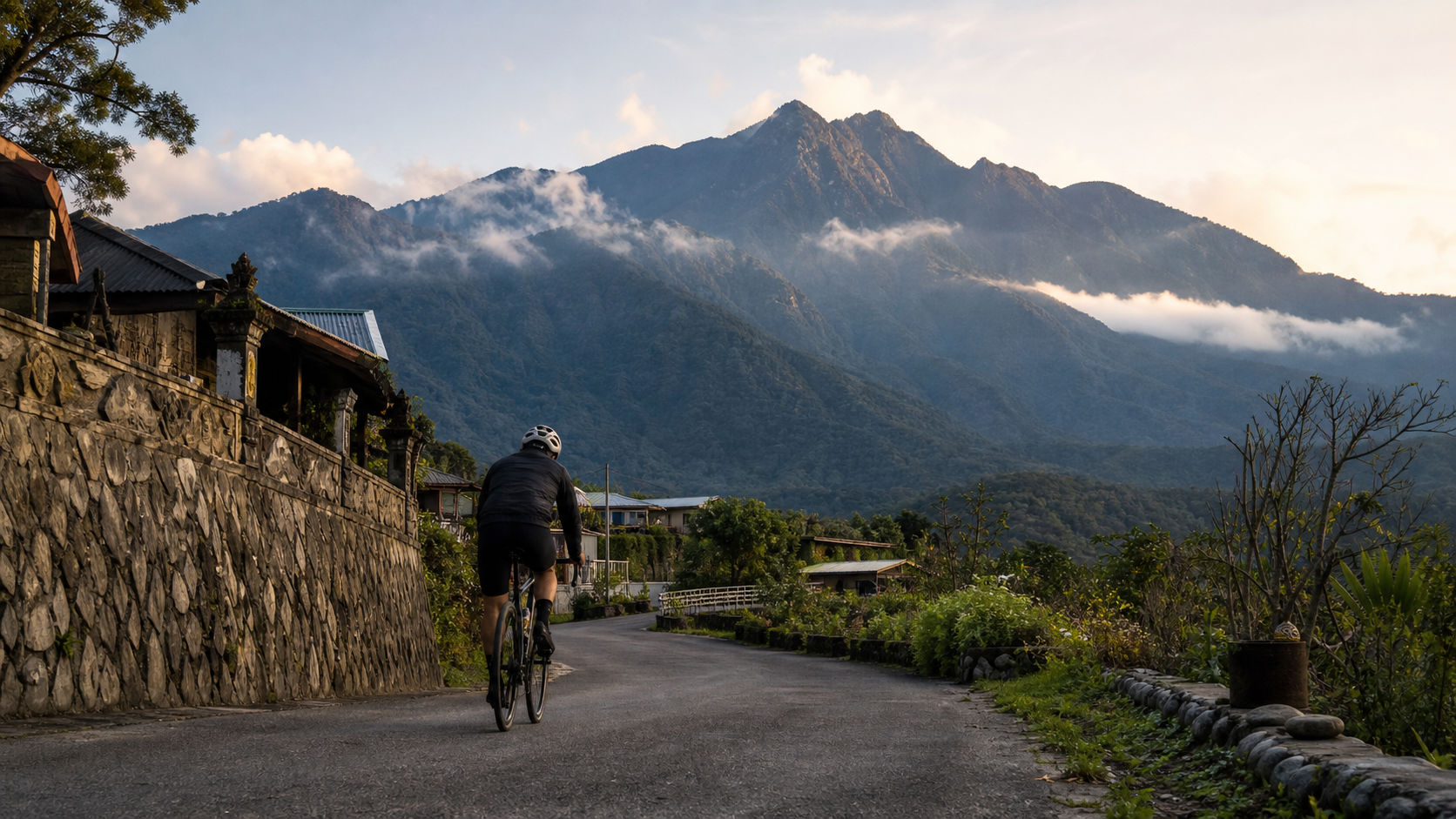
Introduction: A Morning Facing the Sacred Mountain
Before dawn broke, I was already riding toward Jiaping Village, preparing to embark on this journey deep into the indigenous mountain communities of Pingtung.
Jiaping, the Heart of Taiwu Township
Before the car even entered Jiaping Village, Mount Dawu in the distance had already filled the entire sky. The six villages of Taiwu Township in Pingtung County—Wan’an, Jiaping, Wutan, Pinghe, Taiwu, and Jiaxing—are almost entirely situated within the traditional territory of the Paiwan people, and Jiaping is precisely the administrative seat of this mountain township, serving as both its political and cultural center. Many people hearing the name “Jiaping” for the first time instinctively associate it with the neighboring Wanluan Township, but in fact Jiaping Village has no administrative affiliation with Wanluan; it sits firmly within Taiwu Township and is one of the most representative Paiwan settlements in the entire township.
Before riding into this mountain region, I mentally reviewed the map once more: nearly 94 percent of Taiwu Township’s population is Paiwan, and as the township seat, Jiaping Village naturally carries the most essential cultural and everyday fabric of this ethnic group. Mount Dawu, standing 3,092 meters tall, is located at the junction of Haocha Village in Wutai Township, Taiwu Village in Taiwu Township, and Jia Lan Village in Jinfeng Township, Taitung County. It is the highest peak in the southern Central Mountain Range and the shared sacred mountain of both the Paiwan and Rukai peoples. Gazing at this mountain from Jiaping Village, the dual impact—visual and psychological—is something no photograph can fully convey.
The Weight of the Sacred Mountain
In the context of Taiwanese literature and music, Mount Dawu has never been merely “a very tall mountain.” The late musician Hu Teh-fu’s classic composition “Beautiful Mother of Dawu Mountain” transforms the mountain into an image of a mother—gentle yet resolute; writer Lung Ying-tai titled her full-length work directly Under Mount Dawu, using the mountain as the spiritual coordinate of the entire piece; even earlier, the Hakka literary figure Zhong Li-he left behind written records such as “An Account of Climbing Mount Dawu.” These creators may come from different ethnic backgrounds, yet they were all summoned by the mountain’s presence, each writing their own dialogue with Dawu.
As I rode along the industrial road extending from Jiaping Village toward the mountains, gasping on the climbs while trying to imagine: for the Paiwan and Rukai people who have lived on this land for generations, the meaning carried by Mount Dawu far exceeds what the modern classification system of “Taiwan’s Hundred Peaks” can encompass. It is one of the symbols of origin in ancestral legends, a coordinate for the tribe’s sense of direction, and a recurring backdrop in countless oral traditions and life rituals. As an outsider on two wheels, all I could do was carry this awareness and ride through this land at the foot of the sacred mountain—slower and more humbly than usual.
Village Landscapes Along the Way
The streets of Jiaping Village are not wide, and on both sides one occasionally sees low walls built of slate and traces of traditional houses, mixed with modern concrete structures, presenting a settlement appearance where old and new coexist, where tradition and modernity interweave. In Paiwan traditional house culture, slate has always been the core building material—a building wisdom that sources materials locally and adapts to mountain terrain and climate, still recognizable in corners of the village after hundreds of years. Signposts bearing indigenous place names appear along the roadside from time to time, reminding every passing traveler: this land possesses its own independent and complete naming system and cultural context, not merely “geographic coordinates.”
Following the industrial road toward Mount Dawu, the gradient gradually tightens, and my breathing quickens accordingly. The vegetation along the roadside transitions from orchards and vegetable plots around the village to increasingly pristine forest, with shade cutting the scorching sunlight into dancing patches of light scattered across the asphalt. Occasionally I hear the startled rustle of a muntjac or bamboo partridge fleeing, along with bird calls from farther away—this unique soundscape of the mountains is an experience no urban ride can replicate.
A Shift in Perspective Through Sweat
To be honest, this route climbs over 1,300 meters, and riding it is anything but easy. For the first few kilometers, I could maintain a steady rhythm, pedaling while taking in the roadside scenery; but as the gradient grew steeper, my breathing drowned out the wind, and my attention gradually narrowed from “appreciating the view” to “getting through this stretch.” This shift in mind and body is precisely what makes mountain riding both most captivating and most honest—it offers no room for luck. Your fitness and your willpower are laid bare before the numbers on the gradient.
Pausing to catch my breath at a switchback, I looked back at the road I had come up and realized I had already climbed high enough to look down on the village rooftops. In that instant, all the fatigue seemed to find a reasonable outlet. This ritual of “looking back” is a moment I especially treasure when riding challenging routes—it makes you realize that every gasp and every pedal stroke has indeed translated into elevation gained, not futile expenditure.
Continuing upward, the mountain breeze began to carry a chill, a stark contrast to the stuffy heat below. This layering of temperatures, in a sense, also symbolizes the rider gradually entering another world—from the clamor of the plains into the stillness of the forest; from the pace of modern urban life into the rhythm of coexistence between tribe and nature.
The Shadow of Morakot and the Power of Reconstruction
Riding through this mountain region, it is hard not to think of Typhoon Morakot in 2009, the disaster that changed the fate of all of Pingtung’s mountain townships. Records from that time show that Taiwu Township once measured a staggering rainfall of over 1,100 millimeters in a single day—a figure that would constitute catastrophic damage anywhere. Many villages in Pingtung’s mountain townships, including Sandimen, Wutai, and Majia, experienced road closures, destroyed homes, and even permanent relocation during that typhoon.
While the specific details of reconstruction in Jiaping Village and Taiwu Township as a whole after Morakot should be based on the latest official data and the oral accounts of local elders, what is certain is that Pingtung’s entire indigenous mountain region has walked a long road over the past decade and more—from trauma to rebuilding, from displacement to putting down roots. As I rode along this relatively calm route that looks like “just an industrial road,” I knew in my heart that this land once bore the brunt of immense natural forces, and the fact that I can approach and experience it today in the relaxed manner of cycling is itself the accumulated result of countless reconstruction efforts.
Advice for the Next Challenger
If you are also planning to take on the Mount Dawu–Jiaping route, my advice is not so much about gradients and gear ratios as it is about “mindset.” This is not a competitive route for setting personal records or chasing speed; it is better approached as a journey of “paying homage to the mountain.” Slow down, pay attention to the tribal settlements and indigenous place names along the way; during resupply or rest stops, if you have the chance to interact with local residents, listen with curiosity rather than exoticism; after completing the challenge, look back at the trajectory you climbed, and also at the historical weight this land carries.
The Mount Dawu–Jiaping route is not long—the cumulative distance is under 13 kilometers—but it condenses geographic steepness, cultural depth, and the scars and resilience of history. For me, this was not merely a physical challenge but an opportunity for a close-up dialogue with Pingtung’s indigenous mountain homeland. When you arrive at the end of the route, breathless, and turn to look back at the layered mountain ridges and the village rooftops below, that composite sense of awe far exceeds anything any set of Strava data can record.
Side Trip Suggestions and Notes
If time permits, I recommend arranging this ride as part of a full-day itinerary, connecting it with other attractions or tribal cultural centers on the Pingtung plains before or after, so the pace of the trip is more relaxed. Since the business hours of shops and eateries in the village may vary by season or individual circumstances, it is advisable to confirm by phone or with local information before setting out, and not to assume you will definitely find resupply points along the way.
As for riding gear, in addition to the low gear ratio and disc brake recommendations mentioned earlier, it is also advisable to bring a lightweight camera or phone with proper protection—the light and shadow of this mountain forest and its cultural scenery deserve to be well documented. However, when photographing the village and its residents, be sure to ask for permission first; respect is the basic courtesy that any journey into indigenous homelands should carry.
Before leaving Jiaping Village, consider pausing briefly at the village entrance to look back at this sacred mountain that has nurtured countless poems and literary imagery. In that moment, you will understand that the reason the Mount Dawu–Jiaping route deserves to be recorded and recommended has never been merely its gradient numbers, but because it allows every rider willing to slow down to form a genuine and profound connection with this land and its history.
A Portrait of a Local Elder (Field Observation)
On a gentler stretch of the mountain road, I came across an elderly man sitting in a rattan chair in front of his home, enjoying the breeze. He didn’t say much—just offered a slight smile to me, breathless as I was, and gestured that I could rest under the eaves. This kind of wordless goodwill, so characteristic of mountain tribal communities, is often the very feeling that cyclists most easily forget in the city yet rediscover among the mountains. I didn’t linger or intrude; I simply drank some water, nodded in thanks, and continued on my way. But that image has stayed with me ever since—more than any grand mountain vista, it was this simple, unadorned human interaction that formed the warmest part of the journey.
The Paiwan tribal society traditionally operates under a relatively strict class and chieftain system, a structure that profoundly shapes the spatial layout of villages, the scale of household dwellings, and even the etiquette observed in daily life. Although modern lifestyles have brought transformation and adaptation to many of these traditions, a respect for elders, for the land, and for ancestral wisdom can still be faintly sensed in everyday interactions within the tribe. As a passerby, I cannot—and should not—pretend to fully comprehend the entirety of this cultural system, but I can at least approach it with humility and respect, to feel and to learn.
Mountain Wind, Sweat, and the Recalibration of Time
One of the most captivating aspects of riding a challenging mountain route is that it forces you to recalibrate your perception of “time.” In the city, time is sliced into neat segments of calendars and notifications, every second accounted for; but on a mountain road like Bei Dawu Japing, time becomes the rhythm of your breath, the cadence of your heartbeat, and the seemingly endless slope ahead. You come to realize that ten minutes, which feels interminable on flat ground, might barely carry you five hundred meters up a steep grade; while a brief pause that would normally feel fleeting can grant your body and mind an unexpectedly complete rest and recovery.
This dislocation of time perception is, in fact, one of the most precious gifts mountain riding offers to city dwellers. When your attention is forced to narrow down to “the next pedal stroke,” “the next breath,” “the next bend,” the trivial worries and anxieties that usually cling to your mind are, without your noticing, diluted and forgotten. By the time you reach the summit, beyond the physical fatigue, what remains is more a sense of being mentally emptied and then refilled—a profound groundedness.
The Road to Reconstruction Through a Rider’s Eyes
Every stretch of smooth pavement along the way, every seemingly unremarkable bridge or culvert, may well be the tangible result of post-disaster reconstruction efforts. Over the past decade or more, the indigenous mountain townships of Pingtung have undergone a lengthy process, from rebuilding basic infrastructure to restoring the vitality of tribal communities. These projects rarely appear in any promotional photos or tourism brochures, yet they are the crucial foundation that allows outside riders like me to safely and smoothly cycle deep into the heart of the tribe.
I often find myself wondering how much effort and coordination—from engineers, tribal residents, and public agencies—lies behind a seemingly ordinary industrial road. When I’m gasping for breath and complaining about the steepness of the grade, I should, in the same breath, feel gratitude—grateful that this road exists, grateful that it is well maintained, and grateful that I have the opportunity to experience, in the most grounded way possible, the breath and pulse of this mountain forest.
In Closing: A Journey of Humility
On the road leaving Taiwu Township, I took one last look in the rearview mirror at the receding ridgeline of Bei Dawu Mountain. The mountain stood there, still and silent, just as it has stood guard over this land for millennia—unmoved by the arrival of one more breathless outsider. But for me, this ride left an indelible mark on my heart.
What Bei Dawu Japing taught me, perhaps, is not how to conquer a mountain road with greater speed, but how to approach with humility—to understand a piece of land, a people, a history. If I ever have the chance to visit Japing Village again, I would ride at a slower pace, make more stops, and take the time to truly know every corner of this place and every resident willing to share a conversation. Because what is truly worth recording has never been just a segment of climbing data on Strava, but rather those quiet dialogues between land and people that unfold between pedal strokes and breaths.
The Subtle Differences of the Four Seasons
Although this route can be challenged year-round, visiting Japing Village in different seasons offers distinctly different visual and sensory experiences. In spring, the mountain vegetation awakens from the stillness of winter; tender new leaves dot the deep green of the primary forest, and the air carries a faint fragrance of fresh greenery—one of the seasons richest in visual layers. Summer brings the densest, most lush foliage, but also a high probability of afternoon thunderstorms. Setting out in the early morning hours often allows you to capture the clearest, most pristine mountain views before the clouds roll in.
In autumn and winter, the Pingtung mountains are influenced by the northeast monsoon, with pronounced temperature swings between day and night. The peaks are sometimes shrouded in thin mist, and if you’re lucky enough to catch a sea of clouds emerging, the sight of looking down from above as mist swirls around the rooftops of the village below makes every bit of climbing effort instantly worthwhile. Winter air tends to be drier and more transparent, offering some of the best visibility of the year for gazing at the Bei Dawu ridgeline—though the low temperatures and strong mountain winds demand more from your gear in terms of warmth.
Regardless of which season you choose to visit, riders are advised to be mindful of the rapidly changing weather in the Pingtung mountains. Be sure to check the latest weather forecast and road conditions before setting out, so that every ride can be enjoyed safely while taking in the unique scenery that each season brings to this mountain forest.
A Note on Cultural Sensitivity
In writing this article, I have been particularly careful to avoid any descriptions that might veer into stereotypes or exoticization when presenting Paiwan tribal culture. The cultural richness of indigenous peoples is immensely deep and nuanced, and any oversimplified or generalized description risks inadvertently causing misunderstanding or disrespect. As a rider and chronicler, I believe the most responsible approach is to honestly present what I have observed and experienced, while clearly marking which details are personal subjective impressions and which are well-founded public information—rather than filling gaps in knowledge with imagination.
If this article can inspire more riders to approach this mountain forest with greater curiosity and respect, and to personally come to know the stories of this people and this land, then the meaning of this riding challenge far exceeds mere physical training or scenic appreciation. It becomes, in a true sense, an act of cultural exchange and connection to the land.
A Moment of Reflection on the Way Back
The descent is always much faster than the climb. The wind rushes past your ears, and every meter you fought so hard to gain now slips away in just a few short minutes of coasting. This vast asymmetry between ascent and descent always evokes an indescribable feeling—the rhythm of effort and reward takes on such an unequal shape on mountain roads, yet feels so undeniably real.
Back on flat ground, I turned to look at the layered mountain ranges behind me, hardly able to believe I had actually climbed to such a height. The ride data on my phone showed an elevation gain of over 1,300 meters, but those cold numbers could never fully capture every smiling face I encountered along the way, every gust of mountain wind, or those profound moments of self-dialogue on the steep grades. This, perhaps, is the most captivating thing about riding challenging routes—what it gives you is never just physical accomplishment, but a slice of life that can only be truly understood through firsthand experience.
If the opportunity arises in the future, I would very much like to return to Japing Village—perhaps during a time when traditional rituals or cultural events are taking place (please refer to official or tribal announcements for exact dates)—to experience, in a more complete way, the multifaceted character this land reveals across different temporal and cultural contexts. Bei Dawu Japing, this seemingly unremarkable industrial-road climb, carries stories far deeper and richer than its length alone could ever contain.
For Taiwan’s road cycling community, the climbing routes of Pingtung’s indigenous mountain townships are often less well-known than those of the Central Cross-Island Highway or Wuling, yet precisely because of that, they retain a rawness untainted by excessive commercialization. Riding on such routes, you won’t be disturbed by endless tour buses and crowds of sightseers; instead, you’re greeted by quiet forests, unpretentious tribal villages, and one stretch of road after another worth savoring. Perhaps it is precisely this “niche” and “primitiveness” that makes routes like Bei Dawu Japing so precious and endlessly rewarding for riders who truly love cycling and exploring the stories of the land. This is also my original intention in continuing to write about these Pingtung mountain routes—to use words to help more people see, beyond the data and beyond the scenery, the real stories hidden around the bends of the road and within the daily life of the tribe, and to experience and feel them firsthand with understanding and respect. When you one day ride this road yourself, remember to slow down and leave some time for the scenery and the people along the way. That will be a riding memory more treasured than any personal best—and a story truly your own, between you and this indigenous mountain township of Pingtung.
Related Reading
- Knocking on the Gates of the Sacred Mountain: Riding into Taiwu, Pingtung, Paying Homage to the Paiwan’s Kavulungan
- The Complete Guide to the Beidawu Jiaping Climb: A Hardcore Pingtung Challenge with 1,300 Meters of Elevation Gain in 12.9 Kilometers
- A Back Door to Taiwu Township: Reading Resilience and Life Wisdom on Rugged Terrain
- Journey to the Land of Clouds and Mist: A Ride Through the Rukai of Wutai Township and the Double Migration of Haocha Village
大武山後門26%歡樂陡坡!JJSC南台灣單車行Day2 / 被颱風追著跑 / 公路車 / CT Yeh
2 年前
大武山20%魔王陡坡【JJSC南台灣遊騎Day2】!屁股真的要裂開了...凡士林抹滿也沒用?神秘金教堂還有超便宜夜市
3 個月前
一定要騎一次!阿里山最深處:里佳部落!單車旅行 | 2800m爬升 | 深度部落體驗:嗨翻晚會、螢火蟲、銀河 | feat. JJSC & 廢物伙伴 | 公路車 CT Yeh
9 個月前
新竹羅平 x 天湖部落 大禹嶺級變態陡坡! 4K超高畫質 空拍 | 公路車
5 年前
嘉義大埔、阿婆灣挑戰賽,美到以為在日本!ft. 環騎5 Cool 西拉雅188 / 公路車 / CT Yeh
7 個月前
宇老大滿貫(改)/ UBike神人 / 太離譜了!出大景 差點被擊落 / feat. 神秘密境單車團 / 公路車 / CT Yeh
2 年前
台北闊瀨陡坡 騎旅 / 日本單車雜誌編輯車友臨時加入!/ 髮香才是最強的 / feat. 北迴歸線小隊 / 公路車 CT Yeh
6 個月前
新竹白蘭部落! 爬陡坡還能講笑話...? 廢物伙伴の約騎 | 公路車 | CT Yeh
4 年前