Riding into Dona: Slate Houses, Zhuokou River, and the Memory of a Rukai Tribe Rebuilt After the Disaster
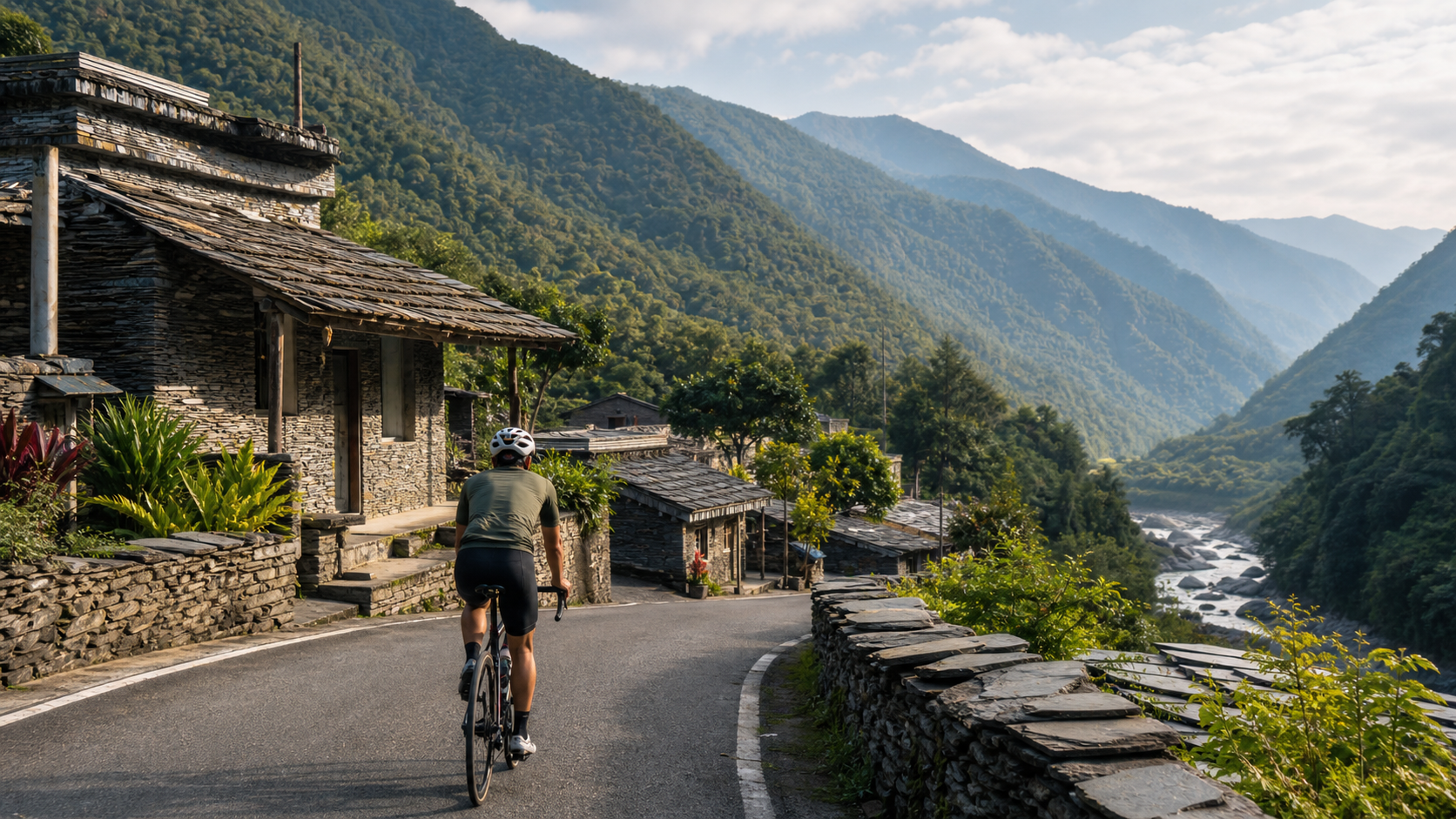
Some routes are measured in seconds and watts; others must be ridden with the heart. Dona is one of the latter.
Before Departure: A Misconception About a “Gentle” Route
Before setting out on this route to Dona, I had assumed it would be nothing more than an easy, routine training ride. The Strava data showed a total distance of 13.11 kilometers and a Category 0 rating—the lowest difficulty grade in the cycling community. Seeing that combination of numbers, any experienced rider would instinctively file it away in the drawer labeled “warm-up route” or “leisurely cruise.”
But when I actually rode the road, weaving through layer upon layer of mountain ridges deep into Maolin District toward Dona Village, I realized this route gave me far more than just a set of gradient numbers. What it gave me was a complete journey through land, collective memory, reconstruction, and resilience. Dona, called “Kungadavane” in the Rukai language, is an ancient village nestled among mountains in the Zhuokou River basin. When you ride into this valley, you’re not just pedaling through climbs and gradient shifts on asphalt—you’re riding into living history.
In this article, I want to set aside the numbers—power, heart rate, finish time—and properly tell the story of Dona as a place, and how riding through it deepened my understanding of what “the meaning of riding” can be.
The night before departure, I deliberately looked up information about Maolin and Dona, only to realize how shallow my prior knowledge of this place had been. Dona is not one of those influencer routes that pop up on popular cycling group check-in walls, touted as a “must-visit hidden gem.” It sits quietly deep in the Kaohsiung mountains, with no bustling commercial atmosphere and no carefully packaged tourism rhetoric. Precisely because of that, I set out with a more cautious and humbler mindset than usual—I wasn’t going to “complete a route,” but to visit a living village, a community of people who have lived in these mountains for generations. This shift in mindset had actually begun the moment I opened the research materials and started planning the trip, long before I swung a leg over the bike.
Memories of Slate Houses: The Architectural Wisdom of Dona Village
Dona’s most breathtaking first impression often comes from the clusters of slate houses built into the mountainside, stacked from shale. This is one of the few indigenous settlements in Taiwan that still preserves a relatively complete collection of slate houses, and it stands as an important testament to the traditional architectural wisdom of the Rukai people.
The construction of slate houses relies not on reinforced concrete, but on shale slabs quarried, cut, and stacked by hand, one by one, by tribal members. Roofs are built by layering slate tiles, and walls are likewise assembled from stone slabs. This building method not only sources materials from the local mountains but also embodies the Rukai people’s profound understanding of the region’s climate and terrain—slate houses offer excellent insulation and wind resistance, adapting to the mountain’s changeable weather. They are the crystallization of wisdom accumulated through generations of coexistence between the people and this land.
As you ride through the village, slow down—or even dismount and walk for a while—and quietly study the varying textures on those slate walls. You’ll realize that every single slab before you was once carried and stacked by someone’s hands. This warmth of hand-built construction is something no digitized cycling route can quantify through gradient or elevation gain. For a rider, Dona’s significance therefore transcends a mere athletic route—it is simultaneously an open-air architectural museum, a page of tribal life history that hasn’t yet been written into textbooks but stands vividly before your eyes.
I paused at the edge of the village, watching a few elders chatting on the open ground in front of a slate house while children chased each other through the alleys. In that moment, I felt that being able to reach a place like this by bicycle was itself a stroke of luck.
It’s worth noting that preserving and maintaining slate houses requires the tribe to invest considerable effort and resources over the long term. Shale slabs weather and loosen under sun and wind, and both roofs and walls need regular inspection and repair. This is not a building form that can be completed once and left forever; it must be continuously maintained and passed down through generational knowledge of the craft. Looking at these slate houses that have stood firm through the passage of time, I couldn’t help but think that this, too, is a display of cultural resilience—the tribe has chosen not to completely replace traditional methods with modern building materials, but to keep guarding this architectural wisdom inherited from their ancestors, so that future generations can still witness and touch this living history with their own eyes and hands, rather than knowing their cultural roots only through museum display cases or photos in textbooks.
Rukai Culture and the Black Rice Festival: More Than a Tourist Symbol
The Rukai are one of Taiwan’s indigenous peoples with an exceptionally deep cultural heritage, and Dona Village, as one of the Rukai’s important settlements, preserves traces of many traditional rituals and ways of life. Among them, the Dona Black Rice Festival is a highly representative traditional ceremony of the local Rukai, carrying profound beliefs about farming, ancestral spirits, and tribal unity.
The exact timing of the Black Rice Festival may vary from year to year depending on the tribe’s traditional calendar, harvest conditions, and internal arrangements. Riders or visitors interested in attending should be sure to check the official announcements for that year or the latest information posted by the tribe’s social media channels before departing, rather than relying on unverified old information found online, to avoid showing up at the wrong time or causing misunderstandings.
Rather than consuming the Black Rice Festival as a mere “tourist activity,” I prefer to understand it with a mindset of respect and learning—it is an important cultural practice passed down through generations of Rukai people, used to unite the tribe and give thanks to ancestors and the land for their blessings. To the tribal members, its meaning far exceeds the “worth photographing for social media” festival scene that outside visitors might see. As a rider visiting this land, I believe the most appropriate attitude is to maintain humble curiosity. If you have the chance to witness the ceremony in person or interact with tribal members, you should respect local customs and protocols, rather than reducing the tribe’s traditional culture to a sensational social media post.
Beyond the Black Rice Festival, the Rukai also possess rich and distinctive cultural traditions in clothing, carving, oral literature, and social hierarchy. These cultural elements are largely scattered throughout the tribe’s daily life and public spaces—if you observe carefully, you’ll find clues worth savoring everywhere. I must admit that, as an outside rider, my understanding of these cultural details remains quite limited, which reminds me all the more not to speculate or oversimplify any specific cultural nuance. The best approach is always to remain open and curious, building understanding through local guides or sharing from tribal members, grounding comprehension in reality rather than imagination.
I also reminded myself that, as a visitor passing through on a bicycle, what I saw of Dona was ultimately just a very narrow cross-section of life in this village. The daily rhythms of tribal life on this land—the timing of farming, traditions of hunting and gathering, ethics and hierarchies among families, ritual stories passed down by word of mouth—none of these can be truly understood through a two- or three-hour ride. Rather than rushing to slap a simplified label on Dona in my mind, I’d rather treat this ride as a starting point—a reminder to spend more time in the future, with a humbler attitude, getting to know this land and this people. The bicycle brought me here, but truly understanding this place requires a much longer period of listening and learning.
The Zhuokou River Basin: Riding Scenery Between Mountains and Water
Dona Village sits in the Zhuokou River basin, a river that winds through the mountains of the Maolin National Scenic Area and forms the most captivating landscape backdrop of the region. Along the Dona route, you’ll frequently catch sight of magnificent scenes where river valleys and mountain ridges interweave. Especially in the early morning or afternoon when the clouds and mist partially clear, light spilling across the valleys creates a tranquil, expansive visual experience that no urban riverside bike path can match.
The Maolin National Scenic Area has long been known for its rich natural ecology and geological landscapes. Beyond nurturing the way of life in Dona Village, the Zhuokou River basin also supports diverse habitats for flora and fauna. Riding through such an environment, with the occasional sound of insects and birds and the moist scent of the forest in your breath, this direct connection with nature is precisely what makes mountain cycling routes so captivating and addictive.
The Maolin National Scenic Area encompasses several indigenous villages, including Dona, Wanshan, and Yumao. This region has been a living space where tribal people and the natural environment have coexisted for generations. The waters of the Zhuokou River not only nourish the surrounding wildlife and plant life but also serve as a vital water source for the villages—irrigation for crops, daily water use, and even water-related rituals in traditional ceremonies are all intimately tied to this river. Riding along the road carved beside the valley, I often found myself slowing down, gazing into the depths of the gorge, and imagining how, hundreds of years ago or even longer, the ancestors of these tribal people followed this river to find this valley—surrounded by mountains, easy to defend, and rich in water—and settled here for generation after generation. Such imaginings add a layer of temporal depth and weight to what would otherwise be merely a scenic backdrop for exercise.
I remember the section in the middle of the route where the gradient picked up. My breathing grew heavier, but catching a glimpse of the mist-wreathed valley in my peripheral vision, the interweaving of effort and beauty made each pedal stroke feel more willing. This echoes the gradient data discrepancy mentioned in the previous practical guide—this route, with 508 meters of total elevation gain yet an average gradient of only 2.5%, is precisely because of its undulating profile, alternating between gentle stretches and steeper pulls, that it creates constantly shifting perspectives and layers of scenery. Even while catching my breath, I couldn’t bear to miss the valley views that unfolded around every corner.
After Typhoon Morakot: A Story of Reconstruction and Resilience
To truly understand Dona, one cannot avoid the immense impact that Typhoon Morakot in 2009 (commonly known as the 88 Flood Disaster) brought to this land and its villages. That year’s century-scale torrential rains devastated the mountain regions of southern Taiwan. The roads connecting Maolin and Dona were severely damaged in the storm, cutting off the village’s access to the outside world, and profoundly affecting the lives and livelihoods of tribal members.
The reconstruction process after the disaster was long and arduous. Whether it was road repair projects, the reorganization of village infrastructure, or the psychological rebuilding of a sense of safety and home among tribal members, none of these could be accomplished in a short time. For any outsider visiting Dona, this history deserves to be kept in mind—approach this seemingly ordinary asphalt road with understanding and respect. It is, in fact, a lifeline painstakingly rebuilt bit by bit by the tribe and engineering teams after surviving the disaster.
Today, when we ride our bikes easily along this access road, enjoying the valley scenery and village atmosphere, it may be hard to directly feel how deep the wounds of that disaster were. But precisely because I know this history, as I rode, I felt a sense of gratitude toward every smooth stretch of pavement and every bridge spanning the valley—gratitude for the people of this land who, with resilience and perseverance, restored their home brick by brick, road by road. In a way, this resilience echoes the very spirit that cycling itself upholds: even when the journey is hard, even when the finish line is nowhere in sight, you still choose to keep pedaling, stroke by stroke, until you reach the other side.
The reconstruction after the disaster was not just about repairing hardware like roads and bridges; it also involved replanning the tribe’s industries and livelihoods. Many tribal members who had depended on farming or tourism had to rethink the direction of sustainable development for the village after the disaster. Quite a few also invested in community building and the promotion of ecotourism, hoping to preserve the tribe’s traditional culture while creating stable living conditions for the next generation. Such efforts echo the reconstruction journeys of many other mountain villages across Taiwan after natural disasters—reconstruction has never been as simple as fixing roads and rebuilding houses; it is a long-term struggle involving tribal identity, economic self-sufficiency, and cultural inheritance. As a traveler passing through on a bike, I think the least I can do is support the local economy with gratitude and respect—patronizing the tribe’s tourism and agricultural products—so that every visit gives something real back to this land and the people who live here.
A First-Person Riding Narrative: Thirteen Kilometers of Breathlessness and Scenery
On the day of departure, the weather wasn’t particularly hot, and the mountain air carried a slight chill. For the first few kilometers from the start, the road was indeed relatively gentle, as the data suggested. The mountain ridges on both sides slowly receded, and I maintained an easy cadence, letting my body ease into the ride, thinking to myself: this is probably going to be a leisurely cruise.
But after reaching the middle section, the gradient began to climb without warning. My cadence dropped noticeably, and my breathing quickened. It was in that moment that I truly understood the discrepancy hidden behind the “2.5% average gradient” figure—this stretch of road was absolutely not as easy as 2.5% should feel. I adjusted my breathing rhythm, shifted to a lower gear, and settled into a pace I could sustain without blowing up, reminding myself that this was exactly the localized steep section masked by the average. Get through this, and the road should ease up again.
Sure enough, after getting past the most breathless stretch, the road gradually leveled out again, and the view opened up at that moment—the outline of the Zhuokou River valley appeared faintly through the mist, and the rooftops of the village’s slate houses were scattered across the hillside. In that instant, all the gasping and aching suddenly felt meaningful. I slowed down, letting myself take in the scenery properly rather than rushing toward the finish to set a completion time that wouldn’t have meant much to me anyway.
When I reached the vicinity of the village, I deliberately stopped, walked into the alleys, and absorbed the tranquil atmosphere of the slate house clusters. A few tribal members nodded warmly in greeting, and children’s laughter echoed through the lanes. In that moment, I felt deeply that the value of this ride had long surpassed the numbers on my Strava record. It had become a journey of genuinely stepping into another’s living space, learning and feeling with respect.
Nearby Attractions: Dona Suspension Bridge and Dona Hot Spring
If time and energy permit, after completing the Dona route, I highly recommend visiting two well-known local attractions—the Dona Suspension Bridge and the Dona Hot Spring—to add further depth and richness to the trip.
Dona Suspension Bridge spans the Zhuokou River and is one of the key landmarks for entering and leaving the village, as well as an excellent vantage point for enjoying the valley scenery. Standing on the bridge, looking down at the stream flowing through the riverbed with green mountains on both sides, it’s a spot where many riders and visitors stop to take photos when visiting Dona. Whether you ride across or walk onto the bridge, you can feel the tranquil atmosphere of mountain breezes on your face and the sound of flowing water in your ears. It’s also a wonderful place for a body still catching its breath after the climb to rest and let the heart rate settle.
Dona Hot Spring is another well-known natural resource of the area. The spring water comes from geothermal sources along the banks of the Zhuokou River. For riders who have just finished a route with climbing intensity, if you can work a hot spring soak into your itinerary, it’s undoubtedly an excellent way to soothe sore muscles and relax both body and mind. Of course, regarding the actual opening status, facility conditions, and whether a local guide is needed, I recommend checking the latest information before departure or asking local businesses or the tribal association—after all, the operating status of mountain attractions can sometimes shift due to seasonal or weather conditions.
These nearby attractions make the Dona ride more than just an “exercise route”—it becomes a complete little journey: riding into the mountains, getting to know the village, experiencing the resilience born of post-disaster reconstruction, and finally, between the suspension bridge and the hot spring, letting both body and mind undergo a profound cleansing.
What This Route Means to Riders: Scenery You Can Only See by Slowing Down
Looking back on this trip to Dona, I’ve gradually come to understand why this kind of route deserves to be written about on a blog and seen by more riders. Its gradient data may not make competitive riders’ eyes light up, and its Category 0 rating ensures it will never appear in discussions of hardman climbing rankings. But it is precisely this “unremarkable on paper” quality that allows Dona to preserve a space where people can slow down and truly absorb everything around them.
Cycling in our generation is easily dominated by quantitative metrics—power numbers, climbing rankings, KOM battles. These are all worthy goals and part of what makes the sport fascinating. But what Dona taught me is another possibility for riding: treating the bicycle as a key, using it to open a door to unfamiliar land and unfamiliar culture, using the rhythm of your pedaling to draw close to a village’s breathing, to understand a history of disaster reconstruction, to respect a way of life that is entirely different from your own yet equally worthy of cherishing.
For me, what the Dona route ultimately leaves behind is not a finish time, but those moments of stopping, looking up at the slate houses, listening to the river, and thinking about what this land has been through. This kind of experience is perhaps what makes bike travel most precious compared to pure physical training—it allows sport and humanity, sweat and reverence, to converge on the same stretch of road.
If you’re also planning to ride this route, my advice is simple: bring your bike, and also bring a heart willing to slow down, to learn, and to respect. Dona will repay you, in its own unique way, with a harvest far richer than any set of gradient numbers.
Related Reading
- Dona Route Practical Guide: Beneath a Category 0 Gentle Rating Lies the Truth of 508 Meters of Climbing
- Riding the Kaohsiung Maolin Mountains: 3 Indigenous Village Routes—Dona, Wutai, Ali
- Riding Through Namasia: Bunun and Kanakanavu Memories Along the Nanzihsian River, and the Resilience of Disaster Reconstruction
- Journey to the Land of Clouds: A Ride Through Wutai Township’s Rukai People and the Double Migration of Haocha Village
藤枝二集團 單車行 Day1 | 南部小武嶺 | 爬坡爬到罵罵叫 | JJSC | 公路車 | CT Yeh
3 年前
一定要騎一次!阿里山最深處:里佳部落!單車旅行 | 2800m爬升 | 深度部落體驗:嗨翻晚會、螢火蟲、銀河 | feat. JJSC & 廢物伙伴 | 公路車 CT Yeh
10 個月前
里佳部落 阿里山單車深度旅遊! | 竹山/草嶺/來吉/奮起湖 | 無敵銀河絕景 全新路線探索! 驚險狀況百出! | 4K沉浸式畫質 | 公路車 | CT Yeh
3 年前
阿里山塔塔加 兩倍特濃版!全新隧道開通! 進喔!公路車 | CT Yeh
3 年前
公路車 | 塔塔加驚險員工旅遊 | 還好手腳快沒被抓交替!
5 年前
那瑪夏x茶山 阿里山系深山單車行 Day2 累積爬升6000M | 🥶超陡連續下坡 整路看隊友刷 | 爬升一座西進武嶺 | JJSC | 公路車 | CT Yeh
3 年前
嘉義大埔、阿婆灣挑戰賽,美到以為在日本!ft. 環騎5 Cool 西拉雅188 / 公路車 / CT Yeh
7 個月前
萬年峽谷! 30% 超激陡坡 里佳部落DAY2 還是很硬! | 公路車 | CT Yeh
3 年前