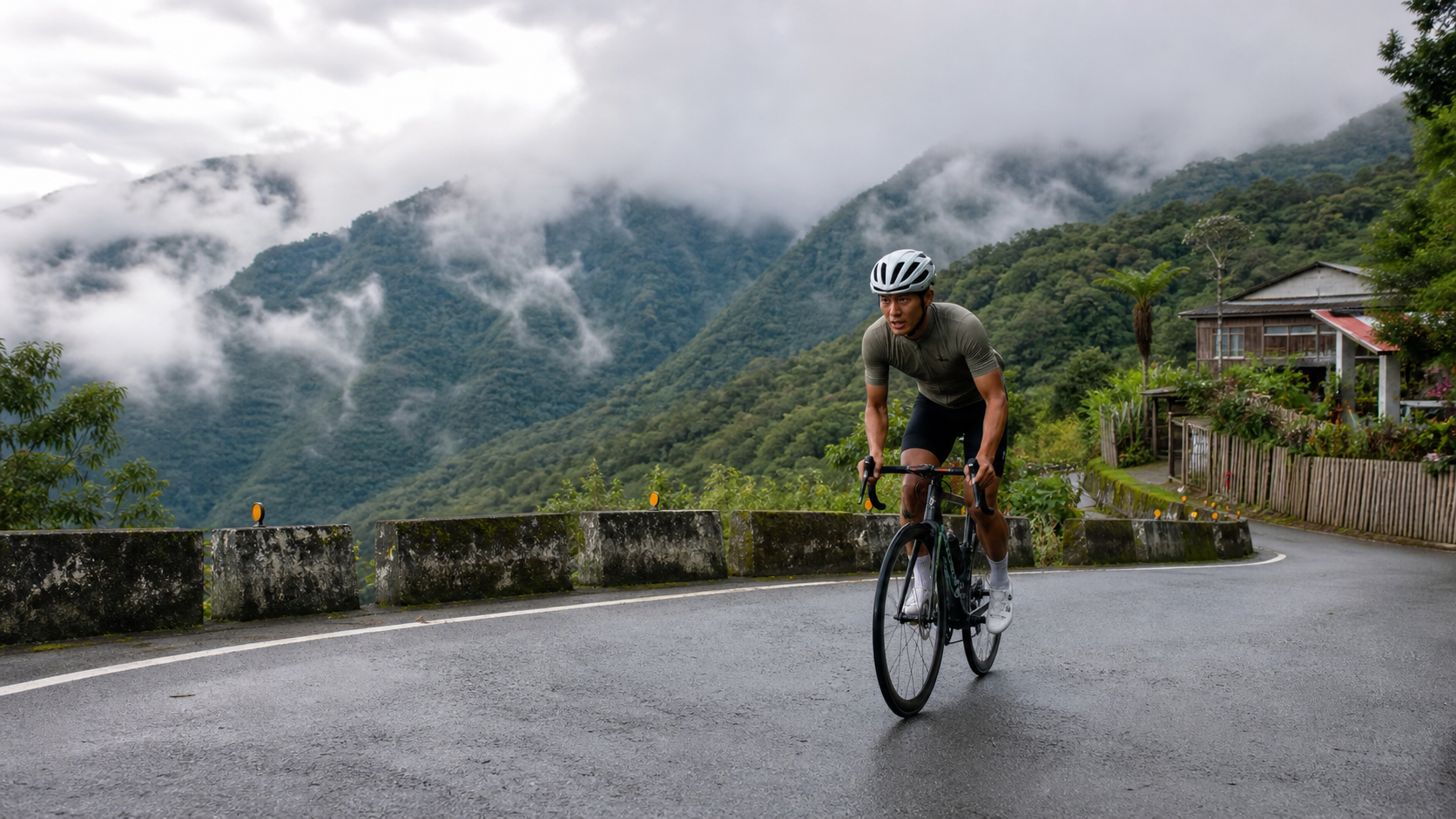
The Crossroads Deep in Jianshi: From Yufeng to Yulao, a Ride Through Clouds and Mist
8.3 kilometers, nearly 700 meters of elevation gain. This road has no grand viewpoints, yet it holds the most authentic mountain life of the Atayal tribes.
Jianshi Township: The Last Untouched Land Before the Northern Cross-Island Highway
Jianshi Township in Hsinchu County—a name familiar to Taiwan’s road cycling enthusiasts, yet always carrying a hint of mystery. It sits at the starting section of Provincial Highway 7, the Northern Cross-Island Highway, serving as the last populated outpost before entering the deep mountain sanctuaries of Shei-Pa National Park, Guanwu, Smangus, and Cinsbu. Nearly the entire township is mountainous, inhabited primarily by the Atayal people, with tribes scattered among the peaks. Yufeng and Yulao are two significant geographical coordinates within this forested expanse.
Yufeng, formerly known as “Malikoan,” is the gateway settlement to the rear mountain area of Jianshi Township (commonly called “Rear Jianshi”). The Atayal community here has preserved a relatively intact traditional way of life, and it serves as a transportation hub toward Naro, Yulao, Qingquan, and Guanwu. Yulao, at an elevation of approximately 1,450 meters, is said to derive its name from the Atayal language, meaning “the place where monkeys live.” It marks the dividing point between the front and rear mountains of Jianshi, and is a必经之地 for those heading to Smangus (commonly known as “the Tribe of God”) and the sacred groves of Cinsbu.
For riders familiar with Taiwan’s mountain geography, this short 8.3-kilometer climb from Yufeng to Yulao symbolizes a geographical and cultural transition—from the relatively open foothill settlements, climbing steadily into the cloud-wreathed, climatically distinct deep mountain zone. This abrupt shift in elevation and climate is what makes this route both the most captivating and the most demanding.
First-Person Ride Narrative: From Valley Humidity to Mountain-Top Mist
Setting out from Zhudong in the early morning, turning onto Provincial Highway 3 toward Jianshi, the dawn light still carried a hint of coolness, and the sound of streams in the valley grew clearer with each turn of the wheels. After crossing Jianshi Bridge, officially entering Jianshi Township, the mountains on both sides began to close in, and the road wound accordingly. By the time I reached Yufeng, the sun had already climbed over the ridge. Elders sat under the eaves of a few homes, soaking in the sun, casting friendly yet quiet glances at the passing rider—this is the unique rhythm of mountain tribes: not boisterous, yet not indifferent either.
Starting from Yufeng, barely a few pedal strokes in, the gradient hit without ceremony. The stuffy heat of the first kilometer still clung to my skin, and sweat quickly soaked through my jersey. This road offers no gentle warm-up period; it tells you in the most direct way possible: this is Jianshi Township, and these roads were never built for the comfort of tourists.
Around the three-kilometer mark, the tree cover began to thicken, sunlight filtered into fine dappled patterns on the asphalt, and the temperature visibly began to drop. This is the most enchanting transformation of the Yufeng-to-Yulao climb—you can physically feel the climatic shift brought by elevation gain, from the humid heat of the valley to the crisp, moist coolness characteristic of mid-altitude mountains. Occasionally a breeze sweeps through, carrying the distinctive scent of mountain vegetation mixed with the damp earthiness after rain—a sensory experience no urban road can replicate.
Hairpin turns came one after another, and with each bend, the view shifted subtly—sometimes layered mountain silhouettes, sometimes mist rising slowly from the valley, wrapping around the treetops halfway up the slopes. This elusive, shifting cloud-and-mist scenery is the most representative climatic feature of the rear mountains of Jianshi, especially prevalent in the early morning or during high-humidity afternoon hours, draping the entire climb in a thin veil.
Approaching the final kilometer before Yulao, the view suddenly opened up. Looking back, the road I had traveled wound and disappeared into the depths of the forest, with the layered peaks of Jianshi Township spread out in full view. The moment I reached Yulao, the ache in my legs and the shortness of breath were instantly diluted by the expansive panorama before me. The Yulao Police Station stands at the high point—a必经 stop for many travelers heading to Smangus and Cinsbu, and the perfect spot for riders to catch their breath and take photos.
Landmarks and Cultural Scenery Along the Way
The Yufeng settlement itself is worth slowing down to savor. This is part of the traditional territory of the Atayal people, and the tribe retains several elements of traditional architecture and traces of daily life. The spire of the church stands out prominently in the valley—Christian faith is a shared cultural characteristic of many indigenous tribes in Taiwan, and a key to understanding the local social fabric. If riders have the chance to converse with local residents along the way, they often hear countless stories about these mountains, from the logging history of earlier years to the tourism transformation of recent times—deep memories that outsiders can never read from a map.
Along the surrounding industrial roads, fruit trees and vegetable gardens occasionally appear on the hillsides—one of the important economic sources for the residents of Jianshi’s mountain areas, and a testament to the wisdom of coexisting with steep terrain. Carving out arable space on such precipitous slopes is itself a survival skill honed through long-term negotiation with the land.
Yulao’s status as a transportation crossroads also makes it a small window into the pulse of Jianshi’s tourism. On weekends, shuttle vans and self-driving tourists heading to Smangus and Cinsbu stream by in an endless flow, forming an interesting contrast with riders who quietly conquer this gradient with their own legs—both aiming to reach the deep mountains, yet choosing vastly different means.
What Riding This Route Means to Me
Every time I challenge the Yufeng-to-Yulao climb, it feels like a process of dialogue with myself. 8.3 kilometers is not long, but an average gradient of 8.2% is enough to force a re-examination of breathing rhythm, heart rate, and that focus usually buried under daily trivialities, with every single pedal stroke. The most captivating aspect of mountain riding has never been merely the sense of accomplishment at the summit, but the heightened state of synchronicity with the environment and your own body throughout the process—you can hear your heartbeat, feel the trail of every drop of sweat, and in the steepest moments, experience a nearly meditative focus.
This route has also made me rethink the essence of “challenge.” It doesn’t have the national fame and pilgrimage status of Wuling, nor the heavy historical baggage of famous Tour de France stages. It is simply a road quietly existing in the deep mountains of Hsinchu, serving the daily commuting needs of local residents, yet coincidentally, because of its gradient and terrain, it has become an excellent training ground for road cycling enthusiasts. This kind of “atypical” challenge route often brings one back to the purest essence of riding—not for check-ins, not for social media shares, but simply to know whether today I can ride just a little better than yesterday.
Seasonal Scenery and Suggested Extensions
The Yufeng-to-Yulao route offers different faces in every season. In spring (March to April), mountain cherry blossoms and other native plants bloom sporadically, adding rich layers of color to the forest. In summer (May to September), the canopy is dense, and while humid, it provides considerable shaded sections; afternoon fog or thunderstorms are common, so an early start is recommended. Autumn (October to November) typically brings more stable weather, making it one of the best seasons for long mountain rides, with excellent visibility and clearly defined ridgelines. Winter (December to February) brings damp, cold conditions from the northeast monsoon, requiring more careful gear preparation; the Yulao area at the summit occasionally experiences low temperatures or even thick fog, offering a uniquely desolate beauty.
If time permits, a suggested extension is to continue to Neiwan Old Street, experiencing the town’s blend of Hakka and indigenous culture, and sampling local specialties such as wild ginger flower rice dumplings and Hakka lei cha (pounded tea) (for specific shops and business hours, please refer to on-site conditions). If energy and time allow, consider venturing further into the Naro tribe to appreciate its poetry-themed trail and tribal art installations. Naro is known as Jianshi’s “Poetry Tribe,” with numerous poetry installations along the way—perfect for riders who appreciate cultural ambiance and prefer to take things slow.
A Message to Future Challengers
If you’re also planning to take on the Yufeng to Yulao climb, what I want to tell you is this: don’t treat this route merely as a data point to conquer. The 8.2% average gradient and 678.8 meters of elevation gain are certainly important—they help you prepare your gear and fitness—but what truly makes this route worth returning to again and again are the fleeting sensory experiences along the way: the dappled sunlight filtering through the forest canopy in the morning, the sight of mist slowly rising from the valley, the expansive view that opens up the moment you reach Yulao, and the unpretentious kindness exchanged with local residents as you pass by.
After riding this route, what you take away won’t just be a finish time or a segment ranking, but a deeper understanding and respect for the mountains of Jianshi Township. Perhaps this is the most precious thing about road cycling—it lets us get to know a place in the most grounded way, to feel its history, and to discover the pristine landscapes hidden deep in Taiwan’s mountains that have yet to be overdeveloped or commercialized. If I ever have the chance to ride from Yufeng to Yulao again, I’ll still look forward to that ascent from the sweltering valley into the mist-shrouded heights—that is the most sincere gift this route offers to every rider who takes it seriously.
Sounds and Scents of the Mountains
Riding mountain routes, beyond the visual scenery, there are many sensory memories that are easily overlooked yet equally profound. On the Yufeng to Yulao stretch, you’ll rarely hear the roar of engines or honking horns of the city. In their place are the rustling of wind through treetops, occasional bird calls, the faint sound of streams echoing from distant valleys, and the gradually quickening rhythm of your own breathing alongside the steady whir of the drivetrain. This nearly pure acoustic environment is one of the sensory experiences urban riders most readily rediscover on mountain rides.
Scent is another layer of memory anchored along this route. Setting off from Yufeng, the air carries the distinctive smell of woodsmoke and earth from the valley settlement; as altitude increases and the forest grows denser, the air begins to mingle with the scent of damp humus and conifer resin—that cool, crisp aroma unique to mid-elevation forests. If you happen to ride shortly after rain, the moist fragrance emanating from soil and vegetation becomes even more pronounced. That distinctive scent known as “petrichor” is especially memorable as it weaves between the asphalt and the surrounding forest.
Brief Encounters with Local Residents
On remote mountain routes, the most precious moments are often the inadvertent encounters with local residents. In the Yufeng settlement, you might occasionally see tribal elders sitting in front of their homes, weaving bamboo baskets or sorting freshly harvested mountain produce. They typically regard passing cyclists with a calm familiarity—sometimes nodding in acknowledgment, sometimes casting a curious glance. This unassuming interaction, devoid of the contrived enthusiasm of commercial tourist areas, actually offers a more authentic glimpse into everyday tribal life.
If you encounter local residents driving farm vehicles or scooters along the way, the narrow mountain roads make mutual yielding and greeting almost an unspoken convention. These subtle yet genuine exchanges between locals and outsiders are a warmth of human connection that can only be experienced on remote routes—an experience that polished tour packages can hardly replicate.
Mountain Wisdom Within the Atayal Cultural Context
As part of the traditional territory of the Atayal people, this mountain landscape has never been merely a set of geographic coordinates for its residents. It is a cultural space carrying hunting grounds, ancestral beliefs, and generations of life wisdom. The traditional Atayal “Gaga” normative system encompasses ethical principles governing hunting, farming, rites of passage, and ceremonies across all aspects of life, with the sustainable use of mountain resources being one of its core values.
When riding through this land, having a basic understanding of and respect for this cultural context will make the entire journey far more meaningful. This is not just a route suited for training climbing ability—it is land with its own historical narrative and cultural weight. I’d suggest that riders slow down when passing through tribal settlements, maintain basic respect and courtesy, and treat the ride not only as a physical challenge but also as a humble lesson in culture.
In Closing: A Rider’s Hidden Gem
Compared to famous climbs like Wuling or Hehuan Mountain—routes already renowned far and wide, with traffic jams on weekends—Yufeng to Yulao is more like a hidden gem that “those who know, know.” There’s no grand landmark arch for photo ops, no row of shops waiting to serve weary riders—just the rawest gradients, the most authentic mountain forests, and the occasional warm moments of passing by local residents.
Precisely because of this, the route is especially suited for riders who have already ticked off the famous climbs and are beginning to seek a riding experience more connected to the texture of the land. It reminds us that the original joy of road cycling was never about chasing popular check-in spots or social media buzz, but about discovering, through our own legs and wheels, the quiet yet profound beauty hidden in the corners of Taiwan. Yufeng to Yulao deserves to be seen by more riders who know how to appreciate it.
One Road, Two Identities Intertwined
Interestingly, the road from Yufeng to Yulao carries two distinctly different identities at once. For the local Atayal residents, it is an everyday lifeline—the route they take for commuting, transporting produce, and traveling between the tribe and town. It is an unremarkable part of daily life. But for road cyclists arriving from afar, it is a “challenge route” that requires advance planning, careful gear preparation, and physical readiness to complete.
This intersection of identities is, in fact, a microcosm of many mountain roads across Taiwan—the same stretch of asphalt bearing vastly different meanings and weights. When we ride on such roads, perhaps we should carry a bit more humility: we are passersby on this land, visitors briefly borrowing this road to accomplish our personal challenges, while this mountain and this road have always belonged to the people who have lived here for generations. Riding with this mindset adds depth to the journey and strips away some of the purely athletic competitiveness.
If you haven’t yet descended by sunset, the light and shadow in the valley take on an indescribably gentle hue. Golden rays spill across the distant ridgelines, forming a stark contrast to the hardship of the climb. In that moment, all the fatigue suddenly seems to have meaning—this is Yufeng to Yulao, responding to every rider who has pedaled this road in earnest with the most honest gradients and the gentlest scenery.
Redefining “Scenery” from a Rider’s Perspective
When people talk about scenery on cycling routes, they often think of majestic mountain ranges, expansive ocean views, or famous viewpoints. But Yufeng to Yulao taught me that scenery has another definition, one much closer to bodily sensation—the focus when pedaling rhythm and breathing rate fall into sync, the instant sweat drips onto the handlebars, and the complex mix of fear and eagerness that arises every time you look up at the endless climb ahead.
This “scenery of bodily sensation” often leaves deeper memories after completing a challenge than purely visual beauty. I still remember finishing this route for the first time, sitting on the low wall beside the Yulao police station, looking at my sweat-soaked jersey, listening to the wind passing by my ears—that feeling of exhaustion mixed with satisfaction was far more profound than simply looking at a beautiful landscape photo. Perhaps this is the most captivating aspect of road cycling—it is never just about “arriving somewhere,” but about “truly experiencing the process of getting there with your own body.”
If you’ve ever stood at the starting point of Yufeng to Yulao, looked up at the winding road ahead, and felt a flicker of hesitation, I want to tell you: just pedal. This road will not shortchange any rider willing to honestly confront their physical limits. It will respond to every ounce of effort you put in, in the most direct and unadorned way. And when you reach Yulao and look back at the road behind you, you’ll understand—it was all worth it.
An Invitation to the Next Visitor
Taiwan’s mountains are always richer and more layered than we imagine. Yufeng to Yulao may not appear on the most popular lists of top-100 cycling routes, nor will it be on every road cyclist’s must-ride checklist for beginners, but it sits quietly deep in the mountains of Jianshi, Hsinchu, waiting for every rider willing to invest the time to truly understand it.
The next time you plan a mountain training trip, consider adding this route to your list. Set out with respect for the land and its local culture, use your legs to feel the climate shifts brought by elevation gain, use your eyes to capture the fleeting moments of clouds and mist weaving through the ridgelines, and use your body to remember that persistence of choosing to keep going even when you’ve pushed your pedaling to the limit. These experiences will stay with you far longer than any finisher’s certificate or segment ranking, becoming one of the reasons you love this sport and this land.
May everyone who rides from Yufeng to Yulao carry this reverence for the mountains forward, turning the memory of this road into the most grounded confidence and strength deep in your heart when facing other challenges ahead. And before you set foot in these deep mountains again, don’t forget to leave some time to sit quietly by the roadside at Yulao, listen to the wind, watch the clouds and mist, and let both body and mind truly absorb the emotion this journey brings. This crossroads hidden deep in Jianshi will always be there, waiting for the next traveler who wishes to get to know this land on two wheels.
Perhaps this is the most moving part of Taiwan’s mountain road cycling culture—we can always discover our own hidden gems and stories on seemingly ordinary industrial roads or county road branches. Yufeng to Yulao needs no flashy marketing; its gradients, its clouds and mist, and every Atayal elder’s face encountered along the way already form the most authentic and moving narrative. May we all continue to explore the untold stories of Taiwan’s mountains and forests with such humble and curious hearts on our future rides.
Related Reading
- Yufeng to Yulao Practical Guide: The 8.3km, 8.2% Average Grade Tough-Man Test in Jianshi Township
- Yulao, Gazing at the Mountain Tops: A Cycling Epic of Perseverance and Vastness
- Hsinchu Jianshi Township Mountain Routes: A Climbing Training Route Guide in Indigenous Tribal Mountains
- Riding in Jianshi Township’s Mountains: A Cultural Ride Through Atayal Tribes in Hsinchu’s Highlands
一定要騎一次!阿里山最深處:里佳部落!單車旅行 | 2800m爬升 | 深度部落體驗:嗨翻晚會、螢火蟲、銀河 | feat. JJSC & 廢物伙伴 | 公路車 CT Yeh
9 個月前
台北闊瀨陡坡 騎旅 / 日本單車雜誌編輯車友臨時加入!/ 髮香才是最強的 / feat. 北迴歸線小隊 / 公路車 CT Yeh
6 個月前
新竹羅平 x 天湖部落 大禹嶺級變態陡坡! 4K超高畫質 空拍 | 公路車
5 年前
新竹白蘭部落! 爬陡坡還能講笑話...? 廢物伙伴の約騎 | 公路車 | CT Yeh
4 年前
宇老大滿貫(改)/ UBike神人 / 太離譜了!出大景 差點被擊落 / feat. 神秘密境單車團 / 公路車 / CT Yeh
2 年前
大武山20%魔王陡坡【JJSC南台灣遊騎Day2】!屁股真的要裂開了...凡士林抹滿也沒用?神秘金教堂還有超便宜夜市
3 個月前
嘉義大埔、阿婆灣挑戰賽,美到以為在日本!ft. 環騎5 Cool 西拉雅188 / 公路車 / CT Yeh
7 個月前
阿里山塔塔加 兩倍特濃版!全新隧道開通! 進喔!公路車 | CT Yeh
3 年前