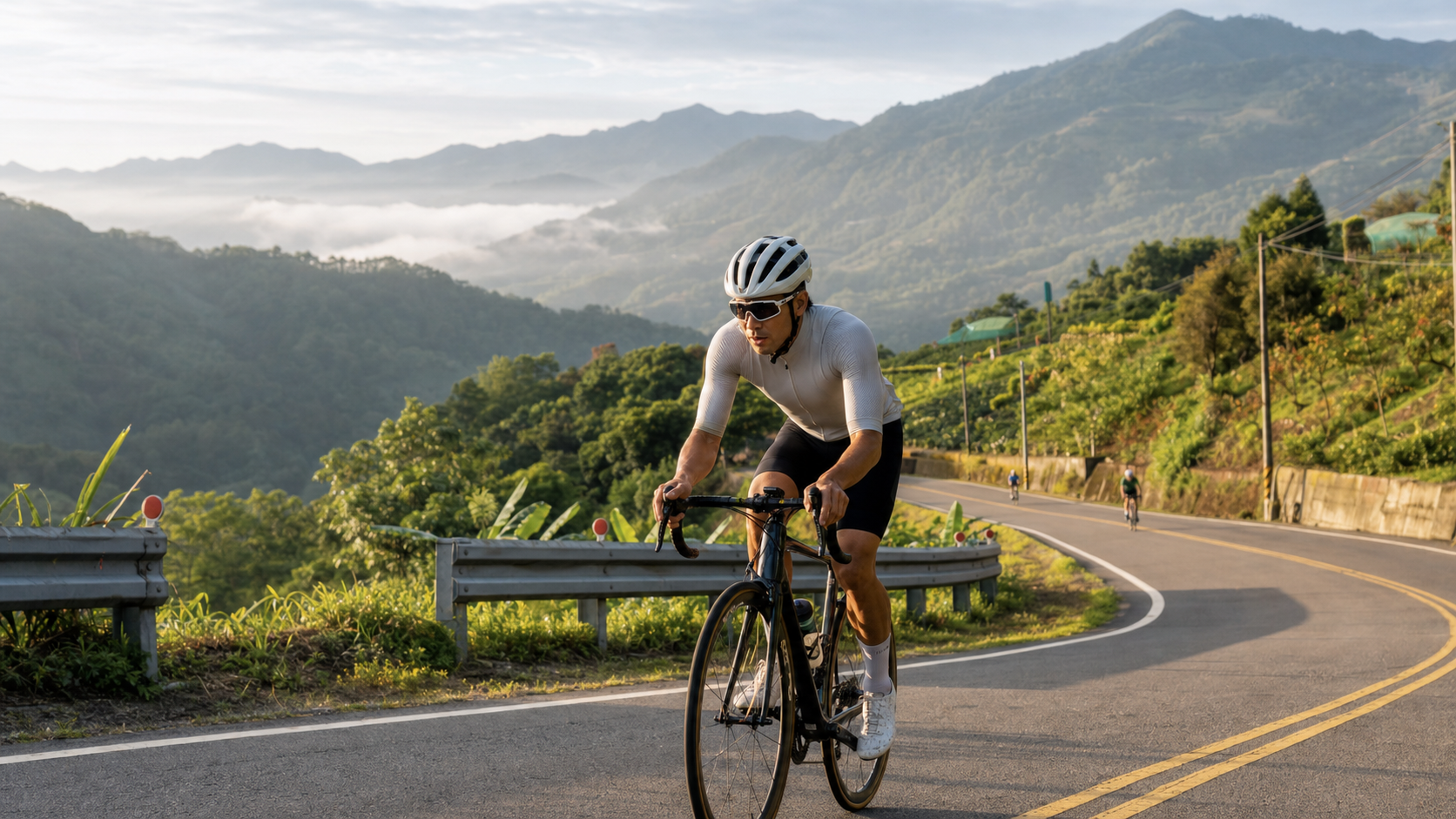
Finding your own rhythm on the grades of Luoma Road—a cycling memory from the mountains of Taoyuan
Some routes are captivating not because of how long or steep they are, but because every time you push down on the pedals, they evoke a feeling that is hard to put into words, yet strangely familiar. For many cyclists in northern Taiwan, Luoma Road is exactly such a route.
1. Luoma Road: a bit of background on its geography and the origin of its name
Luoma Road, located in the mountainous area of Taoyuan City, is an important mountain road connecting Daxi toward Fuxing and the Dongyanshan area. For those familiar with road cycling routes in northern Taiwan, this name needs almost no introduction—alongside the main Northern Cross-Island Highway (Provincial Highway 7), which also heads toward Fuxing, it is one of the common options that many cycling clubs include in their weekend group rides and training plans.
The name “Luoma Road” sounds romantic with a touch of exotic flair. People hearing it for the first time often smile to themselves, wondering if it has something to do with Rome, Italy. But in fact, the more commonly circulated explanation among cyclists is that the name is said to derive from the place names along the route—Luofu and Maduku—that it connects. As for the official and precise origin, we would still recommend deferring to local historical records or the accounts of local elders. We dare not and would rather not make a definitive claim here. After all, the origins of place names often carry layers of accumulated history—there are official recorded versions and versions passed down by word of mouth, and the two do not always align perfectly. Rather than stating things with absolute certainty, it is more honest to say: this is the version circulated among cyclists, and the actual origin is better left to those who know the local history more deeply.
Regardless of the exact origin of the name, the four characters “Luoma Road” have long become a concrete and clear symbol within the northern Taiwan road cycling community—when it is mentioned, what comes to mind for cyclists is not the Colosseum and ancient ruins of Italy, but the winding, undulating asphalt of the Taoyuan mountains, the landscape transitioning gradually from suburban settlements to hilly terraced fields and orchards on both sides, and that riding rhythm somewhere between “a bit breathless, but still able to enjoy the scenery.” Compared to the main Northern Cross-Island Highway, which carries heavier traffic with more tour buses and trucks, Luoma Road—with its relatively sparse traffic and generally well-regarded road surface—has gradually developed its own loyal following, becoming what many consider “a hidden gem route for climbing practice in northern Taiwan.”
What this article aims to record is a roughly 5-kilometer stretch of this route that cyclists call the “middle section”—it is not particularly long, yet it condenses the most captivating parts of the route: a riding experience where the undulations are far from monotonous, the scenery keeps changing, and a unique sense of tranquility unique to the mountains can be felt.
2. First-person riding narrative: stepping onto this familiar yet unfamiliar climb
That day was an ordinary holiday morning. The sky had just shifted from deep blue to the pale gray of dawn. I parked my car around Daxi, did a quick warm-up, checked my water bottles and supplies, and set off in the direction of Luoma Road. The early stretch was still relatively gentle, passing by a few settlements where early-rising locals were already starting their day. Occasionally a scooter or small truck would pass by, and riders would nod to each other in greeting—that particular, almost tacit way of acknowledging one another that is unique to mountain mornings, which always feels especially warm to me.
When I entered this roughly 5-kilometer middle section, the gradient began to make itself clearly felt. At first, it did not feel taxing—there was even a sense of anticipation mixed with excitement, as if thinking, “So this is the legendary Luoma Road.” Cadence stayed steady, breathing was still relatively easy, and from the corner of my eye I could take in the layers of mountains gradually unfolding alongside the road—nearby, dark green forest; farther off, ridgelines of peaks half-hidden under a light morning mist.
After riding for about a kilometer or so, the gradient suddenly seemed to switch into a different mode, becoming noticeably steeper. This transition actually aligns quite well with the data characteristics of this stretch—although the overall average gradient is not extreme, the elevation gain, when calculated out, hints that certain sections are far steeper than the average. The physical sensation at that moment confirmed this as well: my previously relaxed cadence began to drop, my breathing rhythm shifted from a smooth “three in, three out” to deeper breaths requiring more focused control, and sweat began to bead on my forehead, even though the mountain temperature in the early morning was not particularly high.
At that moment, I recalled something a seasoned fellow cyclist once told me: “Climbing is never about battling the gradient—it’s about having a conversation with your own breath and heartbeat.” So I slowed my pace and shifted my attention from “how much farther” to “whether this breath, right now, is flowing smoothly.” Interestingly, when my focus moved from distance to breathing, the climb that had been causing anxiety became bearable, and even carried a subtle sense of groundedness—as if I were reconnecting with my own body, step by step confirming that we could both hold on.
After passing this noticeably steeper section, the gradient gradually returned to a relatively gentler rhythm, as if the mountain road had deliberately offered a moment to catch one’s breath. This rhythm of “steep, then a breather, then tested again” is, to some extent, exactly why so many cyclists have a love-hate relationship with Luoma Road—it never lets you get so comfortable that it becomes boring, yet it never turns so cruel that you want to give up, always maintaining a challenge that feels just right.
3. Landmarks along the way and the hilly pastoral scenery of the Taoyuan mountains
Riding along this stretch, what impressed me most was not any particular well-known scenic spot—honestly, this section feels more like a “journey” than a “destination.” Its beauty comes from the accumulation of the overall atmosphere rather than the presence of any single landmark.
Along the way, you can see typical Taoyuan hilly terrain: layers of low mountains and valleys interwoven, with orchards and vegetable fields dotting the landscape here and there, farmhouses scattered in the hollows of the hills, and occasionally the sight of local farmers bending over to tend their fields. This pastoral scenery, full of the rhythms of daily life, stands in stark contrast to the clamor of the city, and it is one of the reasons many cyclists are willing to return here again and again—riding on a road like this, you feel temporarily pulled away from the pace of urban life, entering a slower, more grounded sense of time.
The vegetation changes gradually with elevation, transitioning from the relatively open orchard landscape near the start of the section to forested stretches where the shade grows denser. In summer, the roadside shade becomes a precious place for riders to catch their breath, and the rustling of the breeze through the leaves, mixed with the occasional sound of cicadas, forms a symphony of the mountains that can only be truly appreciated through firsthand experience.
Since this stretch is part of the route toward Fuxing and Dongyanshan, road signs pointing to nearby scenic spots and indigenous communities can occasionally be seen along the way, serving as a reminder that this road is not merely an exercise route, but also a lifeline connecting the various settlements of the Taoyuan mountains. As for which specific viewpoints along this section are worth stopping at, since memories and perspectives vary from person to person, I would not presume to list exact landmark names and locations here. Instead, I would suggest that cyclists, when actually riding, discover at their own pace and rhythm the particular “most memorable bend” that is uniquely theirs.
4. Sensory memories: wind, sweat, and the scent of the mountains
When it comes to cycling, what often lingers is not precise numbers or road condition details, but a memory woven from an interplay of senses. What this middle section of Luoma Road left with me most deeply are several very concrete sensory fragments.
First is the feel of the wind. The mountain breeze in the early morning carries a chill, and blowing against skin heated from climbing, that contrast of cold and hot feels especially invigorating. As elevation gradually rises, the wind begins to carry the scent of vegetation—a smell that is difficult to describe precisely in words, a blend of dew, soil, and the fresh fragrance of plants, utterly different from the exhaust fumes often encountered on city asphalt.
Next is the salty taste of sweat. When the gradient steepens and breathing quickens, sweat begins to form on the forehead and the back of the neck, and occasionally beads of sweat slide into the corner of an eye or the edge of the mouth. That familiar salty taste is almost a shared memory among every cyclist who has seriously climbed. This slightly uncomfortable yet familiar sensory stimulus, in a way, becomes concrete proof that “I am truly challenging myself right now.”
In terms of hearing, aside from the wind and the occasional cicadas and birdsong, the most vivid sounds are one’s own breathing and heartbeat. When the gradient steepens and intensity rises, the sounds of the outside world seem to have their volume automatically turned down, replaced by the increasingly clear rhythm of one’s own panting—a state of focus bordering on meditation, where the world seems to shrink to just breathing, cadence, and the small stretch of asphalt ahead.
Visually, the morning light piercing through the mountain mist, casting soft, shifting light and shadow between the treetops and distant peaks, is a scene I encountered repeatedly on this stretch yet never grew tired of. Sometimes the mist is thicker, and the peaks ahead appear and disappear, carrying a hazy, poetic quality; other times the sunlight is just right, and the contours of the layered mountains are sharply outlined, with colors especially vivid. This visual experience, ever-changing with weather and time of day, is precisely what makes mountain routes the most captivating and the most impossible to fully predict.
5. The Meaning of Riding and Reflections on the Experience: Why We Keep Coming Back
After climbing this 5-kilometer stretch with 369.3 meters of elevation gain, sitting by the roadside for a brief rest, taking a sip of water, and looking back at the slope I just conquered, there is always a sense of satisfaction that is difficult to describe precisely yet feels utterly real. This satisfaction has less to do with how fast I rode or whether I set a personal record than one might imagine—more often than not, it comes from the simple fact that “I truly used my own legs to pedal every inch of this road.”
Climbing on a road bike is, in a sense, a very honest sport. The gradient doesn’t become gentler just because you’re having a bad day; your fitness doesn’t suddenly improve because you wish it would. Everything must be earned step by step, breath by breath, through sheer legs, lungs, and willpower. In a modern life filled with shortcuts and instant-gratification culture, this sense of honesty feels especially precious.
I’ve also gradually come to understand why Luoma Road has become one of the most popular destinations for weekend group rides among cyclists in northern Taiwan. Beyond the route’s challenge and scenery, what matters even more is the sense of community it carries—every holiday morning, different teams and individual riders, driven by similar yet personally distinct reasons, gather on this mountain road. Some are training for races, some simply enjoy the process of exercise, and others, like me, are just looking for a stretch of time to temporarily set aside the city’s hustle and focus on breathing and cadence.
The group-riding culture is especially vivid on this road. You’ll see experienced riders slow down to accompany teammates who are struggling with their fitness; you’ll see complete strangers cheering each other on at steep sections; and you’ll see people naturally gathering at rest points to share gear insights, road condition updates, or simply engage in casual conversation. This sense of connection—temporary yet genuine, born from shared challenges—is perhaps one of the most captivating aspects of road cycling: it’s not just a dialogue between the individual and the gradient, but a unique community atmosphere co-created by like-minded people.
6. Seasonal Scenery: The Four Faces of Luoma Road Throughout the Year
The beauty of Luoma Road is by no means static. As the seasons change, this route takes on completely different appearances—one of the many reasons cyclists are willing to return here again and again.
In spring, the mountain vegetation begins to sprout new buds, and the overall palette leans toward a fresh, tender green. Combined with the occasional mountain mist after spring rains, this adds a touch of hazy poetry to the road. With comfortable temperatures, this season is considered by many riders to be the best time for scheduling long climbing sessions.
In summer, the greenery is at its densest and most lush, making tree shade the most precious resource along the climb. Although temperatures are higher and the physical load is greater, the mountain area remains pleasantly cool in the early morning. Add to that the refreshing quality that occasional afternoon thunderstorms bring to the air, and summer on Luoma Road carries its own vibrant, thriving energy.
In autumn, the weather typically turns dry and stable, making it the most comfortable season for riding in many cyclists’ eyes. The temperature gap between day and night widens, and a light morning mist occasionally appears in the mountains. Paired with the gradually cooling air, riding feels especially refreshing.
In winter, mountain temperatures are noticeably lower than in the plains, and the northeast monsoon occasionally brings gusts of chill. But this also means none of summer’s stuffiness or drenching sweat, which is precisely why some riders who prefer cooler conditions are especially fond of this season. On clear winter days, the mountain air is exceptionally crisp, and the silhouettes of distant peaks stand out with remarkable clarity—also a great time for photography.
No matter which season you visit, Luoma Road retains its unique charm—this ever-changing landscape, shifting with the passage of time, is exactly why mountain routes, compared to flatland roads, make people more willing to return repeatedly and always find something new.
7. Suggested Side Trip: After the Ride, Consider Lingering Around Dasi
If your itinerary starts from the Dasi direction and heads to Luoma Road, after completing the challenge, consider stopping by the Dasi area on your way back to give your cycling trip a more complete conclusion.
Dasi Old Street is a familiar side-trip option for many. The district preserves numerous historic building facades rich in heritage, and the alleys are lined with all kinds of local snacks and souvenir shops—perfect for strolling at a leisurely pace after finishing a climbing challenge and rewarding yourself with a hearty meal (of course, actual shop choices and spending recommendations should follow personal preference and current business conditions; I won’t single out any particular establishment here).
The Dasi area is also a well-known hub for leisure agriculture and tourism resources in Taoyuan, with plenty of nearby vendors offering local cuisine and agricultural specialties. After burning a huge amount of energy on a climbing route, finding a convenient spot to replenish calories and fluids is something of a ritual for many cyclists.
If time and energy permit, some riders also choose to link Luoma Road with other well-known routes in the area (such as the main Northern Cross-Island Highway or the Dongyanshan direction) into a longer itinerary, treating this 5-kilometer middle section as a pivotal core segment that bridges the journey. Whichever arrangement you choose, it’s advisable to leave ample time flexibility before heading out and not to pack the schedule too tightly. The beauty of the mountains often lies in those unhurried moments when you can spontaneously stop and take one more look.
8. The Unspoken Bond Between Mountain and People: Faces Encountered on the Road
During my rides on Luoma Road, beyond the scenery and the gradient, what has left the deepest impression on me are actually the faces I pass by—strangers with whom I nonetheless feel an inexplicable connection. In the early morning hours, the most common road users on this stretch, besides fellow riders carrying supplies and wearing cycling jerseys, include farmers heading out to the fields, elders riding scooters to check on their orchards, and the occasional truck driver slowly making their way through.
Once, on a section where the gradient turned noticeably steeper, just as I was gasping for breath and nearly ready to slow to a crawl, an experienced-looking rider slowly overtook me from behind and, as he passed, softly said, “Keep going, the easier stretch is just ahead.” Just a few words, yet they gave me unexpected strength in that moment. This unspoken willingness to lend a hand to a complete stranger seems to have become a shared culture on Luoma Road—and across the road cycling community as a whole. Everyone has experienced that moment of being breathless and almost ready to give up, which is why they especially understand the value of offering a simple yet sincere word of encouragement when someone else needs it most.
I’ve also had moments resting by the roadside when local residents approached with curiosity and asked, “Do you cyclists come climb this road often? Isn’t it exhausting?” That tone—partly concerned, partly curious—made me feel that for the local residents, this road is no longer merely a transportation route, but a familiar scene in their daily lives where they continuously witness cyclists from all over pouring in sweat and effort. This subtle interaction and unspoken understanding between riders and local residents, accumulated over time, constitutes a unique human landscape of Luoma Road—something no map or route guide could ever fully capture.
As my number of rides increased, I gradually began to recognize a few “regular” faces—riders who, like me, appear on this road almost every holiday morning. We may not know each other well, perhaps not even each other’s names, but every time we meet on the slope, a natural nod of acknowledgment passes between us, and occasionally we even ride side by side for a stretch, chatting about gear, training insights, how strong the wind is today, or how steep the climb feels. This relationship—somewhere between stranger and acquaintance, born from a shared passion—is perhaps the most intriguing and heartwarming aspect of popular group-riding routes like this one.
9. Words from the Heart for Future Challengers
If you’re also planning a ride on the Luoma Highway, especially this 5.0 km middle section with an average gradient of 4.0% but hidden local steep pitches, I want to tell you this: don’t be afraid of it, but do give it the respect it deserves.
This road won’t become shorter just because you’re well prepared, but thorough preparation—whether it’s gear ratio setup, nutrition planning, or the mental awareness that “the gradient may not be uniform”—will absolutely make your ride more relaxed, safer, and allow you to truly enjoy everything this road has to offer.
I also want to say, don’t obsess over speed and time records. What truly makes this road special has never been just the numbers of gradient and distance, but the feeling of the mountain breeze brushing your face in the early morning, the honest effort you put in as sweat drips down, the solid sense of fulfillment when you look back at the road you’ve conquered after completing the challenge, and the warm sense of community built by fellow riders—strangers who nonetheless cheer each other on during the climbs.
May every rider preparing to take on the Luoma Highway find their own rhythm amidst these undulations, and in the moments where mountain wind and sweat intertwine, meet a more focused, more grounded version of yourself.
I also want to remind every one of you about to set off: the beauty of mountain roads is certainly worth savoring, but safety is always the most fundamental prerequisite for riding this route. Whether riding in a group or solo, check your bike before departure, plan your nutrition and time, ride within your limits, don’t push too hard, don’t be reckless—only then can every challenge become a cherished memory worth looking back on, rather than one filled with regret. Happy riding, the mountain roads are long, stay safe, and I’ll see you up in the mountains.
Related Reading
- Luoma Highway Middle Section Practical Guide: 5.0 km, 4.0% Average Gradient, Full Analysis of Taoyuan’s Popular Group Ride Route
- Shuidao, a Quiet Yet Challenging Climb on the Mountainside of Zhuqi Township
- Riding into Xindian’s Mountains and Waters: Lion’s Head Mountain South Side, a Climbing Memory Alongside the Xindian River
- Cycling in Taoyuan and Hsinchu’s Mountain Areas: High-Difficulty Climbing Routes in Northern Taiwan’s Suburbs
雙十節的溫腥感人約騎,升旗到升天一次滿足 | 公路車 | 鳳山寺 | 米粉坡
6 年前
台中大雪山 膏王領騎 震到都沒畫面了 公路車
5 年前
虎豹潭!日本老師來台一日約騎 台灣車友熱情招待私房路線 / CT Yeh
19 天前
台北闊瀨陡坡 騎旅 / 日本單車雜誌編輯車友臨時加入!/ 髮香才是最強的 / feat. 北迴歸線小隊 / 公路車 CT Yeh
6 個月前
藤枝二集團 單車行 Day1 | 南部小武嶺 | 爬坡爬到罵罵叫 | JJSC | 公路車 | CT Yeh
3 年前
爬坡ITT實境)台中 魔王 松鼠坡 首航 6:12 大肚山 大三元 科福路
8 年前
新竹羅平 x 天湖部落 大禹嶺級變態陡坡! 4K超高畫質 空拍 | 公路車
5 年前
微雨戰! 2022桃園市長盃錦標賽 無敵交管 沒來玩太可惜了! 羅馬公路太可怕 差點成佛! 公路車 | CT Yeh
4 年前