Between Rice Waves and Rolling Hills: A Slow Journey Through the East Rift Valley on Dongfu Highway
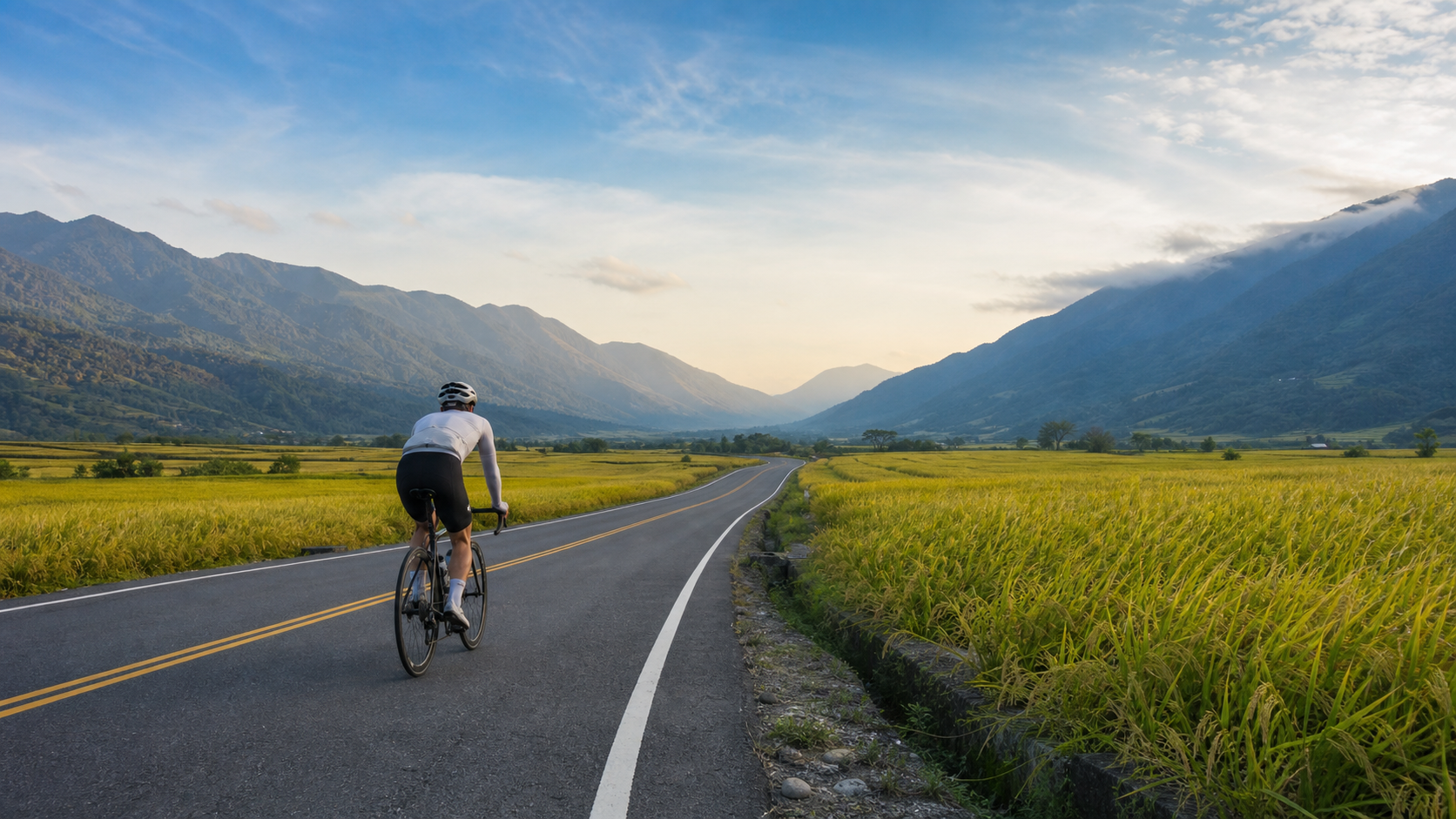
A Provincial Highway Deep in the Rice Fields: The Breathing Rhythm of Dongfu Highway and the Rift Valley
If you unfold a map of Hualien County, you’ll see the East Rift Valley as a long corridor gently cradled between two mountain ranges—the formidable Central Mountain Range to the west and the rolling ridgeline of the Coastal Mountain Range to the east. Dongfu Highway, also known as Provincial Highway 9D, lies quietly along the southern section of this corridor, connecting Dongli and Fuli, two small places whose names carry the imagery of “village” and “abundance.” Fuli—just hearing the name tells you how intimate its relationship with the land is. It is one of the most renowned rice-producing areas in the Hualien Rift Valley. Taikeng rice has grown on this land for generations, nurturing not just food but also a way of life closely tied to the rhythms of the solar terms.
Riding onto Dongfu Highway, you’ll find the atmosphere completely different from Provincial Highway 9, the main artery of the East Rift Valley. Highway 9 carries heavier traffic, linking together villages and towns with the efficiency typical of a trunk road. Dongfu Highway, by contrast, serves as an alternate route with sparse traffic, flanked mostly by farmland and scattered low hills. That sense of tranquility—being surrounded by rice paddies and accompanied by mountain shadows—is a luxury only attainable on roads like this that are “off the main line.” In a way, this road is a microcosm of the Rift Valley’s pace of life: no rush, no pursuit of shortcut efficiency, but rather an invitation to slow down and feel the land’s own breathing.
Interestingly, the terrain of this route seems to echo that very “breathing sensation.” Over a distance of 17.9 kilometers, the total elevation gain is 457.8 meters, with an average gradient of just 2.1%. On paper, that sounds unremarkable, but when you actually ride it, you experience a rhythm of ups and downs—a short climb followed by a gentle descent, then another climb after that, like breathing itself: inhale, exhale, in repeating cycles. These undulations aren’t dramatic plunges and surges; they’re gentle, regular, yet never monotonous—much like the seasonal cycle of rice farming on this land in Fuli, from transplanting to heading, from grain-filling to harvest: no abrupt turns, but always moving steadily forward.
For riders who have spent years cycling through the East Rift Valley, Dongfu Highway is rarely the centerpiece of a journey. More often, it plays the supporting role of connecting Highway 9, a bridge that links one stage of a loop ride to the next. But precisely because of that, this route lacks the clamor and competitiveness of the main road, offering instead a kind of forgotten purity. When you ride here, with rice ears swaying in the breeze on both sides and the interlocking ridgelines of the Coastal and Central Mountain Ranges in the distance, you understand why many veteran cyclists say the most beautiful scenery in the East Rift Valley isn’t on the main line, but in these quiet branch roads known as “alternate routes.”
Between the Ups and Downs: A First-Person Riding Narrative
At six in the morning, as the sky shifted from deep blue to pale gold, I clipped my water bottle into the cage, took a deep breath, and set off from the Dongli end onto Provincial Highway 9D. The air carried a moist, rice-field scent, mingled with the smell of soil and morning dew—an aroma you can only find in the East Rift Valley. The first few kilometers were gentle and flat. I held a moderate cadence, letting my body slowly wake up, while my peripheral vision swept across the continuous rice paddies on both sides. The emerald rice waves rippled softly in the breeze, as if keeping the same beat as my pedaling.
After about four kilometers, the road began to change. A short climb emerged—not steep, but heavy enough to be felt. Instinctively, I shifted the rear derailleur down a gear, my cadence jumped up, and my legs quickened their rhythm. There’s something peculiar about these short climbs: they don’t impose the psychological weight of “still several kilometers to go” like a long ascent on Wuling does. Instead, they feel like a series of small challenges—you know they’ll end soon, so you’re willing to put in a little extra effort. After cresting that small rise came a gentle descent. I relaxed my shoulders and let the wind rush past my ears. That instant shift from tension to release felt just like the daily rhythm of Rift Valley life, alternating between busy farm work and leisurely afternoons.
Midway through the route, the view suddenly opened up. The hilly terrain gave the road a series of rises and falls, and each time I crested a small high point, the valley revealed a broader panorama—layer upon layer of rice paddies stretching all the way to the foot of the Coastal Mountain Range, with the occasional farmhouse dotting the landscape, wisps of cooking smoke rising into the air. This shifting perspective is the unique gift of rolling terrain: if Dongfu Highway were a perfectly flat road, you might never see these angles overlooking the valley from above. The undulations bring not just physical challenge, but also layered surprises for the eyes and the mind.
In the following stretch, the rises and falls came more frequently. I began to feel the gradual buildup of soreness in my thigh muscles, but oddly enough, it wasn’t unpleasant—it carried a grounded sense of satisfaction. Each climb was a small accomplishment; each descent, a gentle reward. I thought about the route’s total elevation gain of 457.8 meters, far more than the 2.1% average gradient might suggest. At that moment, my body was personally verifying the truth behind that number—this is indeed not a road that “climbs steadily all the way,” but one built from many small undulations stacked together, much like those days in life that seem ordinary yet hide quiet turns.
In the final few kilometers before the end, the road gradually leveled out, and my breathing slowed to match. Looking back at the path I’d traveled, the undulating lines of terrain were clearly visible in the sunlight, like a winding ribbon wrapped around the valley. When I reached the Fuli end, there was no grand celebration—only the exhilaration of a body pleasantly spent and the quiet satisfaction of understanding this land just a little more deeply. This ride held no jaw-dropping difficulty, yet in the gentlest way, it let me rediscover another face of the East Rift Valley.
The Rice Memory of the Valley: The Land Stories of Fuli and Dongli
Fuli—the name itself carries an imagination of abundance. It is one of the southernmost townships in the Hualien Rift Valley, facing Chishang in Taitung from across the way. Like its counterpart, it sits on the valley plain flanked by the Central and Coastal Mountain Ranges, blessed with exceptional diurnal temperature variation and pristine water sources that produce rice of outstanding quality. Taikeng rice has been cultivated on this land for decades, long since becoming one of the region’s most important industries and cultural identities. When the rice enters its growing season, the entire valley is dyed emerald green, gradually turning golden as the season progresses. That gradation of color is, in itself, a silent natural epic.
Dongli, as the starting point at the other end of Dongfu Highway, also rests on this bountiful valley plain, a settlement within Fuli Township. Life here moves at a slow, steady pace, following the rhythm of farm work—busy during transplanting, patient during heading, celebratory at harvest. For those who have long lived in cities, this way of life so intimately bound to the land may seem foreign, but it is precisely that unfamiliarity that allows riders passing through to experience a rare sense of inner stillness. When you ride along Dongfu Highway and watch the rice ears swaying in the wind on both sides, you are witnessing a scene of agricultural life that has continued for generations.
The rice culture of the valley is not merely an industry; it is a philosophy of life. The farmers here work according to the solar terms, unhurried, respecting the land’s natural cycles. In a way, this philosophy echoes the terrain of Dongfu Highway itself—not a relentless climbing challenge to be conquered in one sprint, but a route of alternating rhythms, fast and slow, requiring the rider to learn to coexist with the terrain rather than fight against it. Perhaps this is the most thought-provoking metaphor of this route: whether growing rice or riding a bike, following the rhythm of nature often yields richer rewards than relentlessly chasing efficiency.
It’s worth noting that Fuli, along with neighboring Chishang in Taitung, belongs to the premium rice granary of the East Rift Valley. Though the rice cultures of the two places each have their own character, they share the same sky and waters of the valley. Many cycling enthusiasts plan their East Rift Valley loop rides as multi-day journeys spanning both regions, and Dongfu Highway is a connecting segment frequently used in such itineraries—allowing riders, as they move, to experience firsthand the continuous landscape of this valley rice granary from Fuli to Chishang, rather than merely passing through as a sightseer.
What This Route Means to Riders: A Role of Connection and Companionship
Among the many well-known cycling routes in the Huatung Valley, the Dongfu Highway may not qualify as a “star segment”—it lacks the legendary, limit-pushing character of Wuling, nor does it hold the important status of the main Provincial Highway 9 in linking towns and carrying transportation functions. But precisely because of this, it possesses a unique value: as a connecting route, it quietly accompanies every rider who chooses it, completing a transitional segment within the larger Huatung Valley journey.
For riders planning multi-day Huatung loop tours, the Dongfu Highway is often not a segment specifically highlighted on the itinerary, yet it frequently becomes an unexpectedly memorable interlude in the actual riding experience. When you finish a section of the main Provincial Highway 9 and turn onto the Dongfu Highway as an alternative road, traffic instantly thins out, the surrounding clamor gradually fades, replaced by a tranquil tableau of rice paddies and rolling hills. The psychological sense of relief brought by this transition is often more unforgettable than the route’s topographical challenges themselves. When many riders recall their Huatung Valley cycling experiences, what they mention is not necessarily some famous landmark, but rather “supporting-role segments” like the Dongfu Highway that deliver surprises when least expected.
This route is also well-suited to a training role. Its undulating character—short climbs alternating with gentle descents—makes it an ideal venue for practicing gear-shifting responses, interval transitions, and cadence changes. For local Hualien cyclists with limited training venue options, the Dongfu Highway offers a low-traffic, topographically varied, and moderately distanced training option, allowing them to obtain undulating-terrain training effects without needing to expedition into the mountains. This role as a “daily training companion” may, more than any challenging long-distance expedition, reflect the real riding lives of most cyclists.
From a broader perspective, the existence of the Dongfu Highway also reminds us that a route’s value does not necessarily derive from its difficulty or fame. Some routes are destined to become pilgrimage goals, while others are content to play the roles of connection, companionship, and daily training, quietly supporting a larger cycling landscape. The Dongfu Highway belongs to the latter. It may not appear at the top of most people’s “must-ride list,” but for riders who truly come to know the Huatung Valley in depth, it is an indispensable piece of the puzzle on this land.
Season-Limited Valley Scenery: A Visual Feast of Rice Waves and Harvest
The rice paddies of the Huatung Valley are a living landscape that transforms with the seasons. In the Fuli and Dongli areas along the Dongfu Highway, rice is typically harvested twice a year, meaning riders visiting this route in different months will encounter entirely different visual feasts—giving the route a unique charm that is suitable nearly year-round, yet distinct in every season.
In late spring and early summer, during the vigorous growth phase of the first rice crop, the paddies display a rich, verdant green. When a breeze sweeps through, the entire expanse of rice waves undulates with the wind, like a green ocean rippling before your eyes. Riding the Dongfu Highway during this period offers the freshest and most refreshing visual experience along both sides, with air carrying a blend of grass and earth, paired with the route’s naturally undulating terrain, filling the entire ride with vibrant, life-filled energy.
As the season progresses into summer, the rice ears gradually emerge and fill with milk, and the color shifts from verdant green into a golden gradient. The scent of the fields also transforms from fresh to a rich, ripe rice aroma. This is the most dramatically visual transitional period in the Huatung Valley. If timing is right, riders can even witness, within a single ride, different paddy fields—due to slight variations in transplanting schedules—presenting an interwoven mosaic of varying shades of green and gold, like an Impressionist painting in progress.
By harvest season, the entire valley is dyed in a full, saturated gold. Rice ears hang low, rustling softly as they sway in the wind. Riding the Dongfu Highway during this period, with luck, you might encounter farmers operating harvesters in the fields. The air is filled with the fragrance of freshly cut rice—a scent of earth and labor that you will absolutely never encounter in the city. After harvest, the paddies briefly present a somewhat barren yet tranquil appearance, with field ridges clearly visible—a particularly favored moment for photography enthusiasts.
It is worth noting that, because the Huatung Valley has two rice crops per year, the actual transplanting and harvest times fluctuate depending on the year’s climate and farmers’ arrangements, rather than following a fixed calendar schedule. If you particularly wish to capture the rice waves or harvest scenes, it is advisable to check local agricultural information or ask residents before riding to grasp the most precise timing—but even if you don’t hit the exact moment, the valley’s year-round pastoral scenery is itself reason enough to visit again and again.
Suggested Side Trips: A Slow Valley Journey Around Fuli’s Rice Fragrance and Dongli
After completing the ride on the Dongfu Highway, consider slowing down and letting both body and mind linger a while longer in this bountiful valley. Fuli, renowned as the rice capital of the Huatung Valley, offers local rice products and agricultural specialties that many visitors will not want to miss. Whether bringing home a bag of premium locally grown white rice or savoring simple farmhouse cuisine prepared with local ingredients, these are additional taste memories gained beyond the cycling journey itself.
The Dongli and Fuli areas, situated on the flat, open valley plain, are also well-suited as stopover points for cycling travelers to replenish water and energy. The local eateries or general stores, though modest in scale, often preserve the most authentic flavor of valley life. A simple bowl of rice noodle soup or a local snack, paired with a chat with the shopkeeper about local stories, are ways to truly understand this land beyond just riding.
If time permits, it is recommended to incorporate the Dongfu Highway into a longer multi-day Huatung Valley cycling itinerary. Heading south, you can connect to Provincial Highway 9 and continue toward Chishang and Guanshan, experiencing the pastoral scenery of the valley’s rice granary stretching onward; heading north, you can return to the main Provincial Highway 9, linking up with Yuli and Ruisui, exploring the richer landscapes and cultural facets of the valley’s central section. Such an arrangement allows the Dongfu Highway to realize its maximum value as a “connecting route,” rather than being merely a short segment ridden in isolation.
For riders who prefer a slow-travel pace, the Fuli and Dongli area is also suitable for a one- to two-day stay—no rushing, no mileage chasing, simply using the bicycle as transport, weaving between rice paddies and settlements, feeling the most primal rhythm of valley life. This slower way of traveling may well be the message the Dongfu Highway wishes to convey to every rider: not all riding needs to pursue the limits of speed and difficulty. Sometimes, being willing to take the time to feel the breathing of the land is the most precious reward of cycling.
Chance Encounters with Valley Residents: The Human Scenery Along the Road
The most captivating part of riding the Dongfu Highway, beyond the terrain and rice paddy scenery, is another element that is difficult to quantify yet genuinely exists—the fleeting moments of passing by local residents along the way. In the early morning hours, you might encounter farmers carrying tools on their way to the fields, or elders slowly passing on old-style scooters. They typically do not pay excessive attention to unfamiliar cyclists, yet they are not stingy with a nod or a simple greeting. This unforced, unenthusiastic yet goodwill-filled manner of interaction is precisely the unique warmth of human connection found in the rural valley, standing in stark contrast to the habitual detachment between people in the city.
I once paused by the roadside during a ride on the Dongfu Highway to confirm the road conditions, when an elderly man passing on a power tiller deliberately slowed down and asked me, in Mandarin with a thick Hualien accent, where I was headed. Upon hearing that I planned to ride to Fuli, he smiled and nodded, saying, “This road rides very well, not tiring at all,” before continuing on his way. Looking back on it later, this simple remark actually echoed the route’s Category 0 classification—the lived experience of local people often comes closer to the route’s true difficulty than any data. These brief encounters with the land and its residents are the most easily overlooked yet most precious gains of riding the Dongfu Highway.
The rural roads of the valley have long served as daily commuting routes for local residents between their fields and settlements. As cycling travelers pass through, they become, to some extent, part of the everyday scenery of this land. Compared to many highly touristed landmark routes, the Dongfu Highway retains far more unpolished life—no deliberately installed photo-op spots, no commercial facilities tailored for tourists. What remains are the daily laboring figures of farmers, and the brief intersections cyclists occasionally share with this land. These unadorned encounters lend the riding experience an authenticity that is difficult to replicate.
Epilogue: A Road, a Time of Dialogue with the Rift Valley
After riding the Dongfu Highway, I looked back at this rift valley plain covered with rice paddies and rolling hills, and I suddenly understood why this route is so memorable. It’s not because of its magnificent terrain or astonishing statistics, but because it allows every rider to engage in a quiet dialogue with this land in the gentlest, most down-to-earth way. The 457.8 meters of total climbing, the 17.9 kilometers of distance—these numbers are ultimately just tools for measuring the journey. What truly stays in memory are the rhythms of breathing between the rises and falls, the image of rice waves swaying in the wind, and the scent of soil and grain mixed into the morning air.
The Dongfu Highway may never become the brightest star among cycling routes in the East Rift Valley, but it will remain, in many riders’ hearts, that road which quietly leaves a deep impression when least expected. It teaches us that undulations are not obstacles but rhythm; even a supporting role can have its own radiance. Next time you plan a cycling trip through the East Rift Valley, consider setting aside some time for this quiet provincial highway—let it lead you deep into the rice paddies of Fuli and Dongli, and experience a slow yet abundant ride that is uniquely characteristic of the valley.
Related Reading
- Highway 9 East Rift Valley: Finding the Purest Meaning of Cycling Between Serenity and Speed
- Cycling Around the Taitung Rift Valley: Slow-Paced Experiences and Attraction Connections on the Hualien-Taitung Section
- Dongfu Highway Practical Guide: Pacing Pitfalls and Gear Ratio Tactics on the 17.9km Rolling Road
- Hualien Yuli-Fuli Cycling Route: Leisurely Pastoral Pedaling in the East Rift Valley
水金九不厭五分 10度寒流冷到不願停!feat. 卡卡 / 公路車 / CT Yeh
6 個月前
台北大雁西飛 約騎挑戰 feat. Doris | 公路車 | CT Yeh
3 年前
微東進 太魯閣 蘇花 單車兩日遊 ! 颱風過後路況超刺激 行程大亂 | 最狂的鹹酥雞訂單 | CT Yeh | 4K 高畫質空拍絕景!
4 年前
2022 環花東挑戰賽 Day2 搭到特快車 高速真空吸引! 台東一路逆風殺回花蓮! 總排 ??| Feiyu Pocket 2s | 公路車 | CT Yeh
4 年前
花東縱谷單車遊 feat. Doris 景點五分鐘快速掃瞄 / 公路車 / CT Yeh
2 年前
雙十節的溫腥感人約騎,升旗到升天一次滿足 | 公路車 | 鳳山寺 | 米粉坡
6 年前
大武山20%魔王陡坡【JJSC南台灣遊騎Day2】!屁股真的要裂開了...凡士林抹滿也沒用?神秘金教堂還有超便宜夜市
3 個月前
#北橫 + #北進武嶺 最硬的員工旅遊 EP1 | #公路車 #拉拉山 | 明池 | 武嶺 | 武陵農場 | 雲海 | Taiwan Cycling Route Wulin
6 年前