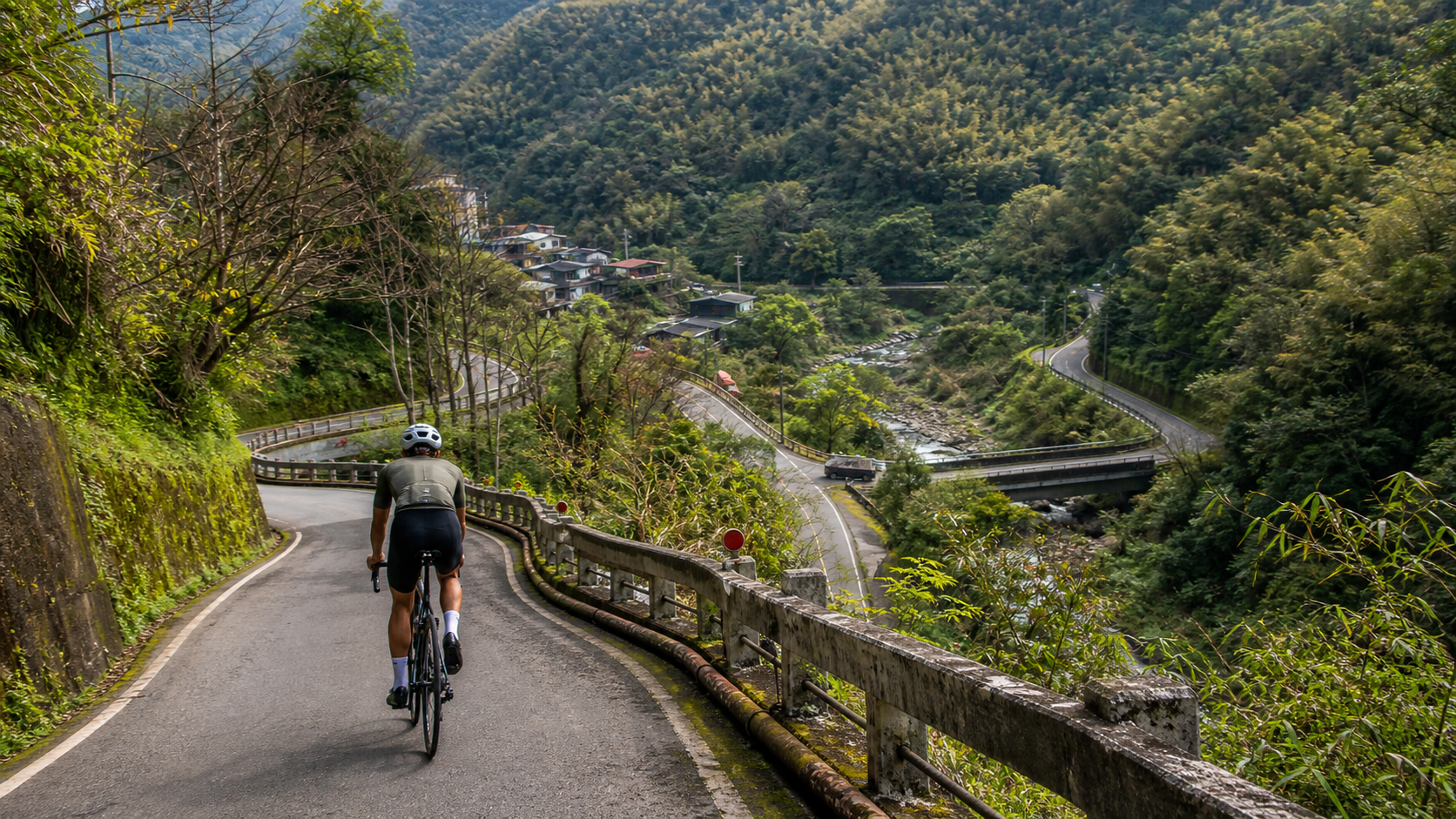
The 793 Meters from Xizhi to Pingxi: A Timeless Trail Hidden in the Valley
“Some roads aren’t meant for chasing PRs—they’re meant to remind you why you got on the bike in the first place.”
A Mountain Road Connecting Two Eras
The Xiping Highway, officially designated as New Taipei City Route 31 North, runs from Baochangkeng in Xizhi in the north to Pingxi in the south, spanning approximately 18 kilometers in total. The classic climb segment we’re taking a closer look at today—the one recorded on Strava—covers 8.33 kilometers with 793 meters of elevation gain, winding from Baochangkeng toward the core section of Pingxi. This road was already included in the rural road system as early as 1961, and it wasn’t until 1983 that the section from Shikengzi to Pingxi was incorporated into the official designation, forming the complete corridor we see today. In other words, this isn’t a road newly built for tourism—it’s a true old mountain road that has carried the living memories of the local community.
Following the Baochangkeng Creek valley southeastward, after crossing Panshi Ridge, you’ll encounter a series of consecutive hairpin turns—which is why, even though the official average gradient is only 4.9%, the actual ride accumulates nearly 800 meters of climbing. Terrain never lies; it’s just that statistics sometimes simplify things a bit too optimistically. When you’re riding this road, feeling the gradient steepen and ease unpredictably, with one switchback stacking on top of another, that genuine muscle burn is far more honest than any average gradient percentage.
For local residents of Xizhi, this road was once a vital route connecting mountain settlements with the outside world. The Dongshan Village along the route still relies on this highway for external communication, and there’s even a dedicated community bus—the “Xiping Line”—that operates along it, the only regular bus service on this mountain road. As you ride past the bus stops where you occasionally encounter these buses, take a moment to imagine: in the era before cars and motorcycles became widespread, how many generations used this winding mountain road as their daily lifeline, traveling on foot or by bicycle? Today we treat it as a weekend fitness route and a climb for chasing PRs—in a sense, that’s another way of keeping this road’s vitality alive.
Along the way, you’ll also see bridges such as Zhongxiao Bridge and Ren’ai Bridge spanning the Baochangkeng Creek and its tributaries. The naming of these bridges carries a strong old-era flavor, which also indirectly speaks to how long ago this road was built. For riders who enjoy exploring local history while cycling, the Xiping Highway is more than just a training ground—it reads like a local chronicle written in asphalt and bridges. Every turn, every bridge holds fragments of stories belonging to this valley. If you slow down and carefully observe the place names and landmarks along the way, you’ll find this road has far more depth than you might imagine—it’s not just a transportation corridor connecting two administrative districts, but a timeline connecting different generations’ ways of life.
Ride this road long enough, and you’ll gradually realize that the charm of mountain roads often lies in how they remain unspoiled by overdevelopment. Most sections of the Xiping Highway still retain a considerable degree of natural forest cover, free from excessive commercial signage and traffic disruption. This sense of tranquility is precisely why so many riders keep coming back time and again. Compared to the bustling urban training environment, this place offers an almost luxurious sense of focus—you can fully immerse yourself in your own breathing rhythm and cadence without having to divert attention to complex traffic conditions.
A Morning Ride Through the Baochangkeng Creek Valley
If you ask me when this road is at its most beautiful, I’d answer without hesitation: in the early morning, when the first light appears and the mist hasn’t yet lifted. Setting off from the Baochangkeng starting point, the valley is often still shrouded in a thin layer of moisture, with sunlight filtering through the treetops and casting dappled shadows on the asphalt. Riding at this hour, the air carries a fresh scent of creek water and vegetation mixed together—a world apart from the city.
The Baochangkeng Creek accompanies the first half of the route, its waters babbling softly, with occasional sightings of egrets or other waterbirds perched along the banks. Riding in such an environment, even as your legs begin to feel the pressure of the gradient, your mind remains surprisingly calm. This is the charm of mountain climbing routes—the body endures challenges while the soul is healed by the scenery. This contradictory yet harmonious experience is something flat-road riding can rarely offer.
As elevation gradually increases, the vegetation begins to shift, transitioning from broadleaf forests along the creek to denser secondary growth, with the air temperature dropping a few degrees as well. This layering of microclimates is a unique pleasure of riding suburban mountain routes like this—you don’t need to climb to high altitudes; even just 800 meters of elevation gain is enough to experience noticeable environmental changes, as if you’ve gone on a mini seasonal journey within the span of an hour.
Morning rides have an additional benefit: sparse traffic. The Xiping Highway doesn’t see heavy traffic on weekdays to begin with, and during the early morning hours, you’ll barely encounter any vehicles at all. Aside from the occasional community bus or residents’ cars heading out for early work, the entire road is essentially yours. This feeling of having the mountain road all to yourself makes every pedal stroke feel especially pure—no honking, no exhaust fumes, only the subtle sound of the chain turning and your own gradually deepening breath, weaving together into a unique rhythm. Some riders even joke that the Xiping Highway in the early morning is “free therapy”—pedaling along, watching the morning light pierce through the treetops, all the worries of work and life seem to be left behind in the city below.
Panshi Ridge Amid the Hairpins: The Soul of the Route
If the Baochangkeng Creek valley is the overture of this road, then the consecutive hairpin turns of Panshi Ridge are undoubtedly the climactic movement of the entire piece. The switchbacks come one after another, and it’s here that the gradient truly shows its teeth—some sections approach or even exceed 10%, forcing you to stand up out of the saddle and use your full body weight to fight gravity.
With every corner, the view shifts subtly: sometimes you catch glimpses of layered mountain ridgelines in the distance, and other times you’re completely enveloped by dense foliage on both sides, creating a near-tunnel-like sense of stillness. This visual rhythm keeps the riding experience full of tension, never monotonous like a long straight climb. Many veteran riders say the hairpins of Panshi Ridge “hurt to ride, but are beautiful to look at”—a phrase that perfectly captures the dual nature of this stretch.
Pausing briefly at the high point of the hairpins to look back at the road you’ve just traveled, you’ll discover just how tortuous your path was—that sense of surprise, thinking “I really wound around all those loops just to get up here,” is often one of the most healing moments after completing this climb. For friends who love documenting their rides with photos, Panshi Ridge is absolutely a prime spot for taking shots—the winding mountain road paired with layered peaks creates a dramatically compelling composition.
The name Panshi Ridge itself carries a weighty imagery—“Panshi” means boulder, symbolizing stability and perseverance, as if metaphorically hinting at the willpower riders must demonstrate on this stretch. With every pedal stroke against double-digit gradients, the protests from your muscles and the recurring question of “how much longer” intertwine, but it’s precisely this struggle that makes the release upon reaching the summit so intensely gratifying. When many riders later recall this section, what stands out most isn’t the scenery itself, but the process of conversing with their own physical limits—you clearly feel the muscle soreness, the accelerating heartbeat, and yet through that process, you come to rediscover the boundaries of your own endurance.
Experienced riders will tell you that the hairpins of Panshi Ridge actually conceal a certain rhythm—the inside line of each corner is typically steeper than the outside. If you can read the line correctly, hugging a slightly outside arc of the inner edge, you can effectively shorten the actual climbing distance and reduce unnecessary energy expenditure. This kind of subtle observation of terrain and the wisdom of line selection often requires riding the same route multiple times to gradually accumulate—which is also one of the reasons why many seasoned riders, even after conquering this route countless times, are still willing to return again and again: every ride reveals details they hadn’t noticed before.
The Railway Memories and Old Street Charm of Pingxi
After conquering the grueling challenges of Panshi Ridge, the route gradually eases and eventually leads you into the Pingxi area. For Taiwanese people, the name Pingxi is almost synonymous with sky lanterns and branch railway lines. The Pingxi Line railway winds along the Keelung River valley, connecting famous attractions such as Shifen, Pingxi, and Jingtong, and is one of the few remaining tourist branch railways in Taiwan.
Along the Xiping Highway, the route passes over Zhuangjing Bridge, which spans the Pingxi Line railway. If your timing is right, you might be lucky enough to witness a small local train slowly passing beneath the bridge. That image of a mountain town intertwined with the railway is a photo opportunity no photography enthusiast would ever miss. Upon arriving at Pingxi Old Street, you’ll find narrow streets flanked by traditional wooden and brick buildings, with red sky lanterns hanging high above the railway tracks—the most iconic visual symbol of this small town.
Although Pingxi Old Street is not large, it carries a rich mining history. The area once thrived on coal mining, and the railway was originally built to transport coal. As the mining industry declined, tourism and the sky lantern culture gradually became the new economic pillars of the region. After a solid stretch of climbing, sitting for a while on the old street, watching visitors write their wishes and release sky lanterns as they slowly ascend into the sky, the blend of tranquility and lively bustle will make you forget the fatigue and soreness from the climb. Nearby, public facilities such as the Pingxi District Library offer a quiet option if you’d like to rest and escape the heat.
Walking on the stone-paved old street in cycling shoes, the sound of your footsteps mingles with the chatter of nearby visitors and the occasional train whistle, forming a unique rhythm of this mountain town. This experience of switching instantly from intense physical exertion to a leisurely sightseeing pace is the most captivating dual personality of the Xiping Highway—it can satisfy your craving for training intensity while offering a culturally rich resting space at the end. This combination of fulfilling both exercise and travel needs in a single ride is exactly why so many cyclists repeatedly recommend this route to their friends.
Pingxi’s mining history is also closely connected to the modern development of all of northern Taiwan. From the Japanese colonial period through the post-war era, the mountains in this area held abundant coal resources, attracting a large influx of labor. Railways, settlements, and markets grew up around them. Today, most of the mines have been sealed, but remnants and memorial facilities related to the mining industry can still be seen along the route. If time permits, taking a moment to learn about this history of industrial transformation will add a layer of historical depth to your ride—making it not just a physical challenge, but also a small journey into understanding Taiwan’s modern development.
A Rider’s First-Person Memory
My first attempt at the Xiping Highway was on a clear autumn morning with pleasant temperatures. Before setting off, I had checked the data and knew the average gradient was only 4.9%, so I was somewhat complacent, thinking, “It’s just a gentle slope; it shouldn’t be too hard.” But around the third kilometer, the gradient suddenly steepened without any warning, and at that moment I truly understood how real the saying “average gradient lies” really is.
My legs began to feel an unmistakable burning sensation, and my breathing grew increasingly rapid. All I could do was focus on one hairpin turn after another, telling myself, “Get past this turn, then look at the next one.” This mental strategy of breaking down a long-distance goal into countless small targets unexpectedly proved to be the most effective way to get through the steep sections. When I finally rode past the steepest part of Panshi Ridge and saw the gradient gradually ease, that overwhelming sense of relief, mixed with muscle soreness and inner accomplishment, was a complex emotion that words can hardly fully describe.
After arriving in Pingxi, I sat at a food stall on the old street, gazing at the mountain road I had just climbed, faintly visible in the distance. I suddenly understood why so many cyclists are willing to challenge the same route again and again—not because it’s grand or majestic, but because every ride brings slightly different physical and mental experiences. That subtle variation is precisely what makes cycling so fascinating. On the return trip, as I descended over Panshi Ridge once more, the cool breeze brushed against my face, and the hardship of the climb seemed to transform into the exhilaration of the descent. That rhythm of sweetness after bitterness is perhaps the most honest reward of mountain riding.
Seasonal Scenery Transitions
The beauty of the Xiping Highway transforms dramatically with the changing seasons. In spring, the mountains burst with fresh greenery, occasionally dotted with wildflowers along the roadside, and the air carries the fresh scent of rain-soaked earth and vegetation. It’s the best season for a leisurely ride, savoring the scenery along the way. Summer brings the most lush greenery, with dense tree canopies providing precious shade on some sections, but the chance of afternoon thunderstorms also rises. It’s recommended to set off in the early morning hours, which lets you avoid the heat while enjoying the dreamlike sight of morning mist swirling through the valleys.
Autumn, before the northeast monsoon fully kicks in, is the most stable and comfortable season of the year. The clear blue sky paired with gradually cooling air makes the effort of climbing feel relatively lighter, which is why many seasoned cyclists consider autumn the golden window for tackling this route. Winter presents a completely different character—the clouds and fog brought by the northeast monsoon often shroud the valleys, and occasionally you might encounter dreamlike seas of clouds. However, wet road surfaces and reduced visibility also raise the risk of riding, so extra caution is advised, along with complete cold-weather and lighting gear.
Worth special mention is the occasional sea-of-clouds spectacle in winter. When the lowlands are drizzling, if you’re lucky enough to reach the high point around Panshi Ridge, you may have the chance to see clouds surging and flowing through the valleys, as if you’ve stepped into a fairyland. This sight isn’t something you encounter on every ride—it requires the perfect alignment of weather and timing—but precisely because it’s so rare, each encounter feels especially precious. Because of this unpredictability, many local cyclists actually visit this route more frequently on cold, wet winter days, just to try their luck at capturing that fleeting sea-of-clouds moment. Of course, while chasing beautiful scenery, safety cannot be overlooked—wet surfaces and low visibility remain the risk factors that demand the most caution when riding this route in winter.
No matter which season you visit, this route has its own unique charm. That’s why so many local cyclists choose to revisit the same route throughout all four seasons—because even though the path is the same, the scenery and the feelings experienced on each ride are never quite the same.
Suggested Side Trips: Extending the Climb into a Mini Journey
If time allows, consider extending the Xiping Highway challenge into a more complete mini journey. After arriving in Pingxi, you could continue riding or walk to explore Shifen Waterfall. As Taiwan’s largest curtain-style waterfall, it’s impressively majestic and one of the most notable natural attractions in the Pingxi area. If you’re interested in railway culture, taking a ride on or simply watching the Pingxi Line local train slowly weaving through the mountain villages is also a wonderfully soothing experience.
As for food, Pingxi and the surrounding mountain settlements have various stalls and shops selling local snacks and agricultural products. The actual offerings may vary depending on the season and each shop’s operating status, so it’s best to rely on the on-site situation and the latest information from the vendors. Take your time and ask local residents for their seasonal recommendations—you’ll often uncover the most authentic local flavors.
On the way back, if your energy allows, you can choose to return along the same route and experience the fun and challenge of Panshi Ridge’s hairpin turns from the opposite direction. If you’d rather save energy, you can also plan a shuttle or ride in segments back to Xizhi. Whichever way you choose, this journey combining athletic challenge and cultural scenery is worth experiencing firsthand with your own legs and wheels on a clear day.
If you have even more time, consider extending this trip into a one- or two-day in-depth excursion—stay overnight at a homestay near Pingxi, then continue exploring nearby attractions such as Shifen Old Street or Jingtong Station the next morning. This slower-paced, itinerary-free style of travel allows you to feel the unique tranquility of this mountain area more deeply, avoid the crowded peak holiday hours, and enjoy a more relaxed and unhurried travel experience.
Conclusion: What This Road Taught Me
Xiping Highway has long surpassed its role as a mere training route for me. It taught me that data is always just a reference—the real terrain and how your body feels are the most honest teachers. It also taught me that the challenge of a mountain road is never just a test of physical endurance, but a process of inner dialogue with yourself. Every time I climb through the hairpin turns of Panshiling, every time I catch sight of the red sky lanterns on Pingxi Old Street, it serves as a reminder—when it comes to cycling, the most precious thing is never the number on the finish time, but the genuine feelings and memories accumulated along the way.
If you’re also tired of the daily commute rides through the city, find a day with clear weather, point your handlebars toward Baochangkeng in Xizhi, and let the 793-meter climb take you back to the purest essence of why you started riding. This road isn’t long, but it’s enough to make you deeply understand what “tired but worth it” truly means the moment you arrive in Pingxi.
Years from now, you might forget exactly how many minutes and seconds it took to complete this route, or which heart-rate zone you happened to fall into during a particular attempt, but those images—the morning mist, the gasping for breath on the hairpin turns, the sky lanterns and the sound of train whistles on Pingxi Old Street—will leave a far deeper mark on your memory. This, perhaps, is the essence of cycling: the body remembers the hardship, but the heart is left with only scenery and emotion. Xiping Highway may never appear on any list of world-famous climbing routes, but for riders willing to get to know this land on two wheels, it has long become an irreplaceable private route in their hearts.
Next time you see the statistics for this route on Strava, try to imagine the real scenes behind those numbers—the morning fog in the Baochangkun Creek valley, the endless hairpin turns of Panshiling, the occasional Pingxi Line train passing under Zhuangjing Bridge, and the sky lanterns slowly rising over the old street. These images are the true meaning behind that 793-meter climb.
Related Reading
- Xiping Highway Practical Guide: 8.3 km, 793 m Climb, the Most Solid Climbing Test in New Taipei’s Suburbs
- White May on the Tung Blossom Road: A Leisurely Ride Through Xiding Road and Its Local Scenery
- Xiding Road Practical Guide: A 4.35 km Warm-Up on the North 33 Tung Blossom Road, with Full Data and Pacing Analysis
- Keelung Nuannuan to Pingxi Route: A Unique Riding Experience Through Northern Taiwan’s Mining Landscape
台北闊瀨陡坡 騎旅 / 日本單車雜誌編輯車友臨時加入!/ 髮香才是最強的 / feat. 北迴歸線小隊 / 公路車 CT Yeh
6 個月前
#北橫 + #北進武嶺 最硬的員工旅遊 EP1 | #公路車 #拉拉山 | 明池 | 武嶺 | 武陵農場 | 雲海 | Taiwan Cycling Route Wulin
6 年前
雙十節的溫腥感人約騎,升旗到升天一次滿足 | 公路車 | 鳳山寺 | 米粉坡
6 年前
新竹羅平 x 天湖部落 大禹嶺級變態陡坡! 4K超高畫質 空拍 | 公路車
5 年前
太平山單車員工旅遊 | 這樣玩CP值最高!| 公路車
5 年前
大武山20%魔王陡坡【JJSC南台灣遊騎Day2】!屁股真的要裂開了...凡士林抹滿也沒用?神秘金教堂還有超便宜夜市
3 個月前
大禹嶺 到 武嶺牌樓 全程前後實況錄影 | 北進武嶺 | 東進武嶺 | KOM | 訓練台 | 坡度分析 | Taiwan KOM Last 10 km HARD | 公路車
6 年前
萬年峽谷! 30% 超激陡坡 里佳部落DAY2 還是很硬! | 公路車 | CT Yeh
3 年前