Riding Along the Nanshi River Toward the Cloud-High Tribe: A 14.4 km River-Tracing Road to Fushan
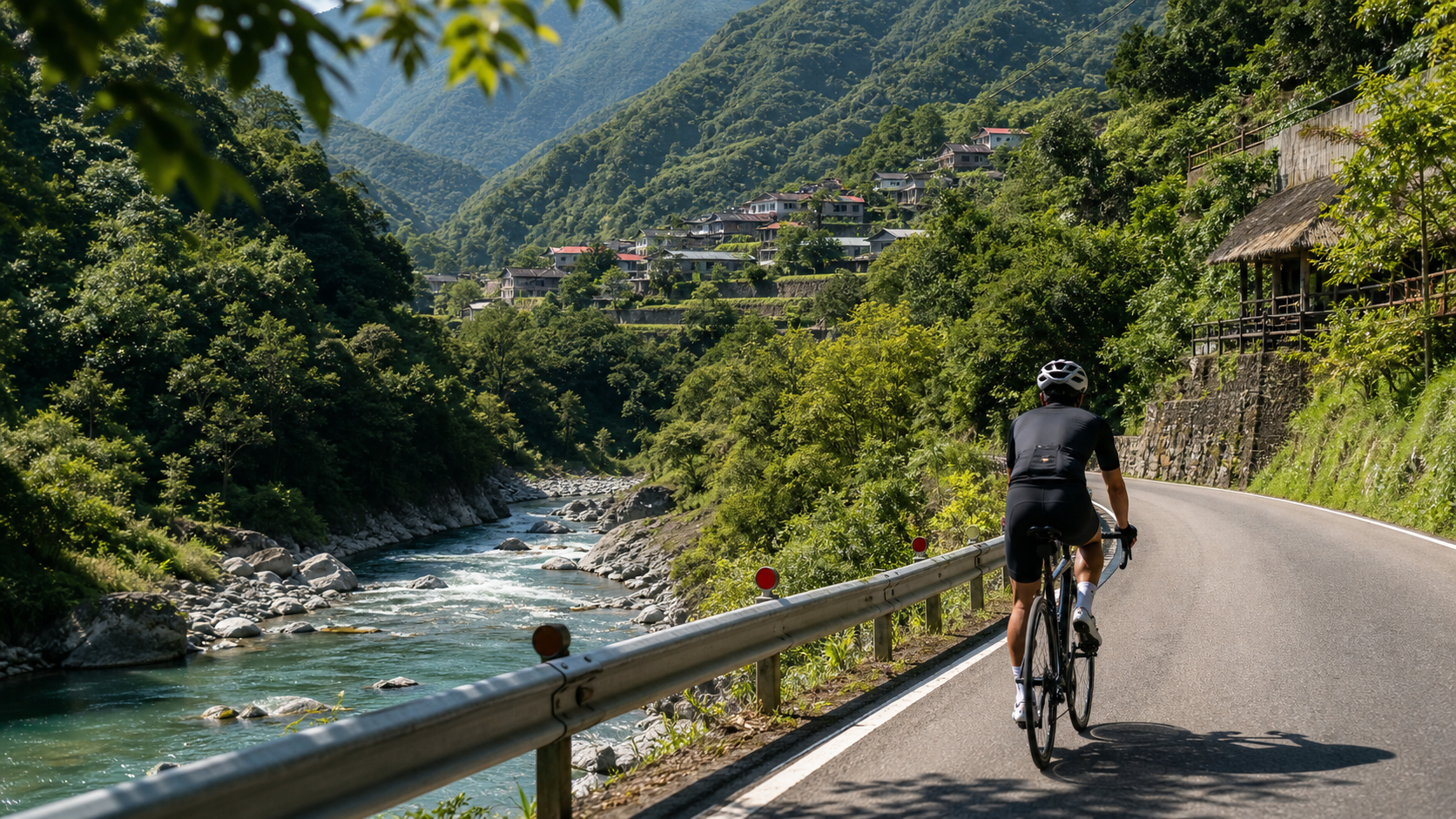
Riding along the Nanshi River toward the Cloud Village: The 14.4 km River-Tracing Road to Fushan
A Road That Grows Alongside the River
Some routes exist to conquer a mountain peak; others exist to follow a river—the industrial road from Wulai to the Fushan tribe clearly belongs to the latter. It stretches 14,355.3 meters, roughly 14.36 kilometers, with a total elevation gain of 291.6 meters and an average gradient of just 1.4%. Looking at these numbers alone, it would be easy to dismiss this as a “boring gentle slope,” but once you actually ride this road, following the sound of the Nanshi River upstream, you’ll understand that the charm of this route has never been about the challenge of the gradient. It lies in what it carries you through—a journey that gradually descends from the bustle of the market into the tranquility of the mountains, transitioning from lowland life into tribal culture.
Interestingly, if you carefully cross-check the terrain data of this route, you’ll spot a small contradiction: 14,355.3 meters multiplied by a 1.4% average gradient gives a theoretical climb of only about 201 meters, yet the actual total elevation gain is as high as 291.6 meters—a difference of nearly 90 meters. This discrepancy perfectly echoes the route’s truest character—it is not a straight uphill road, but a river-tracing forest path that winds and undulates along the Nanshi River valley, rising and falling in turns. The average gradient figure is “diluted” by the rolling terrain along the way, but the accumulated elevation from those undulations is the weight your body honestly feels during the ride. This gap between “numbers that seem gentle” and “a physical experience that is far richer” is perhaps what makes this route so intriguing.
Setting Out from Downtown Wulai: A Starting Point That Bids Farewell to the Bustle
On the day of departure, downtown Wulai was in the midst of tourists streaming in. Around the old street, the aroma of grilled meat and bamboo tube rice was already wafting through the air, and in front of the hot spring hotels stood small groups of visitors with flushed faces who had just finished soaking. Wheeling your bike through this lively district and heading toward the Fushan tribe, the clamor quickly fades within just a few hundred meters—the shop signs along the asphalt road gradually thin out, replaced by layer upon layer of mountain ridges and the sound of the river drawing closer to your ears.
This experience of “instant switching” is one of the reasons I treasure this route so much. It’s hard to find a place in the city where, within just ten minutes of riding, you can shift from a bustling tourist market to a deep mountain sanctuary where only the babbling stream and birdsong remain. In this stretch, the Nanshi River’s channel is relatively wide, and sunlight scatters across the water’s surface in shimmering ripples. Occasionally, you might spot egrets leaping between the river stones or waterfowl foraging with heads lowered. The sense of peace such scenes bring will unconsciously make you ease off your cadence, wanting to take in a few more glances.
The gradient at the start is indeed gentle, averaging around 1 to 2%, and riding it feels almost like no noticeable climbing effort at all—more like a cruising ride that slowly advances along the valley. This is also why many riders tackling this route for the first time get the illusion in the opening kilometers that “this road seems pretty easy”—until continuous undulations begin to appear in the middle section, and they truly understand the layers hidden within this route.
Mid-Section Undulations: Terrain Dancing with the Stream
After riding about four or five kilometers, the route begins to reveal its true character. The road is no longer simply advancing flat along the riverbank; instead, it turns with the terrain into one small rise and fall after another—where mountain walls jut out, the road detours upward; where tributaries merge at bridges, short descents and climbs often precede and follow. This kind of terrain variation makes the riding rhythm feel like dancing with the stream—just as the water flows around boulders and forms eddies at river bends, the road’s undulations seem to echo this logic of the water.
I really enjoy this state of riding that demands focus without being painful. It’s not like a steep climb that requires gritting your teeth and pushing through; it’s more like a sustained, mildly challenging rhythm game—you must constantly watch the terrain ahead, adjusting your gear ratio and pedaling force in time. This continuous fine-tuning and adaptation gives the entire ride a dynamic sense of fun, a completely different texture from a flat, steady cruise from start to finish.
The vegetation along the way also begins to shift noticeably in this section. Broadleaf forests grow denser, canopy coverage increases, and the temperature under the shade feels significantly cooler than in the open stretches. Occasionally, you’ll see ferns clinging thickly to the slopes of the river valley, along with unidentified wildflowers dotting the roadside grass. This raw, unpolished natural appearance is precisely the most precious asset of deep mountain forest road routes.
The Traditional Territory of the Atayal People: The Cultural Weight of the Fushan Tribe
Fushan Village, where the Fushan tribe is located, is the largest administrative district in New Taipei City and the southernmost area of Wulai District, with a population of only about 800 people—a fairly typical high-mountain indigenous settlement. This region belongs to the traditional living territory of the Atayal people, who have lived here for generations, dwelling by the mountains and rivers, developing a way of life and cultural traditions deeply intertwined with this valley and forest.
Riding on the road to the Fushan tribe, it’s hard not to reflect on the historical weight this land carries. In traditional Atayal culture, facial tattooing, weaving, the jaw harp, and headhunting rituals (which existed historically but are no longer practiced) were all significant symbols of the tribe’s identity. As times have changed, these traditions have gradually transformed into forms we more commonly encounter today in cultural displays or tourist settings—weaving crafts, songs and dances, and tribal guided tours. The Atayal people of the Wulai area still maintain a considerable tradition of weaving craftsmanship, and around the old street, you can often see handicrafts and clothing displays featuring Atayal patterns.
I’d like to specifically note that when riding through indigenous settlements like the Fushan tribe, maintaining a respectful attitude is especially important. This is a real home where tribal members live, not a backdrop created for tourism. If you have the chance to interact with tribal residents along the way, approach with humility and curiosity to listen, rather than speculating or consuming the culture of this land through stereotypes. In recent years, Taiwanese society’s understanding of indigenous cultures has gradually deepened, and more and more tribes are proactively developing cultural tours, eco-tourism, and other friendly forms of interaction, allowing outside travelers and riders to appreciate the humanistic depth behind these mountains in a more appropriate way.
Deep Mountain Transition Section: Tranquility in the Depths of the Forest Shade
After riding through the mid-section undulations, the route enters a deep mountain transition section where elevation gradually rises. Here, forest canopy coverage reaches its highest point along the entire route, with sunlight filtered through layers of treetops into fragmented specks of light that scatter across the asphalt in swaying patterns. The temperature feels noticeably cooler on this stretch, and the air carries a moist scent of vegetation and earthy soil—a nearly therapeutic sensory experience that only deep mountain forest roads can provide.
The gradient on this section is relatively gentle, making it perfect for slowing down and truly immersing yourself in the surrounding natural atmosphere. Occasionally, you can hear the calls of unidentified birds in the distance, or the rustling sound of mountain wind through leaves. This layering of sounds is an auditory feast almost impossible to experience in urban life. I often deliberately ease off my cadence on this stretch, giving myself more room to absorb the messages this forest conveys—it doesn’t rush you to reach your destination, but invites you to slow down and truly accompany the journey itself.
The Nanshi River’s channel also gradually narrows along this section, with the sound of water shifting from the slow flow of the wider upstream stretch to crisp, splashing sounds as it surges through the narrow valley. Occasionally, you might catch a glimpse of small rapids or deep pools carved by the water cutting through rock layers. The raw power of this primitive valley landscape inspires genuine awe at nature’s masterful craftsmanship.
Arriving at Fushan: A Mountain Tribe Wrapped in Mist
As the elevation continues to climb, the final few kilometers before reaching the Fushan tribe gradually open up the view—the oppressive feeling of being surrounded by dense forest slowly dissipates, replaced by layered mountain ridgelines unfolding before your eyes. On misty, cloudy days, you can even see ethereal clouds drifting slowly through the valleys, as if you’ve stepped into a fairyland. This shift in terrain and vista is often the signal that you’re about to arrive at the Fushan tribe.
When you ride into the core settlement area of the tribe, that feeling is hard to put into words—after more than an hour of climbing alongside the river, you finally arrive at this settlement hidden deep within the mountains. Seeing houses built against the slopes, scattered in an orderly fashion across the hillside, with laundry occasionally hung out to dry or freshly harvested crops piled by the doorsteps, that tranquil, self-sufficient mountain lifestyle stands in stark contrast to the tourist bustle of the town below.
The Fushan tribe is home to the well-known fish-watching trail and scenic bridge. If time permits, it’s worth spending a moment after arriving to walk along the trail and admire the fish swimming in the clear waters of the upper Nanshi River. Because this river is remote and subject to relatively little human disturbance, its water quality and ecological environment are remarkably well preserved—it’s an excellent place to experience Taiwan’s pristine mountain stream ecology. Standing on the scenic bridge overlooking the river valley, recalling the 14.36-kilometer journey you just rode upstream, brings an indescribable sense of accomplishment and emotion—it’s not just completing a cycling challenge, but more like finishing a small pilgrimage deep into Taiwan’s mountain heartland to visit an indigenous tribe.
Seasonal Valley Scenery
The Nanshi River watershed offers a different flavor in each season. In spring (March–April), the mountain forests gradually awaken, with fresh green leaves adding vibrant color to the valley, and occasionally wildflowers blooming sporadically along the roadside. Summer (June–August) is the season when the river is at its fullest, and the lush forest canopy provides excellent shade—but you should also be mindful of the risk of sudden river surges and slippery roads from afternoon thunderstorms.
Autumn (October–November) is, in my personal opinion, the best season to visit this route—the climate is stable, humidity is moderate, and the mountain air is exceptionally fresh. If you’re lucky enough to catch a clear, cloudless day, you can clearly see the magnificent ridgelines of layered mountains against the blue sky. In winter (December–February), under the influence of the northeast monsoon, the mountains are prone to fog and the temperatures drop noticeably. This misty, cloud-wrapped scenery has its own hazy poetic charm, but be sure to take proper保暖 measures and pay extra caution to riding safety on wet, slippery roads.
Suggested Side Trip: A Complete Journey from River Valley to Old Street
If you’re planning a full-day itinerary, I’d suggest making the Fushan tribe the core of your in-depth exploration, then stopping by Wulai Old Street on the way back to enjoy local mountain cuisine, or arranging a hot spring bath to give your legs—and your mind and body—that have been tense all day a full chance to relax and recover. Around the old street, there are also many shops showcasing Atayal craftsmanship and culture that are worth taking time to appreciate, serving as a cultural finale to this river-valley tribe journey.
If you’d like to learn more about Atayal culture, you can also keep an eye out for the Atayal Cultural Festival events that Wulai District has been holding periodically in recent years. Through songs, dances, craft exhibitions, and other forms, you can gain a closer understanding of this people who have long inhabited the Nanshi River watershed. For specific event times and content, it’s best to refer to the Wulai District Office or official tourism information, as the scheduling of such cultural events may vary slightly each year.
What This Road Taught Me
On the way back, following the undulations of the climb I’d just conquered, the descent felt noticeably lighter and faster, but what occupied my mind was the upstream journey that had required patience and focus to complete. What the Fushan tribe route taught me, perhaps, is the right mindset for a long journey—don’t be fooled by deceptively gentle numbers into underestimating your preparation, and don’t be intimidated by the ups and downs along the way. Instead, carry a heart that respects nature and local culture, step by step, letting both body and mind keep pace with the true rhythm of this road that follows the river.
If you too long for a cycling journey that satisfies both physical challenge and spiritual reflection, I sincerely recommend picking a clear day, riding toward Wulai, and heading upstream along the Nanshi River to experience for yourself what this 14.36-kilometer road has to offer—not just 291.6 meters of cumulative elevation gain, but a profound journey woven from nature, history, and humanity.
The Diverse Ecology of the River Valley
Riding slowly along this industrial road beside the Nanshi River, the thing most likely to distract you (but also most worth being distracted by) is the rich ecological landscape along the way. Taiwan’s low-elevation river valleys have always been habitats of extremely high biodiversity, and because certain sections of the Nanshi River watershed have seen relatively low levels of human development, a comparatively complete natural ecosystem has been preserved. During the ride, if you slow down and soften your breath, you’ll often spot lizards sunbathing on riverside rocks darting suddenly into the grass, or hear the calls of distinctive bird species like the Taiwan blue magpie and the black-browed barbet echoing through the forest—those crisp, rhythmic calls interweaving with the babbling of the stream form a natural symphony belonging to the mountains.
The river’s own ecology is equally impressive. The upper Nanshi River has exceptionally clear water with excellent visibility. Standing by the riverbank or on a bridge and looking down, you can often see schools of river fish leisurely gathering in pools to feed—which is precisely why the Fushan tribe has a dedicated fish-watching trail. The local community clearly recognizes the preciousness of this river ecosystem and has used trail facilities to guide visitors in observing it without disturbing the ecology. If time allows, cyclists passing by the riverside might consider stopping, quietly spending a few minutes by the water, and observing the fish shadows moving beneath the surface—that experience of close coexistence with natural ecology is something you simply can’t feel by rushing through this route.
In terms of vegetation, as elevation and terrain change along the way, you can observe the transition from low-elevation broadleaf forests gradually shifting to mid-elevation forest vegetation zones. Ferns, vines, and epiphytes layer upon layer cover the valley slopes, creating a landscape of primitive, thriving vitality. This ecological richness is, in a sense, precious testimony to the area’s relatively low development and complete preservation—and when cyclists visit these mountains, they should carry the most basic ecological awareness: don’t casually pick plants, don’t disturb wildlife, so that this natural asset can continue to be passed down intact.
A Fragment of a Local Elder’s Story
During that ride, I stopped to rest at a spot with an open view and happened to meet an elder from the tribe tending his fields nearby. After a brief exchange of pleasantries, he mentioned that he had grown up in these mountains, and as a young man he often walked along the river valley between Wulai and the tribe. Back then, there was no well-paved industrial road like today—it was all on foot, relying on generations of accumulated knowledge of mountain trails. He laughed and said that a journey that can now be completed by bicycle in an hour or two might have taken him the better part of a day in his youth, and he still had to watch out for weather and the risk of sudden river surges.
Listening to these fragments of his story, a complex emotion welled up in me—on one hand, marveling at the convenience brought by modern transportation and road construction, allowing us to approach this magnificent mountain wilderness with relative ease; on the other, feeling deep respect for the people who have lived here for generations, measuring the entire mountain landscape with their own feet. This land carries not just a distance on a geographic coordinate, but the collective memory of countless generations who lived, migrated, and adapted to nature here.
When I bid farewell to the elder and got back on my bike to continue, I paid special attention to those seemingly ordinary features along the way—a river stone polished smooth by time, a faint trace of an old trail, an oddly shaped old tree that had clearly been growing for many years. These details would normally be easy to overlook when passing quickly, but when you know they might carry fragments of tribal life memory behind them, the meaning of the entire ride becomes heavier and more profound.
For Riders Heading to Fushan Village: A Note on Mindset
If this is your first time planning this route, my advice isn’t about gear or fitness—it’s about “mental preparation.” This road isn’t suited for rushing, nor for cramming into an overly tight itinerary and breezing through. It deserves you setting aside enough time to stop mid-route and watch the creek, to slow down through the deep-mountain stretch and feel the cool shade of the forest, and after arriving at the village, to take a walk along the fish-viewing trail. And if the opportunity arises, chat with the locals and listen to their stories of living on this land.
Visiting an indigenous tribal settlement by bicycle is, in a sense, an opportunity for cultural exchange—but that exchange is built on approaching with humility and respect, positioning yourself as a courteous guest rather than a tourist consuming an exotic spectacle. With more understanding and less curiosity-seeking, what this journey gives you will far exceed the value measurable by simply completing the 14.36-kilometer ride.
May you also find your own moment, following the Nanshi River, riding all the way to that mist-shrouded mountain village, letting the fatigue of the body and the stirring of the soul meet in the most genuine, profound fulfillment the moment you arrive in Fushan.
On the descent back down, the sunset begins to gild the distant ridgelines in a warm gold, and the sound of the Nanshi River still murmurs softly, as if bidding a quiet farewell to this nearly thirty-kilometer round trip. I know I’ll return to this road again—perhaps on a clear autumn morning, or perhaps on an afternoon when I want to escape the city’s clamor and find a tranquil forest to cleanse my spirit. This road along the river to Wulai Fushan Village will always be there, waiting for every rider willing to slow down and feel, to continue writing their own riverside story.
And those 291.6 meters of cumulative climbing, those 14.36 kilometers of winding road, will eventually become a memory of flowing water, a play of light and shadow through the forest, a warm moment of sincere encounter with a mountain village—lingering long in the hearts of everyone who has ever ridden this road.
Related Reading
- Complete Guide to Wulai Fushan Village: A 14.4 km Riverside Forest Road—What Terrain Traps Lie Behind That 1.4% Average Grade
- 12 km Upstream: Tonghou Forest Road and the Path the Atayal People Carved Out
- The Last 14 km of Lixing: A Riding Memory Toward the Clouds
- An Unheralded Steep Climb: Riding into Wulai’s Mountains to Deer Mountain, 546 Meters of Self-Dialogue
那瑪夏x茶山 阿里山系深山單車行 Day2 累積爬升6000M | 🥶超陡連續下坡 整路看隊友刷 | 爬升一座西進武嶺 | JJSC | 公路車 | CT Yeh
3 年前
一定要騎一次!阿里山最深處:里佳部落!單車旅行 | 2800m爬升 | 深度部落體驗:嗨翻晚會、螢火蟲、銀河 | feat. JJSC & 廢物伙伴 | 公路車 CT Yeh
10 個月前
台北闊瀨陡坡 騎旅 / 日本單車雜誌編輯車友臨時加入!/ 髮香才是最強的 / feat. 北迴歸線小隊 / 公路車 CT Yeh
6 個月前
藤枝二集團 單車行 Day1 | 南部小武嶺 | 爬坡爬到罵罵叫 | JJSC | 公路車 | CT Yeh
3 年前
新竹羅平 x 天湖部落 大禹嶺級變態陡坡! 4K超高畫質 空拍 | 公路車
5 年前
大武山後門26%歡樂陡坡!JJSC南台灣單車行Day2 / 被颱風追著跑 / 公路車 / CT Yeh
2 年前
單車 梅山36灣 坡度介紹 路段介紹 空拍 (相關遊記影片,請參考說明或我的頻道喔,歡迎訂閱)
6 年前
大武山20%魔王陡坡【JJSC南台灣遊騎Day2】!屁股真的要裂開了...凡士林抹滿也沒用?神秘金教堂還有超便宜夜市
3 個月前