The Road Into the Sea of Clouds: Shibi Yunling Hill, a Journey of Climbing 1,400 Meters to Converse with the Sky
Geographic Background: A Highland Settlement Deep in the Bamboo Forest
Shibi—the name itself carries a rugged and somewhat mysterious air. This area belongs to the mountainous region of Gukeng Township, Yunlin County, sitting at an elevation of roughly 1,400 to 1,700 meters, making it one of the higher-altitude areas within Yunlin County. Thanks to the terrain and climatic conditions that suit the growth of Moso bamboo, Shibi has developed a sizable bamboo forest ecosystem. The sea of bamboo stretching across the hillsides has become one of the most iconic natural landscapes of the area. When the wind blows through the bamboo groves, tens of thousands of leaves rub against one another, producing a continuous sound reminiscent of crashing waves—this is also the origin of the name “sea of bamboo”—from a distance, the swaying bamboo truly resembles a surging green ocean.
Shibi shares an inseparable geographic bond with the nearby Caoling Scenic Area; both belong to the key tourism belt of Yunlin’s mountain region and together form the highest and most rugged mountain terrain within Yunlin County. Historically, this area has been affected by earthquakes, and the landscape has undergone changes as a result—traces of the natural forces this land has weathered over the long years. When you ride through this mountain area today, you can still vaguely sense the turbulence this land once experienced through the winding, undulating terrain and the traces of partially repaired roads, and you come to appreciate even more how much engineering and maintenance effort has gone into building the industrial road before you.
This profound sense of the mountain terrain is precisely a psychological layer that is hard to experience on other routes when riding the Shibi Yunling Hill route. As you slowly turn the pedals and gaze at the rugged cliffs on both sides shaped by geological shifts, it naturally makes you think that this seemingly peaceful and serene forest actually harbors the unpredictable power of nature. And it is precisely because people, after enduring the trials of natural forces, chose to stay, rebuild their homes, repair the roads, and continue cultivating life on this land, that today’s Shibi and Caoling can greet every traveler and rider who comes from afar with such a complete and beautiful appearance. This resilient bond between the land and its people adds a sense of awe and emotion toward the power of nature and life to the experience of riding this route.
The settlements in the Shibi area are not particularly large; residents mostly make a living from farming and tourism-related businesses, which is why the pace of life here feels especially slow and simple. Along the way, you might occasionally see residents drying freshly harvested bamboo shoots or other mountain produce in front of their homes, as well as a few modest-looking grocery stores and food stalls full of warmth and hospitality. These seemingly ordinary scenes of daily life are precisely what constitutes the most authentic and touching everyday face of this highland settlement of Shibi. For riders who have long lived in the city, being able to witness firsthand, through a climbing challenge, this mountain lifestyle so different from the urban rhythm is in itself a rare spiritual cleansing experience.
The elevation of 1,400 to 1,700 meters gives the Shibi area a climate markedly different from the Yunlin plains or the Gukeng foothills. The annual average temperature here is noticeably lower, and humidity tends to be higher due to the terrain and the frequent cloud cover. These climatic conditions happen to nurture a rich and diverse high-altitude vegetation ecosystem. Besides the ubiquitous bamboo groves, you can also spot many shrubs and flowers unique to high mountains along the way, each displaying different colors and vitality as the seasons change. This ecological environment, so distinct from the lowlands, is one of the most captivating natural charms of riding the Shibi Yunling Hill route.
Scenery and Landmarks Along the Way: The Rolling Bamboo Sea and the Awe of Yunling Hill
As you continue climbing steadily along this long, gentle slope, the first thing that catches your eye—and leaves the deepest impression—is the unbroken expanse of bamboo sea. Moso bamboo stands tall and dense on both sides of the road, the stalks swaying gently in the wind, sunlight filtering through the gaps between leaves and spilling onto the road surface in dappled, dancing patterns. This landscape is not only pleasing to the eye but also adds a nearly meditative sense of tranquility to the long climb, both visually and audibly—the rhythm of your cadence, the rise and fall of your breathing, and the rustling sound of bamboo leaves interweave, lending an indescribable sense of healing to what would otherwise be a tedious and grueling long ascent.
As the elevation continues to rise, the vegetation on both sides of the road gradually changes, shifting from the broadleaf forests common at lower elevations to plant species better adapted to high-altitude climates. This gradual transition of vegetation along the way is itself a fascinating natural observation experience—you can almost feel, through your eyes and your legs, the real impact that altitude has on the ecosystem. When you finally ride into the area around Yunling Hill, the suddenly open view before you often compensates for all your fatigue in an instant. Yunling Hill is renowned precisely because of its uniquely advantageous geographic location, making it an excellent spot for viewing seas of clouds and night scenery—standing on the observation platform and looking down, if conditions happen to be right, you can see vast swaths of cloud and mist surging and flowing through the valleys, as if you were in a fairyland above the clouds. This sight often leaves first-time riders utterly amazed.
In addition to the sea of clouds, the night view from Yunling Hill is equally famous. The elevated vantage point allows you to take in the Yunlin plains and even the distant lights below, which is why many riders deliberately plan their visits around specific times, just to capture the scene of the sparkling sea of lights below interwoven with a sky full of stars. The nearby Caoling Scenic Area, meanwhile, is known for its rich natural ecology and geological landscapes. If time permits, many riders who visit Shibi Yunling Hill also arrange a side trip to the Caoling Scenic Area, making this mountain excursion even more complete and fulfilling.
Besides the bamboo sea and the observation platform, the terrain changes along this route themselves form a unique visual narrative. From the gentler, more open sections at the foot of the mountain, gradually transitioning to the middle section flanked by towering bamboo on both sides—like a green tunnel—and then to the expansive views near the summit where layers of mountains unfold before your eyes, the entire route feels like a carefully choreographed visual symphony. As the elevation climbs, it continuously delivers a feast of scenery in progressive layers for the rider. This gradual transformation of the landscape also makes the 10.76-kilometer ride full of moments worth anticipating and pausing to admire, never feeling monotonous. Many riders even deliberately slow down just to take in a few more glances at a valley view that suddenly opens up around a bend, or a stretch of bamboo grove bathed in golden morning light.
Local Culture and Cuisine: The Simple Flavors of Mountain Produce and Bamboo Shoot Dishes
As a typical highland settlement, the Shibi area’s food culture fully reflects the characteristics of what this land produces. Bamboo shoots, as one of the most representative agricultural products of the region, frequently appear on the menus of local restaurants. Whether simply blanched and served with dipping sauce, or stir-fried and simmered with local ingredients, they showcase the sweet, crisp, and refreshing original flavor of bamboo shoots. Besides bamboo shoots, mountain-style restaurants also commonly feature freshly harvested mountain produce and wild vegetables in season. These ingredients may not be expensive, but thanks to their freshness and local cooking methods, they deliver a simple yet memorable taste.
After completing the grueling 10.76-kilometer climb, sitting down at a local food stall along the way, ordering a steaming hot bamboo shoot dish paired with a simple stir-fry of mountain produce, and a bowl of hot soup—that dining experience of being physically and mentally exhausted yet immensely satisfied is often more moving than any fine-dining restaurant meal. The dining environment in the mountains is usually quite rustic as well—perhaps just a few simple tables and chairs set up in a space overlooking the mountain ridges. But it is precisely this atmosphere of dining in harmony with the natural surroundings that makes every bite seem to carry the breath and warmth of the mountain forest, becoming another form of profound memory from the journey of riding Shibi Yunling Hill.
In addition to bamboo shoots and mountain produce dishes, this area, thanks to its special elevation and climatic conditions, also nurtures a number of highland specialty agricultural products, such as high-mountain tea and other seasonal fruits and vegetables adapted to cooler climates. These are local flavors worth sampling or purchasing after completing the challenge. Compared to dining in the lowlands, mountain cuisine often lacks a bit of refined presentation but gains more of the ingredients’ true flavor and human warmth—the proprietress might chat enthusiastically with you while serving the dishes, sharing stories about the changing seasons of this mountain forest, or telling you which time of year is best for coming up to enjoy the views. This kind of warm interaction is one of the most cherished bonus rewards of riding mountain routes. Every time you sit in such a small eatery, gazing out the window at the mist-wreathed mountain ridges while slowly savoring the freshly served bamboo shoot dish, you can’t help but sincerely feel that this arduous climbing challenge ultimately rewards you not just with a sense of physical achievement, but with a complete journey that combines taste, sight, and human warmth.
First-Person Riding Narrative: From the Depths of the Bamboo Forest to Above the Clouds
In the first few kilometers of the attack, I deliberately kept my pace in check, knowing that nearly nine kilometers of road still lay ahead of me—any reckless impulse could exact a heavy toll in the latter half. The morning mist had not yet fully dissipated, and the bamboo groves lining both sides of the road appeared and disappeared through the thin fog, evoking the atmosphere of an ink-wash painting, tempting me to slow down and savor this hazy beauty a little longer. My cadence spun steadily, and my breathing gradually found the rhythm suited to this long climb—not fast, but sustained; not fierce, yet resolute.
Around the fourth or fifth kilometer, the change in altitude became distinctly palpable. The temperature had dropped a few more degrees from the start, and the resistance in my breathing seemed to have quietly increased. I could feel my heart beating more rapidly than it would on flat ground with the same pedaling effort. This is the real effect of altitude on the body—a subtle shift that is difficult to describe precisely in words, yet honestly recorded by the body itself. I adjusted my breathing rhythm, lightened my cadence slightly, and gave my body more time to adapt to the thinning air. The bamboo groves on both sides remained dense, their leaves producing an unbroken rustling sound as the wind passed through, as if accompanying my solitary yet resolute climb with a symphony composed for the mountain forest.
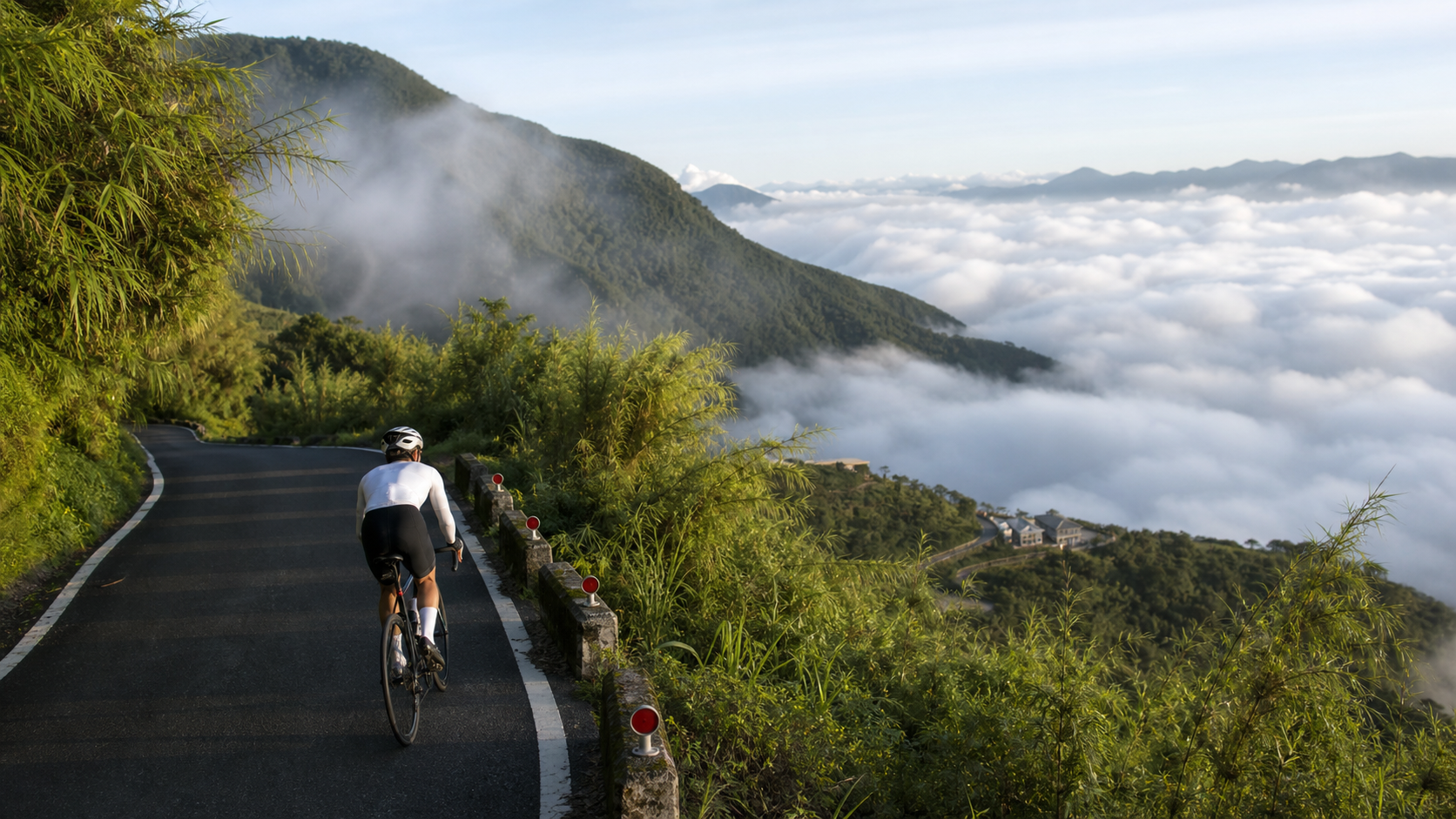
Entering the final three kilometers, physical fatigue had become quite evident, and a dull soreness began to spread through the muscles in my legs. But curiously, the higher the altitude rose, the stronger a certain indescribable sense of anticipation grew—I knew I was approaching the observation platform famous for its sea of clouds, and this psychological cue of “about to arrive at somewhere special” became a vital force carrying me through the final stretch of weary pedaling. Finally, as my view opened up dramatically after the last switchback, I saw the surging, flowing sea of clouds before me—vast banks of mist spread across the valley, shifting and transforming with the air currents, while sunlight pierced through gaps in the clouds, casting streaks of golden light across the cloud surface. In that instant, all my fatigue seemed to be completely washed away by the breathtaking scene before me, leaving only heartfelt awe and emotion. I stopped my bike and stood quietly on the observation platform, feeling the cool mountain breeze brush against my cheeks, gazing at the sea of clouds that seemed almost within reach. Suddenly I understood why so many people are willing to spend an entire morning enduring the toil of a long climb, just to witness with their own eyes this scenery above the clouds.
The Route’s Significance to Riders: A Dual Ascent of Altitude and Mindset
For me, the most profound significance of the Shibi Yunling Zhiqiu route lies in the unique experience it offers of “physical altitude” and “mental altitude” rising in tandem. The 10.76-kilometer long, gentle slope tests not only leg strength and cardiovascular endurance, but also a psychological quality requiring patience and composure—you cannot conquer this route with a brief burst of explosive power; you must rely on sustained, steady effort, advancing pedal by pedal, turn by turn toward your goal. This process of needing prolonged persistence to reach the finish, in a way, mirrors many important endeavors in life that require patient cultivation and cannot be rushed.
And when you finally reach Yunling Zhiqiu and stand on the observation platform overlooking the surging sea of clouds, that feeling of simultaneous release and elevation of body and mind often prompts a re-evaluation of the value of “perseverance.” The climb in altitude is a concrete, measurable figure—545.6 meters of total elevation gain—but the transformation in mindset is something no data can precisely quantify. It is a process of gradually shifting from the unease and anxiety at the foot of the mountain to the calm and contentment at its summit, and this process is the most precious gift that the Shibi Yunling Zhiqiu route bestows upon every rider willing to measure it with their own legs.
I have visited this route multiple times across different seasons and different states of mind, and each arrival at Yunling Zhiqiu has felt slightly different. Sometimes I came with training goals, staring at power and heart rate data throughout, and upon reaching the summit, I felt a solid sense of accomplishment and data-driven satisfaction. Other times, I came simply to escape the noise of the city, climbing slowly with a weary heart, and upon arrival, I felt a sense of release, thoroughly healed by the natural surroundings. This quality of the same route being able to carry different mindsets and offer different rewards is perhaps the deeper reason why Shibi Yunling Zhiqiu draws riders back again and again. It is not merely a route for accumulating training data; it is more like an old friend who silently accompanies the rider, responding differently according to your current state of mind.
During the long, continuous pedaling, I often find myself drawing parallels to important life journeys that require patient accumulation and cannot be achieved overnight. Whether it is career development, the cultivation of relationships, or any long-term goal worth pursuing, they are often like this 10.76-kilometer gentle slope—what they demand is not instantaneous explosive power, but sustained, steady effort and persistence. On this route, you cannot reach the summit through a short sprint; only through one solid revolution of the pedals after another can you truly witness the magnificent sea of clouds at the top. This realization turns every ride on this route into a journey of simultaneous physical and mental cultivation.
Sounds and Light in the Bamboo Sea: An Aesthetic of Slow Riding
If I had to define the uniqueness of the Shibi Yunling Zhiqiu route through a single sensory experience, it would be “sound.” Most climbing routes leave riders with sensory memories dominated by vision—mountain ridges, seas of clouds, switchbacks—but this stretch of Shibi, over ten kilometers long and tightly flanked by bamboo groves, makes the auditory experience remarkably vivid. The rustling of bamboo leaves rubbing against one another produces distinctly different volumes and rhythms depending on wind speed. When a gentle breeze blows, the sound is as soft as a whisper; when the mountain wind strengthens, the entire bamboo sea emits a roar like crashing waves—a sensation of enveloping sound that is difficult to replicate on most other climbing routes.
I have gradually developed a habit when riding Shibi—every so often, I deliberately slow my cadence, letting my breathing recede into the background, and focus on listening to the changing sounds coming from the bamboo groves around me. This almost meditative riding rhythm unexpectedly transforms what should be a tedious, grueling climb into a relaxing experience for both body and mind. The play of light and shadow is equally worth savoring: in the early morning, when the sun sits low, light pierces through gaps in the bamboo to form long, slender beams that shift angles with every turn of the wheel, as if riding through a natural labyrinth of light and shadow; near noon, the sunlight falls from directly above, and the specks of light filtering through the bamboo leaves scatter across the asphalt like crushed diamonds, flickering and dancing with the breeze. This process of elevating the riding experience into a feast of sensory aesthetics is precisely the aspect of Shibi Yunling Zhiqiu that is far richer and more moving than what mere gradient data can convey.
The Mental Discipline of a Long, Gentle Climb
A distance of 10.76 kilometers, a total elevation gain of 545.6 meters, and an average gradient of just 4.2%—at first glance, these figures are unremarkable, even gentler than the steeper routes like Xianshan or Luchang mentioned earlier. But anyone who has actually ridden this route understands that the challenge of a long, gentle climb is a completely different kind of mental discipline. The pain of a steep climb is brief and intense—the burning sensation in the muscles and the extreme pressure on the heart and lungs peak within minutes, but they also tend to end within a relatively short time. The challenge of a long, gentle climb, by contrast, is drawn-out and persistent; you must learn to coexist with prolonged mild discomfort, to find your own patience and rhythm within what feels like an endless ascent.
This kind of riding experience, in some ways, is closer to the psychological qualities required for long-distance road races or endurance off-road challenges—not overcoming obstacles through instantaneous explosive power, but through sustained, steady willpower, accumulating forward progress bit by bit. I often find that around the middle section of the Shibi route, roughly the fifth or sixth kilometer, the feeling of “why aren’t I there yet” is most prone to creeping in as a sense of restlessness. At such moments, learning to shift attention from “how much distance remains” to “what I am experiencing right now” is often the key to pushing through this psychological low point. The sounds of the bamboo forest, the gradually cooling air, and the rhythmic cadence of my legs turning are all effective tools for anchoring myself in the present and calming that restlessness. This mental resilience forged on long, gentle climbs, in a way, carries over to other challenges in daily life that require prolonged persistence before results become visible—and this, perhaps, is the most precious intangible gift that the Shibi Yunling Zhiqiu route bestows upon riders, beyond its scenery.
Seasonal Scenery and Suggested Itinerary
The sea of clouds at Yunling Hilltop generally has a higher chance of appearing under suitable viewing conditions during autumn and winter, but whether you actually get to see the sea of clouds still depends on the combined effects of that day’s air pressure, humidity, and terrain winds. There is no absolutely fixed pattern. Before your visit, it’s advisable to check recent weather trends as a supplementary reference, and keep an open mindset of “appreciating whatever comes.” Even if there’s no sea of clouds that day, the bamboo forest scenery covering the mountains and the fresh mountain air are still well worth a dedicated visit. Beyond the sea of clouds, the vegetation colors in this area also have their own characteristics across the four seasons—from the lush green of spring and summer to the warmer tones some plants take on in autumn and winter—each adding a unique seasonal character to this route.
For riders looking to plan a full mountain mini-trip, in addition to taking on the Shipi Yunling Hilltop climbing route itself, the nearby Caoling Scenic Area is also a worthwhile stop to visit along the way. Its rich natural ecology and geological landscapes can add more layers of experience to this mountain journey. It’s recommended to schedule the climbing challenge in the early morning hours—on one hand, the cooler temperatures are more comfortable for long rides; on the other hand, the early morning is also a relatively favorable time to capture the sea of clouds and the hazy bamboo forest scenery. After completing the challenge, consider stopping by a local restaurant nearby to enjoy a simple yet delicious bamboo shoot dish, allowing your body to replenish energy while your mind soaks in the unique tranquil atmosphere of this high-mountain settlement—bringing this journey from the foot of the mountain to the clouds to a warm and fulfilling close.
On the way out of Shipi, I always can’t help but slow down, turning back to look at the bamboo sea and mist-shrouded mountain ridges gradually receding into the distance, silently noting in my heart the most memorable scenes from this ride—perhaps a bamboo forest tunnel shrouded in morning fog, perhaps that breathtaking sea of clouds from the observation deck, or perhaps just a few casual exchanges with the shop owner at a roadside eatery along the way. These precious memories accumulated from such moments make Shipi Yunling Hilltop, in my mind, far more than just a training route marked by 10.76 kilometers and 545.6 meters of elevation gain—it has become a private scenic treasure that brings new discoveries and new emotions with every visit, worth returning to again and again, with different moods and in different seasons, to embark once more on this long journey slowly climbing from the foothills toward the clouds, each trip yielding scenery and emotions unique to that day and that moment.
Related Reading
- Route 162甲 Ruifeng: Riding into the Sea of Clouds in Alishan’s Tea Region, a Long Climb Dancing with Morning Mist
- Shipi Yunling Hilltop Practical Guide: The Endurance and Pacing Art of a 10.76 km Long Gentle Climb
- A Six-Kilometer Journey Through Time: Caoling Highway’s 921 Memories, Tea Garden Light and Shadow, and Zhushan’s Local Warmth
- Guanhaiping: If the Mountain Is High Enough You Can See the Sea, Tou 49’s Bagua Tea Gardens and Bamboo Sea
觀霧 變好騎了! | 北高車友爆笑大會師 | 公路車 | 單車旅遊 Taiwan Cycling Route GuanWu
6 年前
#北橫 + #北進武嶺 最硬的員工旅遊 EP1 | #公路車 #拉拉山 | 明池 | 武嶺 | 武陵農場 | 雲海 | Taiwan Cycling Route Wulin
6 年前
#北進武嶺 單車員工旅遊 EP2 | Feiyu Pocket 2s 人體空拍機 | 4K沈浸式體驗遊 | 公路車 | CT Yeh
4 年前
嘉義大埔、阿婆灣挑戰賽,美到以為在日本!ft. 環騎5 Cool 西拉雅188 / 公路車 / CT Yeh
7 個月前
台北闊瀨陡坡 騎旅 / 日本單車雜誌編輯車友臨時加入!/ 髮香才是最強的 / feat. 北迴歸線小隊 / 公路車 CT Yeh
6 個月前
單車 梅山36灣 坡度介紹 路段介紹 空拍 (相關遊記影片,請參考說明或我的頻道喔,歡迎訂閱)
6 年前
2023 夏季KOM 參賽實況 / 穿越空拍視角 / 整車都凸台 / 太魯閣峽谷x合歡山絕美大景 / 東進武嶺 / Taiwan KOM Challenge / 公路車 / CT Yeh
3 年前
新竹羅平 x 天湖部落 大禹嶺級變態陡坡! 4K超高畫質 空拍 | 公路車
5 年前