An Unheralded Hard Climb: Riding Into Wulai's Mountains on Zhulu Mountain, a 546-Meter Dialogue With Yourself
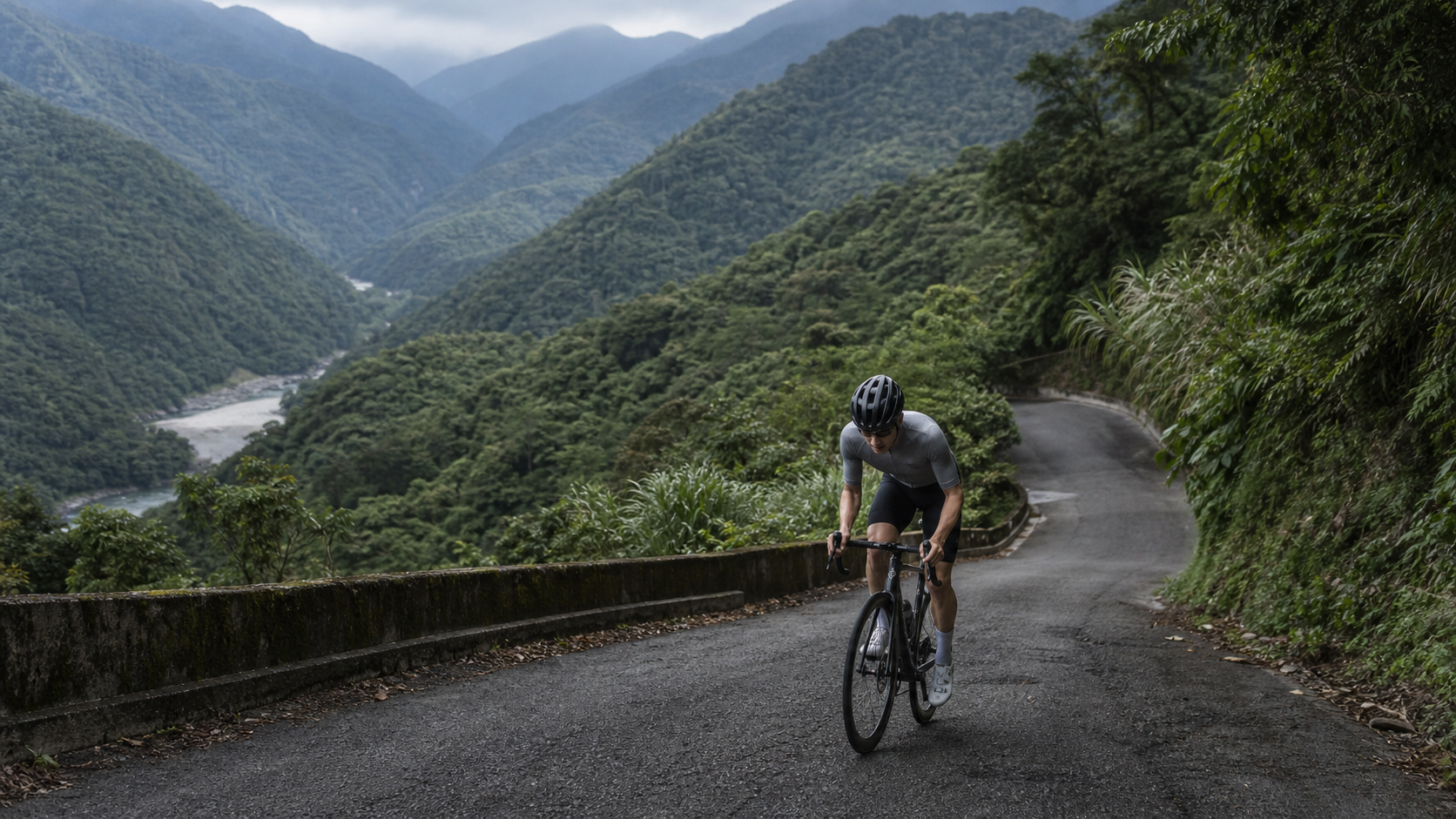
An Unheralded Hard Climb: Riding Into the Zhulu Mountain Area of Wulai, 546 Meters of Self-Dialogue
“Some routes go viral on social media; others live only in the word-of-mouth of a few riders. Zhulu Mountain belongs to the latter—it doesn’t earn fame through stories, it speaks through its gradient alone.”
In an age of information overload, nearly every route worth riding can be found online with detailed introductions, landmark stories, and even turn-by-turn ride reports. But Zhulu Mountain is different. This route, located in the mountainous Wulai District of New Taipei City, stretches 6.89 kilometers with 546.2 meters of elevation gain and an average gradient of 7.9%, yet information about it is astonishingly scarce—even geographic databases have no independent entry for it. Its precise location, surrounding scenery, and even the origin of its name all lack verifiable public records. But it is precisely this near-“blank slate” status that makes Zhulu Mountain a route especially worth writing about—it forces us to understand a route’s significance in a different way: not through others’ stories, but through the experience we carve out with our own pedaling.
Wulai, the Frontier Land on the Northwestern Edge of the Xueshan Range
To understand Zhulu Mountain, one must first understand the land it calls home: Wulai. Located at the southernmost tip of New Taipei City, Wulai District is one of the most rugged and mountainous administrative areas in all of New Taipei. Geographically, it belongs to the northwestern side of the Xueshan Range, with undulating peaks and crisscrossing valleys throughout—a classic youthful river valley terrain. In other words, the rivers on this land are still in an active phase of intense downward erosion, creating steep gradients, deeply incised gorges, and layer upon layer of interconnected yet independent peaks.
It is precisely this geological backdrop that gave rise to a long, steep climb like Zhulu Mountain with an average gradient approaching 8%—on this land at the edge of the Xueshan Range, still being sculpted by flowing streams, nearly every road connecting mountain settlements must contend with dramatic elevation changes. For cyclists, this means the roads of the Wulai mountains carry an inherent “uncompromising” character—they won’t offer you a gentler alternative route just because you’re underprepared; they only test everyone who attempts to approach this land with the most direct gradient possible.
The name Wulai itself carries the imprint of indigenous culture—the area is an important traditional living territory of the Atayal people, and these mountains have long been closely tied to the Atayal’s history of hunting, farming, and tribal migration. Although the exact origin and naming context of “Zhulu Mountain” currently lack verifiable public records, the imagery evoked by the characters “Zhulu” (chasing deer)—pursuit, mountain forests, hunting—seems to subtly echo this mountain area’s historical identity as a traditional indigenous hunting ground. While we cannot confirm whether this is the true origin of the name, such an association still adds a thought-provoking layer of imagination to this route.
Other Stories in the Mountains: Wulai’s Hot Springs and Forest Memories
Although specific geographic details about Zhulu Mountain itself lack documentary support, the broader Wulai mountain area carries a rich and verifiable local heritage that forms the backdrop for Zhulu Mountain—worth taking time to appreciate beyond the ride itself.
Wulai’s hot spring development dates back to the early Japanese colonial period in 1903, making it one of Taiwan’s historic hot spring towns. The thermal resources of the Nanshi River basin have long attracted visitors from far and wide to soak and relax, gradually transforming Wulai from a simple mountain settlement into an industry built around hot spring tourism. For cyclists with sore muscles after a long climb, the Wulai mountains happen to offer hot spring resources that allow the body to fully unwind—adding a particularly thoughtful way to cap off a day of tackling a hard, long climb like Zhulu Mountain: using the warmth of the springs to soothe the fatigue accumulated in your legs over 546.2 meters of elevation gain.
Fushan Village in Wulai is home to the Fushan Fish-Watching Trail and a scenic bridge, a well-known spot for observing the ecology of the Nanshi River basin; Xinyi Village features the Xinyi Suspension Bridge and associated trails, allowing visitors to get close to the natural landscape where streams and forests intertwine. The Neidong Forest Recreation Area is renowned for its spectacular waterfall scenery and is one of the key ecotourism sites in the Wulai mountains. And Wulai Waterfall, commonly known as Yunxian Waterfall, boasts the greatest elevation drop of any waterfall in New Taipei City and has long been a must-see natural wonder for visitors to Wulai.
Wulai Old Street presents yet another facet of local culture—showcasing Atayal culinary customs and life wisdom through bamboo tube rice and mountain produce dishes, making it one of the most direct windows for visitors to experience indigenous culture. These attractions and cultural sites scattered throughout the Wulai mountains together form a rich, multi-layered portrait of this land. To be honest, the precise spatial relationships between Zhulu Mountain and well-known sites such as Fushan, Xinyi, Neidong, the waterfall, and the old street currently lack sufficient public records to verify, so it is not possible to clearly describe the relative positions or distances between Zhulu Mountain and these attractions. But the existence of these sites is enough to show that the entire Wulai mountain area—the Nanshi River basin mountains where Zhulu Mountain sits—is itself a place of rich layers, worthy of repeated exploration, and Zhulu Mountain is, within this mountain area, a unique corner belonging to cyclists.
It is also worth noting that the natural ecology of this Nanshi River basin mountain area possesses considerable diversity. The humid climate on the northwestern side of the Xueshan Range, combined with the elevation changes brought by youthful river valley terrain, nurtures distinct vegetation zones—from low-elevation broadleaf forests to the interwoven secondary forests and bamboo groves that appear as altitude rises—forming the most direct and authentic visual companionship during the ride up Zhulu Mountain. While we cannot confirm specific records of Zhulu Mountain itself in ecological survey data, the entire Wulai mountain area, as part of the Xueshan Range ecological corridor, has long been a region of interest for flora and fauna researchers. This adds another layer of meaning to riding through these mountains—a close encounter with the natural environment.
First Person: A Climb Without a Story to Lean On Forces You to Be More Honest with Yourself
Before setting out, I tried searching online for information about Zhulu Mountain, hoping to find some riders’ insights or cautions, but I came up almost completely empty. No detailed map markings, no rich ride reports, and even the origin of the mountain’s name yielded nothing. This state of “information vacuum” initially made me a bit uneasy—I’m used to doing thorough homework before tackling a new route, understanding every possible road condition in advance. But on second thought, perhaps this is precisely what makes Zhulu Mountain most precious: it forces me to cast aside all preconceptions and the filters of others’ experiences, and face this road in the most raw, most direct way possible.
The air at the starting point carried that distinctive moisture and vegetation scent unique to mountain areas, with the sky still holding the grayish-blue tones of early morning. I glanced at the route data on my cycling computer: 6.89 kilometers, 546.2 meters of elevation gain, 7.9% average gradient. Honestly, seeing those numbers, I felt a twinge of apprehension—this wasn’t the kind of gentle climb you could casually spin through; this was a serious battle requiring deliberate pacing and an honest confrontation with my physical limits.
From the very first pedal stroke, the gradient revealed its character without mercy—there was almost no warm-up buffer, and within the first few hundred meters I could already feel my thigh muscles straining against gravity. The surrounding trees were lush and dense, sunlight filtered through layers of branches into fragmented dapples of light scattered across the damp asphalt. Occasionally I could hear the sound of a stream murmuring in the distance—likely one of the tributaries of the Nanshi River watershed—its voice unusually clear in the silent mountains, becoming the only constant background sound accompanying me on my solitary climb.
By the middle section, my energy was depleting faster than expected. Breathing grew rapid, sweat continuously seeped from inside my helmet, trickling down along my temples. This route offered no specific landmarks to serve as psychological waypoints—no temples, no famous sights, no clearly designated viewpoints—only the unrelenting gradient and occasional side roads pointing toward unknown destinations. This state of “not knowing how much farther, with no clear reference points” tests your willpower more than any route with clearly marked landmarks—you can only trust the numbers on your cycling computer, trust the pacing strategy you chose, and pedal through the gradient before you, one stroke at a time, one revolution at a time.
Nearing the final stretch, my energy was clearly depleted, and I found myself constantly talking to myself internally, telling myself “just hold on a little longer” and “you’ve already passed the majority.” This kind of climbing experience, sustained purely by willpower, is fundamentally different from riding routes backed by historical narratives and famous landmarks—at Zhinan Temple in Maokong, you can imagine the temple’s upturned eaves and the fragrance of tea plantations as concrete thoughts to sustain you; but on Zhulu Mountain, all you can rely on is yourself.
When I finally completed the climb and leaned against the guardrail by the roadside, gasping for air, the surroundings remained nothing but continuous mountain forest—no landmark worthy of a photo-op, no tangible object to prove “I made it.” Yet the sense of accomplishment at that moment was exceptionally strong and pure—because this challenge, from start to finish, had no external encouragement or companionship. It was entirely me, alone, using my legs against that 546.2 meters of elevation gain, engaging in an honest dialogue with no audience.
On the descent, my physical energy was nearly spent, but my mind was unusually clear. The downhill section immediately following a prolonged high-intensity climb demands no less focus than the ascent itself—my arms and shoulders were slightly sore from sustaining the climbing position for so long, and with the mountain road’s many curves and steep grades, I deliberately slowed down, using intermittent braking to give the brake system room to cool and to allow myself more reaction time for unexpected corners or road conditions. Passing again through the familiar turning points I’d climbed earlier, this time I experienced them from a completely different perspective and mindset—on the way up, they were filled with struggle and perseverance; on the way down, they carried a sense of relief that “I did it.”
Back at the starting point, I parked my bike and turned to look back at the mountain road I’d just climbed and descended. In the afternoon light, it looked utterly ordinary, even unremarkable—no striking landmark telling passersby “there’s a challenging climb worth tackling here.” But I knew that in those fifty-some minutes just past, my body and willpower had undergone a genuine test. This experience—known only to myself, not easily shared with others—is in some ways the most captivating aspect of the Zhulu Mountain route: it needs no external validation or exposure to be real enough, profound enough.
The Meaning of a Hidden Gem: Why a Climb Without Fame Deserves to Be Ridden
In an era where cycling increasingly emphasizes check-ins, sharing, and social media exposure, a route like Zhulu Mountain—lacking public information, unable to be easily “consumed” as a compelling post—stands out as especially precious. It offers no ready-made story for you to retell, no striking landmarks for you to photograph. The only thing it gives you is the most naked, most honest gradient data—7.9% average grade, 546.2 meters of elevation gain. That is its entire self-introduction.
This “hidden gem” quality, in a way, echoes the most original and purest essence of cycling—not to prove anything to anyone, not to accumulate likes, but simply to know how much your body and willpower can truly endure. Zhulu Mountain doesn’t actively attract you; it almost deliberately conceals itself in the blank spaces of information, waiting for those riders who are genuinely willing to invest time and effort to seek it out and challenge it, to unveil its appearance with their own hands.
It is precisely for this reason that the sense of accomplishment after completing Zhulu Mountain carries a special purity—you know this achievement comes entirely from your own effort, unadorned by any halo of fame, unlayered by any predecessor’s experience. Everything is earned by you, bit by bit, with your legs, your sweat, and your willpower.
A Solitary Ritual: What Hidden-Gem Routes Taught Me
After riding several routes as information-sparse as Zhulu Mountain, I’ve gradually come to realize something: our “fondness” for a route actually stems from two distinctly different sources. One is externally bestowed—captivating historical stories, famous landmarks, abundant shares and admiration on social media; these external elements amplify our expectations and emotional projection toward a route. The other is entirely internal—derived purely from the most direct, most honest interaction between the body and the road itself. Zhulu Mountain belongs to the latter, and it is the latter in its near-extreme form.
During my ride up Zhulu Mountain, I began to grow accustomed to focusing on the most subtle sensory experiences—the vibration feedback transmitted through the asphalt at different gradients, the fine adjustments in breathing rhythm as the slope changed, the sticky sensation of sweat on skin as it slid down, the background sound woven from wind and the occasional stream. These details, on information-rich routes dense with landmarks, are easily drowned out by the sheer volume of data—you’re busy identifying landmarks, recalling related historical stories, thinking about where to stop for photos, and in doing so, you miss the most authentic riding experience your body is actually undergoing. But on Zhulu Mountain, free from the interference of external information, you are forced—and therefore able—to bring all your attention back to your own body and breath.
This experience, in a way, echoes a state of mind repeatedly mentioned by many seasoned riders—that truly top-tier riding experiences often don’t happen on the most spectacular, most pilgrimage-worthy famous routes, but rather on quiet, even somewhat lonely stretches, where you reach a near-meditative state of focus with the gradient, your heartbeat, and your breathing rhythm. Zhulu Mountain, precisely because of its informational blankness, more readily draws riders into this state—with few external distractions, only the purest contest between pedaling, breathing, and willpower remains.
For Those Willing to Take on the Hidden Gem: Notes on This Journey
If you decide to take on Zhulu Mountain, be sure to approach this mountain area with the respect and caution it deserves. As this is a road with relatively limited information, located in the Nanshi River watershed, and with traffic that is, by general understanding, relatively sparse, it is recommended that you inform family or riding buddies of your itinerary before setting out, and ensure you carry enough water, basic tire repair tools, and emergency gear. This land, still being carved by streams at the edge of the Snow Mountain Range, is beautiful yet carries a certain primitive wildness—worthy of your most cautious and respectful approach.
It is also recommended that, when attempting this route for the first time, you avoid setting out too early in the dim morning hours or returning too late in the evening—given the limited information along the way, the lower degree of road-condition awareness, and the rapidly changing mountain light, ample daylight will help you more clearly judge road conditions and gradient changes, and will also make it easier for other road users to spot you when needed, reducing unnecessary risk.
After completing the ride, if your energy and time allow, consider extending the entire trip into a more complete little getaway in the Wulai mountain area—this mountainous region of the Nanshi River watershed is rich in natural and cultural resources, including hot springs, waterfalls, suspension bridges, and trails, more than enough to help you find a place to fully unwind after conquering this brutally steep climb. Let the heat of the hot springs soothe the soreness in your legs, let the tranquility of the forest settle the riding experience that was a conversation with yourself—this would be the gentlest and most complete ending to the Zhulu Mountain journey, adding a sense of holistic fulfillment to what was originally a challenge purely of physical endurance and willpower.
Zhulu Mountain will not appear near the top of any popular route rankings, nor will many people share its story with you. But perhaps it is precisely this silence and emptiness that makes it a sanctuary where every rider who sets foot on this route can most honestly confront the limits of their own physical ability and willpower. What this route teaches us may well be the most original and precious meaning of cycling—some scenery does not need to be spoken of; it only needs to be personally pedaled through once.
Epilogue: Leaving Space Blank Is Also a Complete Kind of Scenery
While putting this article together, I kept pondering a question: how should a route that lacks specific historical documentation and clear landmark stories be written about? In the end, I realized that perhaps there is no need to force an elaborate story onto Zhulu Mountain, because its very “blankness” is already its most honest and most complete form.
We are accustomed to finding anchors of meaning for every route—the incense of some temple, the rise and fall of some mining industry, the echoes of some historical event. These stories make a route three-dimensional, easy to remember, and easy to share. But Zhulu Mountain reminds us that the value of a route has never necessarily depended on these external narratives. Its value can come simply from its own geographical conditions—the geological structure on the northwestern side of the Snow Mountain Range, the pristine terrain of the Nanshi River watershed still being sculpted by streams, and the physical test that the figure of a 7.9% average gradient represents, delivered directly to every rider who takes on the challenge.
If you have read this far and are also curious about this kind of “blank-space” route experience, why not pick a day, set foot on Zhulu Mountain yourself, and use your own legs, your own breath, and your own willpower to fill in that blank space of information. Every pedal stroke you turn will become your own, one-of-a-kind story on this route—and this, perhaps, is the most precious and most irreplicable gift that Zhulu Mountain, this obscure hard climb, can give to every rider willing to take on the challenge.
Related Reading
- Zhulu Mountain Practical Guide: 6.89 km, 546.2 m of Climbing, 7.9% Average Gradient—Are You Ready for This Hardman-Level Climb in the Wulai Mountains
- A Misidentified Secret Mountain Road: Solo Riding the Back of Nanhua Wushan, Encountering the Taiwan Strait and the Aroma of Po-bu-zi on the Hillside
- Sweat and the Haze of Cooking Fires: A 7.6 km Mountain Ride to Wulai Baoqing Temple
- Tonghou Forest Road Practical Guide: A Real-World Terrain Interpretation Behind 12.07 km and a 1.8% Average Gradient
台北闊瀨陡坡 騎旅 / 日本單車雜誌編輯車友臨時加入!/ 髮香才是最強的 / feat. 北迴歸線小隊 / 公路車 CT Yeh
6 個月前
萬年峽谷! 30% 超激陡坡 里佳部落DAY2 還是很硬! | 公路車 | CT Yeh
3 年前
新竹白蘭部落! 爬陡坡還能講笑話...? 廢物伙伴の約騎 | 公路車 | CT Yeh
4 年前
Q老師約騎烏來瀑布 / 該買樂透了!?/ 公路車 / CT Yeh
11 個月前
一定要騎一次!阿里山最深處:里佳部落!單車旅行 | 2800m爬升 | 深度部落體驗:嗨翻晚會、螢火蟲、銀河 | feat. JJSC & 廢物伙伴 | 公路車 CT Yeh
9 個月前
新竹羅平 x 天湖部落 大禹嶺級變態陡坡! 4K超高畫質 空拍 | 公路車
5 年前
大武山後門26%歡樂陡坡!JJSC南台灣單車行Day2 / 被颱風追著跑 / 公路車 / CT Yeh
2 年前
半日 小台灣 極限單車路線挑戰實錄
7 年前