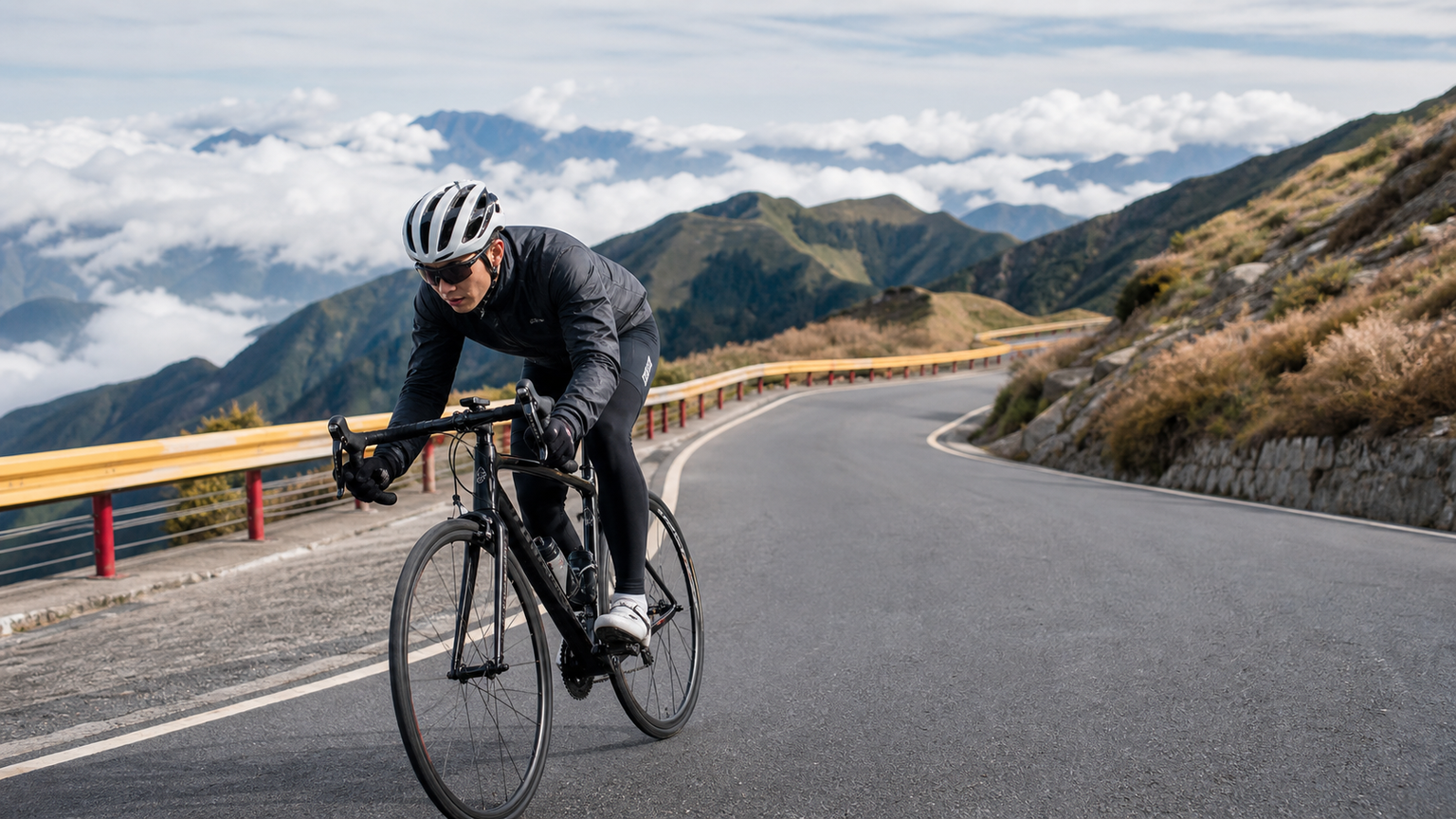
Wuling Descent: Technique and Safety for High-Speed Downhill from 3,275 Meters
Wuling, the highest point on Taiwan’s highways, sits at 3,275 meters above sea level. Many people discuss how to conquer the summit, but few seriously discuss “how to descend safely.” In fact, the challenge of descending Wuling is no less than climbing it, especially with a fatigued body and in the high-mountain environment where temperatures drop sharply—the risks of high-speed descending are very real.
This article explains the correct approach to descending Wuling from three perspectives: technique, safety, and psychology.
Basic Descent Data
| Direction | Distance | Elevation Drop | Features |
|---|---|---|---|
| West descent (Wuling → Puli) | Approx. 52 km | Approx. 2,700 m | Many curves, many villages |
| East descent (Wuling → Taroko) | Approx. 100 km | Approx. 3,200 m | Gorge scenery, narrower road surface |
This article focuses on the west descent route (Wuling → Puli), which is also the descent direction most riders choose.
Preparation Before Departure
1. Check the Braking System
This is the most important safety step. At the top of Wuling, your hands may be somewhat numb, and your eyes fatigued from the long ride. Before descending, please:
- Disc brakes: Squeeze the brakes firmly to feel whether braking power is normal; confirm the brake pads have sufficient thickness (replace if thinner than 2 mm)
- Rim brakes: Confirm the calipers are positioned symmetrically and the pad contact surfaces are even; there should be noticeable braking effect when pulling the brake lever to 1/3 of its travel
- Brake cables: Confirm there is no slack and the hydraulic lines have no damage
2. Replenish Calories and Stay Warm
Right after finishing the climb, your body is in a low-blood-sugar state. While stopping at Wuling, please:
- Immediately replenish carbohydrates (bananas, energy gels, rice balls)
- Put on an insulating layer (light down jacket, windbreaker): Temperatures at Wuling may be only 5–10°C, and with the wind chill from speeds above 40 km/h, hypothermia can set in very easily
- Wear insulated gloves: Loss of feeling in your fingers will seriously affect braking precision
3. Check Helmet Condition
During the climb, your helmet may have become soaked with sweat and may have shifted slightly. Readjust it, confirm the helmet fits snugly, and the buckle is fastened tight.
Descent Technique Essentials
Braking Strategy: Pulse Braking, Not Continuous Braking
This is the most fundamental and most important technique for descending. Do not keep squeezing the brakes continuously; instead, use a “pulse braking” pattern:
- Before entering a corner, brake lightly in advance (at least 3–5 seconds) to reduce speed to a safe cornering speed
- After entering the corner, release the brakes and let the bike corner naturally
- Accelerate out of the corner, then adjust the timing for the next pulse brake
Continuous braking leads to:
- Overheated rims (riders using rim brakes need special attention—tires may blow out from an overheated rim)
- Hot rotors (though disc brake systems are relatively safer and have fewer issues)
- Front wheel lock-up (slamming the front brake will cause the bike to skid and lose control)
Weight Distribution
The correct posture when descending:
- Weight shifted back: Push your hips slightly rearward, place both hands on the drops, and lower your center of gravity
- Knees gripping the top tube outward: Provides lateral stability, making your body and the frame one unit
- Pedals kept level (3 o’clock and 9 o’clock positions): Do not let one foot dangle; maintain balance
- Eyes looking toward the corner exit: Where you look, the bike will go
Cornering Technique
The west descent route from Wuling has numerous consecutive hairpin turns, especially on the section below Hehuan Mountain Lodge and above Wushe, where the corners are most dense. Cornering essentials:
- Cut in from the outside: Enter from the outside, approach the apex, then naturally swing back to the outside
- No braking in the corner: If speed has already been reduced appropriately, maintain a steady pedaling cadence or coast through the corner
- Identify road surface conditions: Slippery surfaces (fallen leaves, standing water, gravel) greatly reduce safe speed and require earlier braking
Dangerous Section Warnings
Hehuan Mountain Lodge → Kunyang (3,275 m → 2,750 m)
This section has the steepest gradient, averaging about 7–9%, with dense corners. Many beginners have accidents here because they enter corners too fast to make the turn. Recommended speed: no more than 35 km/h.
Kunyang → Cingjing (2,750 m → 1,748 m)
The gradient eases slightly, but after rain the road surface tends to accumulate water and fallen leaves, and the roadside drops off into cliffs—do not let your guard down. There are many tour buses; watch for oncoming traffic.
Wushe → Chunyang (1,148 m → 800 m)
Entering the Atayal tribal area, there are residents along both sides of the road, and occasionally children, dogs, and scooters may dart out. Speed should be kept below 30 km/h.
Final 5 km Before Puli City Center
As you approach flat ground, traffic volume increases dramatically, with parked cars and motorcycles everywhere. You need to switch from high-speed mode to urban riding mode.
Weather Factors
Weather at Wuling changes rapidly; even if the morning is sunny, fog or rain may arrive in the afternoon. Recommendations when encountering fog or rain on the descent:
- Visibility below 100 meters: Stop and wait, or drastically reduce speed (no more than 15 km/h)
- Standing water on the road: Assume there is a pothole under every puddle; brake early and avoid them
- When fog rolls in: Turn on your front and rear lights so oncoming vehicles can spot you early
Mental Preparation
After completing the climb, many people relax their vigilance out of a sense of achievement and relief, making them more prone to accidents on the descent. Remember:
- Completing the climb does not mean the journey is over; the descent is the most dangerous part
- Your muscles are fatigued after the climb, and your reaction time is slower than usual
- Choosing a conservative speed is always the right choice
Conclusion
Descending Wuling does not require going as fast as a professional racer. What matters is making the correct speed judgment before every corner and staying calm through every change in road conditions.
Many cycling accidents in Taiwan happen on descents, not climbs. Approach it with humility, control your speed, and let every trip to Wuling end safely.
Related Reading
- Wuling Climb Guide: Challenge Strategies and Nutrition Planning for Taiwan’s Highest Highway
- Wuling Hill Climb Race Guide: Pacing Strategy and Feed Zone Analysis at 3,275 m
- First-Time Wuling Challenge: Conquering the Highest Point on the Highway at 3,275 Meters
- West Approach Wuling Descent Technique and Safety: Complete Guide to Rough Roads, Corners, and Brake Management
大禹嶺 到 武嶺牌樓 全程前後實況錄影 | 北進武嶺 | 東進武嶺 | KOM | 訓練台 | 坡度分析 | Taiwan KOM Last 10 km HARD | 公路車
6 年前
FTL 與 SYB 車隊專訪 西進武嶺 實用攻略分享! 2小時 如何練?!你不知道的眉角!新手準備武嶺必看 EP1 | 實力派女車友 | 精華版 | 公路車 | CTYeh
4 年前
#北橫 + #北進武嶺 最硬的員工旅遊 EP1 | #公路車 #拉拉山 | 明池 | 武嶺 | 武陵農場 | 雲海 | Taiwan Cycling Route Wulin
6 年前
富士山KOM 賽事篇 VLOG!/ 小野田出沒!/ 完整路段分析 / 武嶺要騎多快才能拿環?/ 台灣選手 第20回Mt.富士ヒルクライム 参加!/ 公路車 / CT Yeh
2 年前
CT 喇低賽) 武嶺牽車 才是王道 西進牽車四小時內秘訣 攝手位置 如何判斷 防抽筋小秘訣
7 年前
#公路車 #西進武嶺 配速配瓦實驗 坡度分析 四小時內攻略 建大盃 NeverStop #西進武嶺攻略
6 年前
風櫃嘴時間 預測西進武嶺時間?13000名車友統計數據分析告訴你 !
5 年前
西進武嶺各路段 前8000名 大數據分析 配速攻略/功率/心律/推力比/維持率/踏頻/踏瓦比/牽車率 大公開 | 建大盃 NeverStop 可參考 | 公路車 | CT Yeh
5 年前