Introduction
Stress fractures are an endurance athlete’s nightmare. Among marathon runners, the annual incidence is approximately 1–3%; it is higher in female athletes, especially those with irregular menstrual cycles. Bone health is not as simple as “drinking milk”—it involves a complex interaction of calcium intake, vitamin D status, hormonal balance, mechanical loading patterns, and overall energy availability. However, calcium and vitamin D remain the foundational pillars, and they are also the two micronutrients most easily overlooked by endurance athletes.
Why Endurance Athletes May Actually Have Lower Bone Density
The common intuition is that “more exercise = stronger bones,” but the reality is more nuanced:
- Cyclists have lower bone density: Cycling is a non-weight-bearing sport, and the mechanical stimulus is insufficient to adequately promote bone formation. Studies show that long-term cyclists have lower hip and spine bone density than runners and even the general population.
- Swimmers: Weight-bearing in water is nearly zero, and their bone density is also lower than that of land-based athletes.
- Relative Energy Deficiency in Sport (RED-S): When energy intake is insufficient, ovarian/testicular function is suppressed, estrogen/testosterone levels drop, and bone loss accelerates.
- Calcium loss through sweat: Heavy sweating can result in a loss of 40–60 mg of calcium per hour.
Calcium: Daily Requirements and Food Sources
Taiwan’s Ministry of Health and Welfare recommends a daily calcium intake of 1,000 mg for adults and 1,200 mg for adolescent athletes aged 13–18. Endurance athletes are advised to maintain 1,000–1,500 mg, with female athletes who have irregular menstrual cycles leaning toward the higher end.
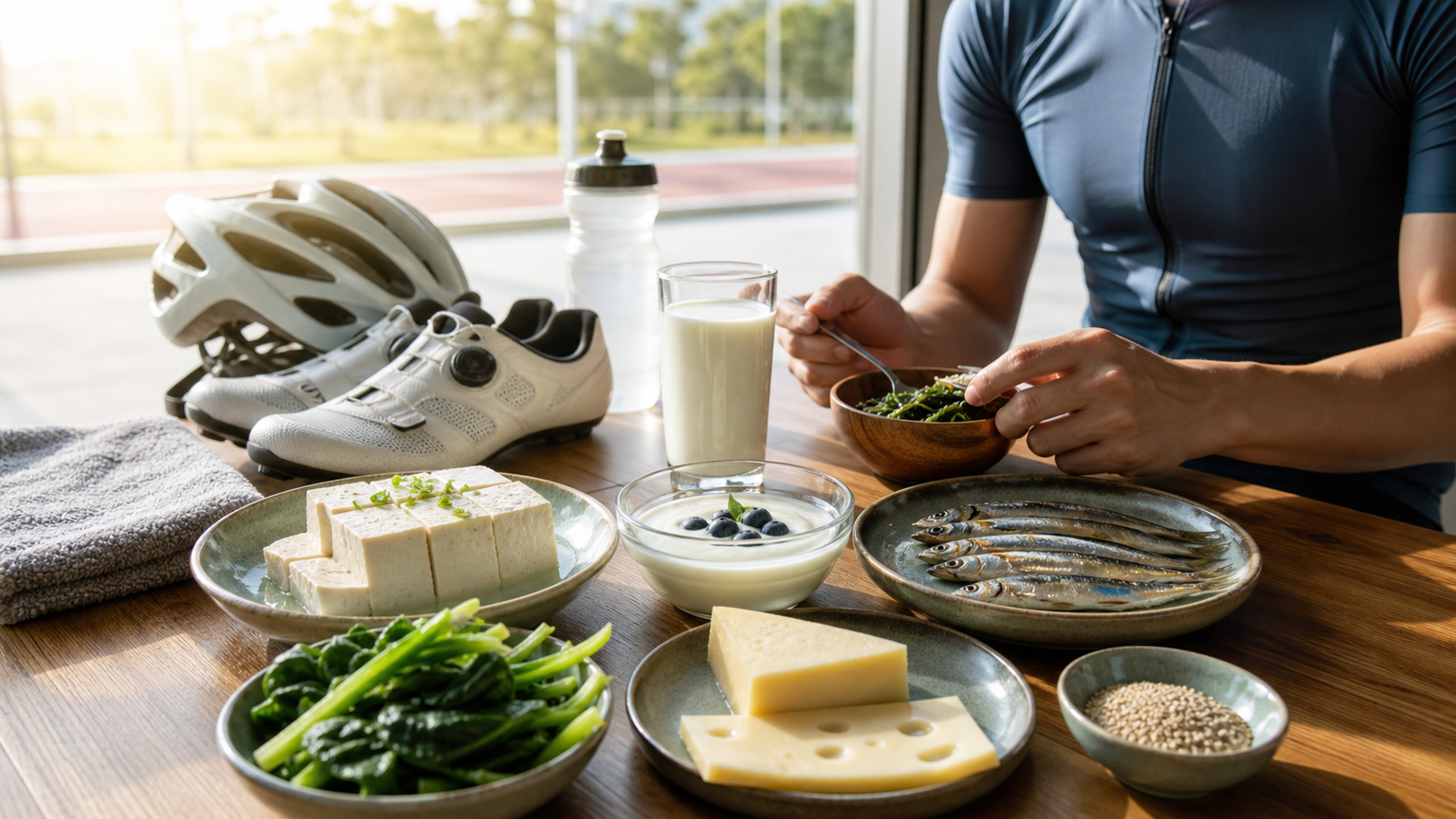
| Food | Serving Size | Calcium (mg) | Notes |
|---|---|---|---|
| Whole milk | 240 mL | 285 | High bioavailability |
| Yogurt (plain) | 200g | 250–300 | Lactic acid bacteria aid absorption |
| Firm tofu | 150g | 350–500 | Varies by coagulant (calcium sulfate) |
| Dried baby sardines | 20g | 220 | Appropriate calcium-to-phosphorus ratio |
| Black sesame seeds | 2 tablespoons | 200 | High in oxalate, slightly lower absorption rate |
| Dark leafy vegetables (Chinese kale) | 100g (cooked) | 170 | Choose those low in oxalate |
| Cheese (Parmesan) | 30g | 330 | Highly concentrated calcium |
Absorption rate differences: Calcium absorption from dairy is 30–35%, from firm tofu (made with calcium sulfate) about 30–32%, from dark leafy vegetables (those low in oxalate, such as broccoli) about 50–60%, and from spinach only 5% due to its high oxalate content.
Vitamin D: The Blind Spot for Endurance Athletes
Although Taiwan is located in the subtropics, indoor training, sun-protection habits, and high-latitude residence mean many athletes still suffer from vitamin D insufficiency (<30 ng/mL). A 2022 survey of Taiwanese competitive athletes showed that approximately 40% had vitamin D insufficiency.
Vitamin D’s functions go beyond bone health:
- Promotes intestinal calcium absorption (when deficient, calcium cannot be effectively utilized even with adequate intake)
- Regulates muscle function; those deficient are more prone to falls and decreased muscle strength
- Modulates immunity, reducing the risk of upper respiratory tract infections
- May affect VO₂max and cardiac function (preliminary research)
Sun exposure recommendations: Face plus arms, 10–30 minutes of midday sun exposure daily (varies by skin tone and latitude). Darker skin requires longer exposure. However, during Taiwan’s summers, many athletes reduce sun exposure due to sun-protection needs and must compensate through diet or supplements.
Food sources: Salmon (400–700 IU/100g), mackerel, fortified milk (100 IU/240mL), egg yolk (40 IU/egg). Diet alone makes it difficult to reach adequate levels (daily recommendation of 600–2000 IU); those deficient should supplement with vitamin D₃ at 1,000–2,000 IU/day.
The Synergistic Effect of Calcium and Vitamin D
| Combination | Benefit |
|---|---|
| Adequate calcium + adequate vitamin D | Maximizes bone mineralization efficiency |
| Adequate calcium + vitamin D deficiency | Intestinal calcium absorption drops to 10–15%, significantly diminishing benefits |
| High-dose calcium supplements but vitamin D deficiency | May cause calcium deposition in blood vessels, increasing cardiovascular risk |
Special Recommendations for Cyclists
Because cycling provides insufficient skeletal stimulation, cyclists should:
- Add running or jump rope 2 times per week (even 10–15 minutes of weight-bearing impact is effective)
- Undergo regular bone density (DXA) scans, especially those who have trained for more than 5 years
- Actively supplement calcium and vitamin D
Practical Recommendations
- Consume 3 servings of dairy daily (or equivalent alternatives such as tofu/dark leafy vegetables) to reach the 1,000 mg calcium target.
- Get a blood test for serum 25(OH)D levels, aiming for 40–60 ng/mL; supplement with D₃ if deficient.
- Avoid excessive caffeine (more than 400 mg of caffeine per day may slightly increase calcium excretion).
- Do not take large doses of calcium and iron supplements simultaneously (they compete for absorption); take them 2 hours apart.
Conclusion
Insufficient bone density is a silent performance killer—it only forces a halt to competition once a stress fracture occurs. Adequate daily calcium intake paired with sufficient vitamin D is the lowest-cost investment to prevent this tragedy. Don’t let a few skipped glasses of milk cost you three months on the sidelines.
Related Reading
- Calcium and Vitamin D: The Cornerstone of Bone Health—A Bone-Building Guide for Athletes and the General Population
- Vitamin D and Endurance: The Impact of the Sunshine Hormone on Bone, Muscle, and Immunity
- Calcium and Bone Density in Female Athletes: The Unique Risks in Three Endurance Sports
- Strength Training for Female Endurance Athletes: Special Considerations for Relative Energy Deficiency and Bone Density
一日北高/長距離團騎 常見問題補充篇 / 組團或跟團的眉角 / 壯車友容易被瘦車友慢性拉爆 / 原來屁股痛可能是這個原因...? / 風場配速法 / 公路車 / CT Yeh
2 年前
CT暗黑廚房) 車友必備 宇宙無敵鮮蚵湯 幫助訓練恢復 天然食補 好市多 超肥鮮蚵 破PR
7 年前
2021 96聯賽 桃園市長盃 4K多視角實況 當天選手瓦數/推力比/均速/時間 即時數據分析 | 公路車 | CT Yeh
5 年前
一日北高常見問題大集合 | 攻略 | 路線 | 訓練 | 補給 | 自行車 單車 | 一日雙城 | 雙塔 | TWB北高360 | 屁股痛
6 年前
西進武嶺 免費訓練分析服務 Intervals | 練不夠還是練過頭?你哪一種類型選手?AI模型告訴你! | 備戰神器 | 公路車 訓練 | CT Yeh
4 年前
一日北高前的西濱集訓 | 跟著11小時軍團 | 300W踩不動的大逆風 | 輪車破風差幾瓦?
6 年前
秘境雪場 日本 八甲田 冰樹探險與滑雪體驗 ft. Q老師 & 運動生活
7 年前
摔車後補裝備: 好市多新款單車安全帽& Specialized Romin 北高整路屁股都不痛的坐墊 | 一千元居然有MIPS | CT Yeh | 公路車
4 年前