Introduction
The day I set out, the sky was a low, iron gray, and the weather forecast said “rain all day.” I hesitated in the garage for about ten minutes, but in the end, I still wheeled the bike out.
My friend thinks I’m a bit odd. He says normal people don’t go cycling in the rain.
I tell him, you wouldn’t understand unless you’ve tried it.
Riding in the rain is an experience you can only grasp by putting yourself through it. It carries danger—real danger, not just scare tactics. But it also holds a purity you can’t find on sunny days, as if everything unnecessary has been washed away by the rain, leaving only you and the road.
The Real Dangers of Riding in the Rain: No Exaggeration, Take It Seriously
Let’s talk about the dangers first—this part matters more.
The biggest safety threat when riding in the rain isn’t “being wet”—it’s “misjudging your predictions.” On a stretch of road where you think you can brake in time, the braking distance in the rain can extend by 40–60%. On a corner where you assume you have enough grip, the coefficient of friction on wet asphalt may drop to just 60% of what it is on a dry day.
| Hazard Factor | Dry Conditions | Wet Conditions | How to Respond |
|---|---|---|---|
| Braking distance | Baseline | Extended by 40–60% | Start braking at 2x the normal distance |
| Cornering grip | 100% | 60–70% | Reduce corner entry speed by 20–30% |
| Metal surfaces (bridge steel plates/manhole covers) | Normal | Extremely slippery | Cross straight on; do not turn or brake |
| Visibility | Normal | Reduced (rain fog/fogged glasses) | Anti-fog lenses, clip-on goggles |
| Visibility to vehicles behind | Taillight visible | Harder to see you | Use a high-lumen taillight + bright-colored rain jacket |
Once, near Muzha, I didn’t slow down early enough on a steel grid bridge deck. The wheel slipped on the steel grating, and the rear wheel suddenly slid about 20 centimeters to the right. Fortunately, I wasn’t going fast, and I managed to regain control. If I’d been going any faster, the outcome could have been very different.
After that incident, whenever I encounter a bridge deck or metal surface in the rain, I always slow down in advance, cross at a right angle, keep both hands on the handlebars, and make no steering movements.
The Strange Beauty of Riding in the Rain
Now that the dangers are covered, let’s talk about why I still ride.
On rainy days, the roads are empty. Very empty. Popular climbing routes that are bumper-to-bumper on weekends are reduced to just you and the road in the rain. That sense of emptiness is something you can’t get from riding on a sunny day.
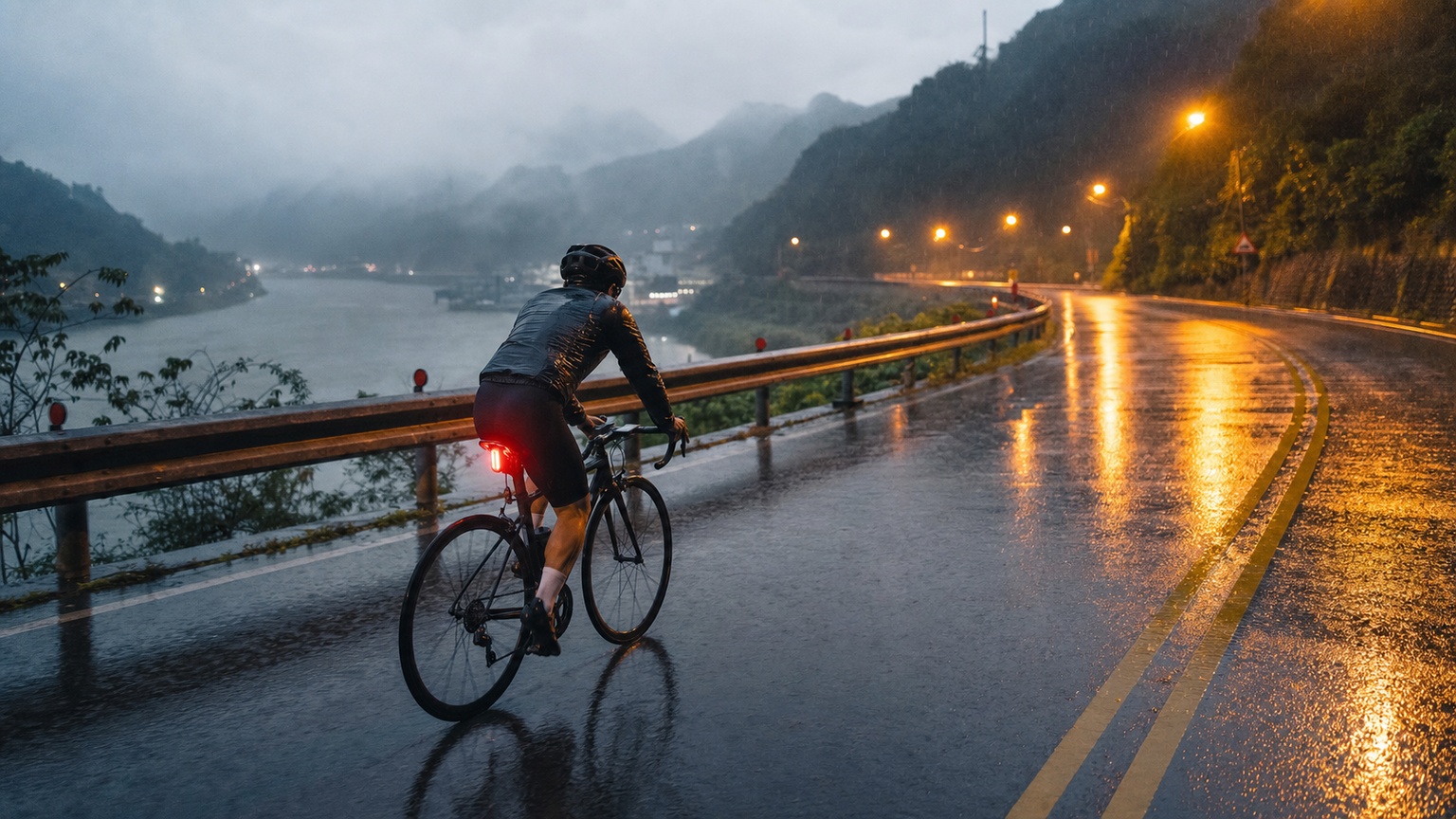
Rain hitting the asphalt makes the road surface reflect light, and at night, streetlights stretch into long, orange-yellow reflections on the wet ground. The first time I saw this on a nighttime rain ride, I stopped and took photos for a long time, thinking that this kind of shot needs no post-processing—it’s already unbelievably beautiful.
Then there’s the sound of the rain. When riding in the rain, your helmet fills with a continuous, even patter of rain that drowns out all outside noise, leaving only that white noise and your breathing. It’s a bit like wearing headphones tuned to a specific frequency, making you intensely focused on the present moment.
That Time on Provincial Highway 9 Before the Typhoon
My most memorable rain ride was on an afternoon when the outer bands of a typhoon were sweeping through. I rode from Taipei along Provincial Highway 9 to Shiding, about 25 kilometers.
That day’s rain wasn’t a drizzle—it was a true downpour, hitting in waves every few minutes. I was wearing a rain jacket, but my ankles and shoes were soaked through long before the end. Riding felt oddly liberating, with that “well, it’s already this way” sense of release.
When I reached Shiding Old Street, the place was completely deserted. The cobblestone road was polished to a shine by the rain, and the old buildings on either side looked calm and ancient in the downpour. I parked my bike under an eave, watched the rain beat against the stone pavement, and listened to thunder rolling in the distant mountains.
That was probably the most peaceful fifteen minutes in my more than a decade of cycling.
Practical Advice
- Dial your pace down 20–30% in the rain: Rainy days aren’t for chasing speed; they’re for honing stability and technique. Deliberately slow down the whole way to give yourself more reaction time.
- Brake in stages, and brake early: Use 30% front brake and 70% rear brake to avoid locking the front wheel; start braking at twice the normal distance, and don’t gamble on when you’ll stop.
- Keep rain boot covers in your bag: For long rides, soaked feet will seriously affect your comfort and focus after two hours. Silicone rain boot covers are a cheap but practical solution.
- Don’t ride in a torrential downpour: Visibility differs greatly between light rain and heavy rain. When visibility drops below 100 meters, find shelter and pause until the rain eases.
Conclusion
I’m not encouraging everyone to go ride in the rain. But what I want to say is this: if you’re already a rider with a solid technical foundation, occasionally letting yourself ride in the rain will show you another side of your cycling self.
Not braver. Not stronger. Quieter.
The rain strips away the performance, strips away the urge to snap photos for social media, strips away the thought of checking your Strava ranking. All that’s left is you, the bike, and the road.
Sometimes, that’s all you need.
Related Reading
- The Complete Guide to Riding in the Rain: Gear, Techniques, and Safety Tips
- Rain Riding Safety Guide: Survival Rules for Slippery Roads
- The Survival Guide to Riding in the Rain: Gear, Techniques, and Mindset
- The Complete Guide to Riding in the Rain: The Physics of Braking Distance Changes, Visibility, and Gear Selection
碟煞公路車 優缺點?換車一年半實際經驗分享 / 公路車 / CT Yeh
2 年前
下雨天就是要改車 #ceramicspeed #bike
1 年前
「悲情男車友」創作單曲 爆笑MV / 公路車 / CT Yeh / 4K劇情版
7 個月前
單車賞雪 裝備準備及注意事項分享 | 公路車
5 年前
一日北高前的西濱集訓 | 跟著11小時軍團 | 300W踩不動的大逆風 | 輪車破風差幾瓦?
6 年前
大武山後門26%歡樂陡坡!JJSC南台灣單車行Day2 / 被颱風追著跑 / 公路車 / CT Yeh
2 年前
微雨戰! 2022桃園市長盃錦標賽 無敵交管 沒來玩太可惜了! 羅馬公路太可怕 差點成佛! 公路車 | CT Yeh
4 年前
CT 喇低賽) 單車 比賽總是沒照片? 攝影師的觀點大公開 姿勢就是力量! 請加速1.25倍收看
7 年前