Introduction
When the season arrives, land training is often the first thing sacrificed in many swimmers’ programs. “I barely have enough time for pool work—how can I find time to lift?” This mindset seems reasonable in the short term, but it comes at a cost in the long run: strength loss in the latter half of the season, increased overuse injuries, and premature performance plateaus.
Scientific research tells us that only a “Minimum Effective Dose” of strength stimulus is needed to maintain the strength gains built before the season. For most swimmers, this means 1–2 sessions per week of 25–35 minutes of streamlined land training is sufficient.
The Physiological Basis of Strength Maintenance
Strength is accumulated through both neural adaptations (motor unit recruitment efficiency) and muscular structure (cross-sectional area). Research shows that maintaining just 1 high-intensity session per week (above 80% 1RM) can preserve strength for up to 8–12 weeks with almost no loss, even when training volume is drastically reduced.
Key principle: Maintain intensity, reduce volume.
Design Principles for In-Season Training
- Frequency: 1–2 sessions per week (Monday + Thursday, or a single session)
- Volume: 40–60% of pre-season (reduce sets, keep reps)
- Intensity: Maintain at 75–85% 1RM; do not lower intensity because of the season
- Exercise Selection: Focus on multi-joint compound movements; drop isolated small-muscle-group exercises
- Duration: 25–35 minutes (including warm-up)
Streamlined In-Season Workouts
Option A: Full-Body Compound (2 sessions per week)
| Exercise | Sets | Reps | Intensity | Rest |
|---|---|---|---|---|
| Pull-ups | 3 | 5–6 | 85% BW | 2 min |
| Squats or Split Squats | 3 | 5–6 | 80% 1RM | 2 min |
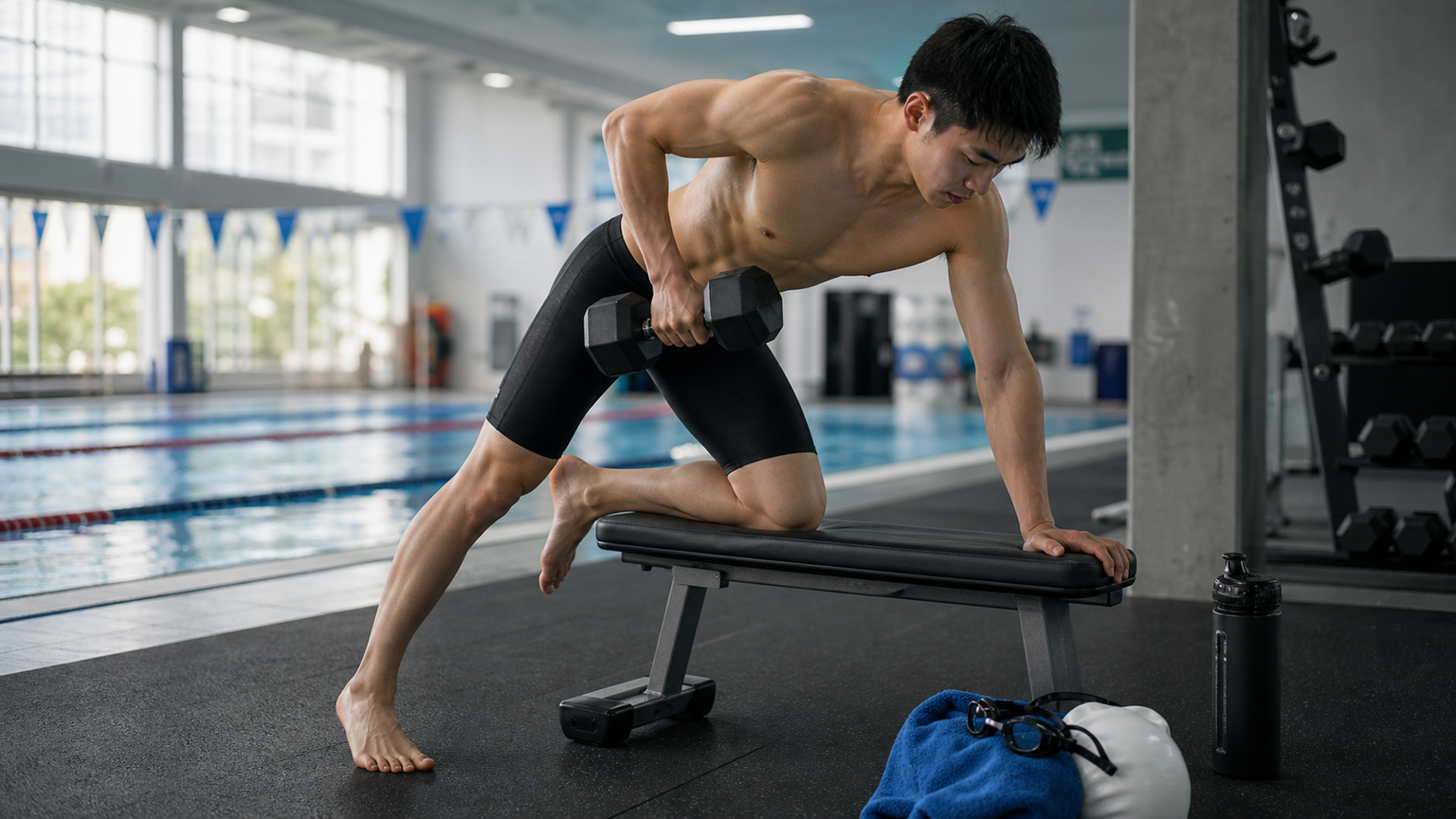
| Dumbbell Rows | 2 | 8 | 80% 1RM | 90 sec |
| Rotator Cuff External Rotation | 2 | 12 | Moderate | 60 sec |
Total approximately 30 minutes.
Option B: Upper-Body Focus (2 sessions per week, alternating with lower-body day)
Upper-Body Day: Pull-ups × 3 sets, Rows × 3 sets, Rotator Cuff × 2 sets
Lower-Body Day: Squats × 3 sets, Single-Leg RDL × 2 sets, Core × 2 sets
Land Training Adjustments During the Taper Week
In the 7–10 days before competition (taper period), make the following adjustments to land training:
- 7–10 days out: Final “full” land training session (normal intensity + reduced volume)
- 5–6 days out: Very light land activation (rotator cuff + core, 15 minutes)
- 3 days before competition: Complete rest from land training
How to Tell If Land Training Is Interfering with In-Water Performance
The following signals indicate that land training volume is too high and needs adjustment:
- Feeling heavy arms and reduced pulling power during water training
- Consistently elevated morning resting heart rate (more than 5 beats above baseline)
- Declining sleep quality and abnormal appetite
- In-water technique feels less fluid
If these signals appear, skip one land training session that week and increase sleep and recovery.
Land Training Strategy for the Post-Competition Recovery Period
The 1–2 weeks following a major competition are a critical time for the body to repair:
- Week 1: Complete rest from land training
- Week 2: Light recovery land training (rotator cuff, core, stretching), no more than 3 × RPE 5
- From Week 3: Gradually resume the normal land training program
Practical Advice
- Think of in-season land training as a “strength maintenance dose” rather than a “progression stimulus”—this mindset reduces psychological pressure and actually improves adherence.
- Schedule land training on lighter water days (technique sessions, recovery sessions) to avoid stacking it with high-intensity pool work.
- Communicate your land training plan with your swim coach to ensure overall training load remains controlled.
Conclusion
In-season land training doesn’t need to be extensive—it needs to be precise. One to two sessions per week, 30 minutes each, with intensity kept at a high level—this “minimum effective dose” strategy allows you to carry all the strength you built before the season to the finish line, rather than lamenting “I don’t know where my strength went” during the final races.
Related Reading
- How to Maintain Hard-Earned Off-Season Strength During the Season (Only Once a Week)
- How to Maintain Strength During the Season: In-Season Strength Strategies
- 8-Week Pre-Season Strength Training Program for Swimmers
- Swimming Off-Season Maintenance Program: Minimum Training Volume to Preserve Base Fitness
西進武嶺 免費訓練分析服務 Intervals | 練不夠還是練過頭?你哪一種類型選手?AI模型告訴你! | 備戰神器 | 公路車 訓練 | CT Yeh
4 年前
滑雪新手們慘摔學習全紀錄(請開字幕),滑雪好好玩 | Snowboard + Ski | 岩原 スキー場 | 滑雪APP使用 | GoPro Max
6 年前
CT暗黑廚房) 車友必備 宇宙無敵鮮蚵湯 幫助訓練恢復 天然食補 好市多 超肥鮮蚵 破PR
7 年前
FTL 與 SYB 車隊專訪 西進武嶺 實用攻略分享! 2小時 如何練?!你不知道的眉角!新手準備武嶺必看 EP1 | 實力派女車友 | 精華版 | 公路車 | CTYeh
4 年前
實景訓練台) 彰化經典百K 高強度喵團 90分鐘 跟著一起練功 2019 Indoor workout Changhua Classic 100 Taiwan
7 年前
福隆鐵人團練隨拍
8 年前
一個測試有沒有認真練車的方法😂 #公路車
10 個月前
[教學] Premiere 影片 手震 修正 教學 防抖 單眼 影像 GoPro 穩定 Video Stabilization
8 年前