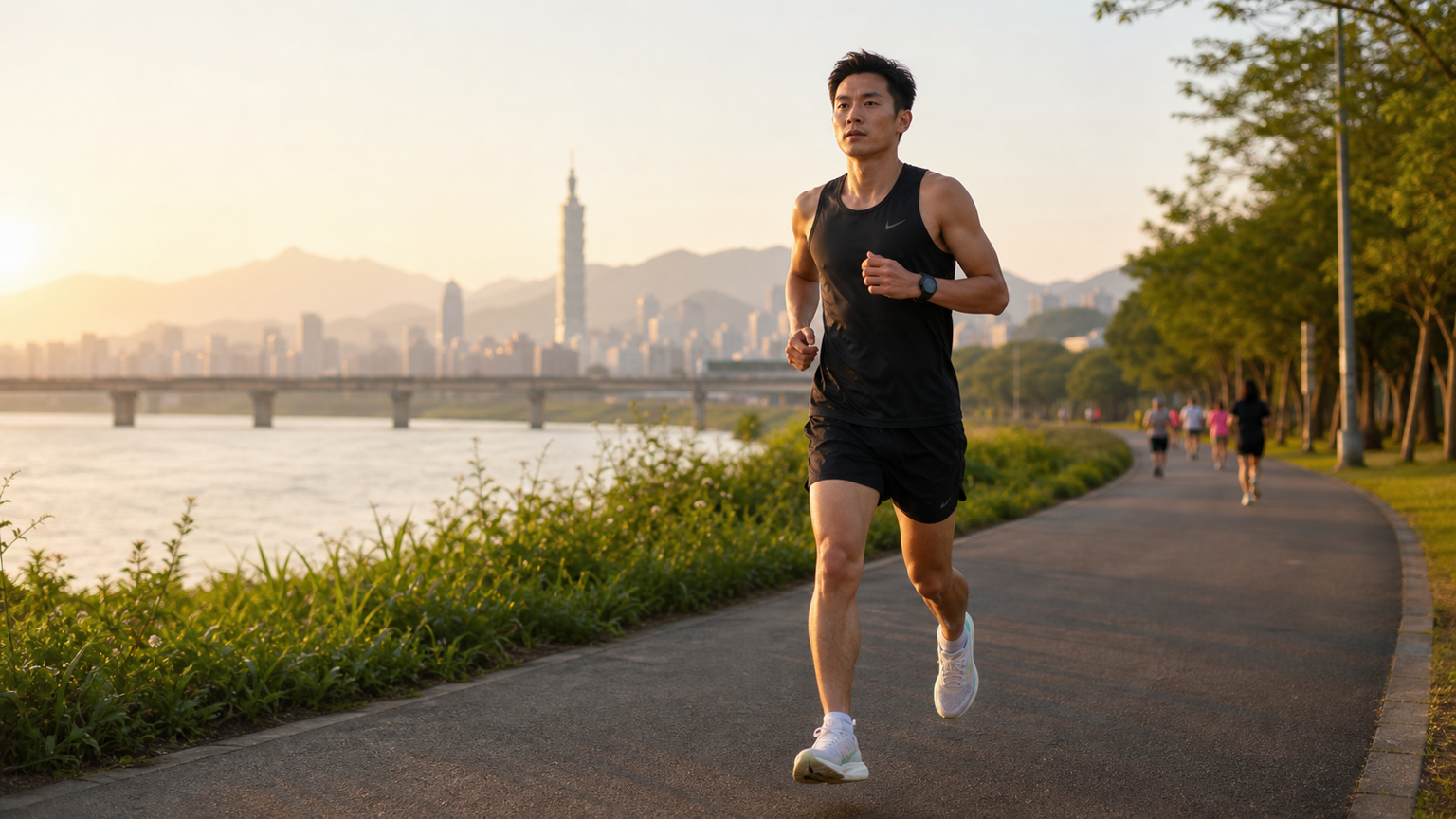
Introduction
Have you ever been on a morning run when suddenly your steps feel light, stray thoughts vanish, time seems to stand still, and all that remains is your breath and rhythm? Sports psychologists call this state “flow state,” a concept introduced by Hungarian-American psychologist Mihaly Csikszentmihalyi in the 1970s. Flow is a state of consciousness in which you are completely immersed in an activity, characterized by intense focus, a distorted sense of time, automatic movements, and profound satisfaction.
For marathon runners, flow not only makes training more enjoyable but can also break through psychological barriers at critical moments in a race. The good news is that flow is not an elusive miracle but a psychological skill with identifiable patterns.
The Science Behind Flow
Csikszentmihalyi’s research points out that flow most readily occurs when there is a “perfect balance between challenge and skill.” If the challenge far exceeds your skill, you feel anxious; if your skill far exceeds the challenge, you feel bored; only when the two are closely matched can flow emerge.
After studying elite athletes, sports psychologist Susan Jackson identified nine key characteristics of flow:
| Characteristic | Manifestation in Running |
|---|---|
| Balance between challenge and skill | Pace is slightly challenging but sustainable |
| Merging of action and awareness | The feeling that “your legs are running on their own” |
| Clear goals | Knowing what pace to hold for this segment |
| Clear immediate feedback | Sensing the rhythm of your breath and heartbeat |
| Concentration on the task at hand | Stray thoughts automatically fade away |
| Sense of control | Feeling you can command your current speed |
| Loss of self-consciousness | No longer worrying about what others think |
| Distorted sense of time | 10 kilometers feels like it passes in an instant |
| Autotelic motivation | Simply enjoying the act of running itself |
Common Obstacles to Flow
Taiwanese runners often encounter several barriers when trying to enter a flow state:
- Over-monitoring data: Constantly glancing at your watch, letting numbers occupy your mind, which pulls you away from your body’s present sensations
- Comparing yourself to others: Continuously comparing on the course, triggering anxiety or pride, which disrupts the flow channel
- External noise: Phone notifications or overly complex song lyrics pull your attention away from your body
- Goals that are too big or too small: Entering races beyond your ability, or training sessions that offer no challenge at all
- Physical fatigue: When sleep-deprived or carrying accumulated fatigue, the nervous system struggles to enter a state of efficient synchronization
Deliberate Methods for Entering Flow
Flow can be “engineered.” Here are systematic methods validated by sports psychology:
1. Set clear process goals
Don’t just think about “finishing the marathon.” Instead, set specific rhythmic goals for each kilometer, such as “maintain a cadence of 170 steps per minute.” Clear, immediate goals give your brain something to “sink its teeth into”—they are the ticket to entering flow.
2. Establish a pre-run ritual
Research shows that consistent, repeatable pre-race rituals help the brain quickly switch into focused mode. This could be a specific dynamic warm-up routine, three deep breaths, or silently repeating an activation phrase (for example, “Right now, there is only running”).
3. Use rhythmic music or music without lyrics
Drawing on the research direction of Costas Karageorghis at Brunel University in the UK, music whose BPM (beats per minute) matches your cadence can significantly enhance the sense of synchronization, thereby accelerating the onset of flow. It is recommended to use instrumental or electronic music at 160–175 BPM.
4. Practice “narrow attention” scanning
Every few minutes, scan in sequence: depth of breath → sensation of footstrike → arm swing → gaze ahead. This deliberate body scan anchors your attention steadily in the present moment and is foundational training for flow.
Practical Advice
- Schedule one “watch-free run” each week: Run entirely by feel for 40–60 minutes to cultivate sensitivity to your body’s signals
- Keep a “flow journal”: After each run, record whether you entered flow, your pace, terrain, and mood to identify your personal flow conditions
- Avoid overtraining: Flow requires adequate nervous system recovery; periodized training is the foundation for maintaining your ability to enter flow
- Limit social media the night before a race: Reduce information noise and prepare your brain for tomorrow’s flow state
Conclusion
Flow is not a privilege reserved for a handful of elite runners—it is a psychological skill that every serious Taiwanese runner can learn. The next time you feel that wonderful sensation of “disappearing into the run” on a riverside park trail at dawn or on a race course, remember: you are touching one of the most profound possibilities of human consciousness. With continued practice, flow will become your most reliable running companion.
Related Reading
- Flow State in Running: How to Enter the “Selfless” Zone of Peak Performance
- Flow State in Road Running: How to Create the Optimal Running Experience
- The Flow Experience in Road Running: How to Enter a Selfless State of Peak Competition
- Flow State: Trigger Conditions and Maintenance Methods in Running
西進武嶺 免費訓練分析服務 Intervals | 練不夠還是練過頭?你哪一種類型選手?AI模型告訴你! | 備戰神器 | 公路車 訓練 | CT Yeh
4 年前
2025 海鷗團體繞圈賽 網路直播 超激烈裁判長視角 / EIPC 李廷威、Waypoint 等眾多高手競爭 / feat. 卡密兒主持 / 海鷗繞圈賽
9 個月前
2018 田中馬拉松 全程健跑 VR 360 環景錄影 體驗現場狂野加油氣氛! Insta 360
7 年前
西進武嶺 自製新版AI配速表產生器 x 賽前攻略 抱佛腳! 沒有功率計也可以產生配速表嗎?有什麼其他眉角賽前要注意的呢? | 西進武嶺 / 東進武嶺 KOM 攻略 | 公路車 | CT Yeh
4 年前
2023桃園團體繞圈賽 / 海鷗繞圈賽 | 全程空拍數據版 | 公路車 | CT Yeh
2 年前
水金九不厭五分 10度寒流冷到不願停!feat. 卡卡 / 公路車 / CT Yeh
6 個月前
JE22 百里任務體驗,心跳不能過150,三小時內有可能...? 沒有天時地利難度有多高? / 公路車 / CT Yeh
1 年前
戰略) Zwift Race 如何咬在第一集團 如何評估自己要開多少推力 (請開1.5倍速看)
7 年前