Psychological Support in Cycling Communities: The Relationship Between Rider Interaction and Training Motivation
Introduction
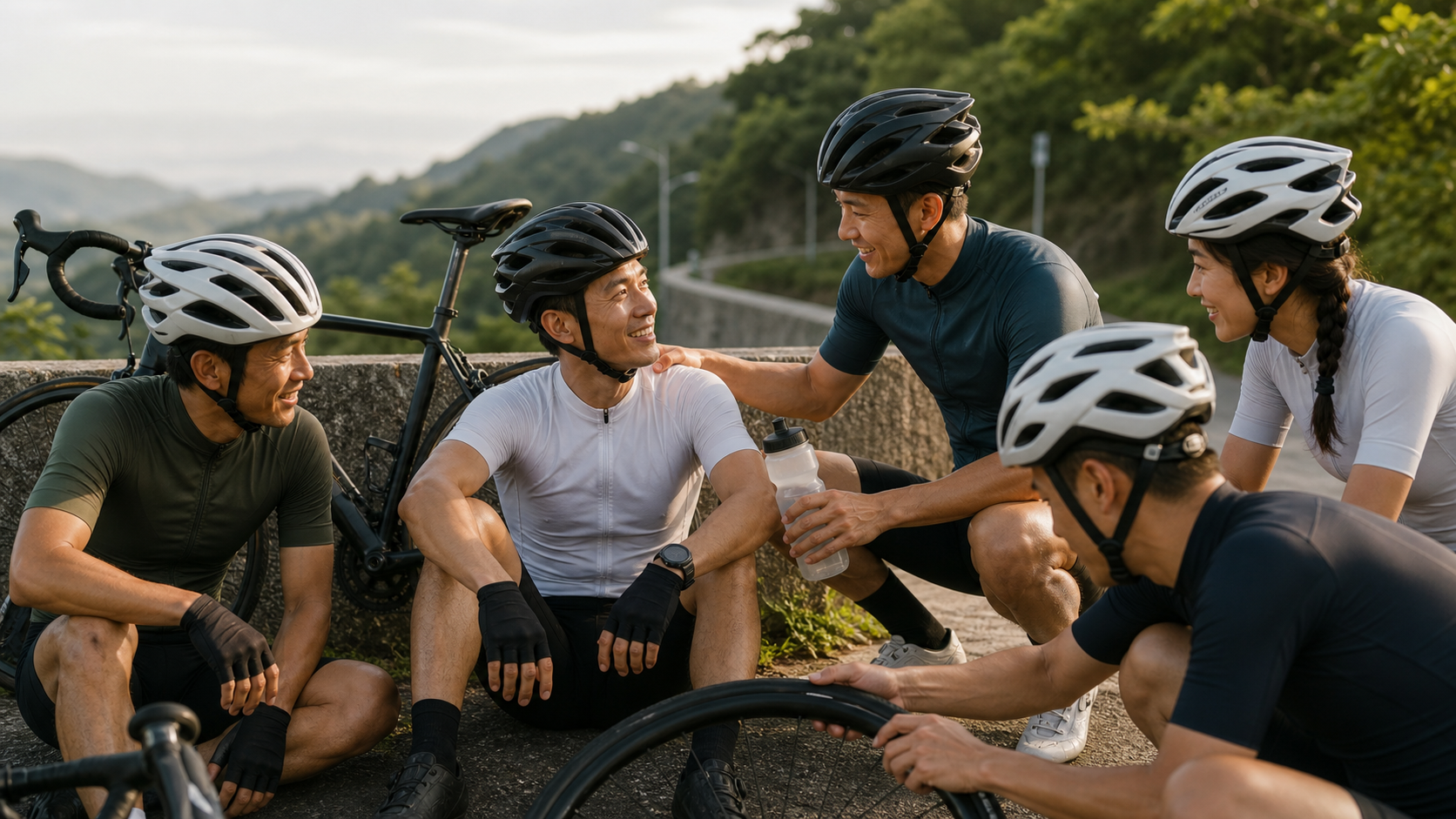
Cycling has a peculiar duality: it is both one of the most individual sports (every pedal stroke, every breath is solitary) and one of the most community-driven (group rides, regular meeting points, and post-ride meals with fellow riders are almost central to Taiwan’s cycling culture).
Researchers in sports psychology have found that people who maintain long-term exercise habits almost always have a stable community support system—whether it’s physical riding buddies, online rider communities, or training partners who cheer each other on. Isolated trainees have a much higher dropout rate than those with social connections. Why is community support so crucial? The psychological mechanisms behind it are worth a deeper look.
Four Psychological Functions of Community Support
A riding community provides more than just the basic function of “having company”; it operates on a deeper psychological level:
| Function Type | Description | Cycling Context Example |
|---|---|---|
| Emotional Support | Feeling understood and accepted | Concern and encouragement from riding buddies after getting dropped |
| Informational Support | Providing useful knowledge and advice | Experienced riders sharing climbing gear-shifting techniques |
| Instrumental Support | Practical help in solving problems | Helping you fix a flat tire on the roadside |
| Appraisal Support | Giving honest and constructive feedback | Pointing out issues with your cadence habits |
These four support functions complement each other, forming a psychological safety net that helps riders stay committed over the long term.
The Power of “Being Seen”: Social Identity and Training Persistence
The “Social Identity Theory” in psychology suggests that when we identify with a group (such as “I am a serious cyclist”), we are more strongly motivated to maintain behaviors consistent with that identity.
Taiwan’s rider community culture provides strong identity reinforcement in this regard:
- Jersey culture: When you put on a team jersey, you “become” part of that group, making it easier to get off the couch
- Group ride rituals: Fixed training times and locations make “showing up” itself the lowest barrier to community interaction
- Sharing ride completions: Posting ride logs on social media carries a comparative pressure, but the recognition of “being seen” does strengthen training motivation
However, this social identity influence is a double-edged sword. If the community culture places excessive emphasis on speed and competition, it can breed anxiety and discomfort, making beginners or riders returning from a break feel out of place.
How Different Types of Riding Buddies Affect Motivation
Research shows that the “type” of training partner matters more than the “number.” Here are several common rider types and their psychological effects:
Motivational Partners
Riders slightly more capable than you provide a healthy level of chase tension and are the best partners for progress. They raise your standards while keeping them within reach (corresponding to the flow conditions mentioned earlier).
Stable Partners
Riders of similar ability and consistent schedules provide steady social support. Studies show that exercisers with such partners have significantly lower rates of missed training sessions—because not showing up means letting the other person down.
Mentor Partners
Experienced veterans willing to share knowledge can significantly accelerate the learning curve while reducing dropout rates caused by frustration. Many Taiwanese cycling communities have this “enthusiastic veteran” culture, which is a valuable asset.
Toxic Partners (Caution Needed)
Riding buddies who overemphasize comparison, mock you when you’re fatigued, or constantly make you feel inadequate will erode training motivation and self-confidence over time. Recognizing them and maintaining appropriate distance is necessary self-protection.
Online Communities vs. Physical Communities
Social media and platforms like Strava and Garmin Connect have created entirely new forms of cycling communities, but their psychological support quality differs from that of physical communities:
- Advantages of online communities: Always accessible, fewer geographic limitations, exposure to more diverse riding cultures
- Disadvantages of online communities: Strong comparison culture, lack of genuine emotional connection, prone to triggering “training volume anxiety”
- Advantages of physical communities: Deep interpersonal bonds, shared physical experiences, practical support like bike repair help
- Disadvantages of physical communities: Requires time coordination, potential for hierarchy or exclusivity
The healthiest community mix is usually a core physical riding group as the foundation, supplemented by online communities as a source of inspiration and information.
Practical Advice
- Find your “minimum viable community”: You don’t need to join a large team; finding 2–3 riding buddies you can consistently schedule rides with is enough. Quality matters far more than scale.
- Proactively become a source of support for others: When you give advice to beginners, like others’ ride completions, or shout encouragement during a tough ride, you’re not just helping others—you’re also reinforcing your own identity as a “cyclist.”
- Regularly attend “open group rides”: Many cycling communities in Taiwanese cities host weekend rides open to newcomers, offering the best low-barrier opportunity to expand your community connections.
- Use Strava’s social features cautiously: If you find that viewing your riding buddies’ activity feeds triggers anxiety rather than motivation, consider temporarily disabling the Leaderboard feature and keeping only personal progress tracking.
Conclusion
On the surface, cycling is a dialogue between a person and the road, but the psychological support system behind it often determines who sticks with it long-term and who hangs up their bike after the first winter. Finding your riding community isn’t weakness or dependence—it’s understanding humanity’s innate social nature and leveraging that drive. Taiwan’s cycling culture is rich and diverse, and there’s a community waiting for you where you can fit in and that makes you want to pull back the curtains at 5 a.m. and put on your jersey.
Related Reading
- Maintaining Motivation in Cycling Training: Psychological Techniques and Strategies for Long-Term Commitment
- Solo Riding vs. Group Riding: A Psychological Analysis of Solitary Challenges and Community Motivation
- The Psychological Support of Running Communities: Why Running Alone and Running with a Group Are Completely Different
- Building a Cycling Community: How to Find Riding Partners That Suit You
靠單車減肥35公斤 心得分享與整理
7 年前
「悲情男車友」創作單曲 爆笑MV / 公路車 / CT Yeh / 4K劇情版
7 個月前
CT 喇低賽) 單車 比賽總是沒照片? 攝影師的觀點大公開 姿勢就是力量! 請加速1.25倍收看
7 年前
#雙崎部落 單車挑戰賽 心跳破200 #公路車 Neko's Fun
6 年前
一日北高/長距離團騎 常見問題補充篇 / 組團或跟團的眉角 / 壯車友容易被瘦車友慢性拉爆 / 原來屁股痛可能是這個原因...? / 風場配速法 / 公路車 / CT Yeh
2 年前
#公路車 #Fitting 靠人工智慧APP 幫你調整單車
6 年前
單車AI教練!全新 ChatGPT4o 幫你分析訓練成果!排武嶺課表,分析騎車姿勢! 太神了! / 公路車 / CT Yeh / feat. 緯緯
2 年前
太平山單車員工旅遊 | 這樣玩CP值最高!| 公路車
5 年前