Introduction
In the few minutes before the starting line, your heart rate spikes, your palms sweat, and your stomach tightens—this is your body telling you in the most primal way: “This matters.” A moderate amount of pre-race anxiety is normal and beneficial; it heightens alertness, sharpens muscle response, and prepares you for battle.
But when anxiety crosses a certain threshold, it shifts from fuel to friction: racing thoughts, rapid breathing, and excessive muscle tension cause you to burn significant energy before you’ve even taken your first step. In Taiwan’s marathon events, a considerable proportion of runners report that pre-race anxiety is one of the key factors affecting their performance.
This article introduces scientifically validated breathing and relaxation techniques to help you keep anxiety within your optimal performance zone on race day.
Understanding the Physiological Mechanisms of Pre-Race Anxiety
The Body’s Response to Anxiety
When the brain perceives a “significant threat” (the race), the sympathetic nervous system triggers the “fight or flight” response:
| Physiological Change | Manifestation | Impact on Running |
|---|---|---|
| Elevated heart rate | 20–40 bpm above resting heart rate | Tendency to start at a faster pace |
| Adrenaline secretion | Feeling of high energy | Overexcitement |
| Muscle tension | Stiff shoulders and jaw | Reduced running efficiency |
| Faster breathing | Shallow, rapid breaths | Hyperventilation, affecting pace perception |
| Blood redirected to muscles | Suppressed digestive system | Stomach discomfort, occasional need for the restroom |
Anxiety and Performance: The Inverted U-Curve
No anxiety at all (relaxed state) → Poor performance
Moderate anxiety (physical and mental activation) → Optimal performance
Excessive anxiety (anxiety-dominated) → Performance breakdown
The goal is to keep pre-race anxiety within the “optimal activation zone,” not to eliminate it.
Core Technique 1: Physiological Coherence Breathing
The 4-7-8 Breathing Technique (30–60 Minutes Before the Start)
This is the most widely validated relaxation breathing method in heart rate variability research:
- Exhale slowly through your mouth, completely emptying your lungs
- Close your mouth, inhale through your nose, counting 4 seconds
- Hold your breath, counting 7 seconds
- Open your mouth and exhale slowly, counting 8 seconds, making a “whoosh” sound
- Repeat for 4–5 cycles
By activating the parasympathetic nervous system, this technique significantly lowers heart rate and cortisol levels within 3–5 minutes.
Resonant Frequency Breathing (10–15 Minutes Before the Start)
This is a simpler technique, suitable for doing discreetly in a crowd:
- Inhale for 5 seconds, exhale for 5 seconds (or 6+6)
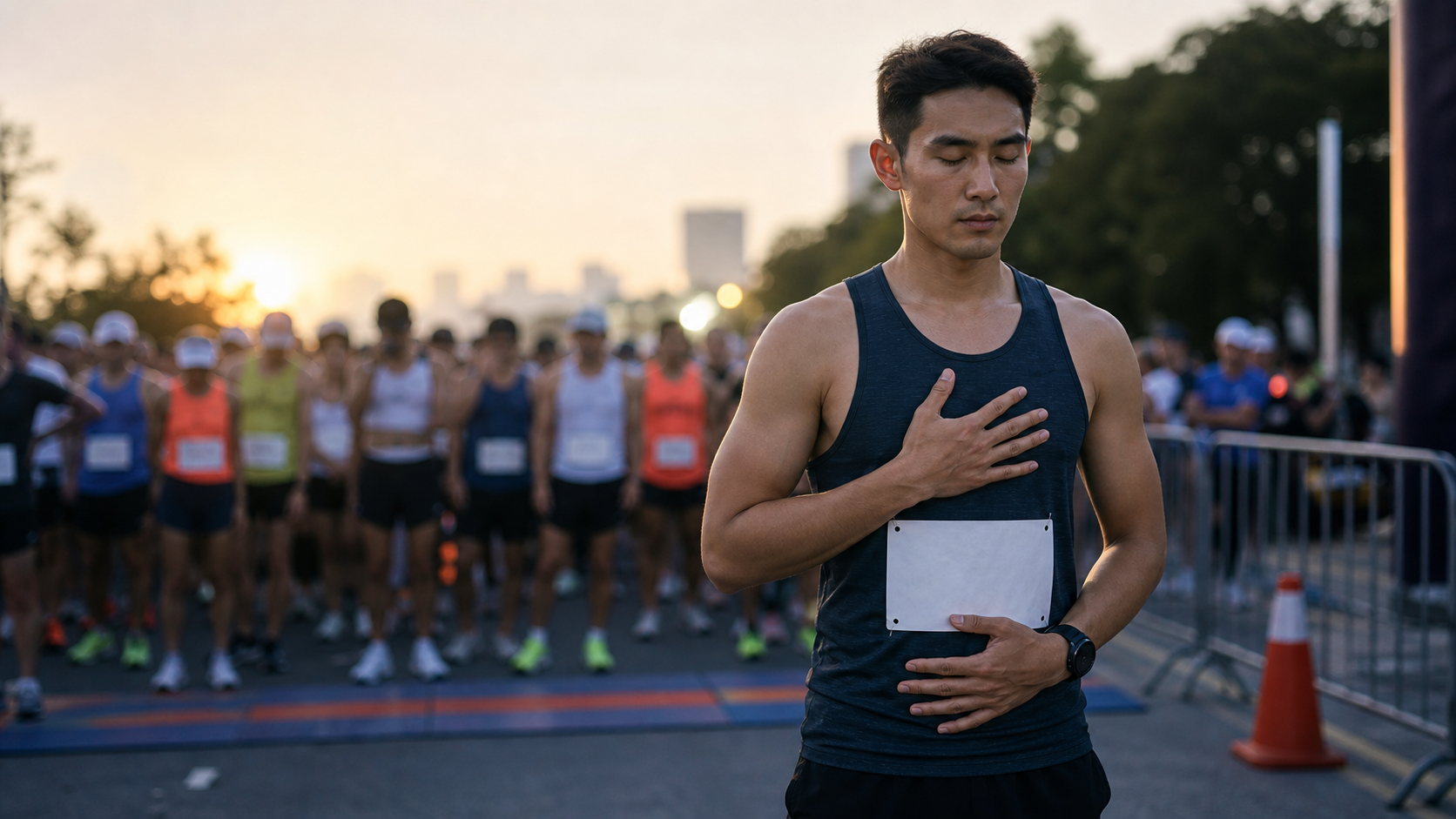
- Use diaphragmatic breathing throughout (place your hand on your belly and feel it rise and fall)
- Maintain this for 5–10 minutes
This breathing rhythm (approximately 6 breaths per minute) has been shown in research to maximize heart rate variability (HRV), effectively inducing a relaxed state.
Core Technique 2: Progressive Muscle Relaxation (PMR)
The Pre-Race Quick Version of PMR (10–15 Minute Version)
Find a corner in the warm-up area and work through the following “tension–release” cycles for each muscle group in sequence:
- Feet and calves: Curl your toes tightly for 5 seconds → fully relax for 10 seconds
- Thighs and glutes: Squeeze them tightly for 5 seconds → fully relax for 10 seconds
- Abdominal core: Take a full breath and tighten your abs for 5 seconds → exhale and relax for 10 seconds
- Shoulders: Shrug them up toward your ears for 5 seconds → let them drop fully and relax for 10 seconds
- Face: Frown hard and clench your jaw for 5 seconds → fully relax for 10 seconds
This sequence helps you “scan and release” unconscious tension throughout your body, ensuring your muscles are in optimal elastic condition at the start.
Core Technique 3: Psychological Boundary Setting
The “Anxiety Box” Technique
Before the race, choose a specific point in time (e.g., 2 hours before the start) and tell yourself: “Right now, I’m putting all my anxious thoughts into a box. I’ll open it and think about them after the race is over.”
This isn’t about suppressing anxiety—it’s about delaying it. When the brain accepts the instruction “I’ll think about it later,” it often quiets down temporarily.
Preparing Positive Self-Talk
Prepare 3 response statements targeting your personal anxiety triggers:
- If you’re worried about pacing: “My body knows how to pace. I’ll follow the feel.”
- If you’re worried about hitting the wall: “I’ve prepared thoroughly for the stretch after 30km.”
- If you’re worried about the weather: “I adapt to all conditions. This challenge only makes me stronger.”
Pre-Race Day Anxiety Management Schedule
| Time Point | Recommended Activity | Purpose |
|---|---|---|
| 2 hours before the start | Finish fueling; stop checking the weather | Reduce information anxiety |
| 90 minutes before the start | Easy 10–15 minute warm-up jog | Activate the body, release dopamine |
| 60 minutes before the start | 4 sets of 4-7-8 breathing | Reduce sympathetic nervous system activation |
| 30 minutes before the start | Progressive muscle relaxation (short version) | Release unconscious muscle tension |
| 15 minutes before the start | Resonant frequency breathing + positive self-talk | Enter the optimal activation state |
| 5 minutes before the start | Focus on gratitude: be thankful for standing at the starting line today | Shift the focus of anxiety |
Practical Tips
- Sleep the night before doesn’t need to be perfect: Research shows that sleep deprivation caused by pre-race anxiety (5–6 hours) has far less impact on race-day performance than you might think, so don’t add more anxiety over “not being able to sleep”
- Accept that the “activation feeling” is a good thing: Interpreting a racing heart as “my body is preparing for battle” rather than “my body is afraid” is a simple cognitive shift that research has shown can improve race performance
- Don’t try anything new on race day: Anxiety management techniques need to be practiced repeatedly in training; trying them for the first time on race day often yields limited results
- Find your “anxious pace feel”: Well-trained runners, even in a state of pre-race anxiety, have bodies that “remember” the correct pace—learn to trust the results of your training
- Prepare an anxiety cheat sheet: Write these techniques on a small note or in your phone’s notes app. When you’re nervous on race day, pulling them out to review is more reliable than relying on memory
Conclusion
Pre-race anxiety isn’t your weakness—it’s proof that you deeply care about this race. Learn to coexist with anxiety, use breathing and physical relaxation techniques to regulate it into its optimal state, and you transform what was once a threat into fuel. Every runner who learns to manage pre-race anxiety gains a secret weapon before the finish line.
Related Reading
- The Science of Pre-Race Anxiety: How to Manage Marathon Nerves
- Pre-Race Anxiety Management: Psychological Stabilization Techniques for the 10 Minutes Before the Start
- Pre-Race Anxiety Management: How to Convert Starting Line Nerves into Motivation
- The Complete Guide to Race Anxiety: Practical Methods for Physiological Responses, Pre-Race Rituals, Breathing, and Attention Regulation
[教學] Premiere 影片 手震 修正 教學 防抖 單眼 影像 GoPro 穩定 Video Stabilization
8 年前
西進武嶺 免費訓練分析服務 Intervals | 練不夠還是練過頭?你哪一種類型選手?AI模型告訴你! | 備戰神器 | 公路車 訓練 | CT Yeh
4 年前
西進武嶺 自製新版AI配速表產生器 x 賽前攻略 抱佛腳! 沒有功率計也可以產生配速表嗎?有什麼其他眉角賽前要注意的呢? | 西進武嶺 / 東進武嶺 KOM 攻略 | 公路車 | CT Yeh
4 年前
戰略) Zwift Race 如何咬在第一集團 如何評估自己要開多少推力 (請開1.5倍速看)
7 年前
Live) 備戰2019彰化經典百K 賽前攻略 (已完賽請看新影片
7 年前
CT 喇低賽) 武嶺牽車 才是王道 西進牽車四小時內秘訣 攝手位置 如何判斷 防抽筋小秘訣
7 年前
FTL 與 SYB 車隊專訪 西進武嶺 實用攻略分享! 2小時 如何練?!你不知道的眉角!新手準備武嶺必看 EP1 | 實力派女車友 | 精華版 | 公路車 | CTYeh
4 年前
CT 喇低賽) 單車 比賽總是沒照片? 攝影師的觀點大公開 姿勢就是力量! 請加速1.25倍收看
7 年前