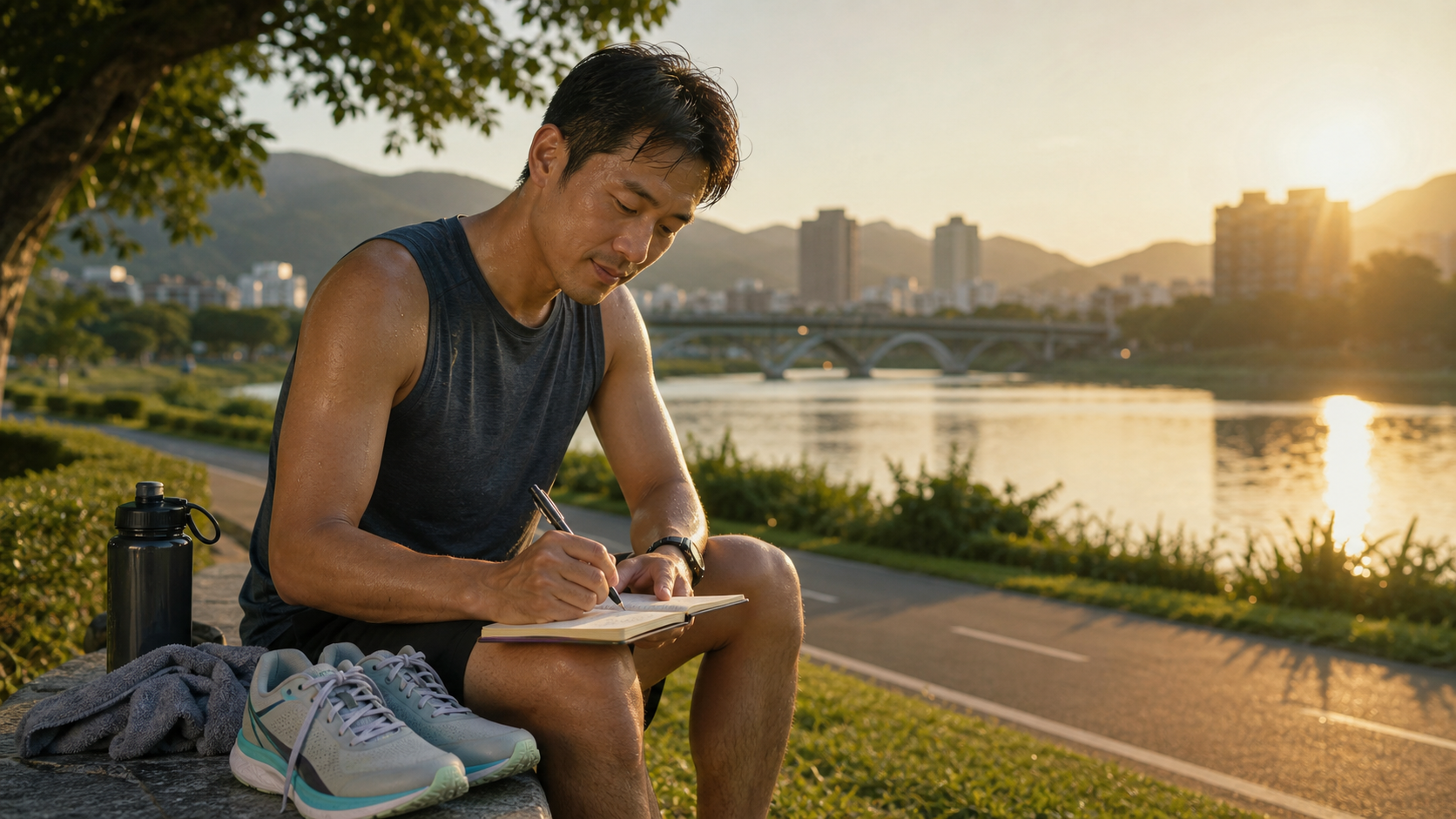
Introduction
“After a day as exhausting as this, what is there to be grateful for?” You might have this question. But research in positive psychology offers a surprising answer: the habit of gratitude isn’t only meaningful when things are going well—it is most powerful when times are hardest.
Road running and gratitude, two seemingly unrelated things, share a profound intersection from a psychological perspective. A regular gratitude practice can reshape how the brain perceives the meaning of running, strengthen long-term training motivation, and even provide a psychological buffer during injuries or setbacks. And the running log is the best tool for putting all of this into practice.
The Scientific Foundation of Gratitude Practice
How Gratitude Changes the Brain’s Mechanisms
Research by Martin Seligman, the founder of positive psychology, shows that writing down three good things three times a week significantly boosts well-being within 6 weeks, with effects lasting up to 6 months.
In neuroscience, gratitude activates the brain’s:
- Prefrontal cortex (rationality and emotional regulation)
- Amygdala regulation (reducing fear and stress responses)
- Dopamine and serotonin circuits (reinforcing positive emotions)
In the context of running, the benefits of a gratitude habit include:
| Benefit | Mechanism |
|---|---|
| Increased training satisfaction | Shifts attention toward positive experiences rather than deficiencies |
| Reduced burnout rates | Sustains a sense of meaning in running |
| Enhanced resilience to adversity | Finding things to be grateful for even in tough training sessions |
| Strengthened mind-body connection | Gratitude for physical capabilities increases self-acceptance |
Designing a Gratitude-Focused Running Log
Traditional Running Log vs. Gratitude Running Log
| Aspect | Traditional Running Log | Gratitude Running Log |
|---|---|---|
| Focus of recording | Pace, distance, heart rate | Feelings, meaning, cherished moments |
| Method of evaluation | Whether the numbers are good or bad | Whether connection and value were felt |
| During low points | “My pace regressed today” | “I’m already grateful I got to run today” |
| Long-term effect | Tracking progress | Building a deep sense of meaning in running |
The ideal approach is to combine both: record the data while also recording your feelings.
A Daily Gratitude Template for Your Running Log
After each run, take 5 minutes to write down answers to the following four questions:
-
What was the one moment during today’s run I was most grateful for?
(It can be small: “At the 3rd kilometer, the wind blew in—it felt wonderful.”) -
What did my body accomplish today that deserves thanks?
(Even if the performance wasn’t great: “My legs felt heavy today, but they still carried me through 8km.”) -
What did today’s training bring me closer to?
(Goals, health, self-awareness…) -
Summarize today’s run in one sentence: I learned/felt/cherished—
Gratitude Practice in Special Situations
Gratitude When Training Goes Poorly
Days when training feels off are often the days we abandon gratitude, but these are precisely the moments when practice is most needed:
- “Thankful that I didn’t get injured today”
- “Thankful that today’s struggle helped me understand my body better”
- “Thankful that I have the capacity to feel fatigue—because it means my body is adapting”
Gratitude After a Race (Regardless of the Outcome)
After finishing:
- Thank your training partners for their companionship
- Thank the route for the scenery it offered
- Thank every aid station volunteer at the event
After not finishing:
- Thank your body for every kilometer it allowed you to run today
- Thank this setback for the lessons it brought
- Thank yourself for making an honest choice in the face of difficulty (dropping out is sometimes the bravest decision)
The “In-the-Moment Gratitude” Practice During Running
Beyond journaling, you can also practice “in-the-moment gratitude” while running:
Gratitude Scan (Every 10–15 Minutes)
During a run, at regular intervals, consciously find one thing in the present moment worth being grateful for:
- “Thankful the sky is so blue today”
- “Thankful there are other runners around me, so I don’t feel alone”
- “Thankful my heart is still working hard to keep beating”
This practice is especially effective in the latter half of long-distance runs, as it can interrupt the spiral of negative thoughts and reconnect you with the joy of running.
Practical Suggestions
- Choose a fixed time to write: Writing immediately after a run is most effective (emotional memory is fresh), but reflecting before bed works well too
- Don’t let the journal become an obligation: If you’re too exhausted one day, just write one sentence: “I ran today, and that’s enough”
- Occasionally look back at past entries: Seeing how you felt about running months ago is a powerful source of motivation
- Share your gratitude (optional): Occasionally share “one small thing you were grateful for during today’s run” on social media instead of only sharing results—you’ll experience a different kind of connection
- Involve your children or family: After running with your kids, ask them, “What was your favorite part today?” and build gratitude into your family culture
Conclusion
A running log is more than just a record of results—it can be the most honest and profound documentation of your relationship with running. When you learn to look back at the road, the legs, and the effort of yourself with grateful eyes after every run, running transforms from a fitness activity into a life philosophy. Gratitude won’t make running easier, but it will make running more meaningful—and that is the real reason that will keep you lacing up your shoes for a lifetime.
Related Reading
- The Grateful Mindset in Road Running: Thanking Your Body’s Capabilities Instead of Obsessing Over Results
- The Power of a Running Journal: The Psychological Benefits and Methods of Recording Your Training
- Running and Mindfulness: Turning Training into Meditation
- Mindfulness Practice in Running: Techniques for Focusing on the Present to Enhance Your Running Experience
2018 田中馬拉松 全程健跑 VR 360 環景錄影 體驗現場狂野加油氣氛! Insta 360
7 年前
西進武嶺 免費訓練分析服務 Intervals | 練不夠還是練過頭?你哪一種類型選手?AI模型告訴你! | 備戰神器 | 公路車 訓練 | CT Yeh
4 年前
JJSC南台灣單車走春三日行 DAY 1 / 強度 x 美食 x 節慶體驗 / 公路車 CT Yeh
5 個月前
#公路車 #Fitting 靠人工智慧APP 幫你調整單車
6 年前
一日北高 11小時 賽後心得分享篇 | TWB北高360 | 一日雙城 | 單車 | 公路車
6 年前
一個測試有沒有認真練車的方法😂 #公路車
10 個月前
一日北高前的高裝檢 | 北高 360 | 挑戰11小時的裝備 | 一日雙塔 | 補給
6 年前
中秋團練!GoPro Hero 9 拍攝絲般順滑,ft. 新竹某校隊 公路車
5 年前