Introduction
For many runners new to the world of ultramarathons, the word “walking” carries an unspoken sense of shame. In regular road races, walking often means depleted energy or injury. However, in the world of ultramarathons, walking is a skill that requires deliberate practice and is an indispensable part of a finishing strategy.
Top ultramarathon runners worldwide, such as Scott Jurek and Kilian Jornet, use walking strategies extensively during races. Not because they aren’t strong enough, but because they deeply understand the principles of energy management in long-distance endurance events. This article will help you build a proper walking strategy mindset, allowing you to “walk smart and run strong” on the ultramarathon course.
Why Walking Is a Rational Choice in Ultramarathons
The Math of Energy Expenditure
From an energy expenditure perspective, on uphill grades of 8–15%, the difference in energy cost between hiking at a walking pace and running up the hill is relatively small, but the impact on muscles is vastly different. Research shows that running uphill on grades exceeding 10% elevates heart rate by 20–30% compared to walking, yet forward speed may only be 15–20% faster. This means running uphill is generally less “efficient” than power hiking uphill.
Preserving Muscle Fatigue
The quadriceps (front thighs) are the fastest-fatiguing muscle group in ultramarathons, primarily bearing enormous eccentric contraction stress during descents. By walking on uphills, you allow the quads to rest, preserving capacity for the descents later in the race.
The Decision Framework for “Run-Walk Strategy”
When to Walk Based on Gradient
The following is a widely used run-walk decision reference for trail ultramarathons:
| Gradient | Recommended Strategy | Notes |
|---|---|---|
| 0–5% | Run | Gentle terrain, maintain running rhythm |
| 5–10% | Depends on ability | Can run early on, consider switching to walking later |
| 10–20% | Walk | Most runners switch to walking at this grade for better efficiency |
| 20%+ | Walk (use trekking poles) | Running offers almost no benefit at this grade |
| Steep descents | Slow run or walk | Depends on technique and muscle condition |
When to Walk Based on Time and Distance
In addition to gradient, the following situations also warrant proactively adopting a walking strategy:
When eating and refueling: Eating solid food while running can easily cause gastrointestinal discomfort. Walking while refueling not only settles your stomach but also allows you to check your map more carefully or adjust your gear.
After passing 50% of the race distance: If the race is 100K, after the 50K mark you should more aggressively adopt a walking strategy on uphills to conserve energy for the final push.
When heart rate is too high: If you have a heart rate monitor, when your heart rate exceeds your aerobic threshold (typically around 80–85% of max heart rate) and you’re on an uphill section, switching to walking is a wise move.
Technical Elements of Efficient Walking
Proper Use of Trekking Poles
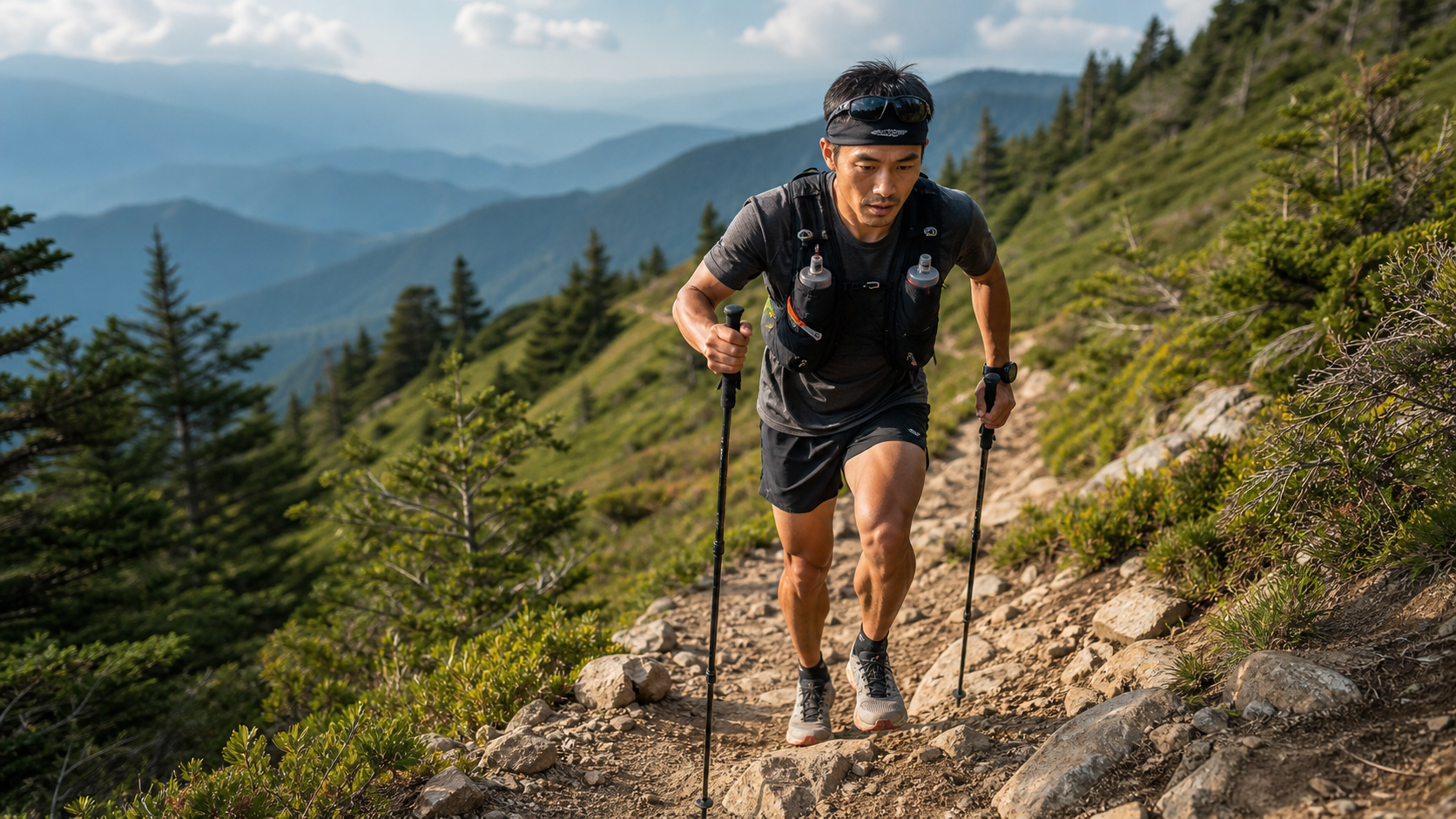
Trekking poles are an amplifier of walking efficiency in ultramarathons, widely used especially in long-distance events. Proper usage:
Uphill:
- Plant the pole tip slightly ahead and to the outside of your foot
- Push through your arms, engaging your upper body in forward propulsion
- Plant both poles simultaneously (the “poling” technique), which can significantly reduce the load on your legs
Downhill:
- Plant the pole tip ahead of your foot, making contact with the ground early
- Use the poles as third and fourth points of support to distribute knee pressure
- It’s not recommended to rely on trekking poles on technically difficult rocky descents; keep your hands free and flexible
Carrying method:
- Choose collapsible trekking poles, stow them in your pack’s side pocket or securing straps during running sections
- Practice the deployment/stowing motion during training to avoid fumbling during the race
Optimizing Your Walking Posture
Ultramarathon walking differs from casual strolling; maintain a “Power Hiking” posture:
- Keep your upper body upright, avoid hunching over (bending compresses the abdominal cavity, affecting breathing and digestion)
- Take slightly longer strides and actively push off with your rear foot
- Swing your arms naturally; if not using trekking poles, arm swing helps maintain rhythm
- Look 2–3 meters ahead, not down at your toes
How to Train Your Walking Strategy
Many runners preparing for ultramarathons deliberately neglect walking training, and this is a mistake. Walking is a skill that requires practice, especially the decisions of “when to walk, how fast to walk, and how long to walk before switching back to running”—all of which need repeated experience in training to internalize.
Recommended training methods:
- Hill interval training: Find a trail with a 10–15% grade and practice walking the entire uphill section while jogging the downhill. Feel the transition between walking rhythm and running rhythm
- Simulate race walking segments: During long training runs (25K+), force yourself to walk every uphill section in the latter part, even if you still have enough energy to run—practice walking anyway
- Trekking pole practice: Use trekking poles in training to familiarize yourself with stowing and deploying, as well as the different techniques for uphill and downhill
Practical Advice
Mental preparation for accepting walking: The psychological pressure is real when you see others running past you while you’re walking. But remember: an ultramarathon is a game that lasts dozens of hours. The energy you conserve by walking early on often translates into opportunities later to pass those who over-ran in the early stages.
Set “trigger points” for walking: Don’t let walking become a passive choice made only when you “can’t go on.” Set clear walking rules before the race, such as “always walk when the grade exceeds 10%” or “walk 2 minutes every 15 minutes,” making walking an active strategic execution.
Observe elite runners: Taiwan has many ultramarathon race livestreams and video recordings. Observing when top runners walk, their posture and pace while walking, is excellent learning material.
Conclusion
In the world of ultramarathons, walking is never synonymous with failure—it is the embodiment of wisdom. Those who can complete 100-mile ultramarathons are, without exception, masters of walking strategy. Learn to walk smart, and you’ll master one of the most core survival skills in ultramarathoning. On your next training run, try treating walking as a skill to deliberately practice, and you’ll find it more interesting and more effective than you ever imagined.
Related Reading
- Trail Running Uphill Technique: At What Grade Is the Energy Divide Between Walking and Running?
- Uphill Technique: How to Find the Switch Point Between Running and Walking?
- Trail Running Uphill Technique: Stride and Arm Movements for Climbing Efficiency
- Ultramarathon and Long-Distance Race Strategy: Full Analysis of Energy Management, Run-Walk Alternation, Nighttime Sleep Deprivation, and Mental Segmentation
白沙屯媽祖進香在家走!UREVO 坡度自調走步機 / 可連接訓練遊戲APP MyWhoosh / 邊看直播邊走起來 / CT Yeh
11 個月前
CT 喇低賽) 武嶺牽車 才是王道 西進牽車四小時內秘訣 攝手位置 如何判斷 防抽筋小秘訣
7 年前
如果Pogačar騎西進武嶺可以多快?會破2嗎?各種情況深度推估探討 / 公路車 / CT Yeh
2 年前
Live) 備戰2019彰化經典百K 賽前攻略 (已完賽請看新影片
7 年前
CT 喇低賽) 單車 比賽總是沒照片? 攝影師的觀點大公開 姿勢就是力量! 請加速1.25倍收看
7 年前
西進武嶺 免費訓練分析服務 Intervals | 練不夠還是練過頭?你哪一種類型選手?AI模型告訴你! | 備戰神器 | 公路車 訓練 | CT Yeh
4 年前
#公路車 #Fitting 靠人工智慧APP 幫你調整單車
6 年前
單車 一日北高 ( 雙城 ) 肥宅雙人瘋狂行 紀錄片 REACTO
10 年前