Introduction
Ultramarathon has a cultural trait rarely seen in other sports: the finish line belongs not only to the runners who cross it, but also to everyone who accompanied them through the journey. Pacers, aid station volunteers, crew members… these roles are held in as much esteem within the ultramarathon community as the finishers themselves.
This culture of mutual aid did not form by chance. The distance and difficulty of ultramarathons make it nearly impossible to go it alone—whether it’s a solitary mountain trek lasting dozens of hours, or the manpower and supplies needed at aid stations, the power of the community makes every ultramarathon possible. This article introduces you to the core mutual-aid mechanisms of the ultramarathon community and how to integrate into this warm running family.
The Pacer System
What Is a Pacer
A pacer is a companion who joins the runner in the latter part of the race (usually the final 1/3 to 1/2 of the distance). In ultra-long-distance events such as 100-mile (160K) races, most events allow runners to have a pacer join them at designated aid stations and run with them all the way to the finish.
The pacer’s role is not just “running together,” but also includes:
- Safety monitoring: Observing the runner’s condition during the late-night hours of fatigue and sleep deprivation, intervening promptly in potential dangers
- Pace management: Preventing the runner from starting too fast, or abandoning a reasonable pace later due to fatigue
- Psychological support: Providing companionship, encouragement, and conversation to break the loneliness of the late-night mountains
- Logistical assistance: Helping retrieve gear, change equipment, and refill fluids at aid stations to improve efficiency
- Navigation support: Helping confirm the course when trail markings are unclear or when the runner’s judgment is impaired by fatigue
How to Be a Good Pacer
If you are invited to be a pacer, the following preparations are important:
| Preparation Item | Details |
|---|---|
| Your own fitness | Ensure you are capable of completing the distance and elevation gain of the pacing segment |
| Bring your own gear | Carry your own water, food, headlamp, and first-aid supplies; do not rely on sharing the runner’s |
| Communication strategy | Discuss with the runner beforehand how they want the pacer to interact (more encouragement / silent companionship / reminders to refuel) |
| Know the course | Familiarize yourself with the pacing segment’s route, aid station locations, and emergency contact methods |
| Mental preparation | Be ready to see the runner persevere through pain and respond with steady composure rather than excessive worry |
The pacer’s golden rule: the runner is always the protagonist; the pacer’s job is to serve, not to show off.
Aid Station Volunteer Culture
The Key Role of Volunteers in Ultramarathons
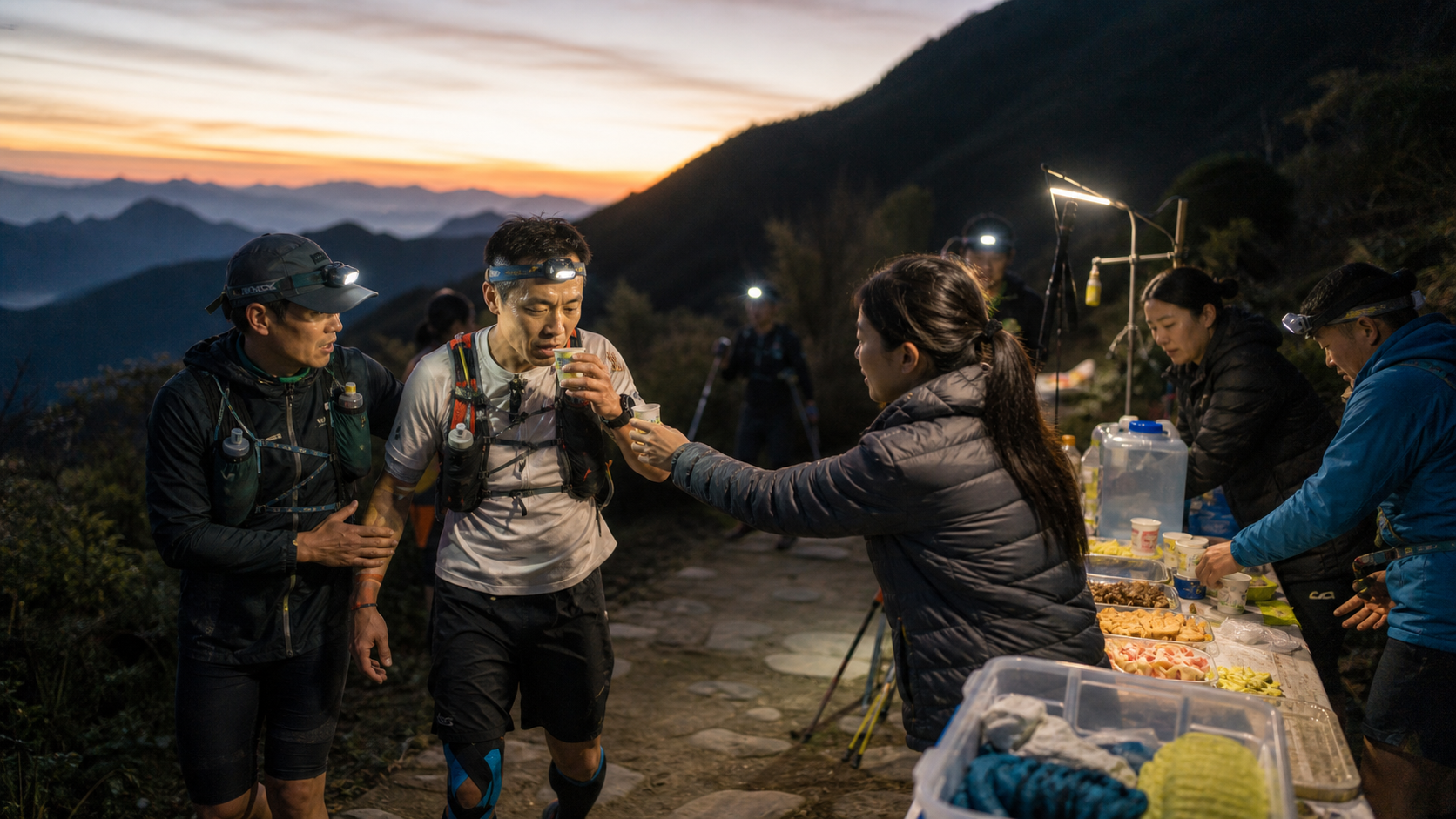
Aid stations are the “gas stations” for runners during the long race, and whether they function well depends entirely on the volunteers’ efforts. The volunteer tasks at an aid station include:
- Preparing and serving food and drinks
- Recording runners’ pass-through times
- Providing basic medical assistance (blister care, taping)
- Cheering for runners and boosting morale
- Keeping the aid station bright and warm at night
- Assisting in contacting race organizers and reporting runners’ conditions
For runners, arriving at an aid station in darkness and exhaustion to see volunteers’ warm smiles and hot food is an indescribably moving experience. Many ultramarathon runners say that a volunteer’s words—“You made it! Not far to go! Keep going!”—are often the strength that carries them through the toughest moments.
Taiwan’s Ultramarathon Volunteer Culture
Taiwan’s ultramarathon scene has a vibrant volunteer culture. Many well-known ultramarathon runners, during the seasons when they are not racing, proactively sign up to volunteer at other events. This culture of “taking turns serving” keeps the community tightly knit and also allows novice runners to gain an in-depth understanding of how ultramarathon events operate as volunteers, preparing them for their own future races.
What you gain from volunteering at an ultramarathon:
- Observing top runners’ race strategies and mental states up close
- Understanding the actual operations of aid station food and services
- Building community connections and meeting runners who share the same passion
- Accumulating organizational and logistical management experience
- Experiencing the unique warmth of the ultramarathon community
How the Crew System Works
Some ultramarathon events allow runners to bring a “crew” that waits at designated aid stations to provide personalized support and supplies. Crew members are usually friends, family, or teammates, responsible for:
- Arriving at aid stations early to set up the runner’s personal supplies (specific foods, change of clothes, medication)
- Assessing the runner’s physical condition and, if necessary, persuading the runner to rest or withdraw
- Moving between multiple aid stations to provide continuous support
Crew work is often harder than the running itself—it requires long waits, rushing to aid stations in the middle of the night, and observing the runner’s condition amid tension and anxiety. A good crew is an intangible asset for finishing the race.
How to Integrate into Taiwan’s Ultramarathon Community
Join local clubs: There are numerous active trail running/ultramarathon clubs across Taiwan, including online communities (Facebook groups) and physical running crews. Start with training partners and gradually build community connections.
Volunteer before racing: If you are new to ultramarathons, it is recommended that you first volunteer at an ultramarathon to understand the full picture of the event before signing up to race. This is not just preparation—it is also a way to contribute to the community.
Keep an open mindset at events: Ultramarathon runners generally share an open, mutually supportive attitude. On the course, regardless of speed, runners are usually willing to help each other, share food, and face challenges together. With an open mindset, you will find that the ultramarathon community is a place where you can find companions regardless of speed, age, or background.
Practical Advice
Build your support network: During your training period, start thinking about your race support network: who can serve as a pacer? Who is willing to form a crew? These people need advance preparation and training—you cannot find them at the last minute.
Give back to the community: The mutual-aid culture of the ultramarathon community is a two-way street. After you finish a race, consider how to give back—volunteer at the next race, share your experience with novice runners, or lead new partners in training. This virtuous cycle is the very foundation of the ultramarathon community’s long-term flourishing.
Conclusion
The moment of finishing an ultramarathon has never been a single person’s victory. Behind it are the pacers who stayed with you through the late night, the volunteers who handed you hot soup at aid stations, and the crew waiting at the finish line. The ultramarathon community’s culture of mutual aid tells us: humanity’s most extreme challenges are never solitary. Join this community, and you will discover that running is not just a sport—it is a way of connecting with one another.
Related Reading
- Ultramarathon Logistics Support: The Collaboration Plan Between Runners and Aid Station Volunteers
- Road Race Pacing Group Culture: The Sense of Achievement and Community Connection in Leading Runners
- Running Community Psychology: The Psychological Support of Pacer-Runner Interaction
- Road Race Volunteer Culture: Reflections on Serving at Events and Its Community Significance
新屋團體繞圈賽 | 眾多菁英好手賽道奔馳 | 千瓦女子軍團 | 無敵交管狂獲好評 明年你一定不能錯過 | #公路車
5 年前
#PUSHBIKE 原來這麼好玩! 小朋友 滑步車 初體驗 超可愛
6 年前
「悲情男車友」創作單曲 爆笑MV / 公路車 / CT Yeh / 4K劇情版
7 個月前
2025 海鷗團體繞圈賽 網路直播 超激烈裁判長視角 / EIPC 李廷威、Waypoint 等眾多高手競爭 / feat. 卡密兒主持 / 海鷗繞圈賽
9 個月前
福隆鐵人團練隨拍
8 年前
Live) 備戰2019彰化經典百K 賽前攻略 (已完賽請看新影片
7 年前
96 彰化讚 挑戰組實錄 x 空拍繞圈賽集團衝刺 | 公路車 | ARTC 車測中心 | CT Yeh
6 年前
2023桃園團體繞圈賽/環台賽等級拍攝/賽事精華/ 10人一隊缺一不可!50隊廝殺大場面 / 第三屆 海鷗繞圈賽 /公路車/CT Yeh
2 年前