Introduction
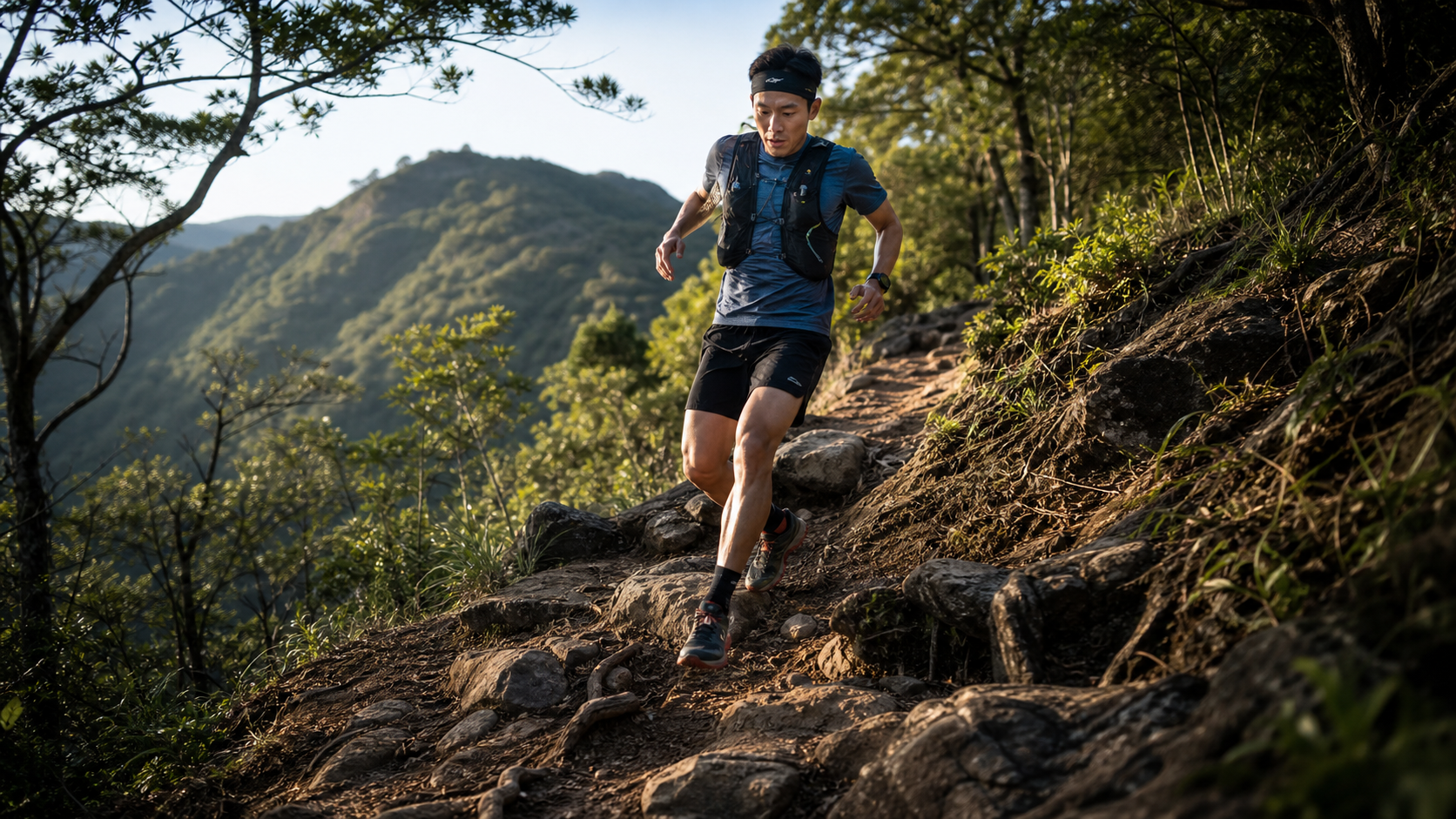
In the world of ultramarathons, there is a painful experience nearly everyone has had: after a downhill section in a high-climbing trail race, the quadriceps on the front of the thighs begin to burn intensely. Every downhill step feels like tearing muscle. In the later stages, descending becomes even more agonizing than climbing, and you start limping with every step.
This phenomenon has a formal name—downhill-induced delayed onset muscle soreness (DOMS)—primarily caused by the quadriceps repeatedly performing “eccentric contractions” during descents. Unlike climbing, where muscles contract concentrically (shortening), downhill running requires the muscles to exert force while being lengthened. This eccentric contraction is far more damaging to muscle fibers than regular running.
This article begins with the biomechanics of downhill technique, provides immediately applicable technique improvements, and offers training strategies to protect the quadriceps.
Biomechanics of Downhill Running
Why Downhill Running Hurts Knees and Legs
When descending, the impact force of each step is approximately 3–5 times body weight (compared to 1.5–2.5 times on flat ground). Most of this impact is absorbed by the quadriceps and knee joints. If downhill technique is poor, these forces concentrate on a few specific areas, accelerating fatigue and injury.
Common downhill technique errors:
| Error | Resulting Problem | Correct Alternative |
|---|---|---|
| Heel striking first | Large braking force, impact concentrated on knees | Forefoot or midfoot striking |
| Overly long stride | Increased impact per step | Shorten stride, increase cadence |
| Leaning back | Instability, prone to slipping | Slight forward lean of center of gravity |
| Excessive tension | Muscles cannot absorb shock | Keep legs slightly relaxed |
| Charging downhill at full speed | Reduced control, increased injury risk | Maintain a controlled pace |
Key Points for Effective Downhill Technique
Cadence: Fast and Short Is Key
The most effective downhill technique improvement is increasing cadence and shortening stride. Each footfall should land close to directly beneath the body (rather than kicking the foot forward), making the impact direction more vertical and reducing front-to-back braking forces.
Target cadence: 180+ steps per minute (maintain high cadence even on descents)
Center of Gravity Control
Keep your center of gravity slightly forward (rather than the instinctive lean back), allowing your forward momentum to continue instead of constantly braking with your feet. A forward center of gravity does not mean bending at the waist—keep your back straight and lean slightly forward from the ankles.
Eye Position
Look 3–5 meters ahead (rather than staring at your feet). This not only helps you anticipate terrain but also gives your brain enough reaction time, making foot placement more natural and fluid.
Slightly Relaxed Legs
Completely tense leg muscles cannot effectively absorb shock. Learn to maintain a feeling of “soft but strong” leg muscles when descending—similar to how a cat lands—not limp, but with elastic control.
Special Handling of Technical Terrain
Rocky/Boulder Terrain
On descents with rocks or scree, quick and agile footwork matters more than strength:
- Decide your foot placement at the moment before stepping, rather than planning every step in advance
- On unstable rocks, slightly bend your knees at the moment of landing to increase stability
- Don’t try to fully stabilize on a single rock—touch down quickly and immediately transfer weight to the next step
Muddy/Slippery Terrain
Descending on wet, muddy trails requires extra caution:
- The lug pattern on trail running shoes is designed for exactly this—trust the shoe’s grip
- Press the foot slightly into the mud (rather than just touching the surface) so the lugs bite into the ground
- Use tree trunks and rocks as auxiliary support points
- Trekking poles are extremely helpful on slippery descents, providing additional points of contact
Traversing Steep Slopes
When the gradient exceeds 35–40%, descending head-on carries high risk. Use the side-cutting technique:
- Turn your body sideways and descend in a traversing pattern, reducing forward-backward movement of your center of gravity
- The lower foot steps first, followed by the higher foot
- Slow down and focus on stability with every step
Training Strategies to Protect the Quadriceps
Eccentric Strengthening Training
The most direct way to prepare is to accustom the quadriceps to eccentric stress. The following exercises can be done at the gym or at home:
Eccentric Step-down:
- Stand on the edge of a step approximately 20–30cm high, on one leg
- Slowly (3–5 seconds) bend the knee of the standing leg, gradually lowering the other foot toward the ground
- Immediately return to the standing position after touching down
- 3 sets × 12 reps (per leg)
This exercise directly mimics the eccentric contraction pattern of the quadriceps during downhill running and is the most recommended knee and quadriceps strengthening exercise during race preparation.
Nordic Hamstring Curl:
Strengthens the back of the thigh (hamstrings), balancing the strength ratio between front and rear muscle groups, indirectly protecting the knees.
Progressive Approach to Downhill Training
Like uphill training, building downhill capability requires progressive training. Avoid large amounts of continuous descending early in training—start with short downhill sections (500–1000m of descent) to let the muscles gradually adapt to eccentric stress, then progressively increase the distance and gradient of descents.
Suggested downhill training progression:
- Weeks 1–4: 200–400m of cumulative descent per session
- Weeks 5–8: 400–700m of cumulative descent
- Weeks 9–12: 700–1000m of cumulative descent
- 8 weeks before race: simulate full race downhill sections
Practical Advice
Protective effect of compression tights: Wearing compression tights can reduce downhill damage to the quadriceps, which is supported by sports science research. Compression tights provide muscle support, reduce unnecessary muscle vibration, and lower the severity of DOMS. If you are sensitive to leg soreness after long descents, compression tights are gear worth considering.
Active recovery after races: After completing a high-descent race, avoid remaining completely still for the first 48 hours. Light active recovery (walking, gentle swimming) promotes blood circulation and accelerates quadriceps repair. Excessive rest actually prolongs the duration of DOMS.
Video recording for technique: Ask a training partner to film you running downhill from the side, and compare it with examples of correct technique. Visual feedback is the most direct way to improve technique, and noticeable changes can often be seen within one or two training sessions.
Conclusion
Downhill technique is one of the abilities in ultramarathons that can improve most rapidly through training. Many runners, after adjusting their downhill technique, not only reduce knee and thigh discomfort but also see significant improvements in overall finish times. Transforming downhill from your “weakness” into a “weapon” will greatly enhance your competitiveness in trail ultramarathons.
Related Reading
- Trail Running Downhill Technique: Managing Braking Muscles, Cadence, and Braking Force
- Ultramarathon Downhill Technique: Knee Protection and Footwork for Charging Downhills
- Trail Running Downhill Technique: Center of Gravity Control, Foot Placement Selection, and Knee Protection
- Trail Running Downhill Technique: Complete Analysis of Center of Gravity, Cadence, Vision, and Braking Muscle Training
一日北高/長距離團騎 常見問題補充篇 / 組團或跟團的眉角 / 壯車友容易被瘦車友慢性拉爆 / 原來屁股痛可能是這個原因...? / 風場配速法 / 公路車 / CT Yeh
2 年前
CT 喇低賽) 武嶺牽車 才是王道 西進牽車四小時內秘訣 攝手位置 如何判斷 防抽筋小秘訣
7 年前
一日北高常見問題大集合 | 攻略 | 路線 | 訓練 | 補給 | 自行車 單車 | 一日雙城 | 雙塔 | TWB北高360 | 屁股痛
6 年前
Never Stop 西進武嶺 前後雙機 完整全程錄影 訓練台 實境
8 年前
[教學] Premiere 影片 手震 修正 教學 防抖 單眼 影像 GoPro 穩定 Video Stabilization
8 年前
CT 喇低賽) 單車 比賽總是沒照片? 攝影師的觀點大公開 姿勢就是力量! 請加速1.25倍收看
7 年前
公路車 爬坡 破PR 紀錄 小技巧 分享
6 年前
摔車後補裝備: 好市多新款單車安全帽& Specialized Romin 北高整路屁股都不痛的坐墊 | 一千元居然有MIPS | CT Yeh | 公路車
4 年前