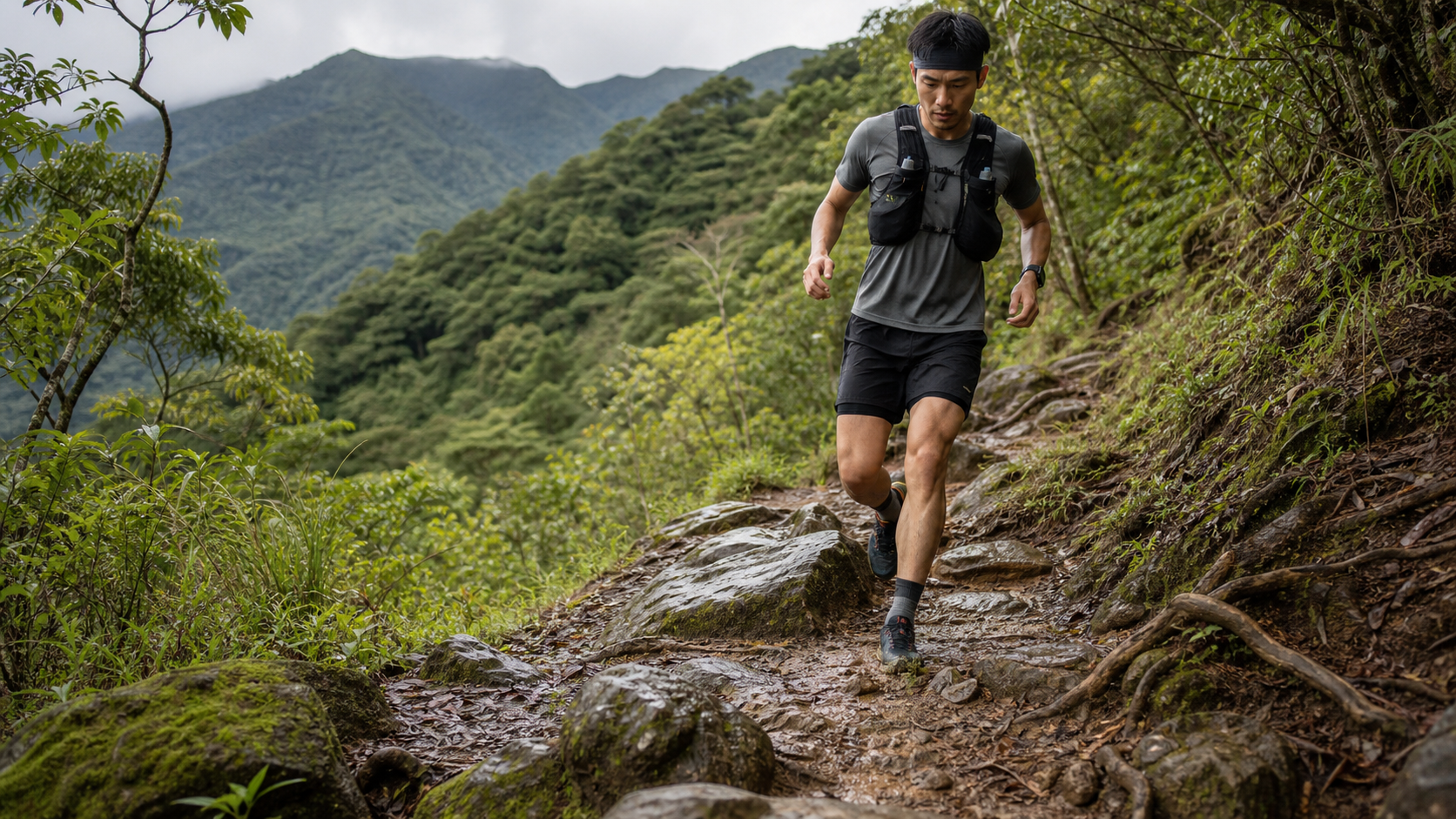
Introduction
“Can’t run uphill” is the most common frustration for trail running beginners. When the road-running pace mindset meets Taiwan’s mountain trails with 20% gradients, your cardiovascular system hits its limit within minutes. However, professional trail runners don’t conquer slopes with “stronger legs”—they rely on smarter uphill technique: knowing when to run, when to hike, and how to gain the most elevation with the least energy.
The Switch Principle: Running vs. Power Hiking Uphill
The most important uphill concept in trail running: “Speed isn’t the goal; efficiency is.” When the gradient exceeds a certain point, running consumes more energy than hiking while yielding nearly the same forward speed.
| Gradient | Recommended Action | Cadence Reference | Notes |
|---|---|---|---|
| 0–8% | Sustained jogging | 160–170 spm | Running form can be maintained |
| 8–15% | Run-hike alternation | 150–160 spm | Switch timing determined by heart rate |
| 15–25% | Power hiking | — | Save energy by pushing on knees |
| 25% and above | Hiking or hands-and-feet | — | Running yields extremely low returns |
Heart rate is the best referee: When your heart rate exceeds 85–87% of your maximum, that’s the signal to switch to power hiking. Forcing yourself to keep running at a high heart rate will only deplete muscle glycogen prematurely, compromising your performance later in the race.
Proper Running Form on Uphills
Forward Lean Angle
When climbing, your body needs to lean forward, but the reference point for “leaning” is the ankles, not the waist. A correct lean keeps the entire body in a straight diagonal line, with your center of gravity over the forefoot rather than the heel. An incorrect “hunched-back” lean compresses your breathing and increases strain on your lower back.
Stride Length and Cadence
Shortening your stride is the core technique for uphill running:
- Each step should gain no more than 10–15 cm of elevation
- Maintain a cadence of 160–170 spm (slightly faster than on flat ground)
- Land on the midfoot to forefoot, avoiding heel strikes
- Lift your knees slightly higher when stepping up to clear obstacles
“Short, quick steps” may feel more tiring than long, slow strides, but they actually consume less energy and make it easier to keep your heart rate stable.
The Propulsive Role of the Arms
Your arms act as “the third and fourth legs” when climbing uphill:
- Arm swing amplitude: Greater than on flat ground, with stronger forward-backward swings to propel your body forward
- Elbow angle: Maintain 90 degrees, don’t exceed 100 degrees (wastes energy)
- Swing direction: Primarily forward and backward; avoid lateral swinging that wastes energy sideways
- Relaxed fists: Clenching your fists tenses your shoulders and wastes unnecessary energy
Energy-Saving Techniques for Power Hiking
When you switch to power hiking, many runners simply slow down and keep moving, but the following techniques can significantly improve efficiency:
Knee Push Method:
- With each step up, push on your thigh with the palm on the same side
- Use arm strength to reduce the load on your legs, effectively distributing the effort
- On sections steeper than 20%, this can reduce leg muscle effort by approximately 20–30%
Using Trekking Poles:
- Hiking with two poles can reduce vertical leg load by 25–30%
- Plant the pole tips about 30 cm in front of your body
- Shorten poles slightly on uphills, lengthen them slightly on downhills
- Many trail races in Taiwan allow or even encourage the use of trekking poles
Pacing Management
The most common mistake in trail running uphill is “starting too fast”—accelerating excitedly at the sight of a slope and burning out your energy in the early section. Here are practical pacing principles:
- First 1/3 of the climb: Go 15–20% slower than your comfortable pace
- Middle 1/3 of the climb: Maintain a steady pace—neither accelerating nor decelerating
- Final 1/3 of the climb: Only consider accelerating if you have energy left
On longer climbs (over 20 minutes), let your heart rate drop slightly every 5–10 minutes (switch to hiking for 1–2 minutes) to extend your endurance for the remainder of the climb.
Practical Recommendations
- Add dedicated hill training weekly: Choose a 200–400 meter climb and repeat it 4–6 times
- Practice heart rate management: Watch your heart rate monitor on climbs; don’t exceed 87% of your maximum
- Record yourself climbing: Have a friend film a side-view video to check your forward lean angle and arm swing
- Practice with trekking poles: Even if you don’t race with them, practicing pole-assisted climbing strengthens your technical awareness
- Accumulate vertical gain: Aim for an initial weekly target of 1500–2000 meters of vertical ascent
Conclusion
Improving your uphill technique is one of the fastest ways to progress in trail running. When you can maintain a steady heart rate on steep slopes and switch smoothly between running and hiking, you’ll find that every mountain slope becomes a manageable challenge rather than an unpredictable battle of attrition. Starting with your next training session, head into the mountains with your heart rate watch and let the data tell you when to run and when to hike.
Related Reading
- Uphill Trail Running Technique: Power Distribution of Cadence, Push-off, and Efficiency
- Uphill Trail Running Technique: At What Gradient Does the Energy Cost Diverge Between Walking and Running?
- Uphill Technique: How to Determine the Switch Point Between Running and Walking?
- Trail Running Technique and Strategy: Complete Guide to Uphill and Downhill Running, Terrain Reading, Gear Navigation, and Safety Preparation
公路車 爬坡 破PR 紀錄 小技巧 分享
6 年前
CT 喇低賽) 武嶺牽車 才是王道 西進牽車四小時內秘訣 攝手位置 如何判斷 防抽筋小秘訣
7 年前
如果Pogačar騎西進武嶺可以多快?會破2嗎?各種情況深度推估探討 / 公路車 / CT Yeh
2 年前
單車 梅山36灣 坡度介紹 路段介紹 空拍 (相關遊記影片,請參考說明或我的頻道喔,歡迎訂閱)
6 年前
白沙屯媽祖進香在家走!UREVO 坡度自調走步機 / 可連接訓練遊戲APP MyWhoosh / 邊看直播邊走起來 / CT Yeh
11 個月前
西進武嶺 免費訓練分析服務 Intervals | 練不夠還是練過頭?你哪一種類型選手?AI模型告訴你! | 備戰神器 | 公路車 訓練 | CT Yeh
4 年前
西進武嶺 8000名單車友數據分析 PART1 | 從新手到高手數量/瓦數/推力比/FTP推力比/功率計使用率 大解析 | 公路車 | CTYeh
5 年前
大禹嶺 到 武嶺牌樓 全程前後實況錄影 | 北進武嶺 | 東進武嶺 | KOM | 訓練台 | 坡度分析 | Taiwan KOM Last 10 km HARD | 公路車
6 年前