Introduction
A trail runner’s pack reveals their training philosophy and safety awareness. Carry too little, and you’re unprepared when mountain weather shifts suddenly; carry too much, and excess weight compromises training quality. In Taiwan’s trail environment—high humidity, afternoon thunderstorms, and the risk of getting lost on trails—striking a balance between safety and lightness is a challenge every trail runner must face.
The Logic Behind Pack Capacity Selection
Trail running pack capacity is primarily determined by trip duration, not the runner’s body size.
| Trip Duration | Recommended Capacity | Suitable Scenarios |
|---|---|---|
| 1–2 hours | 1–3L | Suburban training, familiar routes |
| 2–4 hours | 5–8L | Half-day trail runs, foothill training |
| 4–8 hours | 8–12L | Full-day outings, races |
| Multi-day trips | 12–20L | Traverses, long-distance races |
Taiwan’s weather is unpredictable—even for 2–3 hour training sessions, it’s recommended to carry at least a 5-liter pack to ensure there’s room for emergency gear.
Mandatory Gear List for Taiwan’s Trail Environment
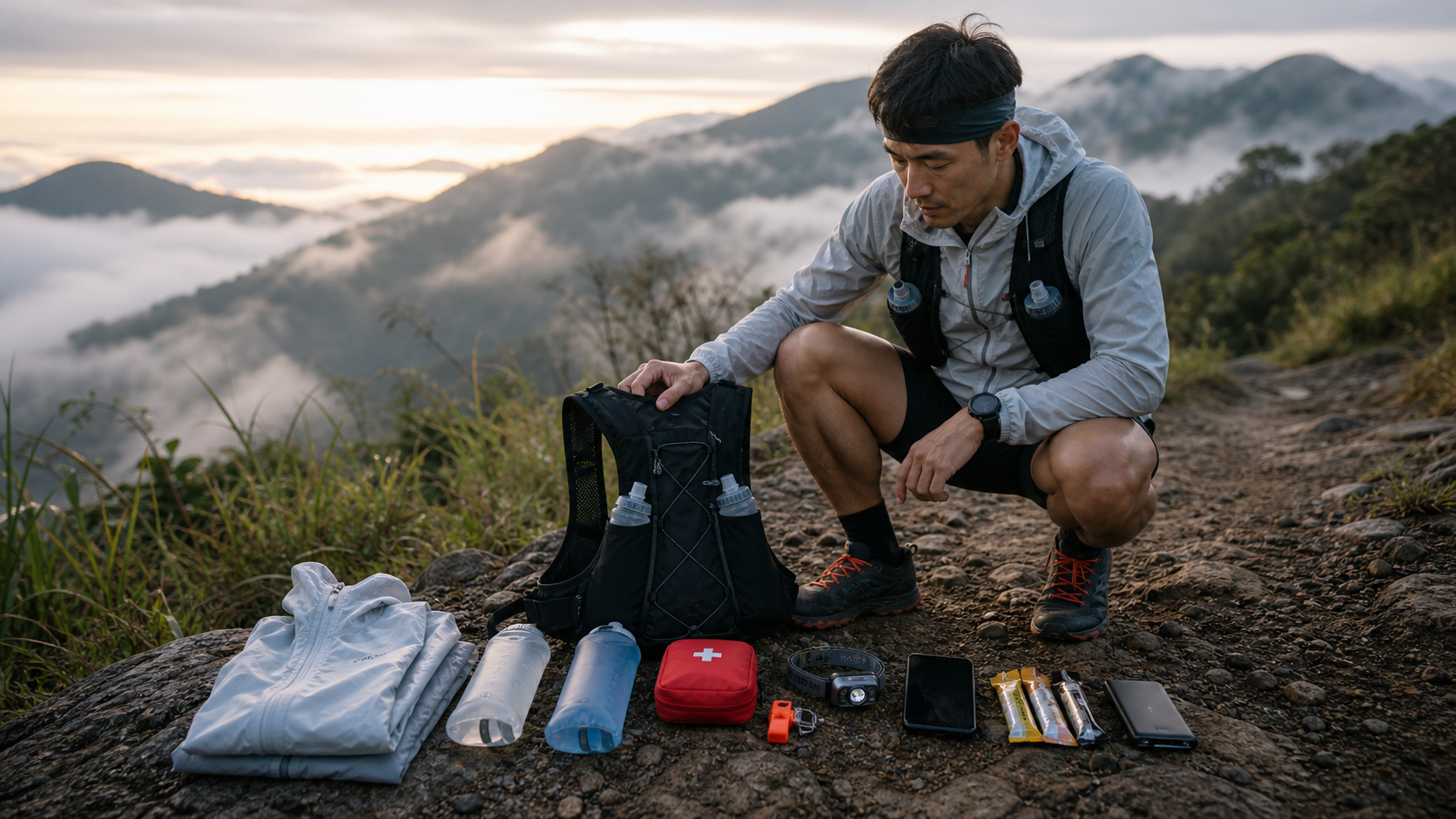
The following items should be considered essential regardless of distance:
Safety:
- Phone (with offline maps downloaded, battery above 70%)
- Emergency rain jacket (lightweight options around 80–120g)
- First aid kit (band-aids, elastic bandage, pain relievers)
- Whistle (sound carries farther than shouting)
Navigation:
- Offline maps (Maps.me or Gaia GPS recommended)
- Power bank (10,000mAh, approximately 180g)
Fuel:
- Water: 500–750ml per hour, up to 1000ml in Taiwan’s summer
- Energy food: 150–200 kcal per hour (energy gels, date cakes, nuts)
Seasonal Mandatory Gear (autumn/winter, high mountains):
- Insulation layer (down jacket or fleece)
- Headlamp (when there’s a risk of schedule delays)
Key Considerations for Pack System Selection
Bladder vs. Soft Flasks
| Comparison | Bladder | Soft Flasks |
|---|---|---|
| Drinking convenience | High (drink anytime) | Medium (must retrieve) |
| Ease of cleaning | Low (hard-to-reach corners) | High |
| Weight (empty) | 150–200g | 30–50g each |
| Suitable distance | 2+ hours | Short distances or paired with a bladder |
Most mainstream trail packs currently use a hybrid design of “front soft flasks + rear bladder.” The two front flasks are convenient for electrolyte drinks, while the rear bladder holds plain water—the optimal setup for long-distance trail running.
Pack Fit Matters More Than Brand
The most overlooked purchasing consideration for trail packs is torso length compatibility. The pack’s torso length needs to match your own, otherwise even the lightest pack will cause back pain on long climbs. Always try the pack on before buying. After putting it on:
- The sternum strap should sit approximately 3–5 cm above the chest line
- The hip belt should sit snugly above the hip bones, not on the waist
- Load the pack fully and jog 100 steps to confirm it doesn’t bounce excessively
Weight Minimization Strategies
Trail running’s lightweight philosophy differs from general hiking—the focus isn’t on sacrificing safety, but on eliminating redundancy.
Three lightweight principles:
- Multi-purpose items: Rain jacket doubles as insulation; headlamp doubles as flashlight
- Functional substitution: Replace heavy solid food with high-concentration energy gels
- Environment-based elimination: On familiar, populated popular routes, some emergency gear can be omitted
Common lightweight substitutions:
- Standard first aid kit (300g) → Minimalist first aid kit (80g)
- 1L hard bottle (200g) → 500ml soft flask (30g)
- Standard rain jacket (300g) → Lightweight emergency rain jacket (90g)
- Traditional trekking poles (400g each) → Carbon fiber trail poles (160g each)
Practical Advice
- Build a personal gear checklist: Weigh and record every item to identify the biggest weight contributors
- Pre-trip pack check: Compare against your checklist before every departure to avoid leaving critical gear behind
- Follow Taiwan race standards: Mandatory gear lists from events like TNF100 serve as excellent reference benchmarks
- Protect high-wear areas: Shoulder straps and hip belts are the most prone to chafing—wear long sleeves or use anti-chafe balm
Conclusion
A trail running pack is the safety bridge between the runner and the mountains. Taking the time to understand your needs, carefully selecting every piece of gear, and repeatedly refining your system—this process is itself part of trail running practice. Remember: the most important gear on the mountain is always judgment and humility.
Related Reading
- Running Pack Selection: Capacity and Stability Assessment for Trail Running Hydration Packs
- Road Running Hydration Pack Selection: Capacity, Bladder Options, and Front Pocket Suitability for Trail Running
- Road Running Hydration Pack Buying Guide: Capacity Planning and Harness System Comparison for Ultra-Trail Marathons
- Trail Running Gear Requirements: Mandatory Gear Checklist and Pack Selection
單車 一日北高 ( 雙城 ) 肥宅雙人瘋狂行 紀錄片 REACTO
10 年前
一日北高前的高裝檢 | 北高 360 | 挑戰11小時的裝備 | 一日雙塔 | 補給
6 年前
雨戰! 西進武嶺員工旅遊 加料 各路段大數據分析 | 同事端出5公斤的公路車來挑戰!? EP1
4 年前
再一組! 全碳幅條 碟煞/無內胎輪組 開箱! 到底好騎嗎? UNAAS X40 | 公路車 | CT Yeh
4 年前
太平山單車員工旅遊 | 這樣玩CP值最高!| 公路車
5 年前
#公路車 #西進武嶺 配速配瓦實驗 坡度分析 四小時內攻略 建大盃 NeverStop #西進武嶺攻略
6 年前
CT 喇低賽) 武嶺牽車 才是王道 西進牽車四小時內秘訣 攝手位置 如何判斷 防抽筋小秘訣
7 年前
大武山後門26%歡樂陡坡!JJSC南台灣單車行Day2 / 被颱風追著跑 / 公路車 / CT Yeh
2 年前