Introduction
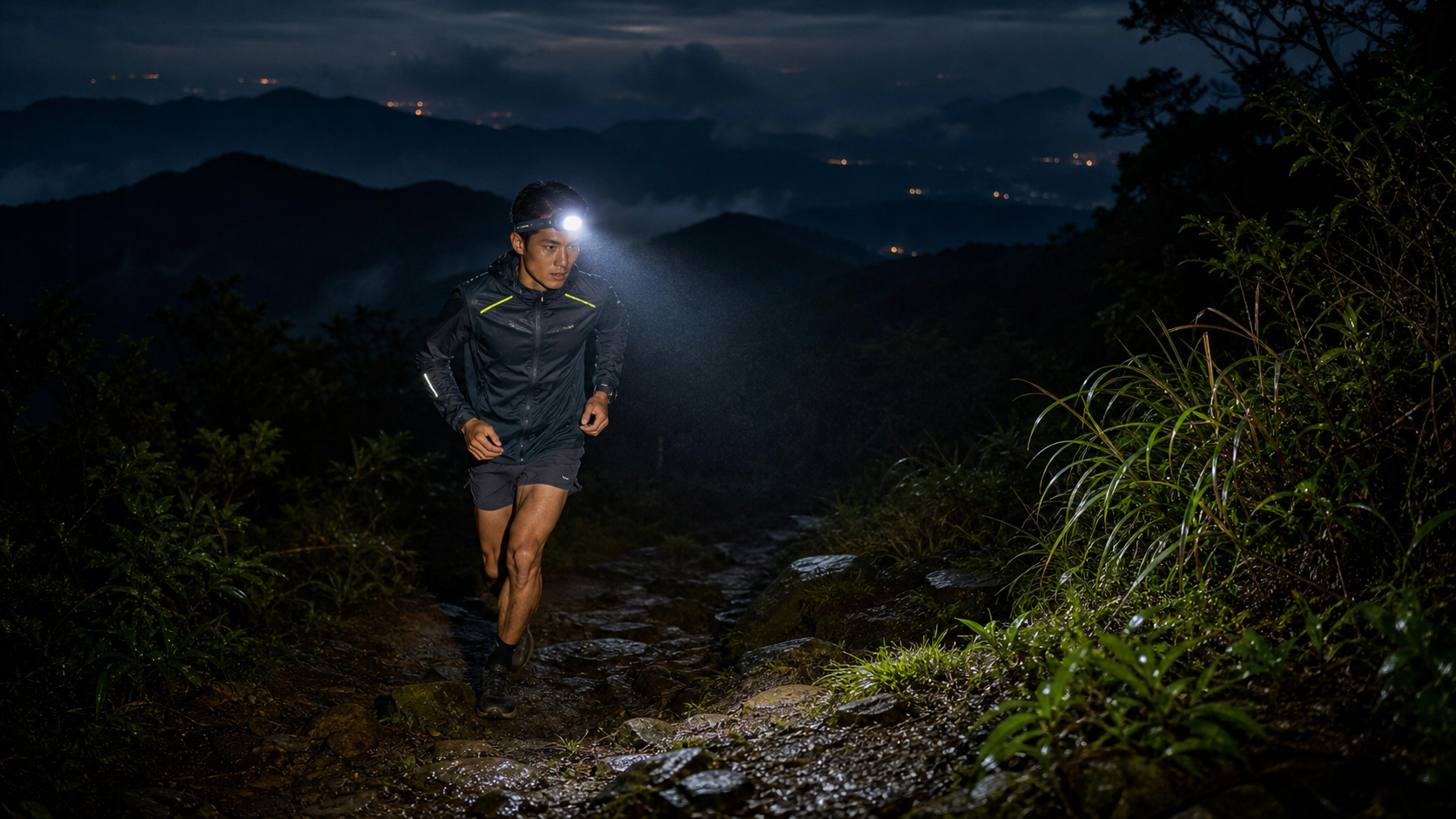
Trail runners in Taiwan have a unique advantage: even on weekdays, they still have opportunities for night trail training. The Yangmingshan night runs in Taipei, the Dakeng night trails in Taichung, and the Shoushan night runs in Kaohsiung are all active runner communities. Night trail running is not just a way to add training time; it also trains different perceptual abilities—when visual information is limited, proprioception and auditory perception are significantly enhanced. However, the risks of night training are also much higher than during the day, making thorough preparation a necessary prerequisite.
Headlamp Selection Guide
Trail running headlamps differ fundamentally from hiking headlamps: the head is in constant motion while running, and the need to quickly read the terrain ahead demands higher brightness and beam patterns.
Core Technical Specifications
| Parameter | Entry-Level Requirement | Advanced Requirement | Notes |
|---|---|---|---|
| Brightness (lumens) | 300–500 lm | 600–1000 lm | Trail running requires high brightness |
| Beam distance | 60–80m | 100–150m | Longer warning distance needed at higher speeds |
| Battery life | 4–6 hours | 8–12 hours | Actual runtime in high-brightness mode |
| Weight | 90–120g | 60–90g | Lighter is better for maintaining running form |
| Water resistance | IPX4 | IPX6–7 | High humidity in Taiwan’s mountain areas |
Beam Pattern Selection
Trail running headlamps come in two beam patterns: Spot and Flood. The ideal trail running headlamp should offer both:
- Spot beam: See the route 80–100 meters ahead
- Flood beam: Illuminate the immediate terrain 1–3 meters at your feet
Some advanced models (such as the Petzl Nao+ and Black Diamond Spot) feature automatic reactive lighting that adjusts brightness based on ambient light, significantly extending battery life.
Popular Models Among Taiwan Trail Runners
- Entry-level: Black Diamond Spot 400 (approx. NT$1,500–2,000)
- Mainstream: Petzl Reactik+ (approx. NT$3,000–4,000)
- Advanced: Petzl NAO+ (approx. NT$6,000–7,000)
- Ultra-light: Nitecore NU25 (approx. NT$1,200, suitable as a short-distance backup)
Safety Guidelines for Night Trails
The risks of night trail running come mainly from three sources: difficulty reading terrain, difficulty for others to rescue you, and increased wildlife activity.
Basic Safety Rules
Tell someone (most important):
- Before heading out, inform family or friends of your destination, planned route, and estimated return time
- Share your real-time location via Google Maps, or enable your phone’s emergency contact feature
- Join a local night running community; only head out with companions
Redundant gear:
- Primary headlamp + backup headlamp (at least 200 lumens)
- Phone battery above 80% + power bank
- Spare batteries or headlamp charging cable
Route selection principles:
- For your first night run, choose a route you already know well from daytime
- Avoid going alone on remote trails with complex navigation or no signal
- Prioritize popular night running routes in Taiwan (sections with streetlights, more foot traffic)
Taiwan-Specific Night Risks
Snakes in Taiwan: Taiwan is home to venomous snakes such as the hundred-pacer viper and the Chinese habu, which are most active at night.
- Confirm the ground with your headlamp before each footfall
- Be especially cautious when crossing grassy areas
- If you encounter a snake, stay still and let it move away on its own
- Know first aid for venomous snake bites (stay calm, immobilize the affected limb, seek medical attention immediately)
Taiwanese wild boars: Wild boars occasionally appear in mountain areas at night.
- Keep your distance when encountering them, and do not approach piglets (sows will attack to protect their young)
- Making loud noises will usually drive wild boars away
Sudden temperature drops: In Taiwan’s autumn and winter, nighttime mountain temperatures can be 8–12°C lower than daytime temperatures.
- Carry a lightweight insulating layer
- Immediately consume warm beverages after training
Special Technical Points for Night Training
Visual Compensation Strategies
Night vision is limited, but several techniques can optimize visual performance:
- Avoid staring directly into the headlamp beam: Let your eyes adapt to the illuminated area rather than focusing on the edge of the beam
- Pre-scan with head movement: Turn your head to sweep the terrain ahead, not just look straight ahead
- Use a handheld auxiliary light: Add a lower-angle view on technical sections
Stride Adjustments
- Shorten your stride by 15–20% (visual warning distance is reduced, requiring more reaction time)
- Slightly lengthen ground contact time (give your feet more time to feel the terrain)
- Avoid attempting unfamiliar technical sections at night
Practical Tips
- For your first night run, go with experienced runners and observe their footwork and light usage
- Headlamp battery life drops significantly in cold conditions (by roughly 30–40%); carry an extra set of spare batteries for winter night runs
- Use red light mode during rest and refueling stops to preserve night vision
- After a night run, let your eyes adapt to bright indoor light for 5–10 minutes before driving
Conclusion
Night trail running is an entirely different sensory experience: when visual information diminishes, a runner’s awareness of the ground beneath their feet, the sound of the wind, and the chirping of insects all become sharper. With thorough safety preparation and companions by your side, Taiwan’s night trails can offer you a running memory that daytime simply cannot replicate.
Related Reading
- Night Trail Running Safety: A Complete Guide from Headlamps to Routes
- Running Light Buying Guide: Lumen Requirements and Battery Life for Night Running Headlamps
- Road Running Headlamp Buying Guide: Complete Comparison of Lumens and Battery Life for Night and Early Morning Runs
- Road Running Headlamp Buying Guide: Lumens, Wide-Angle Beam Distribution, and Real-World Testing Recommendations for Taiwan Night Runs
單車 一日北高 ( 雙城 ) 肥宅雙人瘋狂行 紀錄片 REACTO
10 年前
雷達尾燈 雷不雷? 邁金L508 智慧雷達尾燈 情境考驗實測 | 同場加映 2千元等級的專業車錶 C406 Pro | 公路車 | CT Yeh
3 年前
iPhone 12 Pro 夜間騎車動態錄影 效果屌打 GoPro Hero 9 | 公路車 團練
5 年前
一日北高前的高裝檢 | 北高 360 | 挑戰11小時的裝備 | 一日雙塔 | 補給
6 年前
沉浸室內單車練功房開箱! 100吋大畫面,最便宜的花費? 居然還能K歌!? | 公路車 | CT Yeh
3 年前
FTL 與 SYB 車隊專訪 西進武嶺 實用攻略分享! 2小時 如何練?!你不知道的眉角!新手準備武嶺必看 EP1 | 實力派女車友 | 精華版 | 公路車 | CTYeh
4 年前
太平山單車員工旅遊 | 這樣玩CP值最高!| 公路車
5 年前
西進武嶺 自製新版AI配速表產生器 x 賽前攻略 抱佛腳! 沒有功率計也可以產生配速表嗎?有什麼其他眉角賽前要注意的呢? | 西進武嶺 / 東進武嶺 KOM 攻略 | 公路車 | CT Yeh
4 年前