Race Anxiety in Running: Psychological Coping for Pre-Race Insomnia and Gastrointestinal Discomfort
Introduction
The night before a race, have you ever stared at the ceiling until 2 a.m.? Before heading out in the morning, does your stomach churn relentlessly, forcing you to make repeated trips to the bathroom? These experiences are almost a universal ritual among runners, from beginners to marathon veterans, and few are completely immune. Sports psychology groups these reactions under the term “Pre-competition Anxiety,” further divided into cognitive anxiety (negative thoughts in the mind) and somatic anxiety (physical tension symptoms). Understanding it is the first step to managing it.
The Physiological Roots of Pre-Race Anxiety
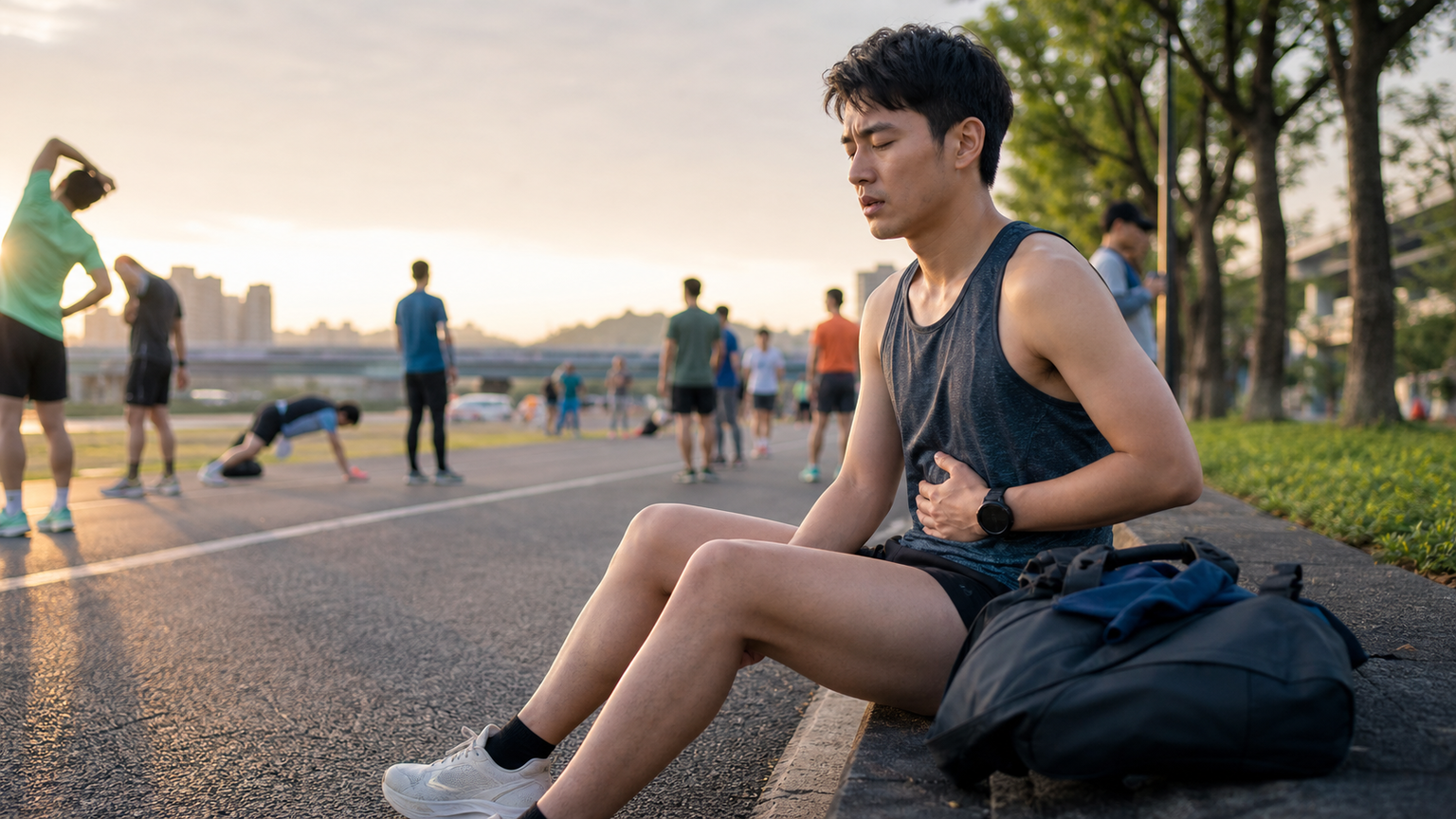
Pre-race nervousness is, at its core, the body’s “preparation response.” When the brain determines that an important event is imminent, it activates the sympathetic nervous system: adrenaline rises, heart rate accelerates, and the digestive system slows down (blood flow is redirected to the muscles). This is precisely the physiological reason behind pre-race stomach upset: the body is ready to run, but the digestive system hasn’t been told it can take a break.
Brief, moderate pre-race anxiety can actually aid performance, as it raises arousal levels and speeds up reactions. The problem lies in excessive anxiety—persistent insomnia, severe intestinal cramping, or even pre-race vomiting—which is what requires active management.
Common Manifestations of Pre-Race Anxiety and Corresponding Strategies
| Symptom | Psychological Root | Coping Strategy |
|---|---|---|
| Pre-race insomnia | Excessive worry about race outcome | Reframe: “Even if I didn’t sleep well, I can still finish” |
| Churning stomach, frequent bathroom trips | Overactivation of the sympathetic nervous system | Diaphragmatic breathing, fixed pre-race diet |
| Repeatedly checking gear | Anxiety from lack of control | Complete checklist the night before; don’t touch it on race day |
| Negative self-talk (“I can’t finish”) | Cognitive distortion | Prepare rebuttal phrases in advance |
| Overtraining before the race | Trying to eliminate uncertainty through action | Strictly follow the taper week; no extra running |
Three Core Coping Tools
Tool One: Diaphragmatic Breathing (4-7-8 Method)
Can be done in the race staging area or even in the restroom:
- Inhale for 4 seconds (using the abdomen, feeling the belly expand outward)
- Hold for 7 seconds
- Exhale for 8 seconds (slowly)
- Repeat 3–5 times
An exhalation longer than the inhalation directly activates the parasympathetic nervous system, slowing the heart rate. The tightness in the stomach typically eases noticeably after 2–3 breaths.
Tool Two: Cognitive Reframing—Renaming Your Anxiety
Research from Harvard psychologists shows that when anxiety is reinterpreted as “excitement,” performance improves significantly. Next time you feel your heart racing and palms sweating, try telling yourself: “I’m excited, my body is ready.” This isn’t denying the anxiety; it’s attaching a beneficial label to the same physiological state.
Tool Three: Pre-Race Routine
Establish a fixed sequence of pre-race behaviors to give your brain a predictable “safety script”:
- The night before: prepare gear, eat a fixed meal, get into bed by 11 p.m. (whether you fall asleep or not)
- Race morning: fixed breakfast, fixed warm-up routine, fixed pre-start song
The psychological function of a fixed routine is this: within an uncontrollable race, you create a “fully controllable domain,” reducing overall uncertainty.
A Special Note on Pre-Race Insomnia
Many runners firmly believe that “if I don’t sleep well, I won’t run well,” but research doesn’t fully support this belief. The short-term impact of one night of insomnia on aerobic endurance exercise is far smaller than its impact on anaerobic explosive power. Moreover, pre-race excitement often compensates for some of the fatigue caused by sleep deprivation. Telling yourself “Even if I didn’t get enough sleep, I can still finish the race” is itself a cognitive intervention that reduces insomnia-related anxiety.
Practical Advice
- Start controlling caffeine intake two weeks before the race to avoid an overstimulated nervous system from excessive caffeine in the days leading up to the event.
- Test your pre-race diet: every food you plan to eat on race morning must be tested on training days first to confirm your stomach can handle it.
- Allow yourself to feel anxious: trying to suppress anxiety only intensifies it. Accepting “I’m a bit nervous, and that’s normal” actually allows the anxiety to subside naturally.
- Talk to other runners: light conversation at the race venue (not about results) effectively shifts your focus and reduces feelings of isolated anxiety.
Conclusion
Pre-race anxiety is not a sign of weakness—it’s your brain taking the race seriously. The question has never been “how to eliminate anxiety,” but rather “how to make anxiety work for you instead of against you.” When you learn to calm somatic reactions with diaphragmatic breathing, shift psychological labels through cognitive reframing, and build predictability with a fixed routine, you stand at the starting line in the best possible position—not anxiety-free, but coexisting with anxiety, and still setting off.
Related Reading
- Race Anxiety Management: Breathing and Relaxation Techniques Before the Start
- The Science of Pre-Race Anxiety: How to Manage Marathon Nerves
- Pre-Race Anxiety Management: Mental Stabilization Techniques for the 10 Minutes Before the Start
- The Complete Guide to Race Anxiety: Practical Methods for Physiological Reactions, Pre-Race Rituals, Breathing, and Attention Regulation
[教學] Premiere 影片 手震 修正 教學 防抖 單眼 影像 GoPro 穩定 Video Stabilization
8 年前
FTL 與 SYB 車隊專訪 西進武嶺 實用攻略分享! 2小時 如何練?!你不知道的眉角!新手準備武嶺必看 EP1 | 實力派女車友 | 精華版 | 公路車 | CTYeh
4 年前
一日北高/長距離團騎 常見問題補充篇 / 組團或跟團的眉角 / 壯車友容易被瘦車友慢性拉爆 / 原來屁股痛可能是這個原因...? / 風場配速法 / 公路車 / CT Yeh
2 年前
約騎爆笑地獄梗 大腸怎麼了🤣 #公路車 #cycling
3 年前
一日北高前的高裝檢 | 北高 360 | 挑戰11小時的裝備 | 一日雙塔 | 補給
6 年前
一日北高常見問題大集合 | 攻略 | 路線 | 訓練 | 補給 | 自行車 單車 | 一日雙城 | 雙塔 | TWB北高360 | 屁股痛
6 年前
西進武嶺 自製新版AI配速表產生器 x 賽前攻略 抱佛腳! 沒有功率計也可以產生配速表嗎?有什麼其他眉角賽前要注意的呢? | 西進武嶺 / 東進武嶺 KOM 攻略 | 公路車 | CT Yeh
4 年前
CT 喇低賽) 單車 比賽總是沒照片? 攝影師的觀點大公開 姿勢就是力量! 請加速1.25倍收看
7 年前