Introduction
There’s an old saying in ultramarathon nutrition: “Races are won at aid stations, and lost at aid stations.” Too little fuel, and you’ll crash in the second half; too much or the wrong fuel, and you’ll be hunting for a restroom on the course. Especially in Taiwan’s hot and humid summer ultramarathons, electrolyte loss is rapid, making nutrition management far more critical than in a standard marathon. This article breaks down the three key aspects—solid food, fluids, and electrolytes—to help you build your own ultramarathon fueling strategy.
Energy Needs: How Much Do You Actually Need to Consume?
During an ultramarathon, you burn approximately 500–800 kcal per hour (varying by body weight, pace, and elevation gain), but your gut can only absorb about 200–300 kcal of carbohydrates during high-intensity exercise. This means you can’t fully replenish what you burn; the goal is to maintain stable blood sugar and delay hitting the wall, not to replace every calorie expended.
| Race Duration | Recommended Carbohydrate Intake per Hour | Primary Fuel Sources |
|---|---|---|
| 1–3 hours | 60g | Energy gels, sports drinks |
| 3–6 hours | 60–80g | Energy bars, bananas, salty foods |
| 6–12 hours | 60–80g + solid food | Bread, crackers, braised snacks, rice balls |
| 12+ hours | Depends on individual, mix of solid and liquid | Congee, noodles, real food |
Solid Food: The Ultramarathon’s Secret Weapon
Energy gels work great for a full marathon, but in races lasting over 6 hours, the cloying sweetness of gels often becomes nauseating at the mere sight. The advantage of solid food lies in its variety and its “psychological comfort”—the act of chewing itself can ease anxiety and make your body feel “fed.”
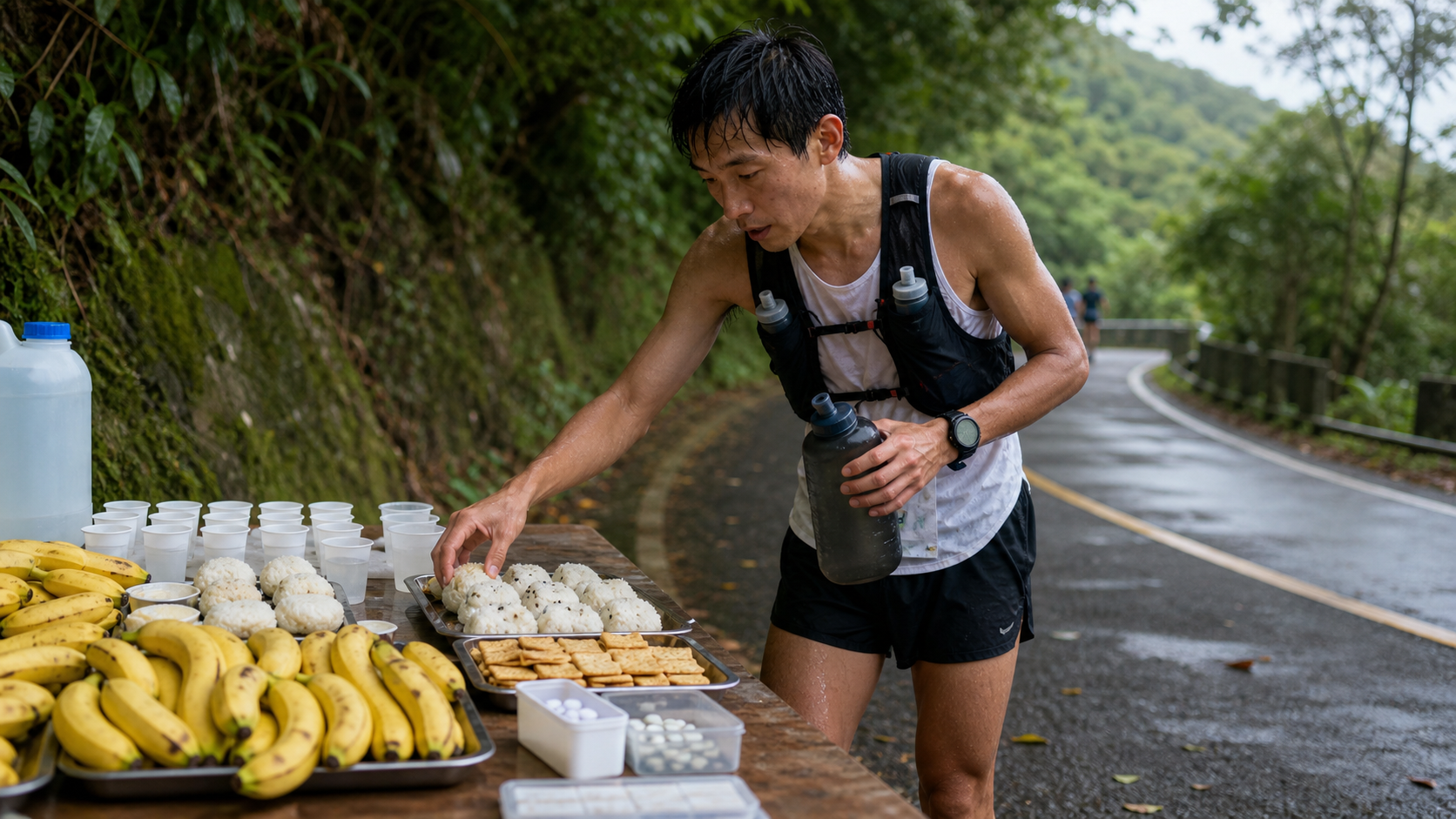
Common Foods at Taiwan Ultramarathon Aid Stations
- Bananas: Easy to digest, rich in potassium, and portable—a staple at every ultramarathon aid station
- Salted dried plums: A uniquely Taiwanese option that replenishes sodium and stimulates saliva production
- White rice or rice balls: In the later stages of long-distance races, white rice is one of the most popular fuel sources
- Crackers/soda crackers: Low-fat, easy to digest, and pair well with salt
- Braised eggs or dried tofu: Provide a small amount of protein to help slow muscle breakdown
When to Consume Solid Food
- Start introducing solid food after running for more than 3 hours
- Take in solid fuel every 60–90 minutes
- Keep aid station stops under 5 minutes (to avoid your body “thinking the race is over” and stiffening up)
Fluid Management: It’s Not Just About Drinking Water
Fluid needs during Taiwan’s summer ultramarathons are far higher than you might expect, but overhydration (hyponatremia) is equally dangerous. Here are the basic principles:
- Drink to thirst, don’t force water on a fixed schedule (modern sports medicine recommends drinking based on thirst cues rather than a set frequency)
- Consume approximately 400–800ml per hour (adjust based on temperature and sweat rate)
- In hot summer races, consider alternating between plain water and electrolyte drinks
- Urine color is the simplest dehydration indicator: pale yellow means adequate hydration; dark yellow or orange means you need to drink water immediately
Electrolytes: The Underrated Core of Fueling
Sweating doesn’t just lose water—it also depletes electrolytes like sodium, potassium, and magnesium. Electrolyte imbalance can cause cramping, nausea, impaired judgment, and even life-threatening conditions.
- Sodium: The most important electrolyte; aim for 300–1000mg per hour (heavy sweaters should take the upper end)
- Potassium: Abundant in bananas and sports drinks; supports muscle contraction
- Magnesium: Some cramping is linked to magnesium deficiency; consider taking one magnesium supplement daily (during training)
Electrolyte Supplement Options
- Salt tablets (S! Caps, Precision Hydration, etc.): The most precise way to replenish sodium
- Sports drinks: Electrolyte concentration is usually low, so you can’t rely on sports drinks alone for sodium
- Taiwanese fueling staples: salted plums, salty crackers, soy sauce packets—highly effective and cheap
Aid Station Time Management
Many runners spend too long at aid stations, wasting time on one hand and letting their muscles cool down, making it harder to get going again on the other. Recommendations:
- Mentally rehearse before entering the station: “I’ll grab one banana, refill water, swap my fuel pack, and leave within 3 minutes”
- Don’t change shoes or treat blisters at aid stations unless it’s severely affecting your ability to move
- Don’t linger at aid stations at night or in cold weather (a rapid drop in body temperature will make running much harder afterward)
Practical Tips
- Test all your fuel during training: Never try new food for the first time on race day
- Carry backup fuel: Keep energy bars or gels in your pack as a fallback in case the aid station doesn’t have what you want
- Keep a fueling log: After every long run, note what you ate, at what kilometer, and how you felt; after a few months, you’ll have built your own fueling system
- Don’t stop fueling just because you feel nauseous: Nausea is often a symptom of low blood sugar; try eating something salty, and it may improve immediately
Conclusion
Ultramarathon fueling is a highly individual science—there’s no one-size-fits-all formula. The best fueling strategy comes from repeatedly testing and adjusting during countless training sessions to find the combination of foods your gut can tolerate even in a fatigued state. Treat fueling as part of your running technique and practice it, and your ultramarathon performance will improve dramatically.
Related Reading
- Ultramarathon Fueling Strategy: Energy and Electrolyte Rhythm from 50K to 100K
- Ultramarathon Fueling Strategy: The Ratio of Solid Food vs. Liquid Fuel in 100km Races
- Complete 100K Ultramarathon Fueling Plan: The Scientific Formula for Hourly Calories, Sodium, and Solid-Liquid Switching
- Marathon Fueling Strategy: Timing of Gels, Electrolytes, and Energy Bars
CT暗黑廚房) 車友必備 宇宙無敵鮮蚵湯 幫助訓練恢復 天然食補 好市多 超肥鮮蚵 破PR
7 年前
西進武嶺 免費訓練分析服務 Intervals | 練不夠還是練過頭?你哪一種類型選手?AI模型告訴你! | 備戰神器 | 公路車 訓練 | CT Yeh
4 年前
一日北高前的高裝檢 | 北高 360 | 挑戰11小時的裝備 | 一日雙塔 | 補給
6 年前
Live) 備戰2019彰化經典百K 賽前攻略 (已完賽請看新影片
7 年前
靠單車減肥35公斤 心得分享與整理
7 年前
CT 喇低賽) 武嶺牽車 才是王道 西進牽車四小時內秘訣 攝手位置 如何判斷 防抽筋小秘訣
7 年前
水金九不厭五分 10度寒流冷到不願停!feat. 卡卡 / 公路車 / CT Yeh
6 個月前
#公路車 #西進武嶺 配速配瓦實驗 坡度分析 四小時內攻略 建大盃 NeverStop #西進武嶺攻略
6 年前