Introduction
On the ultramarathon racecourse, you often see this scene: a runner gets dropped on the climbs, but the moment the descent begins, they’re like a released stone, roaring past a dozen or more runners ahead. Downhill technique is one of the most underestimated skills in ultramarathon racing—and one that can create the biggest gaps. However, poor downhill form will exact a heavy toll on your knees in the latter stages of the race. This article shares the proper technique and training methods for ultramarathon downhill running.
Why Does Downhill Running Hurt the Knees?
When running downhill, the knee joint bears 3–5 times the load of running on flat ground. The quadriceps must perform “eccentric contractions” (muscle lengthening while exerting force) to control the body and prevent it from pitching forward. This type of contraction consumes more energy than concentric contractions and is more prone to causing micro-damage to muscle fibers.
Common downhill injuries:
- Iliotibial Band Syndrome (IT Band Syndrome): Pain on the outside of the knee, most common after heavy downhill running
- Patellofemoral Pain Syndrome (Runner’s Knee): Pain at the front of the knee, related to overuse of the quadriceps
- Achilles Tendinitis: Downhill running increases ankle dorsiflexion, raising the risk of tendinitis
Proper Downhill Stride Mechanics Explained
Posture Fundamentals
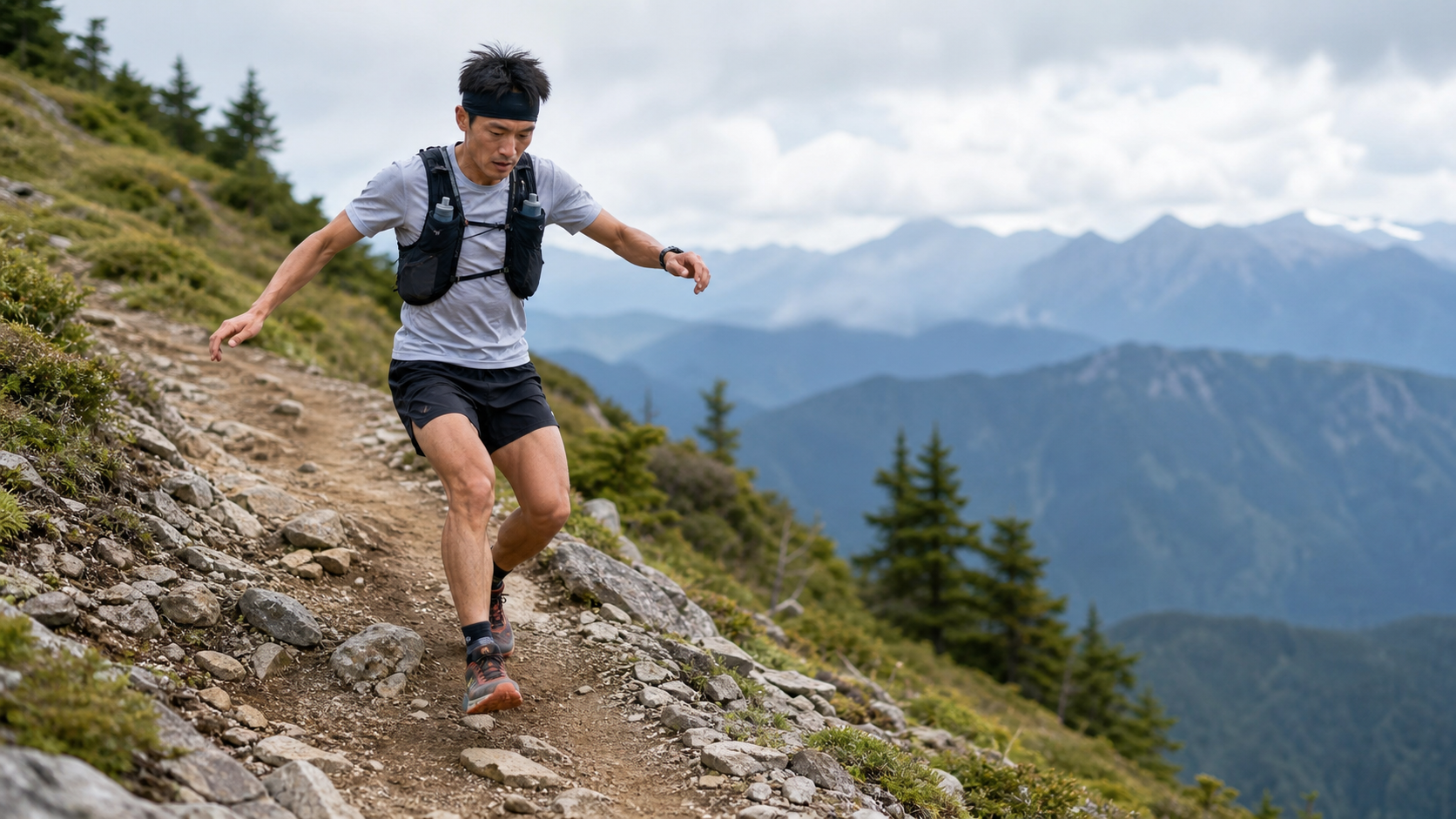
- Slight forward lean (or stay upright)—do not lean back. Leaning back is the most common mistake; it forces a heel-strike and dramatically increases impact forces
- Knees slightly bent: Keep the knees slightly flexed rather than locked out, letting muscles rather than joints absorb the impact
- Arms spread wide: On descents, open the arms out to the sides as balance poles to improve stability
- Eyes scanning the trail ahead: Look 3–5 meters ahead to anticipate foot placements, not just at your feet
Stride Technique
| Technical Aspect | Incorrect Approach | Correct Approach |
|---|---|---|
| Foot strike | Heavy heel stomping | Light midfoot or forefoot landing |
| Stride length | Overstriding (“braking”) | Short, quick steps, keeping cadence high |
| Vision | Looking down at feet | Looking up at the terrain ahead |
| Arms | Crossing or tucked against the body | Extended for balance, even more important on rocky terrain |
| Speed control | Braking hard | Control speed with cadence, not by “braking” with every step |
Downhill Strategies for Different Terrain
- Loose gravel: Plant your feet steadily, lower your center of gravity with a slight squat—better to go slow than to fall
- Muddy ground: Place the foot lightly, feel the traction before shifting weight; trekking poles are extremely helpful here
- Flagstone or rocky sections: “Find the flat spot”—choose the flattest rock surface and avoid stepping on rounded boulders
- Steep grassy slopes: Can be slicker than they look, especially with dew; consider side-stepping or switchbacking down
Strength Training for Downhill Running
Part of downhill technique comes down to feel, but what matters more is having enough strength to support it:
- Eccentric Squats: Lower slowly (4–6 seconds), stand up quickly. 8–10 reps per set, specifically training quadriceps eccentric strength
- Step Downs: Stand on one foot at the edge of a step, slowly lower the other foot to touch the ground, mimicking the downhill landing motion
- Lateral Lunges: Strengthen the inner and outer stabilizer muscles, directly beneficial for descending switchback corners on trails
- Balance Board Training: Improves ankle proprioception for faster reactions on uneven ground
Race Strategy for Ultramarathon Downhills
Downhill sections in an ultramarathon aren’t just recovery zones—attacking them appropriately can save you significant time:
- First 30% of the race: Don’t rush the downhills—your quads are still fresh, but the later stages will be twice as painful
- Middle to late race: Downhills are your weapon—when others’ legs have gone soft, smooth descending lets you pass runner after runner
- Downhills in the final 10–15K: No need to hold back now; if the terrain allows, go all out
Practical Advice
- At least one dedicated downhill session per week: Find a 200–500 meter slope and do 4–8 downhill repeats, focusing on your stride
- Wear trail shoes, not road shoes: The lug pattern and forefoot protection of trail shoes make descending safer
- Don’t listen to music on descents: Trail downhills demand high concentration, and sound can help you gauge ground conditions
- Ice your knees after training: After heavy downhill sessions, icing for 15–20 minutes can reduce inflammation
- Cut back on downhill training the week before an ultramarathon: Let your quads fully recover and avoid starting the race with damaged muscles
Conclusion
Downhill technique is the “hidden skill stat” of ultramarathon runners. Master it, and you can dramatically improve your race results with the same training volume. More importantly, proper downhill form will let your knees keep enjoying the trails decades from now. Incorporate downhill practice into your regular training, and make the other side of the mountain your favorite part of the racecourse.
Related Reading
- Trail Running Downhill Technique: Center of Gravity Control, Foot Placement, and Knee Protection
- Mountain Ultramarathon Downhill Technique: Quadriceps Protection and Center of Gravity Control
- Trail Running Downhill Technique: Managing Braking Muscles, Cadence, and Braking Force
- Downhill Running Training: Using Descents to Improve Cadence and Leg Turnover
公路車 爬坡 破PR 紀錄 小技巧 分享
6 年前
CT 喇低賽) 武嶺牽車 才是王道 西進牽車四小時內秘訣 攝手位置 如何判斷 防抽筋小秘訣
7 年前
大禹嶺 到 武嶺牌樓 全程前後實況錄影 | 北進武嶺 | 東進武嶺 | KOM | 訓練台 | 坡度分析 | Taiwan KOM Last 10 km HARD | 公路車
6 年前
一日北高常見問題大集合 | 攻略 | 路線 | 訓練 | 補給 | 自行車 單車 | 一日雙城 | 雙塔 | TWB北高360 | 屁股痛
6 年前
CT 喇低賽) 單車 比賽總是沒照片? 攝影師的觀點大公開 姿勢就是力量! 請加速1.25倍收看
7 年前
一日北高/長距離團騎 常見問題補充篇 / 組團或跟團的眉角 / 壯車友容易被瘦車友慢性拉爆 / 原來屁股痛可能是這個原因...? / 風場配速法 / 公路車 / CT Yeh
2 年前
Never Stop 西進武嶺 前後雙機 完整全程錄影 訓練台 實境
8 年前
Insta 360 One 超級防手震技術實測
7 年前