Introduction
The “Cut-off Time” in ultramarathons is a sword hanging over every runner’s head. Each aid station has a latest arrival deadline; if you don’t make it in time, race officials will require you to withdraw, even if you’re only a few kilometers from the finish. Many runners invest countless hours in training, only to be pulled from the race because they failed to manage their time properly. This article systematically organizes ultramarathon time management methods so you can stay calm on race day without wasting your buffer.
Understanding the Logic of Cut-off Times
Race organizers set cut-off times based on a “baseline pace,” and typically announce the estimated cut-off time for each aid station along with the distances between them before the race. The runner’s task is: to arrive at each aid station before its cut-off time while retaining enough buffer to handle unexpected situations.
Take a 50K trail ultramarathon with a total cut-off time of 10 hours as an example:
| Aid Station | Distance | Cut-off Time | Baseline Pace (min/km) |
|---|---|---|---|
| Aid Station A | 15K | 3 hours after start | 12 min |
| Aid Station B | 30K | 6 hours after start | 12 min |
| Aid Station C | 40K | 8.5 hours after start | 13.5 min |
| Finish | 50K | 10 hours after start | 12 min |
From the table above, you can see that organizers give runners more buffer in the early stages, while cut-off times in the latter sections (with more climbing or nighttime segments) are relatively more generous.
How to Calculate Your Personal Pacing Plan
Step 1: Gather Race Information
Obtain the official race manual and identify:
- The mileage and cut-off time for each aid station
- The elevation gain for each segment
- Whether there are nighttime sections
Step 2: Estimate Your Speed
Use “moving time” (excluding aid station stops) to estimate your pace for each segment, using the following formula:
Trail pace estimate = Road pace × 1.3 (moderate climbing segments) to × 1.8 (high climbing segments)
If your road marathon pace is 7 min/km, your flat ultramarathon pace would be approximately 8–9 min/km, and your trail pace on segments with moderate climbing would be around 10–13 min/km.
Step 3: Build Your Personal Schedule
Add up your estimated moving time for each segment plus your planned aid station stop time, then compare against the cut-off times:
- If your estimated arrival time is more than 20 minutes ahead of the cut-off: your buffer is sufficient, but don’t get overly relaxed
- If your buffer is 10–20 minutes: it’s tight; you’ll need to shorten your aid station stops
- If your buffer is less than 10 minutes: the risk is extremely high; you should reassess your pacing or consider whether to enter this race at all
Controlling Aid Station Stop Times
Many runners “overstay” at aid stations, burning through their buffer. Here are reference benchmarks for stop times:
- Small aid points (water/drinks only): 30–60 seconds
- Medium aid stations (food, supplies): 2–4 minutes
- Major aid stations (gear change, food, medical): 5–10 minutes
- Late-night long-distance aid stations (nap): 10–20 minutes (only if the race truly requires it)
Tips for Improving Aid Station Efficiency
- Rehearse before entering: decide what you need to grab, don’t wander aimlessly inside the station
- Prioritize standing refuels: sitting down makes it easy to fall into the “just one more minute” trap
- Use crew support: if family or friends are helping you, communicate the process in advance
- Don’t handle non-urgent gear issues (like changing shoes) at aid stations
Buffer Strategies for Handling Unexpected Situations
Ultramarathon courses are long, and surprises are inevitable. Here are the time impacts of common unexpected situations:
- Getting lost or taking a wrong turn: can cost 15–60 minutes (trail markers in Taiwan are sometimes unclear)
- Treating blisters: 5–15 minutes
- Gastrointestinal issues requiring a restroom stop: 5–15 minutes
- Gear failure (e.g., headlamp batteries dying): 5–20 minutes
- Sudden weather changes (putting on a rain jacket): 5–10 minutes
It’s recommended to keep a 20% time buffer: if the total cut-off time is 10 hours, your target finish time should be set at under 8 hours.
Using Technology to Aid Time Management
- GPS watch “virtual pacer” feature: set your target finish time and the watch tells you in real time whether you’re ahead or behind
- Garmin Pace Pro: you can input segment elevation data and it automatically calculates a reasonable pace for each segment
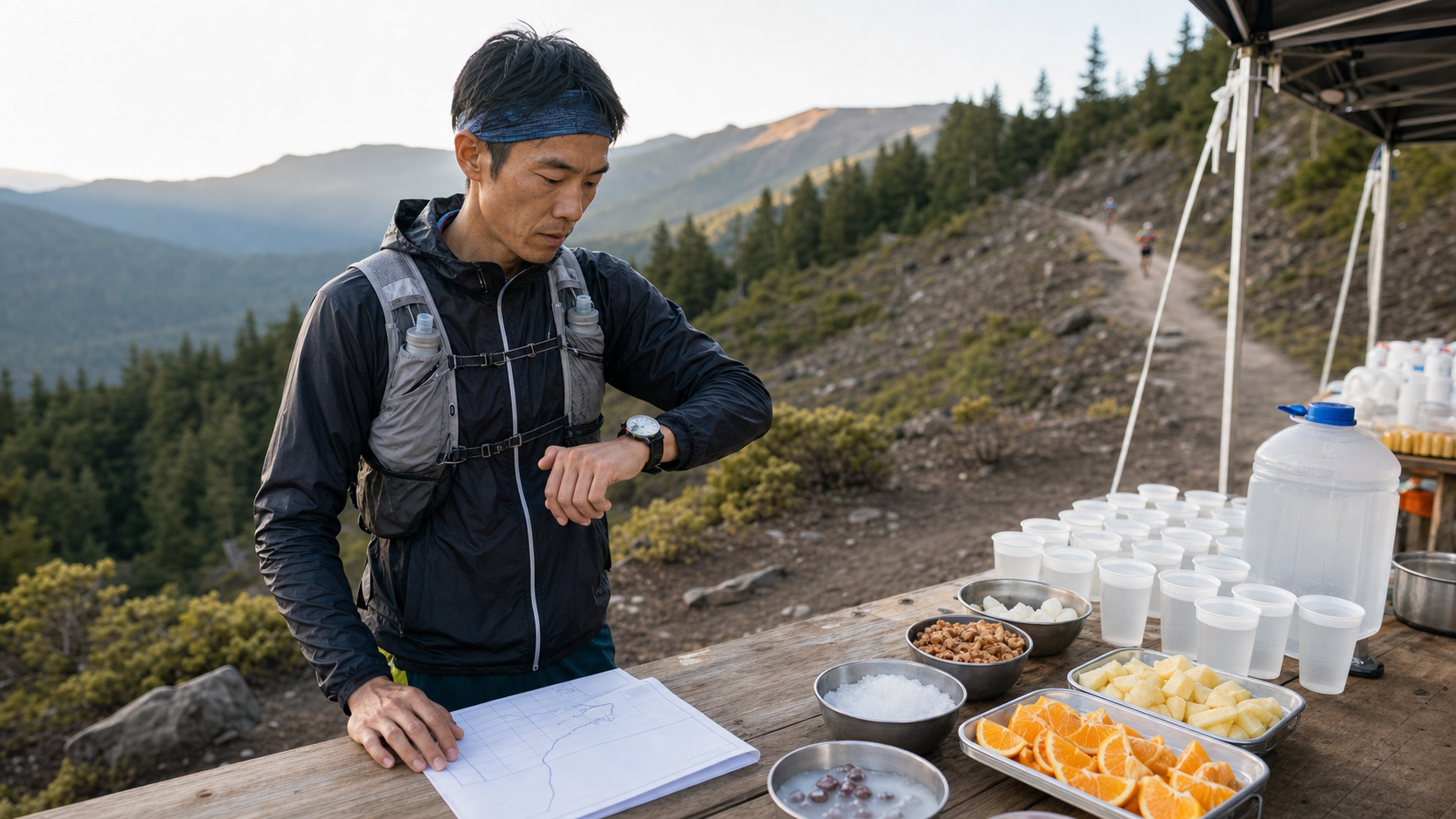
- Handwritten cue card: write each aid station’s cut-off time and target arrival time on a waterproof card, strap it to your wrist or attach it to your pack for quick reference at any time
Practical Advice
- Don’t plan based on your “fastest pace”; calculate using “the pace you can sustain at 70% effort” so you can handle changes in weather, terrain, or how your body feels
- Study the course map before race day: identify which sections are “time killers” (high climbing, technical descents) and allocate more time to them in your plan
- Check the previous year’s finish rate: if a race’s finish rate is below 50%, it means the cut-offs are strict and you need a more conservative time plan
- Carry a watch with an alarm: your sense of time becomes distorted during long races; an alarm reminds you it’s time to leave the aid station
Conclusion
Time management in ultramarathons isn’t a shackle that limits you—it’s a map that lets you move forward with confidence. Knowing exactly where you stand on the timeline allows you to make sound decisions under fatigue and pressure. Get your time plan right, and the composure you’ll feel on the ultramarathon course will transform your running experience entirely.
Related Reading
- Fubon Taipei Marathon Pacing Plan: Cut-off Time Calculation and Safety Margin Settings
- Complete 100K Ultramarathon Nutrition Rhythm Planning: The Science of Hourly Calories, Sodium, and Solid-Liquid Switching
- Ultramarathon Nutrition Strategies: Timing Management for Solid Food, Fluids, and Electrolytes
- Ultramarathon Fueling Strategies: Energy and Electrolyte Rhythm from 50K to 100K
西進武嶺 免費訓練分析服務 Intervals | 練不夠還是練過頭?你哪一種類型選手?AI模型告訴你! | 備戰神器 | 公路車 訓練 | CT Yeh
4 年前
一日北高前的高裝檢 | 北高 360 | 挑戰11小時的裝備 | 一日雙塔 | 補給
6 年前
Live) 備戰2019彰化經典百K 賽前攻略 (已完賽請看新影片
7 年前
備戰 戀戀197 賽前關門點分析 西濱團練 #公路車 4K高畫質
6 年前
風櫃嘴時間 預測西進武嶺時間?13000名車友統計數據分析告訴你 !
5 年前
西進武嶺 自製新版AI配速表產生器 x 賽前攻略 抱佛腳! 沒有功率計也可以產生配速表嗎?有什麼其他眉角賽前要注意的呢? | 西進武嶺 / 東進武嶺 KOM 攻略 | 公路車 | CT Yeh
4 年前
FTL 與 SYB 車隊專訪 西進武嶺 實用攻略分享! 2小時 如何練?!你不知道的眉角!新手準備武嶺必看 EP1 | 實力派女車友 | 精華版 | 公路車 | CTYeh
4 年前
CT 喇低賽) 武嶺牽車 才是王道 西進牽車四小時內秘訣 攝手位置 如何判斷 防抽筋小秘訣
7 年前