Dynamic Bike Fit vs. Static Fit: Which Is More Accurate?
Introduction
When you walk into a bike shop and ask for a Bike Fit, the staff might have you sit directly on a trainer, or they might measure your height and inseam with a tape measure before making adjustments. These two approaches represent the two extremes of Bike Fit—static assessment and dynamic analysis. It’s not a matter of one being superior to the other, but rather a difference in applicable scenarios and levels of precision.
Principles and Process of Static Fit
Static Fit is performed while the bike is stationary and typically includes the following steps:
- Consultation: Understanding riding habits, goals, and history of pain
- Body measurements: Inseam, torso length, arm length, shoulder width, sit bone spacing
- Flexibility assessment: Hip flexor tightness, spinal mobility, shoulder joint mobility
- Static angle measurement: With the rider seated on a stationary bike, the technician observes knee angle and spinal curvature
- Adjustment and setup: Adjusting saddle, handlebar, and cleat position based on measurement results
Advantages:
- Lower cost (approximately NT$1,500–3,000)
- Short duration (1–2 hours)
- No special equipment required
- Can initially identify obvious setup deviations
Disadvantages:
- Cannot capture true joint angles during dynamic pedaling
- Cannot assess posture changes at different cadences or intensities
- Dynamic issues such as pelvic rocking and ankle compensation are difficult to detect
Principles and Process of Dynamic Fit
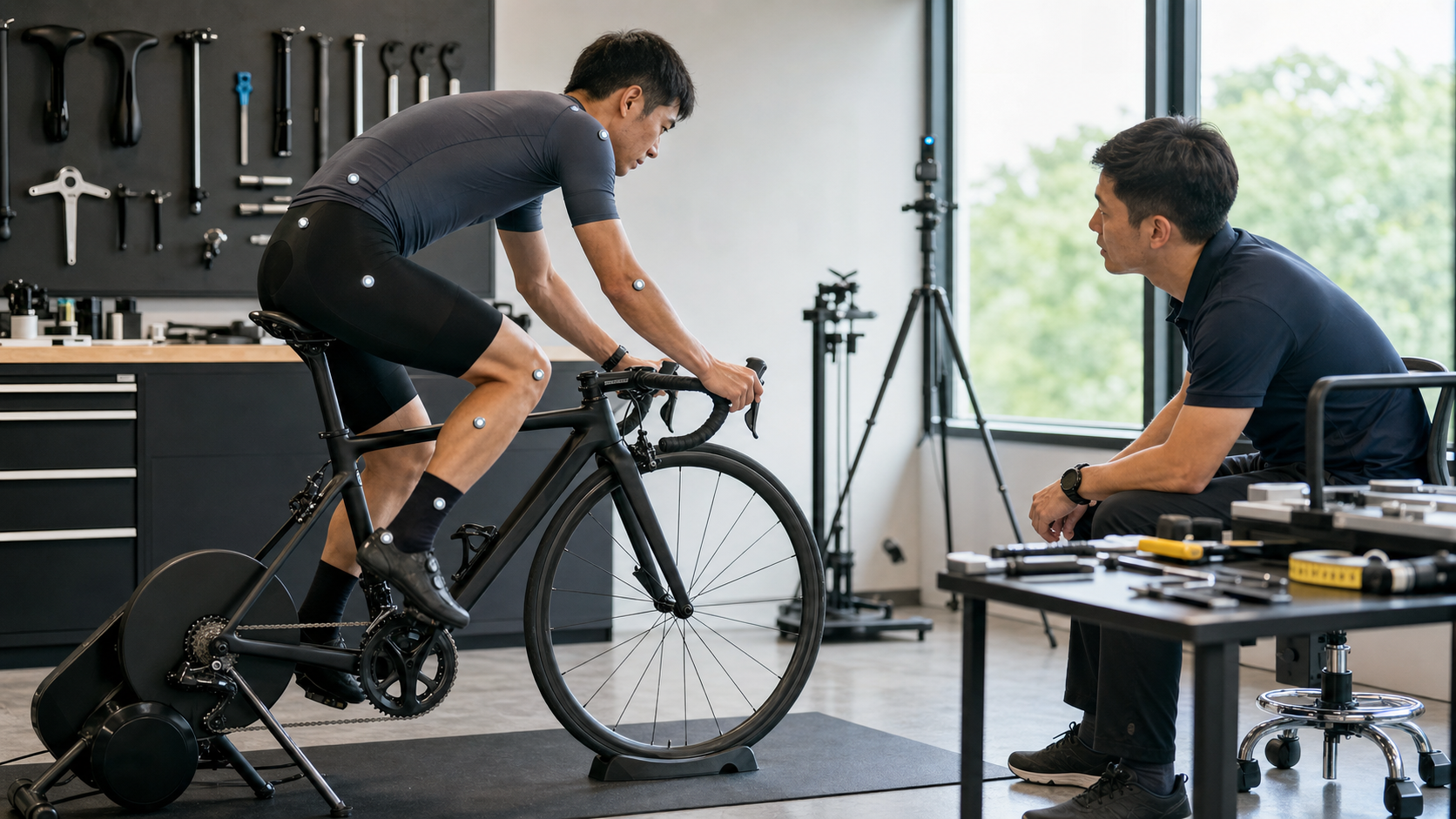
Dynamic Fit requires the rider to actually pedal on a trainer while the technician observes and analyzes in real time:
- Warm-up period: The rider pedals at an easy cadence for 10–15 minutes
- Marker placement: Reflective markers are placed on joints such as the hip, knee, ankle, and shoulder
- Motion capture: High-speed cameras or infrared sensors (e.g., Retül, Dartfish) track joint trajectories
- Multi-intensity testing: Observation at low cadence (80rpm), high cadence (100rpm), and climbing intensity
- Real-time adjustment verification: Observing data changes immediately after each adjustment to confirm effectiveness
| Assessment Item | Static Fit | Dynamic Fit |
|---|---|---|
| Lowest knee point angle | Estimated value | Precisely measured value |
| Pelvic rocking amount | Cannot be quantified | Quantifiable (cm) |
| Ankle compensation | Cannot be observed | Can be observed in real time |
| Posture changes at different intensities | None | Yes |
| Cleat rotation tracking | Static observation | Dynamic tracking |
Common Dynamic Fit Systems in Taiwan
- Retül (3D motion capture): The most widely used dynamic fit system globally, adopted by many major bike shops in Taiwan
- Dartfish (2D video analysis): Primarily uses 2D side-view recording, lower cost, still more accurate than purely static fit
- iPad + App (e.g., Coach’s Eye): Entry-level dynamic analysis, where the technician records video and analyzes frame by frame
When Is Static Fit Sufficient?
- Beginners who need a basic setup but don’t yet have chronic pain issues
- Initial setup after purchasing a bike, to confirm there are no major frame size problems
- Limited budget, wanting basic corrections first and then upgrading as needed
- No special requirements for riding efficiency, primarily recreational riding
When Should You Upgrade to Dynamic Fit?
- Pain symptoms do not improve or recur after a static fit
- Serious riders training more than 8–10 hours per week
- Preparing for races and needing to optimize pedaling efficiency
- Getting a new bike, new shoes, or clearly feeling that the setup “doesn’t feel right”
- Having existing spinal, knee, or hip joint issues that require more precise assessment
Conclusion
Both static fit and dynamic fit have their value; which one you choose depends on your riding goals, budget, and current pain condition. For most recreational riders, a good static fit combined with the self-adjustment knowledge from this article series can resolve 80% of common issues. For serious training-oriented riders, the precise data provided by dynamic fit can also address the remaining 20% of problems.
Related Reading
- The Science of Bike Fitting: A Complete Guide from Ergonomics to Competitive Performance
- The Complete Guide to Bike Fitting and Adjustment: Why You Need a Professional Fit?
- Bike Fitting: The Cost, Process, and Long-Term Benefits of Professional Setup
- The Fit Science of Road Bikes: Saddle Height, Reach, and Pivot Point Adjustments
#公路車 #Fitting 靠人工智慧APP 幫你調整單車
6 年前
Fitting訓練兩用功率車 ! Thinkrider ST900 完整實測!/ 坡度升降 / 鄰居測試/ smart bike/公路車/ CT Yeh
2 年前
單車AI教練!全新 ChatGPT4o 幫你分析訓練成果!排武嶺課表,分析騎車姿勢! 太神了! / 公路車 / CT Yeh / feat. 緯緯
2 年前
下次拍照前要查清楚啦🤣 #cycling
7 個月前
單車 一日北高 ( 雙城 ) 肥宅雙人瘋狂行 紀錄片 REACTO
10 年前
靠單車減肥35公斤 心得分享與整理
7 年前
風櫃嘴! 現實與虛擬騎乘 會有誤差嗎? 背著iPad邊騎一趟風櫃嘴實際測試一次 | 公路車 | CT Yeh
3 年前
安裝) 超酷! RGT Cycling 最新 訓練台 騎乘軟體 模擬一級賽經典路線 選手 Road Grand Tours 安裝教學 Zwift 替代方案
7 年前