Triathlon Strength Training — Core, Single-Leg, and Posterior Chain Training Prescriptions for Triathletes
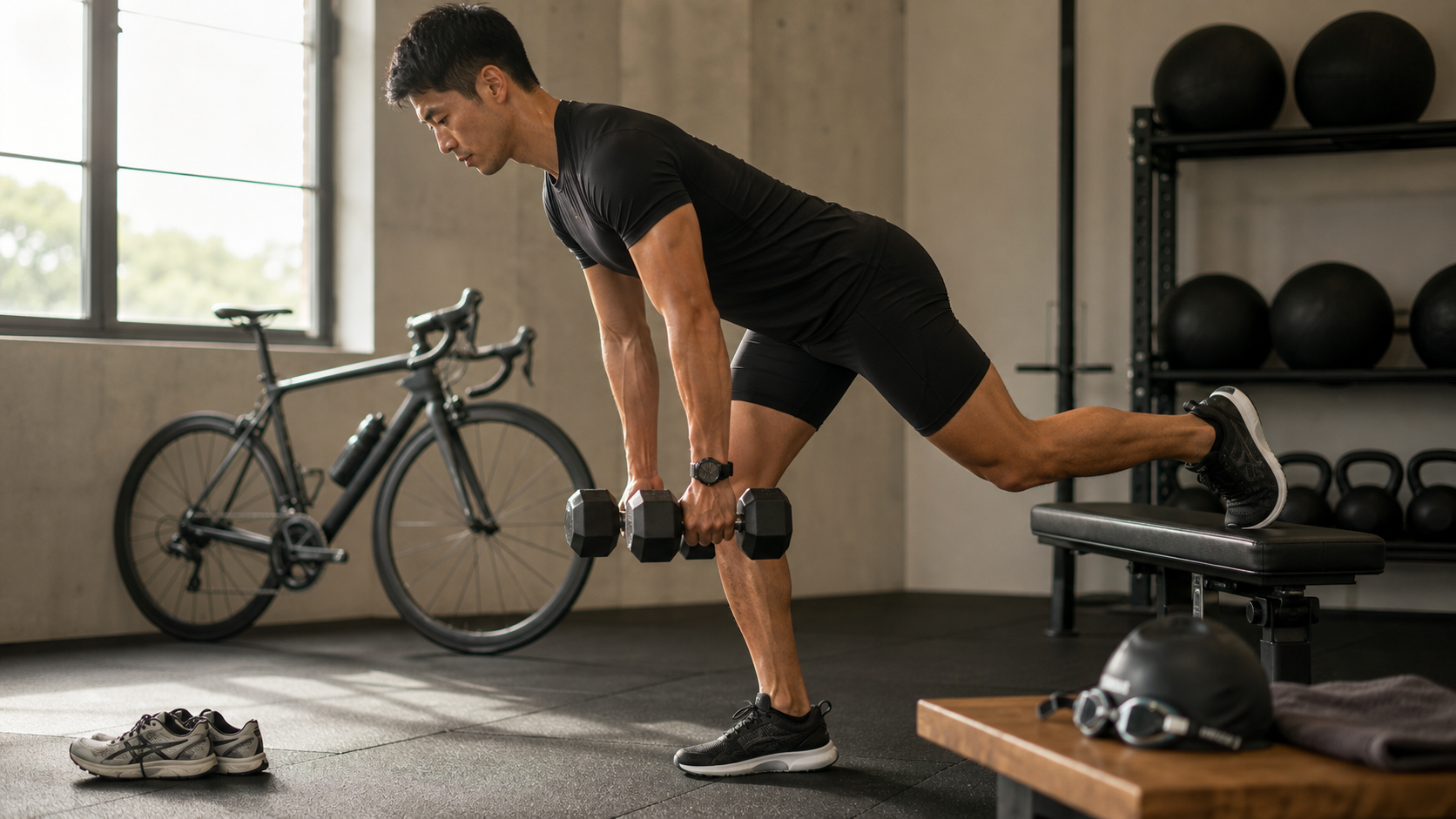
Why Triathletes Must Do Strength Training?
Most triathletes spend their training time on “doing more of the three disciplines,” but research shows that 2 strength training sessions per week:
- Improves running economy by 4-6%
- Increases maximum bike wattage by 8-12%
- Improves swimming propulsion efficiency by 3-5%
- Reduces injury rates by 30-50%
The Three Pillars of Strength Training
Pillar 1: Core Stability
The core is not the abs, but the deep muscles that wrap around the torso (diaphragm, transversus abdominis, multifidus, pelvic floor). All three triathlon disciplines require core strength:
- Swimming: force transfer through torso rotation
- Cycling: force transfer from handlebars to saddle
- Running: pelvic stability during each stride
Recommended Exercises
| Exercise | Sets × Reps | Focus |
|---|---|---|
| Pallof Press | 3 × 12 (each side) | Anti-rotation |
| Bird Dog | 3 × 10 (each side) | Contralateral stability |
| Dead Bug | 3 × 12 | Transversus abdominis activation |
| Side Plank | 3 × 45 sec | Lateral chain stability |
| Suitcase Carry | 3 × 30m | Unilateral loading |
Pillar 2: Unilateral Strength
Running is 100% a single-leg movement. Although cycling involves both legs pedaling simultaneously, each revolution is also a unilateral effort from alternating legs. Unilateral training is closer to sport-specific demands than bilateral training.
Recommended Exercises
| Exercise | Sets × Reps | Loading Recommendations |
|---|---|---|
| Bulgarian Split Squat | 4 × 8 (each side) | Dumbbells at 50-70% body weight |
| Single Leg RDL | 3 × 10 (each side) | Dumbbells 12-20kg |
| Step Up | 3 × 12 (each side) | Dumbbells 8-15kg |
| Pistol Squat (Advanced) | 3 × 5 (each side) | Body weight |
| Single Leg Glute Bridge | 3 × 12 (each side) | Body weight or barbell |
Pillar 3: Posterior Chain Power
The posterior chain muscles (gluteus maximus, hamstrings, gastrocnemius) are the primary source of running propulsion and cycling pedal force.
Recommended Exercises
| Exercise | Sets × Reps | Loading Recommendations |
|---|---|---|
| Romanian Deadlift | 4 × 6 | 80-120% body weight |
| Hip Thrust | 4 × 8 | 100-150% body weight |
| Trap Bar Deadlift | 4 × 5 | 100-130% body weight |
| Kettlebell Swing | 4 × 15 | 16-24kg |
| Box Jump | 4 × 5 | Body weight |
Periodized Strength Allocation
Base Phase (12 weeks) — Hypertrophy Focus
- Frequency: 2 sessions per week
- Reps: 8-12 reps × 4 sets
- Intensity: 65-75% 1RM
- Exercises: Compound movements as the focus
Development Phase (8 weeks) — Maximal Strength
- Frequency: 2 sessions per week
- Reps: 3-6 reps × 4-5 sets
- Intensity: 80-90% 1RM
- Exercises: Deadlifts, squats, bench press
Peak Phase (4 weeks) — Power
- Frequency: 1-2 sessions per week
- Reps: 3-5 reps × 4 sets
- Intensity: 50-70% 1RM (high velocity)
- Exercises: Box jumps, explosive bench press, Olympic lifting variations
Taper Phase (2-3 weeks) — Maintenance Focus
- Frequency: 1 session per week
- Reps: 5 reps × 2 sets
- Intensity: Light-load technique practice
- Stop weight training 7 days before race day
Common Strength Blind Spots for Triathletes
- Over-training the rectus abdominis: Should prioritize core anti-rotation
- Neglecting upper-body pulling strength: Affects the swimming pull
- Overdeveloped quads, underdeveloped posterior chain: A root cause of knee injuries
- Asymmetrical single-leg strength: A left-right difference exceeding 10% is a warning sign
Weekly Training Example (Combined with the Three Disciplines)
| Day | Triathlon Training | Strength Training |
|---|---|---|
| Mon | Swim 60 min | Lower-body strength 60 min |
| Tue | Bike 90 min | Core 20 min |
| Wed | Run 45 min | — |
| Thu | Swim 60 min | Upper-body strength 45 min |
| Fri | Rest | Core 20 min |
| Sat | Bike 3 hr | — |
| Sun | Run 90 min + Brick | — |
Conclusion
Strength training is not “an extra assignment” — it is an accelerator for triathlon training. Build strength into your periodized plan, and your speed, endurance, and injury resistance will all improve simultaneously.
Related Reading
- Common Movements Across Triathlon Disciplines: Posterior Chain, Core, and Hips
- Strength Training for Triathlon: A Workout Plan That Improves All Three Disciplines
- Full-Body Coordination Strength Workout for Triathletes: Swim, Bike, and Run All in One
- The Complete Core Training Guide for Triathletes: Stable Power Across Swim, Bike, and Run
福隆鐵人團練隨拍
8 年前
西進武嶺 免費訓練分析服務 Intervals | 練不夠還是練過頭?你哪一種類型選手?AI模型告訴你! | 備戰神器 | 公路車 訓練 | CT Yeh
4 年前
Never Stop 西進武嶺 前後雙機 完整全程錄影 訓練台 實境
8 年前
靠單車減肥35公斤 心得分享與整理
7 年前
新玩具!Feiyu Pocket 3 無線三軸 運動攝影機 開箱!/ GoPro拍不出來的震撼視角? / 完全沒殘影的神夜拍效果 (內有專屬優惠!) / 公路車 / CT Yeh
2 年前
一日北高常見問題大集合 | 攻略 | 路線 | 訓練 | 補給 | 自行車 單車 | 一日雙城 | 雙塔 | TWB北高360 | 屁股痛
6 年前
CT 喇低賽) 武嶺牽車 才是王道 西進牽車四小時內秘訣 攝手位置 如何判斷 防抽筋小秘訣
7 年前
CT暗黑廚房) 車友必備 宇宙無敵鮮蚵湯 幫助訓練恢復 天然食補 好市多 超肥鮮蚵 破PR
7 年前