The Three Biggest Challenges of an Overseas 70.3
The biggest differences between overseas triathlons and domestic races:
- Jet Lag Adaptation: Crossing more than 6 time zones can affect performance by 5-10%
- Climate Adaptation: Differences in altitude, humidity, and temperature
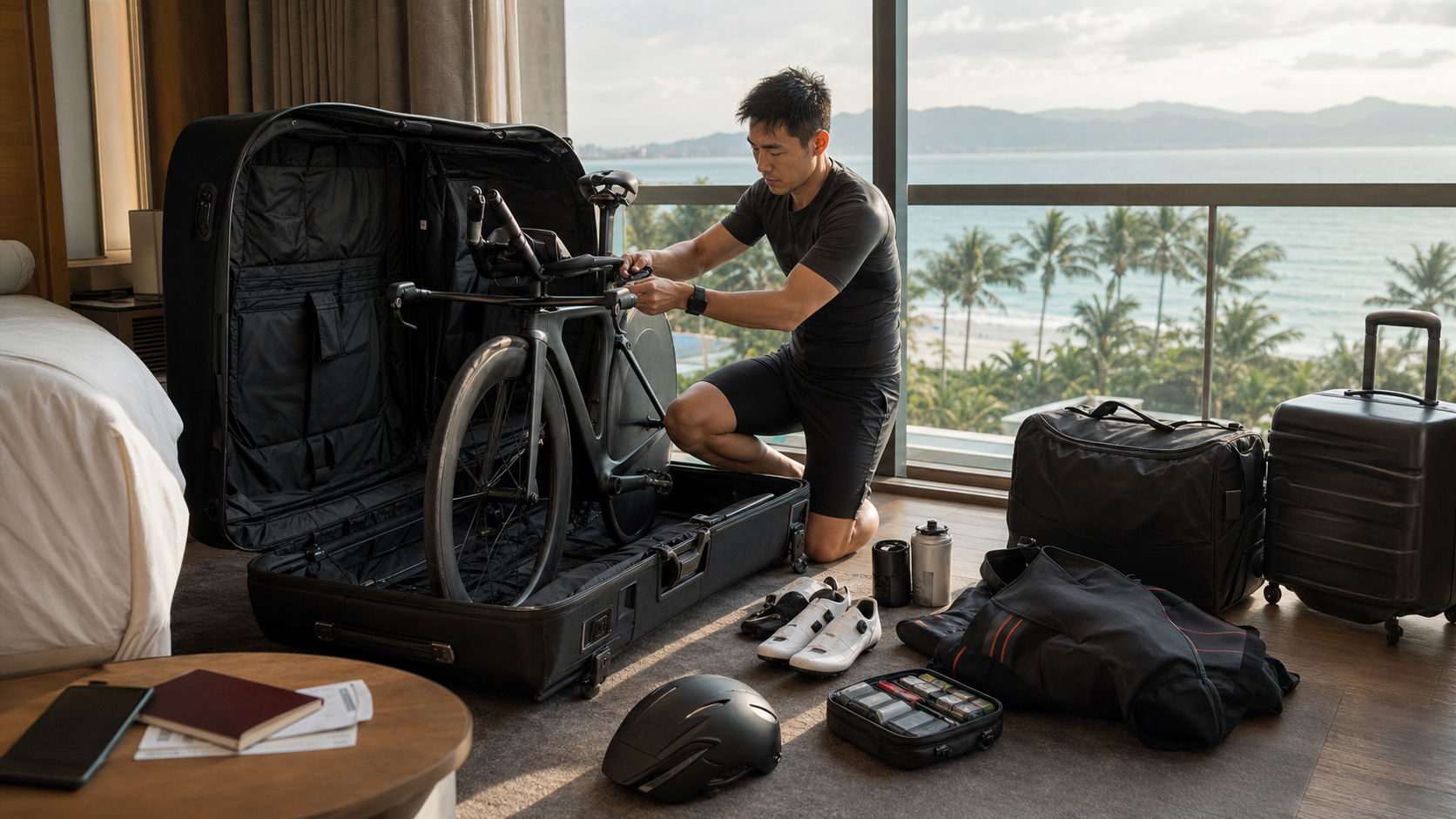
- Gear Transport: Bike packing, checked baggage, and customs issues
3-Month Pre-Race Preparation Timeline
Weeks 12-8: Basic Preparation
Documents and Information
- [ ] Confirm passport validity (at least 6 months)
- [ ] Apply for destination visa
- [ ] International driver’s license (if self-driving)
- [ ] Travel insurance (including sports accident coverage)
- [ ] Race registration confirmation letter
Hotels and Transportation
- [ ] Book flights (direct flights preferred)
- [ ] Book hotel near the race venue (6-9 months in advance)
- [ ] Reserve bike shuttle service
- [ ] Confirm race shuttle schedule
Weeks 7-4: Climate Adaptation Preparation
Destination Climate Research
Research the race location’s:
- Average temperature (during race month)
- Humidity levels
- Altitude
- Water temperature (determines whether a wetsuit is needed)
- Sea conditions (waves, currents)
Adaptation Training
Adjust training based on climate differences:
| Destination Characteristics | Adaptation Training |
|---|---|
| High heat and humidity (e.g., Southeast Asia) | Sauna training, running in the heat |
| High altitude (e.g., Mexico) | Hypoxic training masks, hill climbing |
| Cold (e.g., European autumn) | Cold-weather cycling practice |
| Rough open water | Advanced open-water training |
Weeks 3-2: Gear Preparation
Bike Packing Preparation
Essential Tools
- [ ] Bike case (hard shell or soft shell)
- [ ] Disassembly tool kit (hex wrenches, wrenches)
- [ ] Handlebar and wheel protectors
- [ ] Impact-resistant foam/air cushions
- [ ] Pump (small)
Bike Case Selection
| Type | Pros | Cons | Price |
|---|---|---|---|
| Hard shell plastic | Strongest protection | Heavy, bulky | NT$10,000-20,000 |
| Semi-hard shell | Balanced | Moderate | NT$8,000-15,000 |
| Soft shell bag | Lightweight, easy to store | Weak protection | NT$5,000-10,000 |
Gear Checklist
Triathlon Gear
- [ ] Tri suit (2 sets)
- [ ] Wetsuit (if water temperature is low)
- [ ] Bike helmet
- [ ] Cycling shoes + pedals
- [ ] Running shoes
- [ ] Goggles (2 pairs, in case of loss)
- [ ] Nutrition (3 days’ worth before and after the race)
Bike Spare Parts
- [ ] Spare tubes × 2
- [ ] Puncture repair kit
- [ ] CO2 cartridges × 4
- [ ] Chain lube
- [ ] Multi-tool
- [ ] Batteries (for electronic shifting)
Checked Baggage Notes
- Bike case weight limit: usually 20-32kg
- Airline fees vary: 100-300 USD
- Reserve sports equipment check-in
- Declare bike value (for insurance)
Week 1: Before Departure
7 Days Before Departure
- [ ] Final bike check
- [ ] Divide nutrition (carry-on + checked baggage)
- [ ] Print race confirmation, insurance, and accommodation vouchers
- [ ] Exchange local currency
3 Days Before Departure
- [ ] Pack the bike
- [ ] Pack luggage (carry-on must include: helmet, cycling shoes, tri suit, goggles)
- [ ] Mental preparation
Jet Lag Adjustment Strategies
Basic Principles for Crossing Time Zones
- Eastbound (flying east): Equivalent to going to bed earlier; harder to adjust
- Westbound (flying west): Equivalent to going to bed later; easier to adjust
Jet Lag Adjustment Table for 6+ Hour Time Differences
| Days Before Departure | Sleep Schedule Adjustment |
|---|---|
| -7 | Start tracking local time |
| -5 | Go to bed 1 hour earlier/later |
| -3 | Go to bed 2 hours earlier/later |
| -1 | Approximate local schedule |
| Arrival day | Force local schedule |
Adjustment After Arrival
Day 1
- Absolutely do not go straight to sleep after arrival (unless it’s nighttime locally)
- Get 30 minutes of outdoor sunlight (to reset your circadian rhythm)
- Short, light exercise (20 minutes of swimming or running)
Days 2-3
- Fully follow the local schedule
- Begin normal training (at half intensity)
- Drink plenty of water, reduce caffeine
Golden Rule
It takes 1 day to adapt for every 1 hour of time difference. A 6-hour difference = 6 days of adaptation. So it’s recommended to arrive 7-10 days before the race.
Climate Adaptation Strategies
Heat Adaptation (for races in hot regions)
Heat Adaptation Training 14-21 Days Before the Race
- Sauna: 20-30 minutes per session, 4-5 times per week
- Running in the heat: wear long sleeves, run at noon in summer
- Indoor trainer: wear thick clothing, turn off the AC
Physiological Benefits of Heat Adaptation
- Plasma volume increases by 10-15%
- Lower sweating threshold (sweat earlier)
- Lower sodium concentration in sweat
- Core body temperature rises more slowly
High-Altitude Adaptation
Effects of Altitude Above 1500m
- VO2max decreases by 1-2% per 100m
- Heart rate increases by 5-10bpm
- Faster dehydration
Adaptation Strategies
- Reduce intensity by 30% for the first 3 days after arrival
- Hydrate more (an extra 200ml per hour)
- Increase carbohydrate intake
- Avoid alcohol
Seawater/Water Temperature Adaptation
Low Water Temperature (< 20°C)
- Swim 2-3 times in similar water temperature before the race
- Confirm wetsuit fit
- Adapt to the gasp reflex when entering cold water
High Water Temperature (> 26°C)
- Criteria for wetsuit being disallowed
- Supplement electrolytes (you can dehydrate in the water too)
- Reduce swim warm-up
Local Preparation 3 Days Before the Race
Day -3: Arrival
- Check in, pick up race packet
- Confirm course map
- Easy test ride (30 minutes)
- Open-water test swim (30 minutes)
Day -2: Course Recon
- Ride a full section of the race course (1-2 hrs)
- Check T1 / T2 locations
- Confirm nutrition is available locally
Day -1: Pre-Race Preparation
- Rack bike in transition area
- Arrange gear by zone
- Go to bed early (don’t stay up at the athlete village)
Common Issues in Overseas Races
Bike Transport Issues
- Damage risk: Insurance is recommended (an additional 50-100 USD per leg)
- Customs scrutiny: Declare as personal sports equipment, carry race documentation
- Return shipping costs: May be 30% more expensive than the outbound leg
Food and Nutrition
- Don’t try local food (3 days before the race)
- Bring enough nutrition from Taiwan for race day
- The night before the race, eat familiar pasta (don’t try local specialty dishes)
Language and Communication
- Download a translation app
- Print key phrases (bike parts, first aid)
- Watch the race briefing before the race (multilingual)
Conclusion
Overseas triathlon is a comprehensive challenge of racing + travel + gear management. It is recommended that your first overseas race be in a nearby Asian destination (such as the Philippines or Malaysia) to get familiar with the race process before taking on events in Europe or the US. Completing an overseas 70.3 will be one of the most memorable experiences of your triathlon career.
Related Reading
- IRONMAN 70.3 Half-Distance Triathlon Training Plan: A Periodized 24-Week Race Preparation Design
- Half-Distance Triathlon 70.3 Training Plan: A Complete 16-Week Race Preparation Program
- The Progression Path from Half Marathon to IM 70.3 — A Training Bridge for Runners Crossing into Triathlon
- Triathlon Transition Bags and Logistics Management: Don’t Fall Apart Right Before the Race
相關影片
訂閱CT的頻道 2019 夏季KOM 5小 完賽心得 準備攻略 東進武嶺 夏季登山王之路 Taiwan KOM Challenge
7 年前
FTL 與 SYB 車隊專訪 西進武嶺 實用攻略分享! 2小時 如何練?!你不知道的眉角!新手準備武嶺必看 EP1 | 實力派女車友 | 精華版 | 公路車 | CTYeh
4 年前
一日北高前的高裝檢 | 北高 360 | 挑戰11小時的裝備 | 一日雙塔 | 補給
6 年前
Live) 備戰2019彰化經典百K 賽前攻略 (已完賽請看新影片
7 年前
#公路車 #西進武嶺 配速配瓦實驗 坡度分析 四小時內攻略 建大盃 NeverStop #西進武嶺攻略
6 年前
西進武嶺 免費訓練分析服務 Intervals | 練不夠還是練過頭?你哪一種類型選手?AI模型告訴你! | 備戰神器 | 公路車 訓練 | CT Yeh
4 年前
單車賞雪 裝備準備及注意事項分享 | 公路車
5 年前
單車 一日北高 ( 雙城 ) 肥宅雙人瘋狂行 紀錄片 REACTO
10 年前