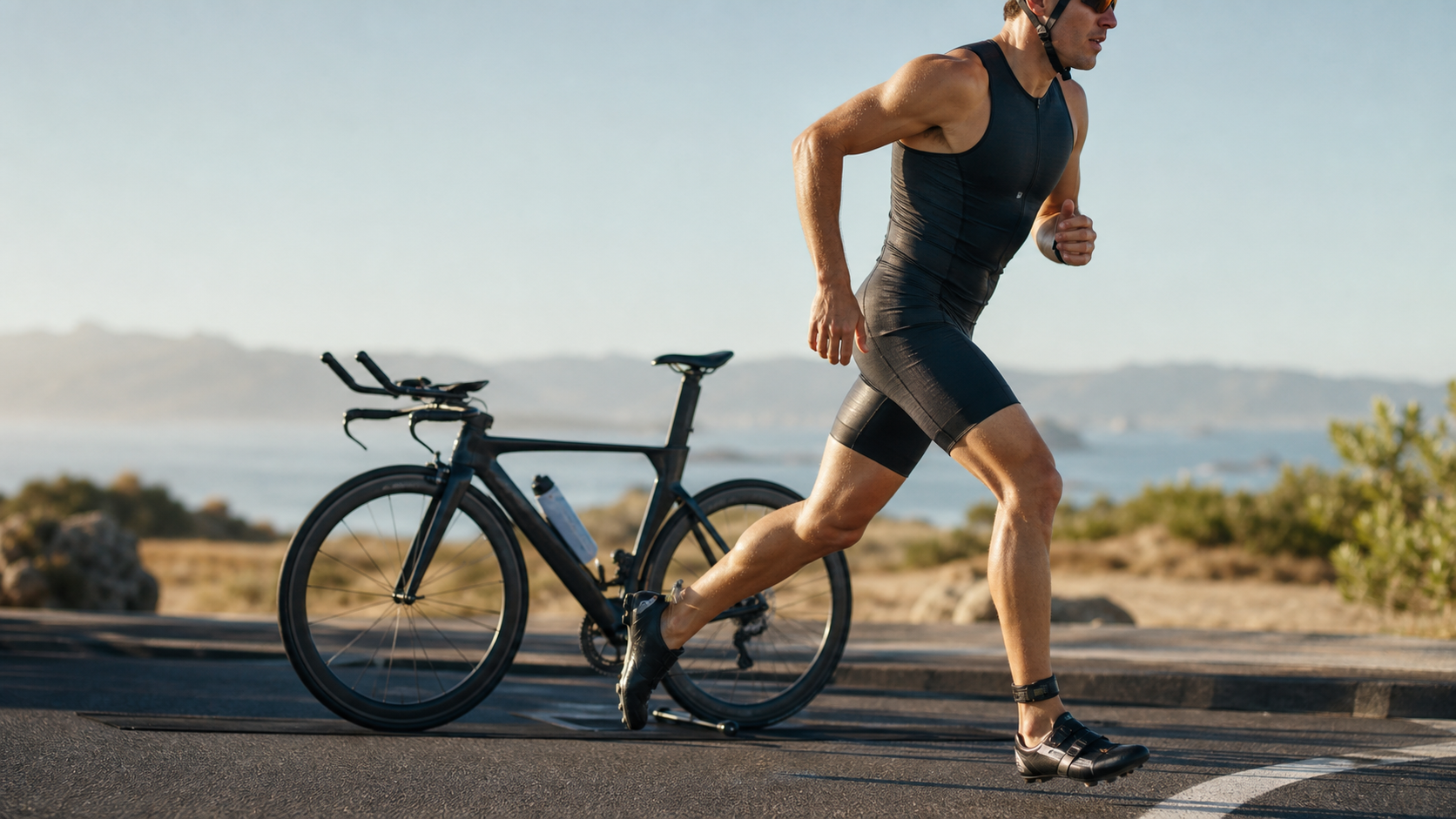
The Muscle Physiology of Brick Training: Neuromuscular Reprogramming from Pedaling to Striding
“Five minutes before getting off the bike, my legs don’t feel like my own.” Almost every athlete new to triathlon has felt this. It’s not psychological—it’s a real physiological phenomenon. Muscle recruitment patterns, neural firing rates, and blood flow distribution must all switch over within 60 seconds. This article breaks down, from a muscle physiology perspective, what Brick training is actually training.
1. Cycling vs. Running: Two Completely Different Muscle Recruitment Patterns
They may both look like “the legs are moving,” but the dominant muscle groups differ greatly between the two.
| Movement Phase | Cycling-Dominant Muscles | Running-Dominant Muscles |
|---|---|---|
| Propulsion | Quadriceps (VMO/VL), deep gluteus maximus | Gastrocnemius, soleus |
| Pull-up | Iliopsoas, proximal biceps femoris | Iliopsoas, hip flexors |
| Stabilization | Core, hip abductors | Gluteus medius, ankle stabilizers |
| Movement Pattern | Closed chain, fixed pedals | Open chain, ground reaction force |
| Eccentric Contraction | Minimal (approx. 5%) | Extensive (accounts for 60% of force) |
The key is the last row: cycling involves almost no eccentric contraction (the pedals push the leg up passively), but every running step requires the quadriceps and calf muscles to absorb impacts of 2–3 times body weight. The moment you get off the bike, this eccentric capacity is frozen for 1–4 hours and takes 5–10 minutes to fully wake up.
2. The Shift in Neural Firing Rate
Cycling cadence is about 80–95 rpm (roughly 1.5 revolutions per second), while running cadence is 170–185 spm (roughly 3 steps per second). In other words, the neural firing rate for running is about twice that of cycling. Right after dismounting, motor neurons are still maintaining the cycling rhythm, leading to:
- Lower cadence: In the first kilometer after T2, cadence may drop to just 160 spm, 15–20 spm lower than usual
- Longer ground contact time (GCT): Extending from a normal 240ms to 280ms
- Increased vertical oscillation: Core stabilizers haven’t caught up yet, causing greater up-and-down bouncing
3. Blood Shunting
While cycling, blood flow is heavily directed to the quadriceps and glutes (70% of lower-limb blood flow), leaving the calf muscles relatively underperfused. When you start running after dismounting:
- 0–60 seconds: The calf muscles have insufficient oxygen supply, lactate accumulates rapidly, creating a feeling of “can’t run”
- 60–180 seconds: Cardiac output is redistributed, and calf blood flow recovers
- 3–5 minutes: Blood flow stabilizes, and running feel returns
This is why Brick training isn’t about training to “run fast,” but about “shortening the time needed for blood redistribution.”
4. What Does Brick Training Actually Train?
There are 4 adaptations at the physiological level:
- Neural switching speed: Shortening the time to switch from pedaling rhythm to running rhythm, improving from 5 minutes to 90 seconds
- Eccentric contraction tolerance: The quadriceps can still absorb impact under fatigue, reducing pace drop-off
- Blood redistribution efficiency: The cardiovascular system learns to complete lower-limb blood redistribution within 60 seconds
- Psychological adaptation: Getting used to the feeling of “heavy legs but still moving forward,” avoiding panic during a race
5. Common Muscle Soreness Locations After Brick
Based on soreness distribution 24–48 hours after actual training:
- Vastus medialis (VMO): Overuse from cycling + eccentric loading from running, soreness in approx. 70% of cases
- Lateral head of gastrocnemius: Running impact, soreness in approx. 60% of cases
- Gluteus medius: Overworked stabilizer, soreness in approx. 45% of cases
- Soleus: Primary power source at slower running speeds, soreness in approx. 40% of cases
If after a Brick session only your quads are sore and your calves aren’t sore at all, it means your running stride is too long and your ankle push-off is insufficient—a technical issue that needs correction.
6. Practical Recommendations
- First Brick attempt: 30 minutes of cycling + 10 minutes of running, with running pace 30 sec/km slower
- Advanced schedule: 1–2 sessions per week, avoiding Brick sessions on consecutive days (eccentric contractions need 48 hours to recover)
- 3 weeks before race: Do a race-intensity Brick to let the nervous system familiarize itself with the switching sensation
- 1 week before race: Reduce volume but keep one short Brick (20+5 minutes) to maintain neural sensitivity
Understanding these physiological mechanisms, you’ll realize that Brick isn’t just “adding fatigue on top of fatigue”—it’s targeted training. What it trains is the body’s ability to complete the switch within 60 seconds.
Related Reading
- The Physiology of Brick Training: Why Your Legs Feel Like Lead After Dismounting
- The Science of Brick Training — Muscle Adaptation Mechanisms and Workout Design for Cycling-to-Running Transition
- The Science of Brick Training: Why Running After Dismounting Feels Like Running on Cotton
- Triathlon Brick Training: Designing Leg Adaptation Workouts by Running Immediately After Cycling
本週北高前練習,連同天比的226們也來⋯鐵車真的太猛了 #cycling #北高
2 年前
西進武嶺 免費訓練分析服務 Intervals | 練不夠還是練過頭?你哪一種類型選手?AI模型告訴你! | 備戰神器 | 公路車 訓練 | CT Yeh
4 年前
iPhone內建一秒變長腿🤣 車友必備#cycling
2 年前
#公路車 #Fitting 靠人工智慧APP 幫你調整單車
6 年前
Live) 備戰2019彰化經典百K 賽前攻略 (已完賽請看新影片
7 年前
一日北高/長距離團騎 常見問題補充篇 / 組團或跟團的眉角 / 壯車友容易被瘦車友慢性拉爆 / 原來屁股痛可能是這個原因...? / 風場配速法 / 公路車 / CT Yeh
2 年前
一日北高常見問題大集合 | 攻略 | 路線 | 訓練 | 補給 | 自行車 單車 | 一日雙城 | 雙塔 | TWB北高360 | 屁股痛
6 年前
單車 一日北高 ( 雙城 ) 肥宅雙人瘋狂行 紀錄片 REACTO
10 年前