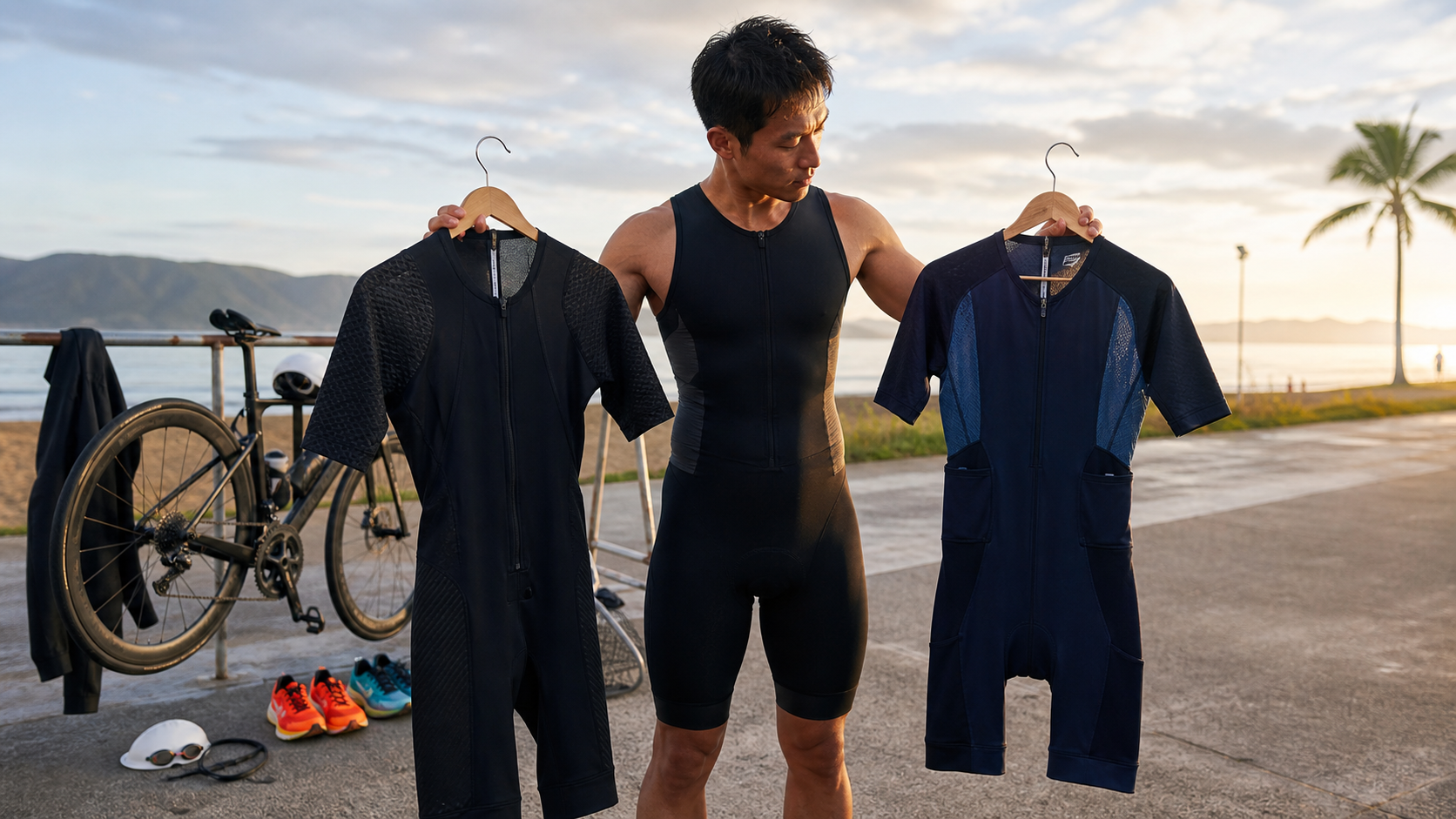
Triathlon Trisuit Selection Guide: Aero vs Comfort Trade-offs
The trisuit is the core piece of gear for triathletes—one garment must simultaneously handle the completely different movement demands of swimming, cycling, and running. On the market, prices range from entry-level NT$2,000 to race-level NT$15,000, and choosing wrong could leave you regretting it for the entire race.
1. The Core Conflicting Demands of a Trisuit
| Movement | Demand | Conflict Point |
|---|---|---|
| Swimming | Low water resistance, form-fitting, sun protection | Can’t be too tight (affects stroke) |
| Cycling | Low wind resistance, saddle protection, pockets | Pad can’t be too thick (affects running) |
| Running | Breathability, no chafing, no pad interference | The thinner the pad, the better |
Key conflict: Pad thickness—cycling needs thick (protects the perineum), running needs thin (no chafing in the groin area).
2. Aero (Race-Type) Trisuits
Features
- Tight-fitting, muscle compression
- Surface with aerodynamic textures (dimples, ribs)
- Sleeves may extend to the elbow (improves aerodynamics)
- Thin pad (4~6mm)
- Zipper placement: back (streamlined)
Wind Resistance Test Data
According to wind tunnel testing, an Aero trisuit at 40km/h:
- Saves approximately 5~15W of power
- Translates to 30~90 seconds saved in a 40km time trial
Suitable For
- 51.5 and half-distance triathlon athletes
- Athletes where the bike leg is a large proportion
- Lean body types with BMI < 23
- Ample budget (NT$8,000 and above)
Disadvantages
- Skin friction during running may cause heat rash
- Not suitable for long-duration wear (may be too tight for IM 226)
- Few nutrition pockets or poorly positioned
3. Comfort-Type Trisuits
Features
- Slightly more relaxed fit
- Thick pad (6~10mm)
- Multiple nutrition pockets (3 at the back, 2 on the sides)
- Large areas of breathable mesh fabric
- Zipper placement: front (easier for bathroom breaks)
Suitable For
- IM 226 and 113 long-distance athletes
- Athletes with bike legs exceeding 4 hours
- Athletes with high nutrition needs
- Body types that are not extremely lean
Disadvantages
- Higher wind resistance
- May balloon slightly during swimming (affects streamlining)
4. Choosing by Race Distance
| Distance | Bike Time | Recommended Type | Key Features |
|---|---|---|---|
| Sprint (25.75) | 30~40 min | Aero | Wind resistance, lightweight |
| Olympic (51.5) | 1~1.5 hours | Aero | Wind resistance, running comfort |
| 70.3 (113) | 2.5~3 hours | Balanced | Pad + pockets |
| Ironman (226) | 5~6.5 hours | Comfort | Thick pad, many pockets |
5. Purchase Considerations
1. Chamois
| Thickness | Bike Duration | Running Impact |
|---|---|---|
| 4mm | Under 1 hour | Almost unnoticeable |
| 6mm | 1~3 hours | Slight sensation |
| 8mm | 3~5 hours | Noticeable chafing |
| 10mm+ | Over 5 hours | Clearly uncomfortable when running |
2. Materials
- Neoprene blend: Good cold-water insulation for swimming, but stuffy
- Polyester + Lycra: Standard option, balances breathability and compression
- Carbon fiber compression fabric: Strong muscle support, expensive
- Ice silk material: Best breathability, ideal for hot weather
3. Zipper Placement
- Front zipper: Convenient for bathroom breaks, can be unzipped for ventilation on the bike
- Back zipper: Streamlined, low wind resistance, but inconvenient for bathroom breaks
- Half zipper (front 30cm): A compromise option
4. Pocket Design
| Pocket Type | Capacity | Suitable For |
|---|---|---|
| 3 vertical back pockets | 3 gels | 51.5 distance |
| Back + side pockets | 5~6 gels | 113 distance |
| Multiple pockets + waist | 10 gels + salt tablets | 226 distance |
6. Key Points for Trying On
- Squat test: Simulate the cycling position; the crotch should not feel constricted
- Arms raised: Simulate the swimming stroke; shoulders should not feel restricted
- Running test: Jog in place for 30 seconds; the pad should not shift
- Reach behind: Reach for the back pockets; you should be able to grab them easily
- Zipper test: Should be operable with one hand
7. Price and Brand Reference
| Price Range | Brand | Features |
|---|---|---|
| NT$2,000~4,000 | Domestic brands (GIANT, PEARL) | Entry-level, finish the race |
| NT$4,000~7,000 | ZONE3, Orca, Huub | Good balanced choice |
| NT$7,000~12,000 | 2XU, Castelli | Mid-level race |
| NT$12,000+ | Sailfish, Roka | Top-tier race |
8. Care and Lifespan
- Washing: Hand wash in cold water, avoid bleach
- Drying: Dry in the shade, never machine dry
- Storage: Fold without compressing the pad
- Lifespan: Loses elasticity after 30~50 races + training sessions
- Replacement signs: Zipper catching, pad hardening, fabric pilling
9. Special Considerations for Women’s Models
- Bra padding: Choose removable padding (absorbs water during swimming)
- Waistline: High-waist styles avoid pressure on the stomach during the bike leg
- Bottom: Choose a one-piece construction (won’t ride up)
- Menstruation: Darker colors are less of a concern
Choosing the right trisuit is the 1% that matters. On race day, the right suit won’t make you faster, but the wrong one will make you regret the entire race.
Related Reading
- Trisuit vs Two-Piece: The Ultimate Choice in Triathlon Apparel
- The Complete Triathlon Gear Guide: Trisuits, Tri Bikes, Helmets to Transition Bags
- The Complete Guide to Buying a Triathlon Wetsuit: Key Factors from Material to Fit
- Choosing and Wearing Triathlon Wetsuits: Balancing Buoyancy Benefits and Movement Limitations
相關影片
訂閱CT的頻道 [防寒衣體驗] 鐵人魂 三鐵 防寒衣試穿會 於松運 深水游泳池 鯨魚池
8 年前
3D 列印車褲墊 / 舒適改善? / 無痕 x 分區壓縮 / ATK & Decider系列 / JE22黑科技 / #公路車 #CTYEH
11 個月前
新玩具!Feiyu Pocket 3 無線三軸 運動攝影機 開箱!/ GoPro拍不出來的震撼視角? / 完全沒殘影的神夜拍效果 (內有專屬優惠!) / 公路車 / CT Yeh
2 年前
訓練台體驗) 2019台北自行車展 三大家 訓練台體驗 Tacx Neo Flux 2 Xepdo Apx Wahoo Kickr
7 年前
類空拍神器 Feiyu Pocket 2s (有優惠連結)三軸穩定 運動攝影機 開箱!比GoPro 還強的滑順視角!三小時長時間錄影 行車記錄器 | 環花東365實測 | 公路車 CT Yeh
4 年前
三鉄共購百人風中劍/ feat. 單車小D、Doris 、城希、Ruby、Ada/ 公路車 / CT Yeh
2 年前
多到選擇障礙... 換個單車把帶想一個小時 / BTP / 編織&軟木特有材質超吸睛! / 公路車 / CT Yeh
1 年前
Nepest NOVA 碳條輪組:輕量、空力、舒適一次滿足!/ 公路車 / CT Yeh
7 個月前