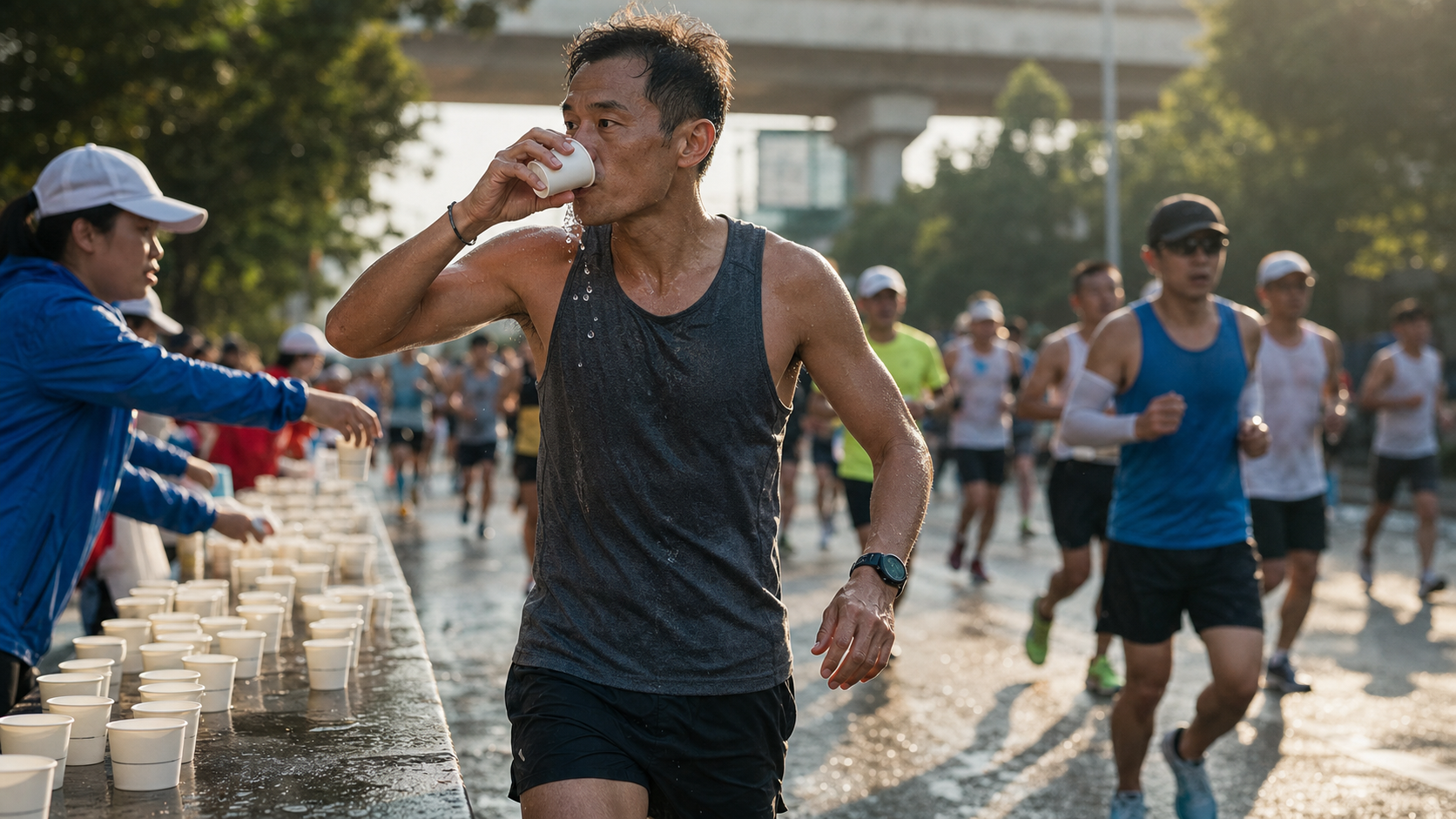
The Hidden Cost of Aid Stations
Typical marathon aid station operations:
- Slow down before entering: 1-2 seconds
- Grab a cup: 1-2 seconds
- Drink: 3-5 seconds
- Accelerate back to pace: 2-3 seconds
Total loss per station: 7-12 seconds
With roughly 8-10 aid stations in a full marathon, cumulative loss: 56-120 seconds.
This number determines whether you finish in 3:29 or 3:31.
Quantitative Comparison of Different Strategies
Using a full marathon 3:30 goal (5:00/km) as an example:
Strategy A: Come to a Full Stop and Walk 10 Steps
- Loss per station: 12-15 seconds
- Cumulative over 10 stations: 120-150 seconds
- Total finish time: 3:32:00-3:32:30
Strategy B: Slow to 6:30/km and Drink While Running
- Loss per station: 5-7 seconds
- Cumulative over 10 stations: 50-70 seconds
- Total finish time: 3:30:50-3:31:10
Strategy C: No Slowdown at All, Force the Drink
- Loss per station: 1-2 seconds
- Cumulative over 10 stations: 10-20 seconds
- Total finish time: 3:30:10-3:30:20
- Risks: Choking, spilling half, insufficient hydration/nutrition
Strategy D: Fully Stop at 5 Selected Stations, Skip 5
- Loss at 5 stations: 60 seconds
- No fueling at 5 stations: possible glycogen depletion late in the race
- Total finish time: 3:31:00 (but with risk of hitting the wall)
Best Strategy: Phased Differential Fueling
Recommended hybrid strategy:
0-15K: Strategy C (No Slowdown)
- Water needs are low at this point, energy stores are sufficient
- Grab a cup and take a quick sip (may spill 50%)
- Minimize speed loss
15-30K: Strategy B (Slow Down 5 Seconds)
- Main fueling period
- Ensure you get 100-150 ml plus one energy gel
- Trade a slight slowdown for guaranteed fueling
30-42K: Strategy A or B (Depending on Conditions)
- If heart rate has drifted to 90% of max, a “strategic 20-second walk” may actually aid recovery
- If you’re still feeling okay, continue with Strategy B
Aid Station Technique Training
Drinking while running is a skill that requires practice:
Drill 1: Cup Pinching
Pinch the paper cup into a V shape with your thumb and index finger to narrow the flow and reduce spills.
Drill 2: Breathing Coordination
Pause your exhale while drinking, close your mouth to swallow, and avoid choking.
Drill 3: Stable Running Form
While drinking, lean your upper body slightly forward and lift your chin to prevent water from running down your chin.
Drill 4: Opening Energy Gels
Tear open the corner of the gel before the race starts; during the race you only need to pull it open, no biting required.
Choosing Your Position at the Station
Aid stations at major races can stretch 100-200m with multiple volunteers handing out cups. Position selection:
- First table: Most crowded and congested, high risk of runner collisions
- Middle tables: Good choice, volunteers are focused
- Last table: Fewest people, but volunteers may run out of cups
- Recommendation: Choose from the middle to the back end for smoother flow
Fueling Preferences
How to handle various fueling options:
| Fuel | Handling Method | Time Loss |
|---|---|---|
| Water | One gulp down | 3-5 seconds |
| Sports drink | Drink while running | 5-7 seconds |
| Energy gel | Tear open, swallow + water | 8-12 seconds |
| Banana/cookie | Must slow down | 15-20 seconds |
| Salt tablet | Pre-place in pocket | 2-3 seconds |
Solid food should only be considered after 30K; otherwise, stuffing it into your stomach at an aid station will be hard to digest with the bouncing of running.
Conclusion
Aid stations are not rest stops—they are “trade-off points between pacing and nutrition.” Master the skill of drinking while running, and you can save 60-90 seconds in a full marathon. But never skip fueling just to save time—glycogen depletion costs far more.
Related Reading
西進武嶺 自製新版AI配速表產生器 x 賽前攻略 抱佛腳! 沒有功率計也可以產生配速表嗎?有什麼其他眉角賽前要注意的呢? | 西進武嶺 / 東進武嶺 KOM 攻略 | 公路車 | CT Yeh
4 年前
西進武嶺 免費訓練分析服務 Intervals | 練不夠還是練過頭?你哪一種類型選手?AI模型告訴你! | 備戰神器 | 公路車 訓練 | CT Yeh
4 年前
#公路車 #西進武嶺 配速配瓦實驗 坡度分析 四小時內攻略 建大盃 NeverStop #西進武嶺攻略
6 年前
西進武嶺配速器 3.0更新 / NEW 免功率FTP估算! / 大數據xAI體能模型 / 如何模擬人止關前集團效應 / 配速儲存功能 / AI全台自行車賽事行事曆 / 公路車 / CT Yeh
1 年前
Live) 備戰2019彰化經典百K 賽前攻略 (已完賽請看新影片
7 年前
公路車 爬坡 破PR 紀錄 小技巧 分享
6 年前
靠單車減肥35公斤 心得分享與整理
7 年前
崇越盃武嶺冠軍高手 賽前JJSC 群峰會精華!對應大數據分析,會有落差嗎?/ feat. JJSC中部公路車約騎 /公路車 / CT Yeh
2 年前