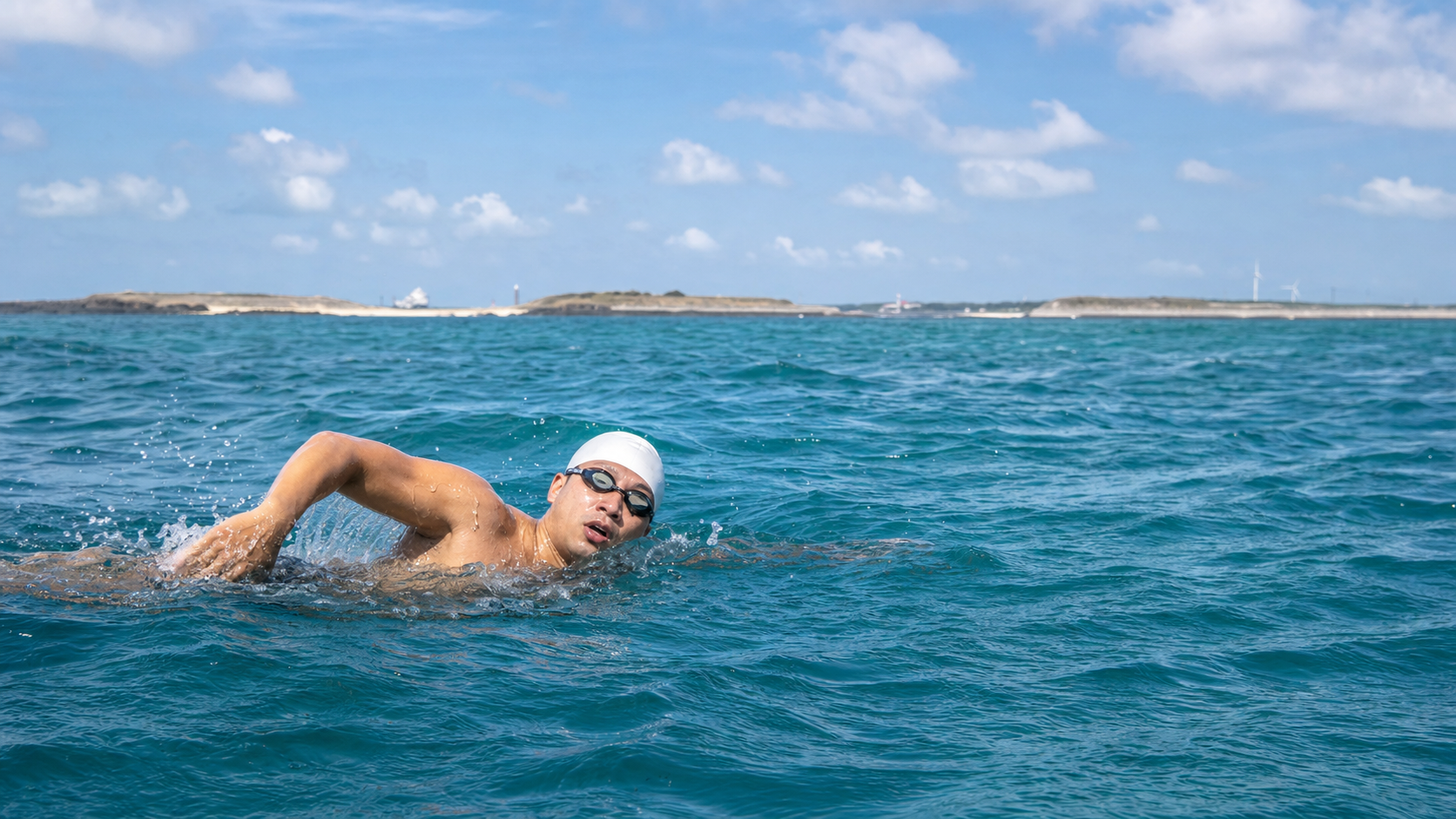
Penghu Cross-Sea Swim Challenge: Direction Control and Mental Overcoming in Strait Currents
Introduction
The waters of Penghu are a transparent blue-green. From the shore, they look so clear you can see the bottom, making you think you could easily swim across. But once you’re actually in the water, the invisible currents tell you otherwise: this is the Taiwan Strait, not a swimming pool.
Before taking on the Penghu Cross-Sea Swim Challenge, I already had open-water experience from Sun Moon Lake and thought I was prepared. But the difference between ocean swimming and lake swimming is far greater than I imagined. This article is an honest record of the real experience of that challenge, especially the two lessons that left the deepest impression on me: maintaining direction in lateral currents, and the psychological pressure of facing deep water with no visible bottom.
Characteristics of the Penghu Waters
Penghu is located in the middle of the Taiwan Strait. In summer, southwest monsoons prevail, shifting to northeast monsoons in autumn and winter. Cross-sea swims are typically held in summer, when water temperatures are around 28-30°C and relatively comfortable; however, current direction is influenced by both monsoons and tides, often flowing diagonally.
| Sea Conditions | Sun Moon Lake Comparison | Challenge Level |
|---|---|---|
| Waves | No waves | Swell of 0.3-0.8 m |
| Current | Still or weak | Lateral current of 0.3-1 knot |
| Water Depth Visibility | Bottom visible | Deep blue, bottom not visible |
| Water Quality | Pure freshwater | Saltwater |
| Rescue Distance | Dense boat coverage | More dispersed |
Saltwater does provide more buoyancy than freshwater, which is an advantage for long-distance swimming; but the swell disrupts your breathing rhythm, and this requires dedicated practice to adapt to.
Special Training Items for Preparation
After confirming my registration, I designed several additional training sessions targeting the characteristics of the ocean:
Lateral Current Adaptation Practice
In the pool, I deliberately positioned myself near the side overflow outlet to feel what it’s like to maintain a straight swimming line while being disturbed by water flow. Although the current strength is nowhere near real sea conditions, it helps the body build a basic sense of awareness.
Swell Breathing Practice
At the beach or in open water, I deliberately chose conditions with small waves to practice breathing at the low point of a wave rather than breathing on a fixed rhythm.
Mental Pre-Setting Training
Before the race, I repeatedly simulated various difficulties in my mind: “What if I drift 100 meters off course?” “What if I suddenly enter a dark, deep-water zone?” “What if there’s no one around me?” Through pre-setting, I reduced the likelihood of panic in the moment.
- Open-water training at least three times per week
- At least two swimming experiences in real sea conditions (not lakes)
- Consulted fellow swimmers with Penghu swimming experience for route information
- Prepared an inflatable swim buoy and confirmed the race rescue protocol
Entering the Water: The Strangeness of That Blue
The race start was a beach next to a pier. One hour before the start, the staff announced the day’s current conditions: “Southeast lateral current, speed approximately 0.4 knots, estimated total drift of 80-100 meters. Please compensate by swimming upstream.”
That statement was my first shock. 80-100 meters of drift? That meant I would have to swim at an angle the entire time to counteract the force pushing me off course. This is something you never have to think about in a pool, but here it became a math problem I had to solve every minute.
The feeling after entering the water was twofold. On one hand, the buoyancy of the seawater made my body feel much lighter, and my arm strokes were noticeably more efficient; on the other hand, when the first swell hit, I instinctively held my breath and sank down, only lifting my head after the wave passed. Those three short seconds made me understand: “In the ocean, your breathing rhythm must adapt to the sea, not to your habits.”
The Real Challenge of Direction Control
After swimming about 500 meters, I deliberately glanced to the right at the lighthouse on shore—the landmark I had set as my “reference point” before departure. Then I realized with alarm that I had already drifted nearly 50 meters, faster than expected.
I adjusted my angle and swam on, then checked again. The drift had slowed but was still ongoing. At that moment, I realized something: ocean currents are not uniform. They change in intensity over time and location, and I had to reassess and fine-tune every 10-15 strokes.
This continuous calculation consumed a great deal of attention, to the point that I almost forgot about physical fatigue. In a way, that was a good thing—focusing attention on the task actually left less room for fear.
The Psychological Pressure of an Invisible Bottom
Around the middle of the crossing, the water depth increased dramatically, shifting from bottom-visible light blue to completely opaque deep blue. Looking down, there was nothing to see—only dark water.
In that moment, a primal fear rose up: I was swimming over an unknowable abyss. Rationally, I knew there was no danger at the bottom, but the unease at the instinctual level was real. My breathing rate visibly accelerated during those 10 seconds, and my movements became slightly tense.
The way I overcame it was to forcibly shift my gaze from “downward” to “forward.” Ahead, there were buoys, other swimmers, and a clear outline of the target island—these “visible things” re-established a sense of safety. By deliberately breathing in a steady rhythm and consciously relaxing my shoulders, the fear receded after about 20-30 seconds.
Practical Advice for Challengers
- Know the day’s current direction and strength in advance: This determines your entire route strategy—do not skip this
- Set multiple landmarks on land, not just buoys: Landmarks are more stable; buoys sway with the waves
- Accept that drifting is normal: Correct it when you can; if you can’t, adjust your expectations for the finish
- Build psychological immunity to the “invisible”: Pre-race simulation practice is highly effective
- Ocean swimming must always have a rescue boat nearby: Never challenge it alone
Conclusion
After getting ashore, the first thing I did was look down at my hands: my palms were slightly wrinkled from the long hours of stroking, but every crease was proof of something real—you just swam in the Taiwan Strait. The sea of Penghu is honest. It won’t go easy on you just because you’re from elsewhere or it’s your first challenge, but it also gives you something a pool can never offer: a direct confrontation with real nature.
That feeling is worth every drop of sweat from training.
Related Reading
- Penghu Cross-Sea Swim: Windy and Rough Strait Challenge and Preparation Strategies
- Penghu Cross-Sea Marathon: Complete Race Management Techniques for Island Wind Conditions and Summer Heat
- The Physiological Challenges of Open-Water Swimming: Waves, Currents, Navigation, and Psychology
- Adapting to Waves and Currents in Sea Swimming: Technical Essentials for Swimming Along Taiwan’s Coast
2023桃園團體繞圈賽 / 海鷗繞圈賽 | 全程空拍數據版 | 公路車 | CT Yeh
2 年前
備戰 戀戀197 賽前關門點分析 西濱團練 #公路車 4K高畫質
6 年前
嘉義大埔、阿婆灣挑戰賽,美到以為在日本!ft. 環騎5 Cool 西拉雅188 / 公路車 / CT Yeh
7 個月前
2025 海鷗團體繞圈賽 網路直播 超激烈裁判長視角 / EIPC 李廷威、Waypoint 等眾多高手競爭 / feat. 卡密兒主持 / 海鷗繞圈賽
9 個月前
大武山後門26%歡樂陡坡!JJSC南台灣單車行Day2 / 被颱風追著跑 / 公路車 / CT Yeh
2 年前
一起升級!海鷗盃LSD團練...JJSC Zone2招待 騎到手抖 / 公路車 / CT Yeh
2 天前
單車 梅山36灣 坡度介紹 路段介紹 空拍 (相關遊記影片,請參考說明或我的頻道喔,歡迎訂閱)
6 年前
密境!雙灣自行車道 / 環法日月潭 x YAKIMA 百人大約騎 / 公路車 / CT Yeh
11 個月前