High School Swimming Career Retrospective: The Nerves and Growth of Inter-school Competition
Introduction
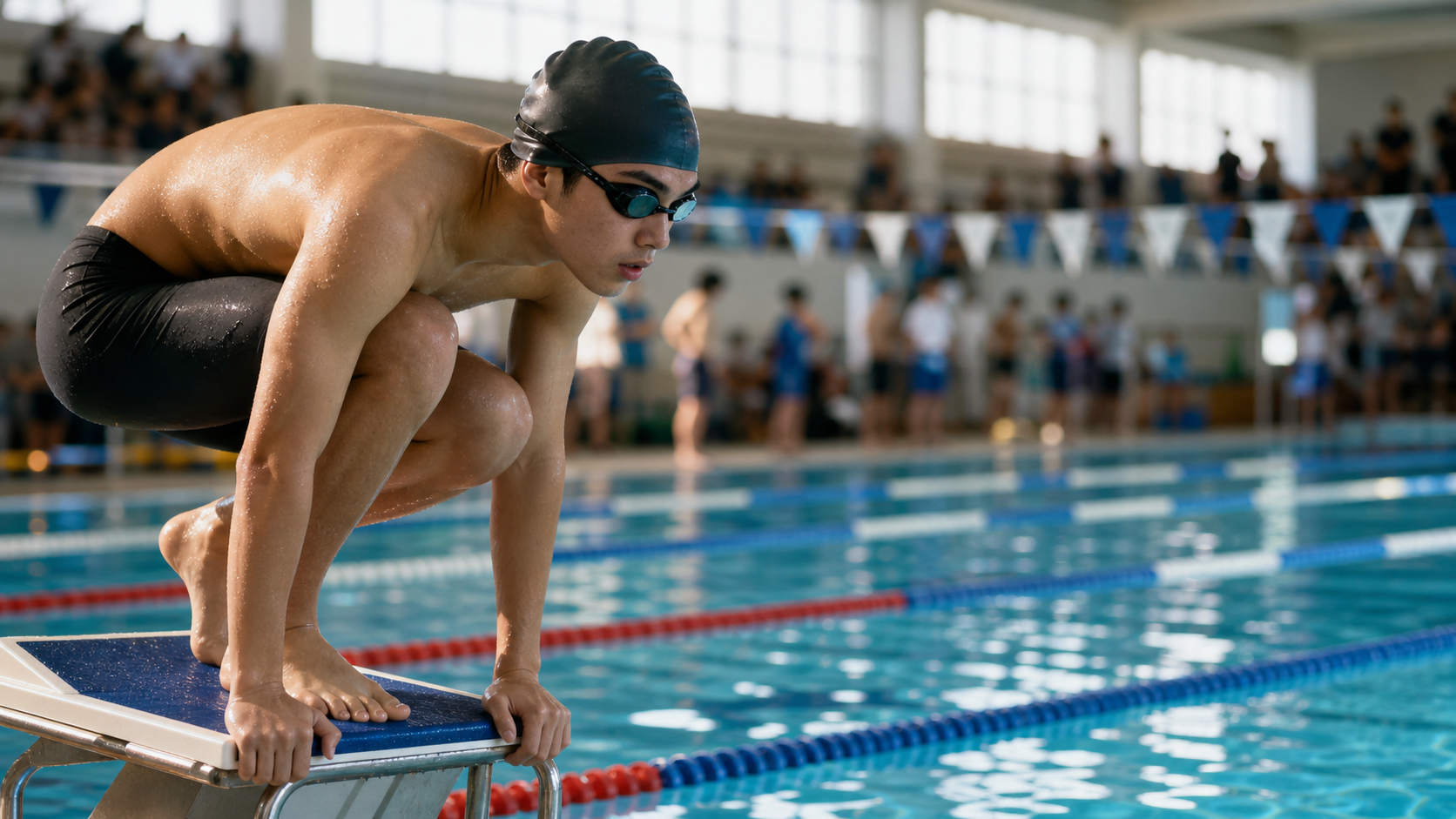
Some memories don’t fade with time; instead, they become clearer, like old photographs. Standing on the starting block at a high school inter-school swimming competition, hearing my name and school announced over the loudspeaker—I remember that moment vividly, even down to the pool’s chlorine smell being a bit stronger than usual that day.
High school is where many Taiwanese swimmers begin their competitive journey. School representative teams, Mayor’s Cup, county and city games—these events might not seem like much to adults, but to a fifteen-year-old, they meant everything. This article is my retrospective on those years, an attempt to re-understand the meaning behind all that nervousness and growth through the lens of today.
How I Joined the Swim Team
I learned the basics in middle school swim class, made the school representative team, and started training at six o’clock every morning. During that time, many classmates were still in bed while I stood by the pool, warming up against the cold water.
It would be a lie to say I didn’t care. Getting up that early every day, with my parents driving me there and rushing back for morning study hall—that routine wasn’t born of obligation, but of an indescribable drive—a curiosity to see just “how fast I could swim.”
Once I entered high school, the swim team’s training intensity ramped up noticeably. The coach was a strict but fair former competitive swimmer, and one thing he said has stuck with me to this day: “The pool doesn’t lie. Whatever you put in, it gives back.”
The Nerves of My First Official Race
The inter-school league in the second semester of my freshman year was my first time representing the school. My event was the 100m butterfly, which was also my strongest event.
| Race Preparation Metrics | Training Results | Race Goals |
|---|---|---|
| 100m butterfly | 1:02 | Break 1 minute |
| 50m sprint | 29 seconds | Under 28 seconds |
| Physical condition | Good | Maintain stability |
| Technical focus | Breathing rhythm | Don’t fall apart in the second half |
The night before the race, I barely slept. Not because I was anxious with nerves, but because my mind kept “rehearsing”—how to dive off the blocks, how to execute the first turn, how to sprint the final 15 meters. That state of excitement mixed with tension, I later learned, has a name: “pre-race activation.” A moderate amount of activation actually helps performance.
I stepped onto the block, glanced at the competitors beside me, then at the timing board across the pool, and stopped thinking altogether. The gun went off. I dove.
The result was 1:01. A second faster than practice, but short of the one-minute goal. After getting out of the pool, I felt a bit disappointed, until the coach patted my shoulder and said: “You swam a personal best in your first official race. Well done.” That moment made me realize: I hadn’t actually failed—I had just stepped onto the starting block for the first time.
Failure Is Another Kind of Teacher
The Mayor’s Cup in my sophomore year was my first memory of a crushing defeat in an official event. A week before the race, I caught a cold and missed three days of training. I convinced myself I had recovered and pushed through to compete anyway.
The result: I completely fell apart in the second half. My breathing rhythm went haywire in the final 10 meters, and when I hauled myself out of the water, my time was 1:08—nearly 10 seconds slower than my usual training times.
That failure brought more than just disappointment; it brought an important lesson: when your body isn’t fit to compete, rationally stepping back is wiser than stubbornly pushing through. While “never giving up easily” is the spirit of sport, “pushing through at the wrong time” isn’t courage—it’s disrespect to your body.
The coach’s reaction surprised me—he didn’t criticize my time. Instead, he asked: “Do you know why you lost?” Then he made me analyze it myself. That process taught me more than any successful race ever did.
The Breakthrough and Farewell of Senior Year
Senior year was my final season. Facing the pressure of college entrance exams, many teammates gradually cut back on training or even quit the team. With my family’s support, I chose to stick it out until the very last race.
At the final inter-school competition, I swam my personal best of high school: 58.7 seconds in the 100m butterfly, finally breaking the one-minute barrier.
When I saw 58.7 on the timing board, I stood in the water stunned for about three seconds, then slapped the surface hard and let out a yell. The nearby official probably got a fright, and the coach let out a loud whistle from the stands. In that moment, every single 6 a.m. training session over those three years of high school became worth it.
Five Things High School Swimming Taught Me
Looking back on those three years, what they left me with goes beyond technique and times:
- The honesty of the body: The pool doesn’t lie—whatever you put in, it gives back. There are no shortcuts.
- Reframing failure: Losing a race doesn’t mean “I’m not good enough”; it means “what do I need to do next.”
- The meaning of team: Swimming is an individual sport, but a swim team is a collective. Seeing a teammate break their personal best—that joy is real, not performative.
- Process over outcome: What I remember most isn’t that 58.7, but the countless 6 a.m. mornings that led up to it.
- Respecting your body’s limits: That disastrous race on a cold was the most expensive but most valuable lesson.
Advice for Current High School Swimmers
- Don’t just stare at times; focus on weekly technical improvements
- Pre-race nerves are normal—they mean you care, not that you’re weak
- Losing a race isn’t the end; as long as there’s a next one, there’s still a chance
- Be honest with your coach—your condition, your fears, your doubts. Saying them out loud beats keeping them bottled up
Conclusion
The memories of high school swim meets aren’t just numbers on a results sheet; they’re a collection of “firsts”: the first time stepping onto the starting block, the first time losing a race, the first time breaking through what you thought was your limit.
Those firsts shaped the fundamental attitude I bring to every challenge since. Whenever I hit difficulties swimming in open water, I think back to that senior-year morning, and the coach’s words: “The pool doesn’t lie.”
Related Reading
- Psychological Development in Youth Swimming: Competitive Pressure and Confidence Building
- Youth Swimming Competitions: The Impact of Team Training Volume on Academics and Balance Strategies
- Swimming and Friendship: Building Team Culture and In-Water Bonds
- Upper Elementary Swimming (Ages 9–12): Technical Refinement and Competitive Introduction
一日北高 2022 廢物伙伴年度大戲 | 我們跨越濁水溪了 | 尖叫雞變滴雞精 | 公路車 | CT Yeh
3 年前
TBA 北高360 逆風爆熱再送空汙 苦行挑戰賽全記錄 4K沈浸式臨空畫質| 公路車 | CT Yeh
3 年前
2025 海鷗團體繞圈賽 網路直播 超激烈裁判長視角 / EIPC 李廷威、Waypoint 等眾多高手競爭 / feat. 卡密兒主持 / 海鷗繞圈賽
9 個月前
一輪盃環湖挑戰賽 | TIME新車首航 | 一輪帶我飛 | 百萬流量都在場 | 4K畫質 | 公路車 | CT Yeh
3 年前
live) 超越北高 之一日北高12小時 策略
7 年前
#PUSHBIKE 原來這麼好玩! 小朋友 滑步車 初體驗 超可愛
6 年前
一日北高/長距離團騎 常見問題補充篇 / 組團或跟團的眉角 / 壯車友容易被瘦車友慢性拉爆 / 原來屁股痛可能是這個原因...? / 風場配速法 / 公路車 / CT Yeh
2 年前
2026 輪霸西濱200K 挑戰VLOG / 第一集團 / 首次參加..經驗不足、膀胱不足 /死守6H內 / AI戰鬥力顯示系統 / 公路車 / CT Yeh
4 個月前