Open Water Marathon Swimming (10km): Nutrition and Mental Strategies for Long-Distance Open Water
Introduction
A 10km open water marathon swim is, for most swimmers, a challenge whose significance lies more in the numbers than in the actual distance. It represents this: you are willing to keep swimming in open water for over two hours, relying solely on your own physical strength and willpower, to get from the start to the finish.
This is not a technical issue—at least, not entirely. The technique required to swim 10km is not much different from swimming 5km; but the nutrition strategy and mental framework required to complete 10km is an entirely different proposition. This article aims to focus on “nutrition design” and “mental strategy”—the two aspects of long-distance swimming that are most often overlooked.
Energy Expenditure in Long-Distance Open Water Swimming
For a 10km open water swim, a typical athlete’s finish time ranges from 2.5 to 4 hours (depending on currents, technique, and body type). Swimming continuously at moderate intensity burns approximately 600-800 calories per hour. In other words, total expenditure for the entire race is around 1500-3200 calories.
| Swim Segment | Distance | Estimated Time | Energy Expenditure (Estimated) |
|---|---|---|---|
| Segment 1 | 0-2.5km | 40-60 minutes | 400-500 kcal |
| Segment 2 | 2.5-5km | 40-60 minutes | 400-500 kcal |
| Segment 3 | 5-7.5km | 40-60 minutes | 400-500 kcal |
| Segment 4 | 7.5-10km | 40-60 minutes | 400-500 kcal |
This level of expenditure requires mid-race replenishment; otherwise, you will experience obvious energy depletion (commonly known as “hitting the wall”) in the later stages.
Nutrition Strategy Design
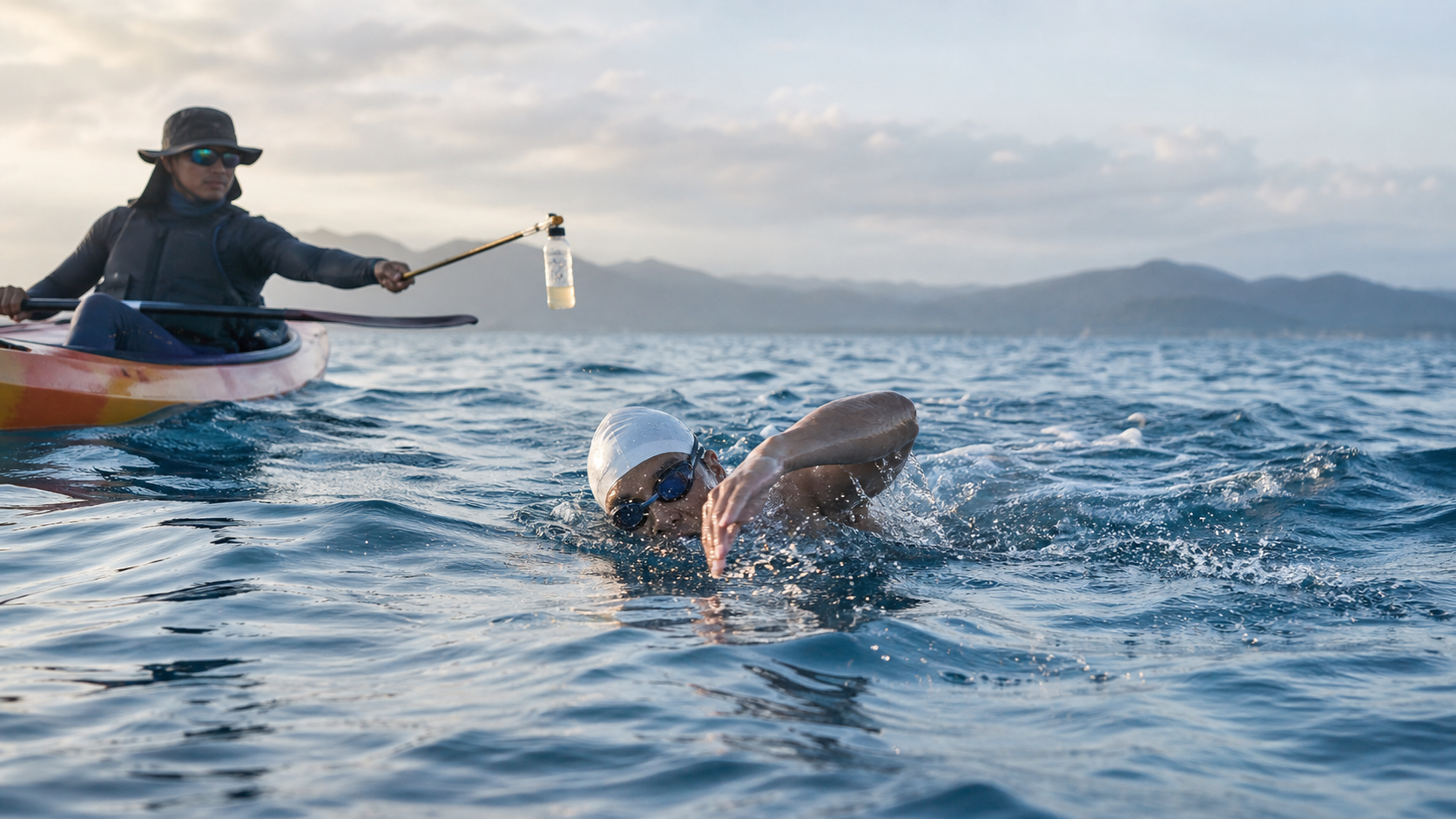
Nutrition for long-distance swimming is more complex than for road running, for one key reason: you cannot simply stop and drink while swimming. You must make brief stops at shore-based aid stations, or take items from a support boat while treading water.
Timing of Nutrition
It is recommended to refuel every 45-60 minutes, for the following reasons:
- Refueling more often than every 40 minutes disrupts your rhythm with too many stops
- Waiting longer than 75 minutes means your blood sugar may have dropped enough to affect performance
Choosing What to Consume
- Carbohydrates: Energy gels are the most convenient option—easy to carry in the seam of a swim cap or a specially designed belt
- Electrolytes: Long-distance swimming causes significant sweat loss (even if you don’t feel it), making electrolyte replenishment crucial
- Liquid Calories: Diluted sports drinks are more suitable than plain water at aid stations for long-distance swimming
- Solid Food: Some athletes use banana slices or crackers at aid stations, but these need to be tested during training first
My Actual Nutrition Plan
- At the 2.5km aid station: 1 energy gel + 150ml electrolyte drink (stop for about 20-30 seconds)
- At the 5km aid station: 1 energy gel + half a banana + 200ml electrolyte drink (stop for 1 minute)
- At the 7.5km aid station: 1 energy gel + 150ml electrolyte drink
- Avoid plain water throughout the race (to prevent hyponatremia)
This plan was finalized two months before the race and tested and fine-tuned during every long-distance training session.
Mental Strategy: Breaking 10km into Pieces
The psychological weight of 10km—if you spend the entire race thinking “how much farther”—will crush you. An effective mental strategy is to “break down” the 10km distance into small goals your mind can accept.
Milestone Segmentation
Divide the 10km into four segments of 2.5km each. Set your mental goal as: “I just need to swim to the next aid station.” Aid stations are not just for refueling—they are psychological milestones. Every time you reach one, it is confirmation that “I have completed another 2.5km.”
Dealing with the Mid-Race Crisis
In long-distance swimming, the most difficult mental moment usually occurs between 5-7km: your body is already tired, but the finish line is still out of sight. This “silent middle section” is where most people give up.
Effective coping strategies:
- Shift Your Focus: Move your attention from “being tired” to “technique” (Is my breathing rhythm correct? How efficient is my stroke?)
- Thank Your Body: “My body has swum 6km for me now—thank you.” This is not sentimental; it is an effective form of cognitive reframing
- Count Down: “Only 4km left—that’s just 1.2 times the length of Sun Moon Lake.” Convert the remaining distance into a familiar reference point
Managing the Final Stretch
Entering the last 2km, most athletes face obvious muscle fatigue. The power of your arm strokes drops, and your breathing rhythm may become unstable.
At this point, the strategy is not to push harder and speed up, but rather:
- Maintain Technical Efficiency: Reduce ineffective strokes; every stroke should be complete
- Use Body Rotation: The propulsion generated by torso rotation becomes even more important when your arms are fatigued
- Shorten the Breathing Interval: If you normally breathe every three strokes, consider adjusting to every two strokes to reduce the feeling of oxygen debt
Key Training Points for Race Preparation
- Training mileage for long-distance swimming should be built up gradually—do not suddenly extend the distance
- At least one 7-8km long-distance training session should be completed three months before the race
- Test your nutrition products during every long-distance training session
- Keep a training diary to record your energy status and identify your personal “hitting the wall” time
Conclusion
The moment I finished the 10km open water marathon swim and got out of the water, I lay on the shore for about two minutes, letting my body remember the feeling.
It was not a feeling of utter exhaustion, but rather an indescribable sense of “fullness”—every muscle had been used, every breath had been counted, every mental low point had been passed. The 10km open water marathon swim gave me the most convincing proof of my own ability. No spectator told me “you can do it”—I swam it myself.
Related Reading
- Open Water Energy Replenishment: How to Eat During a Long-Distance Swim Race
- Open Water Nutrition Strategy: Energy Replenishment for Long-Distance Sea Swimming
- Nutrition Strategy for Long-Distance Swim Races: Energy Preparation for 1500m and Beyond
- Nutrition Strategy for Long-Distance Swimming: Differences Between Pool and Open Water Replenishment
西進武嶺 免費訓練分析服務 Intervals | 練不夠還是練過頭?你哪一種類型選手?AI模型告訴你! | 備戰神器 | 公路車 訓練 | CT Yeh
4 年前
半日 小台灣 極限單車路線挑戰實錄
7 年前
一日北高前的高裝檢 | 北高 360 | 挑戰11小時的裝備 | 一日雙塔 | 補給
6 年前
水金九不厭五分 10度寒流冷到不願停!feat. 卡卡 / 公路車 / CT Yeh
6 個月前
2019 夏季KOM 5小 完賽心得 準備攻略 東進武嶺 夏季登山王之路 Taiwan KOM Challenge
7 年前
Live) 備戰2019彰化經典百K 賽前攻略 (已完賽請看新影片
7 年前
一日北高 11小時 賽後心得分享篇 | TWB北高360 | 一日雙城 | 單車 | 公路車
6 年前
live) 超越北高 之一日北高12小時 策略
7 年前