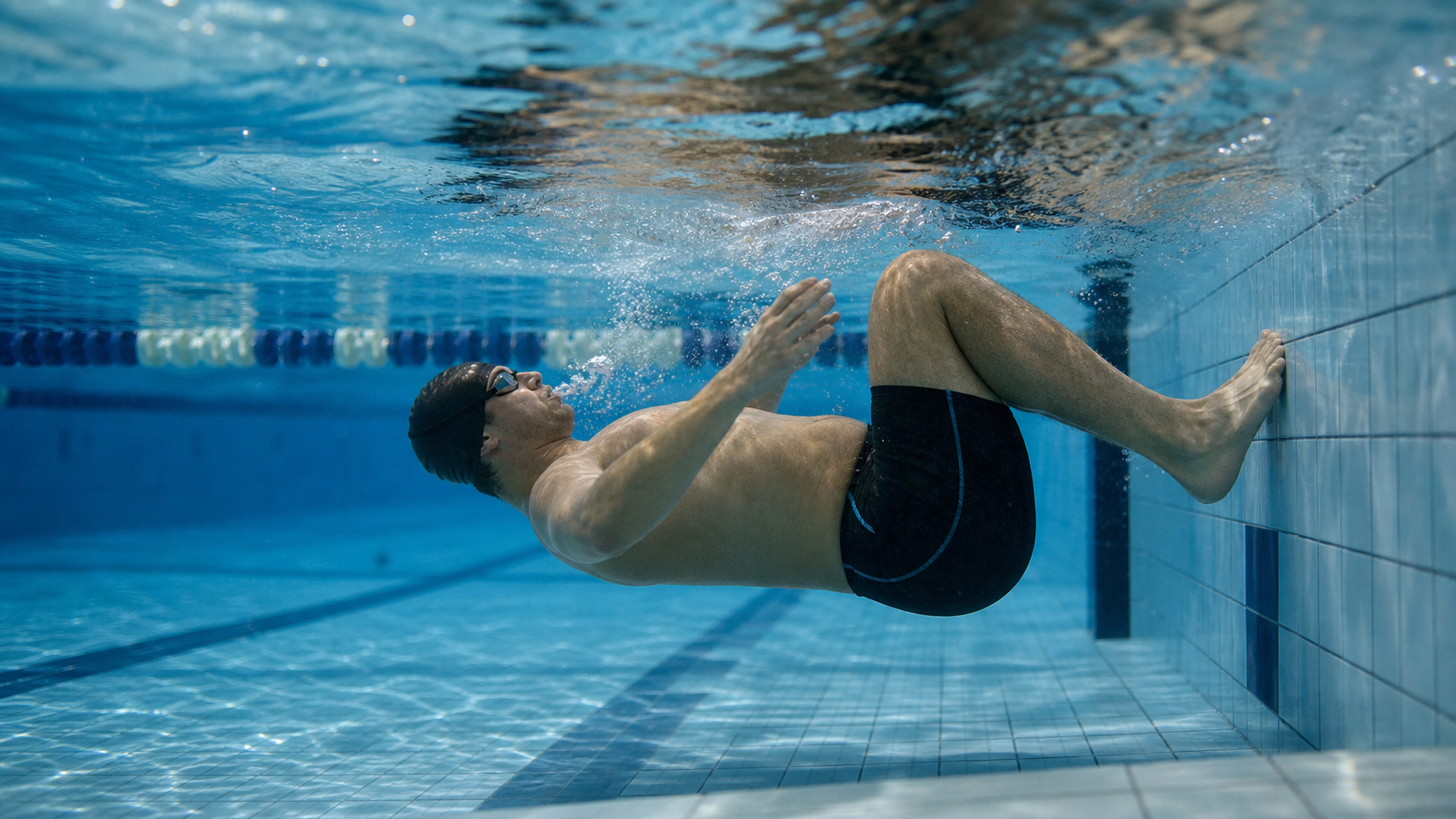
Swimming Technique Breakthrough: My Journey to Finally Learning the Flip Turn After Three Months
Introduction
I’ve been swimming for seven years and always used the wall-touch turn. It wasn’t that I didn’t know the flip turn existed—it was that every time I tried, my brain told me, “Go down, flip over, then push off the wall,” but my body always lost its sense of direction mid-flip. Either water went up my nose, or my push-off angle was off, leaving half my body scraping against the wall.
For seven years, I tried more than a dozen times and gave up every single time. It wasn’t until the end of that seventh year, under the guidance of a patient swim coach, that I systematically learned the flip turn over the course of three full months. This article aims to document that three-month learning process in its entirety, hoping it can help anyone stuck on this technique.
Where the Real Difficulty of the Flip Turn Lies
Many instructional materials say the flip turn “isn’t actually that hard” and that you just need to follow a few steps. I believe this overlooks the real difficulty adult learners face: it requires coordinating three things simultaneously while in motion—judging distance, initiating the flip, and controlling breathing.
| Difficulty | Problem Description | Root Cause |
|---|---|---|
| Distance judgment | Not knowing when to start the flip | Lack of visual cue training using the T-marking |
| Flip direction | Losing the sense of up and down during the flip | Spatial awareness not yet established |
| Breathing control | Water entering the nose during the flip | Incorrect timing of nasal exhalation |
| Push-off angle | Pushing off crooked or without power | Unstable foot placement on the wall |
| Exit rhythm | Freezing up after the flip | Overall fluidity not yet developed |
The Three-Month Segmented Learning Process
Month One: Break Down the Movements, Focus on One Thing at a Time
My coach had me completely abandon the idea of “practicing the flip turn directly” and instead focus on practicing each component movement:
Forward roll practice (on land): Doing forward rolls on a mat to re-establish spatial awareness during rotation. Many adult swimming learners haven’t done a forward roll in years, and it’s worth taking the time to regain familiarity with the movement itself.
In-water roll practice (without the wall): Rolling in place in the water to feel the resistance and directional sense of rotating underwater, without worrying about distance judgment—just practicing the roll itself.
Nasal exhalation timing practice: The nasal cavity needs to exhale gently during the flip to prevent water from entering. The practice method: while performing any rolling movement in the water, deliberately maintain a continuous, subtle stream of bubbles from the nose.
Month Two: Wall Practice, Split into Two Phases
Phase One: Practice flip + push-off while positioned at the wall
Without swimming, stand directly at the wall and perform the flip motion, confirming foot placement on the wall and push-off angle. This exercise completely removes the coordination difficulty of “swimming + flipping” and only addresses the technique of “flipping + pushing off.”
Phase Two: Swim toward the wall from 3 meters away, calculating the flip timing
Shortening the swimming distance simplifies the distance-judgment problem: “The moment you see the T-marking, flip immediately.” Regardless of whether the technique is correct, first establish the reflexive connection between “T-marking → flip.”
Month Three: Integration, from Fragments to Fluidity
By this stage, each component of the flip turn could be completed individually, but the problem lay in integration: how to transition between movements without any “hesitation.”
My coach said something that stuck with me: “Every time before you flip, there’s a moment of hesitation, and that hesitation is your enemy. The flip doesn’t require hesitation—it’s a conditioned reflex, not a decision.”
This mindset shift changed how I practiced: I stopped “thinking” about how to do it and started “doing,” letting muscle memory take over.
I practiced the flip turn 8–10 times daily, not chasing perfection but chasing “no hesitation.” Three weeks later, the hesitation was gone.
The Day of the Breakthrough
During week 11 of training, after swimming 50 meters, I executed a flip turn and kept swimming after pushing off the wall—without stopping to check my technique, without water up my nose, without a crooked push-off—the movement was so fluid it surprised even me.
I stopped at the other end of the lane, froze for a few seconds, then turned around and swam back, ready to confirm it wasn’t a fluke.
That time, it was just as fluid.
Later, I completed a continuous 1,000-meter training set using the flip turn exclusively. Swimming 1,000 meters with the flip turn for the first time was a full 40 seconds faster than my usual wall-touch turns.
Advice for Learning the Flip Turn
- Practice on land first: Don’t rush into the water; regain the feel of a forward roll on a mat
- Break down the movements—no practicing the full motion directly: Solve one problem at a time; you’ll progress faster in the end
- Nasal exhalation is the key: Without solving this, the fear of water entering your nose will keep interfering with your learning
- Accept that it will look “ugly” for a while: The movements during the skill-building phase won’t look pretty—don’t give up because of that
- Practice 8–10 times daily, rather than occasional marathon sessions: The flip turn requires high-frequency repetition to build muscle memory
- Find a patient coach: If you’ve been self-teaching for a long time and remain stuck, investing in a few lessons to have a coach identify your problem areas will pay off twofold
Conclusion
Learning a skill in three months may seem slow to some. But for me, it ended seven years of frustration and brought a unique sense of satisfaction.
That satisfaction doesn’t come from “I’m now 40 seconds faster than before,” but from “I learned something I thought I could never learn.” This realization applies far beyond swimming. What the flip turn taught me isn’t just how to turn around—it’s how to face long-term learning plateaus: break it down, persist, and don’t hesitate.
Related Reading
- The Application of Swimming Turn Techniques in Competition: Using the Flip Turn to Gain Time
- Refining Swimming Turn Technique: Push-Off Timing and Streamlining in the Flip Turn
- Improving Swimming Turn Efficiency: 5 Technical Detail Corrections for the Flip Turn
- Swimming Breathing Techniques: Pros and Cons of Side Breathing vs. Bilateral Breathing
滑雪新手們慘摔學習全紀錄(請開字幕),滑雪好好玩 | Snowboard + Ski | 岩原 スキー場 | 滑雪APP使用 | GoPro Max
6 年前
近視雷射三個月後悔嗎?單車族/工程師必看,Smart TransPRK 術後血淚史與後遺症全公開 / CT Yeh
4 個月前
碟煞公路車 優缺點?換車一年半實際經驗分享 / 公路車 / CT Yeh
2 年前
公路車 爬坡 破PR 紀錄 小技巧 分享
6 年前
碟煞公路車 銑面器 !? 原來銑完差這麼多! 降低蹭碟機率! | TIME 公路車 保養小記錄 | CT Yeh
3 年前
2016 桐花飛舞 單車挑戰 精華片段
10 年前
一日北高前的西濱集訓 | 跟著11小時軍團 | 300W踩不動的大逆風 | 輪車破風差幾瓦?
6 年前
CT 喇低賽) 武嶺牽車 才是王道 西進牽車四小時內秘訣 攝手位置 如何判斷 防抽筋小秘訣
7 年前