Swimming Helped Me Regain My Health: A Story of Physical Transformation from Starting Swimming in Midlife
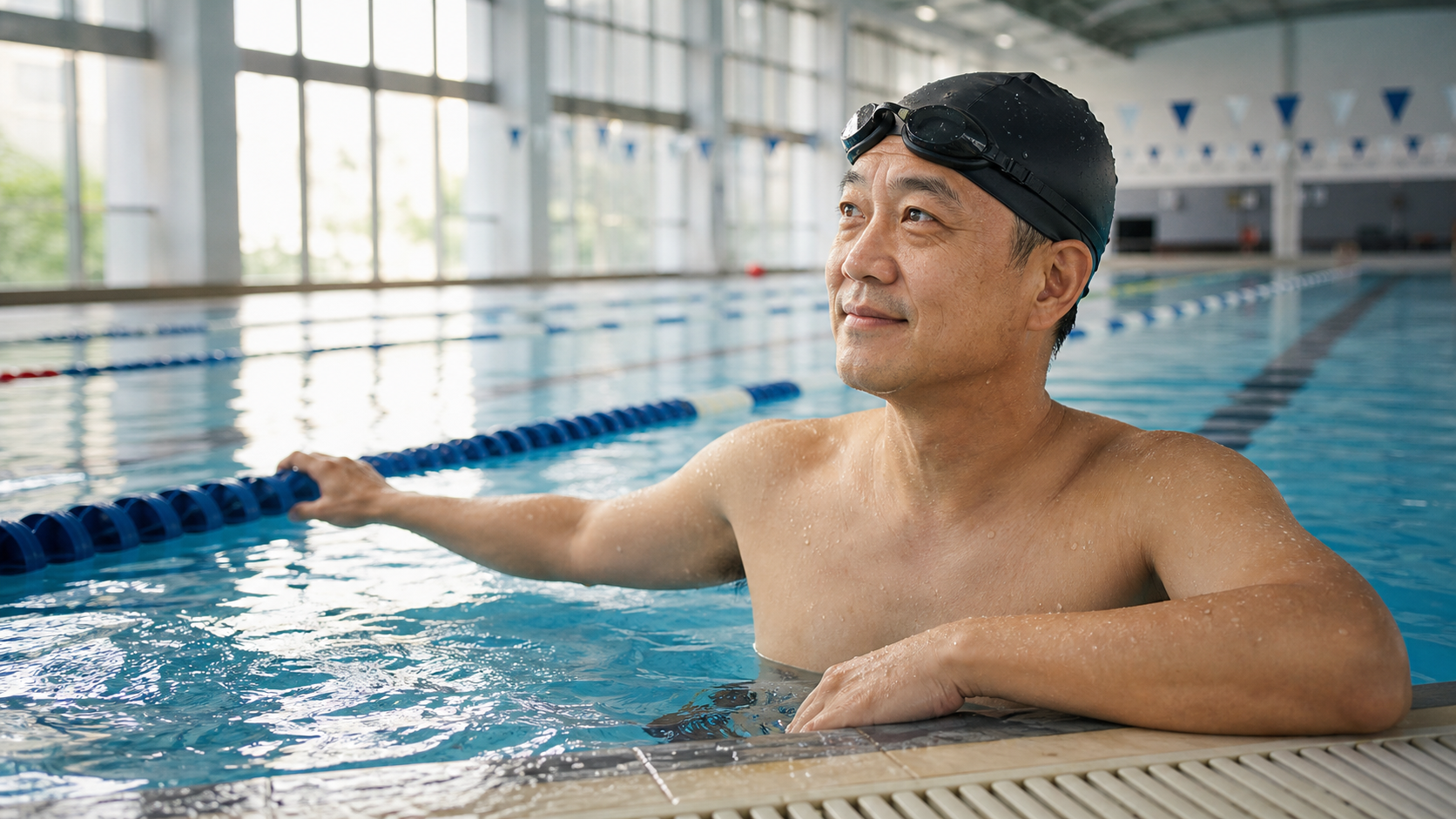
Swimming Helped Me Regain My Health: A Story of Physical Transformation Starting Swimming in Midlife
Introduction
At my 45-year-old health checkup, the doctor’s expression made me nervous. Pre-diabetes and high blood pressure were emerging, body fat was above the limit, and my cardiopulmonary function was only 70% of the average for my age. The doctor said: “You need regular aerobic exercise, and it has to be low-impact. Your knee degeneration means running is no longer suitable.”
She recommended swimming.
I didn’t know how to swim. To be precise, I could do a little breaststroke—about 20 meters before I’d sink.
Three years later, I swim three to four times a week, 1,000–1,500 meters per session, and have competed in two open-water races. My weight has dropped from 83 kg to 71 kg, and my blood pressure has returned to normal from 135/88. Most importantly—I want to swim. Not because a doctor told me to, but because I need that water.
This is the story of those three years.
Starting from Zero: The Psychological Barrier of Learning to Swim as an Adult
Starting to learn swimming at 45, the first hurdle wasn’t technique—it was psychology.
In the first class of the adult swimming course, there were a few students in their 50s and a few in their 20s. I stood in the shallow end, holding onto the lane line, trying to make my body float horizontally—that most basic movement took me a full 20 minutes to accomplish for the first time.
No one around me laughed, but a voice inside me said: “Learning to swim at 45—isn’t that a bit late?”
Later I realized that voice was the most dangerous enemy, not any external obstacle.
Main psychological barriers for adults learning to swim
- Primal fear of water (especially putting the face in)
- Anxiety about social judgment—fear of “being laughed at”
- The self-fulfilling prophecy of “too old to learn”
- Frustration from slow initial progress
Every barrier is real, and every one can be crossed—it just takes time and proper guidance.
Year One: Turning Swimming into a Habit
First three months: Technique-building phase
This period was spent almost entirely in the pool, focused on technique. The basic freestyle movements—kicking, arm pulls, breathing—took a full three months to integrate into a coherent stroke.
The biggest breakthrough came at the end of the second month. That day I swam 100 meters without stopping for the first time. When I got out, I stood there for a long time, feeling that sense of “I did it.” Those 100 meters were a threshold.
Months four to twelve: Building distance
| Period | Max distance per session | Weekly frequency | Fitness indicator changes |
|---|---|---|---|
| Month 1 | 50 meters | 2 times | Began developing water feel |
| Month 3 | 200 meters | 3 times | 100m without stopping |
| Month 6 | 600 meters | 3 times | Weight -3kg |
| Month 12 | 1000 meters | 3-4 times | Blood pressure began to drop |
By the end of year one, I could steadily swim 1,000 meters in about 22–25 minutes. The doctor’s follow-up checkup showed: blood pressure back in the normal range, body fat down from 28% to 22%, resting heart rate down from 82 to 68.
The numbers are objective, but the change more important than the numbers was this: I began to want to swim. It was no longer an obligation, but something I looked forward to.
Year Two: From Health to Passion
The biggest turning point in year two was joining an open-water swimming community.
My first time swimming outside a pool was that experience of “getting to know water anew,” as I mentioned earlier. The lake water wasn’t blue, the bottom wasn’t clear, there were no black lines—those “flaws” actually sparked a new curiosity about swimming in me.
The effect of joining the community wasn’t just technical improvement—it was finding a group of people “who, like me, started swimming in midlife.” Their stories taught me: there’s no such thing as “starting too late,” only “not having started yet.”
Unexpected benefits from swimming
- Improved sleep quality: The physical fatigue from swimming (not anxiety-driven fatigue) brought the best deep sleep I’d had in years
- An outlet for work stress: You can’t use your phone while swimming. That forced “disconnected” hour was a fixed daily time for releasing stress
- A shift in body awareness: I started paying attention to diet not for appearance, but for “swimming performance.” That change in goal made my dietary adjustments sustainable without rebounding
Year Three: Competition and Breakthrough
Early in year three, a fellow swimmer asked if I wanted to sign up for a small open-water event (1.5 kilometers).
“I’m not an athlete.”
“You swim three times a week, over a kilometer each time—of course you’re an athlete.”
That exchange changed how I defined myself. I was no longer “a middle-aged man told to swim by his doctor.” I was “a swimmer.”
After finishing the race, I cried a little on the shore. Not from exhaustion, but because I thought of that 45-year-old holding the lane line learning to float three years earlier, and the 48-year-old who had just swum 1,500 meters in open water. The road in between was worth every step.
Health Changes from Swimming (Three-Year Summary)
- Weight: 83kg → 71kg (-12kg)
- Body fat percentage: 28% → 20% (-8%)
- Resting heart rate: 82bpm → 62bpm (-20bpm)
- Blood pressure: 135/88 → 118/76 (back to normal)
- Sleep quality: subjective score improved from 5/10 to 8/10
- Metabolic markers: all returned to normal range
For Middle-Aged People Considering Starting Swimming
- Don’t wait until you’re “in better shape” to start: Your condition will improve because you started
- Adult swimming classes are the best starting point: You get a coach, companions, and a structured progression
- The first three months are the hardest: Push through, and things will change
- Set your goal on health, not speed: Speed is a byproduct; health is the purpose
- Find a swimming community: Training alone is far less sustainable than training with community support
Conclusion
What swimming gave back to me wasn’t just the numbers on my health metrics, but a feeling that “my body can be trusted.” A middle-aged body can change.
The doctor who recommended swimming looked at my report during my year-three follow-up and said: “You did it.” I wanted to tell her: it’s not just health—she pushed me into a world I didn’t know existed before.
If you’re waiting for a reason to start swimming, this article is it.
Related Reading
- Adjusting Swim Training for Older Adults: Training Volume and Intensity Modifications for Swimmers Over 50
- The Complete Guide to Learning Swimming as an Adult: Practical Instruction for Overcoming Aquaphobia and Mastering the Four Strokes
- How to Build a Swimming Habit: The Transition from Occasional Dips to Regular Training
- Swimming Guide for Seniors: Safe Entry and Training Recommendations After 50
靠單車減肥35公斤 心得分享與整理
7 年前
一日北高常見問題大集合 | 攻略 | 路線 | 訓練 | 補給 | 自行車 單車 | 一日雙城 | 雙塔 | TWB北高360 | 屁股痛
6 年前
16/02/16 - 夜訪中社路 緩慢進步中
10 年前
2026 輪霸西濱200K 挑戰VLOG / 第一集團 / 首次參加..經驗不足、膀胱不足 /死守6H內 / AI戰鬥力顯示系統 / 公路車 / CT Yeh
4 個月前
西進武嶺 免費訓練分析服務 Intervals | 練不夠還是練過頭?你哪一種類型選手?AI模型告訴你! | 備戰神器 | 公路車 訓練 | CT Yeh
4 年前
近視雷射三個月後悔嗎?單車族/工程師必看,Smart TransPRK 術後血淚史與後遺症全公開 / CT Yeh
4 個月前
滑雪新手們慘摔學習全紀錄(請開字幕),滑雪好好玩 | Snowboard + Ski | 岩原 スキー場 | 滑雪APP使用 | GoPro Max
6 年前
一日北高/長距離團騎 常見問題補充篇 / 組團或跟團的眉角 / 壯車友容易被瘦車友慢性拉爆 / 原來屁股痛可能是這個原因...? / 風場配速法 / 公路車 / CT Yeh
2 年前